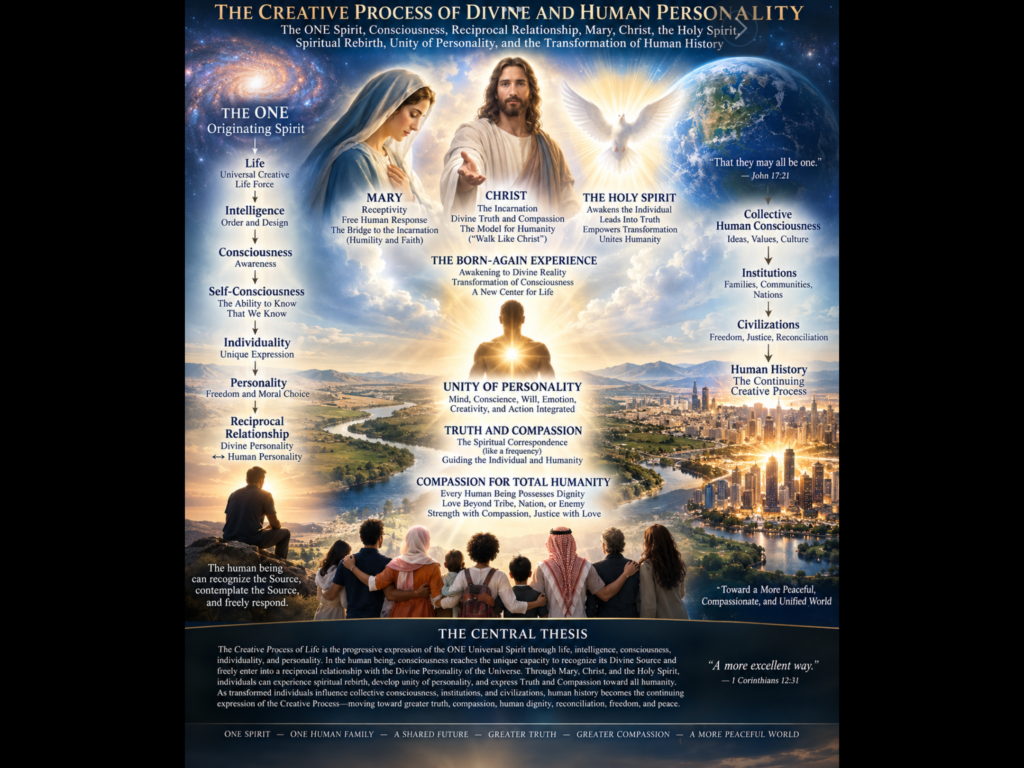
WITNESS TO CALLING — THE CREATIVE PROCESS OF DIVINE AND HUMAN PERSONALITY
THE CREATIVE PROCESS OF
DIVINE AND HUMAN PERSONALITY
The ONE Spirit, Consciousness, Reciprocal Relationship, Mary, Christ, the Holy Spirit, Spiritual Rebirth, Unity of Personality, and the Transformation of Human History
A Companion Reflection to
Self-Contemplation of the Divine Personality of Man
and
The Reciprocal Relationship and the Moral Arc of Human History
WITNESS TO CALLING
CENTRAL THESIS
Humanity’s next stage of development depends upon the transformation of the individual personality through conscious reciprocal relationship with the Divine Originating Spirit, whereby Truth and Compassion – revealed most completely in Christ and awakened through the Holy Spirit – unify the individual personality, expand love toward the total human family, enter humanity’s collective consciousness, and guide mankind’s increasing creative and technological power toward human dignity, freedom, reconciliation, and world peace.
The Creative Process of Life may be understood as the progressive expression of the ONE Universal Originating Spirit through life, intelligence, consciousness, individuality, and personality. In the human being, consciousness reaches the extraordinary capacity to recognize its Source, contemplate its own existence, make moral choices, and freely respond to the Divine Personality from which life proceeds.
Within the Christian revelation, this capacity for response becomes the basis of reciprocal relationship. Mary demonstrates the freedom and receptivity of human personality in answering Divine initiative. Christ reveals Divine Truth and Compassion within human existence and provides the supreme pattern for the development of human personality. The Holy Spirit continues this transforming relationship within individual consciousness. The Born-Again experience marks the awakening of the individual to a new center of life in which Truth, Compassion, Love, conscience, intellect, will, and action progressively move toward Unity of Personality.
The authentic fruit of this transformation is not separation from humanity, spiritual superiority, or domination. It is an expanding compassion for the total human family. Because every individual consciousness exists in relationship with other persons, spiritual transformation can enter collective consciousness, influence culture and institutions, and ultimately participate in the continuing development of human history.
1. TROWARD AND THE ONE ORIGINATING SPIRIT
Thomas Troward’s Creative Process begins with a fundamental metaphysical proposition: behind the multiplicity of forms stands one originating Life, Intelligence, or Spirit. Creation is not a collection of wholly unrelated realities. It displays continuity, order, development, and increasing degrees of expression.
Matter exhibits order and relation. Organic life adds growth and reproduction. Animal life adds increasingly complex awareness. In the human being, however, consciousness reaches a distinctive stage: the individual not only experiences life but can become conscious that he or she is conscious. Humanity possesses self-reflective consciousness.
Life -> Intelligence -> Consciousness -> Self-Consciousness -> Individuality -> Personality -> Reciprocal Relationship.
This progression does not require the conclusion that the individual human being is identical with the totality of God. Rather, it suggests that individualized consciousness participates in the universal Creative Process while remaining genuinely individual. The human person can recognize the Source, contemplate it, respond to it, cooperate with it, resist it, and take responsibility for the consequences of choice.
2. CONSCIOUSNESS AND THE POSSIBILITY OF RECIPROCAL RELATIONSHIP
If the Originating Spirit were understood only as impersonal force, one could speak of causation but not fully of relationship. The Christian theological development of this framework makes a stronger claim: the Source of life is not merely Power but Divine Personality.
Personality makes relationship possible. Human consciousness therefore becomes a meeting place between universal Divine initiative and individual human response. The individual receives life, intelligence, possibility, freedom, and consciousness; yet the individual can answer through contemplation, prayer, conscience, love, moral action, and creative participation.
Divine Personality -> Human Personality
Human Personality -> Divine Personality
Reciprocity does not mean equality of Creator and creature. Divine initiative remains prior. Human response is nevertheless real. The dignity of the human person lies partly in this capacity to respond freely rather than functioning merely as an unconscious mechanism.
3. TRUTH AND COMPASSION AS SPIRITUAL CORRESPONDENCE
Truth and Compassion provide the governing language of this reciprocal relationship. The word frequency may be used metaphorically, but it should not be confused with a scientifically measured electromagnetic frequency. The deeper proposition is spiritual correspondence.
Truth brings consciousness into correspondence with reality. Compassion brings personality into correspondence with love. Truth prevents compassion from becoming illusion or sentimentality. Compassion prevents truth from becoming cruelty, humiliation, or domination.
TRUTH without COMPASSION can become cruelty.
COMPASSION without TRUTH can become sentimentality.
TRUTH joined to COMPASSION becomes a discipline of Divine Love.
The developing personality therefore asks not merely, ‘What do I want?’ but increasingly, ‘What does Truth require of me?’ and ‘What does Love require of me?’ That movement from appetite toward conscience represents a profound development of human consciousness.
4. THE HEBREW PROPHETIC PATTERN
The Hebrew prophetic tradition provides an essential historical and theological model. The prophet does not merely predict future events. The prophet calls the individual, ruler, and nation back into relationship with a moral law higher than political power.
Moses confronts Pharaoh. Samuel warns Israel about the dangers of kingship. Nathan confronts David. Elijah challenges Ahab and Jezebel over Naboth. Amos condemns worship separated from justice. Isaiah joins holiness with care for the oppressed. Micah joins justice, mercy, and humility. Jeremiah rejects false security and calls rulers to accountability. Ezekiel condemns shepherds who feed themselves while neglecting the flock.
The prophetic principle is therefore reciprocal and corrective: Divine Truth addresses human consciousness; human personality must decide whether to receive or resist it; the consequences of that response enter communal and national history.
5. MARY: HUMAN FREEDOM RECEIVING DIVINE INITIATIVE
Mary becomes essential to this framework for a reason deeper than biological necessity. Within Christian faith, the Incarnation does not occur through an appearance of humanity. Christ receives genuine humanity through Mary and therefore enters human ancestry, Jewish history, family, culture, language, vulnerability, suffering, and the collective experience of humankind.
At the Annunciation, Mary is not portrayed merely as an unconscious instrument. Divine initiative comes first, but Mary responds. Her assent is a human act of receptivity, trust, and freedom.
Divine Initiative -> Mary -> Free Human Response -> Incarnation -> Human History
Mary therefore demonstrates a profound principle of the Creative Process: the highest Divine creativity does not annihilate human personality. It calls human personality into willing cooperation. Receptivity is not passivity; humility is not insignificance; obedience need not destroy individuality.
Mary’s role illustrates the possibility that individual personality reaches its highest creative fulfillment not by separating itself from the Originating Spirit, nor by imagining itself to be the Originating Spirit, but by consciously receiving and cooperating with Divine purpose.
6. CHRIST: DIVINE TRUTH AND COMPASSION WITHIN HUMAN HISTORY
Christ stands at the center of this theological synthesis. Christian faith makes a claim beyond that of a spiritually advanced human being: Christ is the Incarnate Word. Yet Christ also reveals what human life looks like when perfectly oriented toward the Father.
The Gospels repeatedly describe relationship: Father and Son, sending and receiving, speaking and hearing, abiding, knowing, loving, Spirit and truth. Christ’s authority therefore does not culminate in self-worship. It becomes service.
Power without domination.
Truth without deception.
Compassion without weakness.
Justice without hatred.
Courage without cruelty.
Humility without passivity.
Love without exclusion.
Christ reveals that spiritual power is not proven by the ability to dominate another personality. It is demonstrated through the ability to remain truthful, compassionate, courageous, and loving even when confronted by hostility, suffering, temptation, and power.
7. THE HOLY SPIRIT AND THE CONTINUATION OF THE CREATIVE PROCESS
The Christian story does not end with the historical ministry of Jesus. The Holy Spirit extends the transforming relationship into individual persons and communities. The Spirit of Truth calls consciousness toward reality; the fruits of the Spirit describe the transformation of personality through love, joy, peace, patience, kindness, goodness, faithfulness, gentleness, and self-control.
The Holy Spirit therefore becomes essential to the continuing development of personality. Intelligence alone cannot guarantee wisdom. Education cannot guarantee compassion. Technology cannot guarantee conscience. Power cannot guarantee restraint. The transformation required is interior as well as institutional.
8. THE BORN-AGAIN EXPERIENCE
The Born-Again experience can be understood as the awakening of the individual personality to conscious reciprocal relationship with the Divine Personality. It is more than accepting a religious label, mastering doctrine, or experiencing emotion. It concerns the center from which the person thinks, loves, chooses, and acts.
The individual remains the same biological person, retaining memory, history, intellect, talents, relationships, and individuality. What changes is orientation. Self ceases to function as the unquestioned center.
Self as Center -> God as Origin -> Humanity as Neighbor -> Love as Action.
The individual moves from merely believing that a Universal Creative Spirit exists toward recognizing: ‘My life exists within relationship to that Spirit, and therefore the way I use my life matters.’ Consciousness becomes relationship. Relationship becomes responsibility. Responsibility becomes transformation. Transformation begins producing fruit.
9. COMPASSION FOR TOTAL HUMANITY
The spiritual awakening described here expands rather than contracts the field of compassion. Christ’s teaching refuses to confine neighbor-love to family, tribe, nation, religion, political faction, or friendship. The Good Samaritan expands the definition of neighbor, while the command to love enemies confronts one of humanity’s deepest tendencies: the division of mankind into morally absolute categories of us and them.
Compassion for total humanity does not abolish moral judgment. One may oppose injustice, resist aggression, protect the innocent, enforce law, and speak against falsehood. But the transformed personality refuses to make hatred its organizing principle.
I may oppose another person’s actions without denying that person’s humanity.
I may defend the innocent without learning to love destruction.
I may confront falsehood without becoming false.
I may resist tyranny without making hatred my identity.
I may love my nation without denying the dignity of another people.
The authentic fruit of spiritual rebirth is therefore not the declaration, ‘I am spiritually superior.’ It is the discovery, ‘Because I have encountered Divine Love, every human being has become more precious to me.’
10. UNITY OF PERSONALITY
Unity of Personality is essential to the development of the individual. A human being can possess great intelligence while remaining internally divided. One may profess compassion while acting from resentment, proclaim truth while practicing self-deception, profess faith while worshiping power, speak of peace while desiring domination, or love humanity abstractly while treating the person immediately present without dignity.
This is fragmented personality. Spiritual development moves toward integration. Mind, conscience, will, emotion, ambition, creativity, relationships, work, wealth, power, and spiritual aspiration increasingly come under one governing orientation.
Thought -> Truth
Emotion -> Compassion
Will -> Service
Power -> Responsibility
Freedom -> Moral Choice
Creativity -> Life
Relationship -> Love
Leadership -> Stewardship
Unity does not mean psychological or moral perfection. It means increasing coherence: the person’s professed values, inward conscience, outward conduct, and treatment of others progressively correspond.
11. WALKING LIKE CHRIST
To walk like Christ does not mean believing oneself to be Christ or claiming Christ’s unique theological identity. It means attempting to develop a human personality increasingly patterned after the qualities revealed through Christ.
The Christlike individual seeks strength without domination, truth without cruelty, compassion without abandoning justice, freedom joined to responsibility, courage without hatred, humility without passivity, sacrifice without resentment, and love capable of recognizing dignity even in an adversary.
The more strongly a person believes he or she has received spiritual insight, the greater the obligation to humility should become. Spiritual conviction that produces personal infallibility contradicts the very Unity of Personality being sought.
12. INDIVIDUAL CONSCIOUSNESS AND COLLECTIVE HUMAN CONSCIOUSNESS
The reciprocal relationship does not terminate within the individual. Human consciousness is relational. Every person enters networks of family, friendship, education, commerce, religion, politics, art, science, technology, and culture. What develops within individual personality therefore can enter collective consciousness.
The Hebrew prophet receives or understands a truth and communicates it to the community. Christ communicates Divine Truth and Compassion into human history. The spiritually transformed individual likewise returns to humanity carrying the fruits of transformation.
ONE ORIGINATING SPIRIT
-> DIVINE PERSONALITY
-> CONSCIOUSNESS
-> RECIPROCAL RELATIONSHIP
-> INDIVIDUAL HUMAN PERSONALITY
-> SPIRITUAL REBIRTH
-> UNITY OF PERSONALITY
-> TRUTH + COMPASSION
-> CHRISTLIKE ACTION
-> RELATIONSHIP WITH OTHER PERSONS
-> COLLECTIVE HUMAN CONSCIOUSNESS
-> CULTURE + INSTITUTIONS + CIVILIZATION
-> HUMAN HISTORY
Historical change never arises from personality alone. Economic conditions, institutions, geography, technology, social movements, conflict, and chance all matter. Yet personality can become a point of concentration through which ideas acquire language, courage, organization, and historical agency.
13. THE TEST OF SPIRITUAL EXPERIENCE: FRUITS
A powerful spiritual experience does not by itself establish Divine truth. Intensity of conviction is not proof. Feeling chosen is not proof. Private revelation cannot place an individual beyond moral accountability, reason, evidence, community, or correction.
The appropriate Christian test is fruit. Does the experience make the person more truthful, compassionate, humble, forgiving, courageous in defense of dignity, responsible with power, willing to admit error, capable of loving people outside his or her own group, and committed to reconciliation?
If an alleged spiritual awakening instead produces arrogance, hatred, obsession with enemies, contempt, domination, deception, exemption from accountability, or certainty of personal infallibility, the individual should question the interpretation of that experience regardless of its emotional intensity.
This safeguard protects the entire thesis. Reciprocal relationship requires humility because the finite human personality remains capable of misunderstanding.
14. FROM INDIVIDUAL TRANSFORMATION TO HUMAN HISTORY
The transformation of one person may appear small when measured against nations, armies, economies, and technologies. Yet civilization itself consists of relationships among persons expressed through institutions. Character enters families. Families influence communities. Communities create norms. Norms influence institutions. Institutions govern the use of power.
The development of personality therefore possesses historical consequences. Truthful personalities strengthen cultures of truth. Compassionate personalities humanize institutions. Courageous personalities can resist injustice. Humble leaders can accept correction. Reconciliatory personalities can interrupt inherited cycles of vengeance.
Conversely, pride, fear, falsehood, resentment, racial or national supremacy, ideological absolutism, and contempt can also move from individual consciousness into collective consciousness and become institutionalized. The Creative Process does not eliminate human freedom; it makes the moral use of freedom increasingly consequential.
15. TECHNOLOGY, ARTIFICIAL INTELLIGENCE, AND THE NEXT STAGE
Human creative power is now expanding at extraordinary speed through artificial intelligence, autonomous systems, biotechnology, robotics, cyber capabilities, global communications, advanced energy, and increasingly powerful forms of computation. This makes the development of personality more urgent, not less.
Artificial intelligence can increase human capability, but computational intelligence is not identical with wisdom. Optimization is not conscience. Prediction is not compassion. Information is not truthfulness. Technological capability is not legitimate moral authority.
If human creative power expands faster than human moral personality, civilization can become more capable while becoming less wise. The next stage of development therefore cannot be technological alone. Humanity must develop persons and institutions capable of governing increasingly powerful tools according to truth, compassion, dignity, freedom, responsibility, and peace.
16. THE CREATIVE PROCESS AND WORLD PEACE
World peace within this framework is not passive surrender, the disappearance of disagreement, or the abandonment of legitimate defense. Peace means right relationship under justice. It requires protection of human dignity, restraint in the use of power, truthful communication, legitimate sovereignty, accountability, and the possibility of reconciliation.
The individual who develops Unity of Personality contributes to peace first by refusing to reproduce within himself the very forces that generate conflict at larger scales: falsehood, contempt, domination, vengeance, dehumanization, and pride.
The same principles can then be applied to leadership and nations. Strength remains necessary, but strength must serve life. Technology remains necessary, but technology must serve humanity. National interest remains legitimate, but it must not erase the dignity of other peoples. Justice remains necessary, but justice must not become vengeance.
17. THE FULL CREATIVE PROCESS
ONE SPIRIT -> LIFE -> INTELLIGENCE -> CONSCIOUSNESS -> SELF-CONSCIOUSNESS -> INDIVIDUALITY -> PERSONALITY -> RECIPROCAL RELATIONSHIP -> MARY’S FREE RESPONSE -> CHRIST -> HOLY SPIRIT -> BORN AGAIN -> UNITY OF PERSONALITY -> TRUTH + COMPASSION -> LOVE OF TOTAL HUMANITY -> COLLECTIVE CONSCIOUSNESS -> HUMAN HISTORY -> HUMANITY’S CONTINUING CREATIVE PROCESS.
This progression provides the intellectual backbone of the present work. It does not claim that every step is empirically demonstrable in the same way. Troward’s metaphysical propositions, Christian theological claims, scriptural interpretation, historical observation, and ethical reasoning belong to different categories of knowledge. Their relationship must therefore be stated carefully.
The thesis is offered as a theological-philosophical interpretation of human development: a framework for contemplating the relationship between Divine creativity, human freedom, spiritual transformation, moral personality, collective consciousness, and history.
18. FINAL CONTEMPLATION — WHAT MUST HUMANITY BECOME?
The central question is ultimately not how powerful humanity can become. Humanity has already demonstrated extraordinary power. The deeper question is what kind of personality will govern that power.
The future requires individuals capable of being strong without worshiping strength; intelligent without worshiping intelligence; technologically capable without surrendering human judgment to technology; patriotic without dehumanizing other peoples; faithful without coercing conscience; truthful without cruelty; compassionate without abandoning justice; courageous without loving war; and powerful while remaining accountable to a moral law higher than personal ambition.
Within the Christian interpretation developed here, the Holy Spirit of Truth and Compassion awakens and develops that personality. Christ reveals its supreme pattern. Mary reveals the freedom and receptivity through which Divine initiative can enter human history. The Born-Again experience represents the reorientation of the individual toward Divine relationship. Unity of Personality represents the continuing integration of the whole person around Truth and Love.
The transformation does not end within the individual. The awakened person returns to humanity. Love becomes relationship. Relationship becomes community. Community becomes culture. Culture enters institutions. Institutions shape civilization. Civilization enters history.
The ultimate purpose of the Creative Process is not the destruction of individuality but its fulfillment: free human personalities, consciously participating with the Divine Creative Spirit and with one another, bringing greater Truth, Compassion, human dignity, reconciliation, freedom, and peace into the continuing development of human civilization.
SELECTED SCRIPTURAL ANCHORS
Genesis 1:26-27 — Humanity created in the image and likeness of God.
Exodus 3-14 — Moses, liberation, and prophetic confrontation with power.
1 Samuel 8 — The prophetic warning concerning concentrated kingship.
2 Samuel 12 — Nathan’s confrontation of David and the principle that rulers remain morally accountable.
1 Kings 21 — Elijah, Ahab, Jezebel, and Naboth’s vineyard.
Amos 5:21-24 — Worship joined to justice.
Micah 6:8 — Justice, mercy, and humility.
Luke 1:26-38 — The Annunciation and Mary’s free response to Divine initiative.
John 1:1-14 — The Word and the Incarnation.
John 3:1-8 — The Born-Again experience and birth of the Spirit.
John 14:16-17; 16:13 — The Spirit of Truth.
Matthew 5-7 — The development of inward moral personality.
Matthew 20:25-28 — Authority understood as service.
Luke 10:25-37 — The Good Samaritan and expansion of the meaning of neighbor.
Galatians 5:22-23 — The fruits of the Spirit.
2 Corinthians 5:17 — The new creation.
EDITORIAL NOTE
This document deliberately distinguishes theological interpretation from empirically verifiable history and science. References to the ONE Spirit, Divine Personality, reciprocal consciousness, spiritual rebirth, and the Holy Spirit are statements within a theological-philosophical framework. The use of ‘frequency’ is metaphorical and does not assert a measurable physical mechanism of spiritual communication. The framework does not claim that private spiritual conviction makes an individual infallible or exempts anyone from evidence, reason, constitutional law, moral accountability, or correction.
Its governing test remains the fruits of personality: Truth rather than falsehood; Compassion rather than cruelty; humility rather than pride; dignity rather than dehumanization; freedom rather than domination; justice joined to restraint; and strength ultimately directed toward reconciliation and peace.
Witness to Calling |