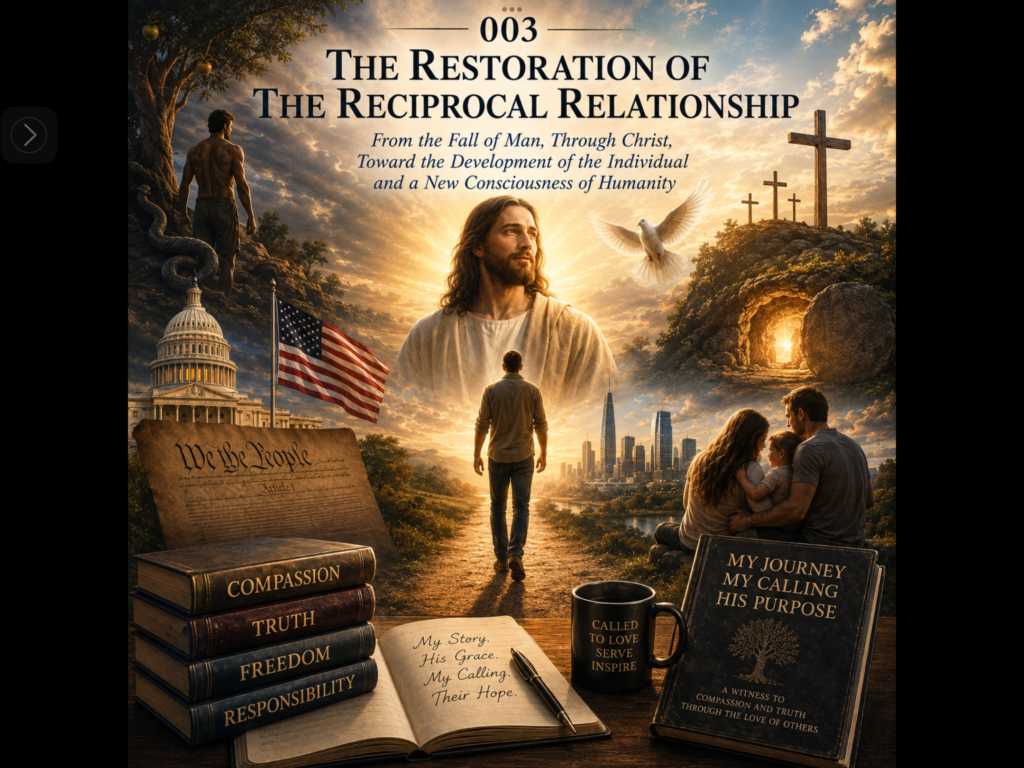
From the Fall of Man, Through Christ, Toward the Development of the Individual and a New Consciousness of Humanity
The Fall of Man can be understood not only as an ancient event recorded in Scripture, but as the beginning of a continuing spiritual condition: the moment humanity, through the consciousness of the individual, separated itself from its reciprocal relationship with the Benevolent Creative Personality of the Universe. The fundamental disorder was therefore separation. Humanity began to act as though the individual personality existed independently of the Divine Source from which Life, Intelligence, Individuality, and Personality themselves arise. The human person became increasingly conscious of individual power, but without necessarily remaining conscious of the Divine Purpose within which that power was intended to operate.
The problem was not individuality itself. Individuality was part of the Creative Process. The problem was individuality separated from its Source. When human intelligence operates without reciprocal relationship with Divine Intelligence, knowledge can become manipulation. When human personality operates without Benevolent Personality, authority can become domination. When individual freedom becomes detached from responsibility, liberty can deteriorate into appetite, ego, or power. Civilization can therefore become technologically sophisticated while remaining spiritually immature. This is the deeper meaning of the Fall: humanity possessing increasing consciousness of itself while losing consciousness of the relationship between the individual soul and the Creative Spirit from which life proceeds.
Yet this condition of separation is not merely something to contemplate in the history of humanity. It can also be recognized within the development of an individual life. Looking backward upon my own journey, I can see periods when life appeared fragmented into unrelated experiences: childhood, family, military service, education, work, faith, business, love, responsibility, loss, national concern, friendship, searching, reconciliation, and spiritual inquiry. For much of life these events were simply lived forward. Only later did I begin to ask whether they belonged to a larger pattern and whether an apparently ordinary life might contain a deeper movement toward the development of Individual Personality.
That question has become increasingly important to me. I am no longer interested merely in remembering what happened. I am trying to make Compassionate and Truthful sense of what happened and to understand whether the experiences of one ordinary and imperfect human life can reveal something about the relationship between human personality, the Divine, and the Other. In that effort, the Personality of Christ has become increasingly central.
Christ and the Restoration of Relationship
Within this understanding, the mission of Jesus Christ was fundamentally restorative. Christ did not merely establish another institution or religious system. His mission was to restore the human person to conscious relationship with God. The Gospel repeatedly turns the individual away from dependence upon external power alone and toward an interior transformation of consciousness: the Kingdom of God within, rebirth of the individual, love of God and neighbor, forgiveness, truth, compassion, responsibility, and recognition that human life possesses a Divine origin and purpose.
Christ revealed the Benevolent Personality of God through a human life. Through Christ, Divine Life became visible as love, Divine Intelligence became wisdom, Divine Individuality became perfect moral freedom, and Divine Personality became Compassion and Truth expressed through relationship with others. The restoration Christ offered was therefore not the destruction of human individuality but its fulfillment. The individual was invited to become increasingly conscious of God while simultaneously becoming more fully himself or herself. This is reciprocal relationship. The Divine Spirit gives Life, Intelligence, Individuality, and Personality to the human being, while the human personality freely responds through faith, conscience, creativity, responsibility, service, and love. The individual does not disappear into God, nor does the individual stand isolated from God. Personality develops through relationship.
This is where Christ becomes central to the meaning of Witness to Calling. Christ is not only the One who teaches the way back to God. He is the living revelation of what human personality can become when individuality remains in conscious reciprocal relationship with the Divine Benevolent Personality. In this sense, His life becomes a blueprint of human development. Christ is born into family, grows within human relationships, learns, works, participates in community, encounters authority, poverty, illness, grief, friendship, betrayal, injustice, temptation, suffering, and death. Yet through every stage, His Personality remains oriented toward the Father and expressed outward toward the Other.
The Benevolence revealed in Christ is not passive softness. It is moral strength governed by love. Christ heals, but He also speaks Truth. He forgives, but He does not confuse forgiveness with approval of wrongdoing. He serves, but He is not servile. He demonstrates humility without loss of dignity, authority without domination, courage without hatred, and Compassion without surrendering moral clarity. He loves the individual without becoming captive to the crowd. He withdraws for prayer and communion with the Father, yet returns to the world of responsibility. He confronts concentrated earthly power without attempting to become another earthly ruler. The Personality of Christ therefore reveals not the extinction of individuality but its mature fulfillment in Benevolent relationship.
Seen this way, the Christian life is more than obedience to an external religious code. It is the gradual formation of personality according to the pattern revealed in Christ. The questions become deeply human: How does a person become more compassionate without becoming weak, more truthful without becoming harsh, more individual without becoming selfish, more free without becoming irresponsible, more willing to serve without surrendering dignity, and more willing to forgive without abandoning Truth? How does one love the Other while remaining conscious of one’s own Divine dignity and calling? Christ answers such questions not primarily through abstraction, but through the story of a life lived in relationship.
Christ as the Blueprint of Human Development
If the Creative Process moves through Life, Intelligence, Individuality, and Personality, then Christ can be understood as revealing the mature integration of these qualities in a human life. Life in Christ is not merely biological existence; it is life conscious of its Divine Source. Intelligence is not merely analytical capability; it becomes wisdom disciplined by Truth and directed by Compassion. Individuality is not rebellion for its own sake; it becomes moral freedom, the capacity to stand apart from collective pressure when conscience requires it. Personality is not ego; it becomes the unique expression of Divine Benevolence through a free human being.
This is why Christ can be understood as a blueprint of human development. He does not erase individuality; He brings it into right relationship. He does not deny freedom; He reveals its purpose. He does not destroy personality; He aligns personality with Benevolent Purpose. He does not remove the individual from the world; He sends the individual into the world with greater responsibility toward the Other. In Christ, relationship with God becomes love of neighbor, consciousness of Divine origin becomes respect for human dignity, prayer becomes action, Truth becomes courage, Compassion becomes service, and freedom becomes voluntary responsibility.
This pattern has become increasingly important to my own understanding of life. At first, faith was something I believed. Then it became something I tried to walk. Through family and responsibility, it became something I had to live. Only later, looking backward, did I begin to understand that the deeper question was always about the formation of personality. What kind of person was I becoming, and toward whom was that becoming directed?
The Love of the Other
The life of Christ consistently moves toward the Other. The Other is not an abstract category called humanity. The Other is the particular person immediately present: the sick person, the rejected person, the child, the friend, the stranger, the grieving person, the sinner, the doubter, the person trapped in fear, the person standing outside accepted social boundaries, or the person whose dignity others have forgotten. Christ does not merely speak about universal love; He gives universal love a human face.
This became important in my own life because Compassion also became real through particular people. The Gospel awakened the principle, but family gave the principle flesh. My father was not humanity in the abstract; he was Pop. My mother was not a philosophical example of the Other; she was Mom. Marriage was not merely an institution; it was a relationship with Margie. Children and stepchildren were not categories; they were individual lives with names, needs, hopes, and responsibilities. Through them I learned that love is not primarily a theory. Love is attention, presence, patience, protection, forgiveness, companionship, responsibility, sacrifice, and the willingness to allow another person’s welfare to matter to one’s own life.
The Other makes demands upon personality because the Other requires the individual to move beyond the self. The Other reveals whether Compassion is genuine. Yet the Other also reveals whether Truth is genuine, because love sometimes requires honesty, courage, boundaries, forgiveness, reconciliation, and the refusal to live in illusion. This is why Compassion and Truth belong together. Christ expresses both. He does not reduce love to sentimentality, nor does He reduce Truth to condemnation. His Benevolent Personality joins them, and that joining becomes a model for the development of human personality.
Family as a School of Christlike Development
If the Gospel introduced me to the spiritual commandment of love, family became one of the great schools in which that love had to be practiced. Family teaches reciprocity because one gives and receives, protects and is protected, cares and eventually may need care, forgives and seeks forgiveness, experiences closeness and sometimes separation, and discovers that love can contain joy, responsibility, pain, sacrifice, and hope at the same time. In family, personality is formed because the individual can no longer pretend to exist alone.
My relationship with my father became one of the most important relationships of my life. My life with Margie taught another dimension of reciprocal love. Marriage, companionship, caregiving, responsibility, family burdens, family joys, and the ordinary routines of life gradually became forms of spiritual formation. What appeared ordinary while I was living it now appears profound. Meals, conversations, shared concerns, work, bills, illness, caregiving, sitting beside another person, showing up when one would rather withdraw, and continuing to love through difficulty are not necessarily interruptions to spiritual life. They may be among its most important forms.
This is one of the great lessons I increasingly see in Christ. The Gospel repeatedly reveals Divine Benevolence in ordinary human encounter. A meal becomes sacred. A conversation becomes sacred. A child becomes sacred. A touch becomes sacred. An act of forgiveness becomes sacred. A stranger becomes sacred. Human development occurs through relationship because personality is tested, expanded, disciplined, and formed there.
Christ, Suffering, and the Meaning of Loss
The life of Christ also reveals that human development does not occur only through success. It also occurs through suffering. Christ experiences rejection, misunderstanding, betrayal, abandonment, grief, injustice, and death. Yet suffering does not destroy His Benevolent Personality. Instead, the manner in which He passes through suffering reveals the depth of that Personality.
This does not mean suffering is good in itself, nor does it require suffering to be romanticized. It means that suffering does not possess final authority over meaning. The Cross becomes the ultimate refusal to allow domination, hatred, betrayal, violence, and death to determine the final character of the human response. Resurrection then becomes the declaration that Benevolent Purpose is not exhausted by apparent endings.
This has become increasingly important in understanding my own journey. Loss changes the architecture of a human life. Relationships through which identity was formed may suddenly no longer be physically present. The person who shared ordinary life becomes memory. The question changes from, How do I live with this person? to, What does the love we shared now require of me? Loss can close personality inward and produce bitterness, fear, passivity, or withdrawal, but it can also deepen consciousness. It can strip away superficial measures of success and force the individual to ask what remains when so much has been taken away.
Christ offers another possibility. Suffering can become transformation when it remains joined to love, Truth, and purpose. People I loved cannot be brought back physically. The past cannot be relived. Mistakes cannot be undone. Yet the meaning of those relationships does not therefore disappear. Love can still become wisdom, memory can become responsibility, loss can deepen Compassion, and what was received through another human being can still be carried forward toward someone else.
The Creative Process and the Development of Humanity
Seen through this perspective, human history is more than a succession of kingdoms, wars, technologies, governments, and economic systems. Human consciousness itself is developing. The Creative Process moves progressively through Life, Intelligence, Individuality, and Personality. Life produces increasingly complex forms, Intelligence produces awareness, awareness develops individuality, and individuality develops personality. Mature personality eventually confronts the greatest question of all: What will the individual freely choose to become?
This is where spiritual evolution becomes inseparable from moral responsibility. Humanity’s increasing scientific and technological power makes the question unavoidable. The same intelligence capable of healing disease can construct weapons. The same technology capable of connecting humanity can monitor and manipulate humanity. Artificial intelligence can become an extraordinary extension of human creativity or an unprecedented instrument of centralized control. Technology therefore cannot determine humanity’s destiny. Personality must determine how technology is used.
The character of that personality depends upon whether the individual understands himself or herself as an isolated center of power or as a free participant in reciprocal relationship with the Benevolent Creative Personality of the Universe. Christ becomes critically important here because technology cannot supply the moral architecture needed to govern technology. Christ reveals a model of Benevolent Personality: power under discipline, Intelligence under wisdom, freedom under responsibility, authority under Compassion, Truth without domination, service without servility, and individuality without separation.
If human civilization continues expanding technological power without a corresponding development of Benevolent Personality, Intelligence may increasingly outrun wisdom. The future of humanity may therefore depend not merely upon what we invent, but upon what kind of human beings we become.
America and the Political Liberation of the Individual
Within this continuing Creative Process, America represents an extraordinary historical development. The Declaration of Independence introduced into political civilization a revolutionary proposition: that the individual possesses rights not because government grants them, but because those rights precede government and arise from the Creator. This changed the direction of political consciousness. Government was no longer theoretically the master of the individual. Government became the servant of rights inherent in the individual.
Freedom of conscience, freedom of worship, freedom of speech, private enterprise, representative government, due process, and constitutional limitation of power created a political environment in which individual personality could develop with a degree of independence rarely achieved on such a scale in previous civilizations. America was never perfect. Its history contains profound contradictions between its principles and its practices. Yet the governing ideal remained revolutionary: the human individual possesses intrinsic dignity, moral agency, and rights that political authority must respect.
That principle created something beyond a political system. It created an environment for the development of personality. Within liberty, individuals could think, worship, invent, build, associate, disagree, create businesses, pursue knowledge, establish institutions, serve communities, and discover their own particular calling. Political liberty therefore became capable of serving a spiritual purpose because it gave the individual room to grow.
This understanding of America became deeply connected with my own life. My concern for the Nation was never solely political. It gradually became part of a larger spiritual question about the conditions necessary for human development. What kind of society best permits the human person to develop in freedom? What protects conscience? What protects the individual from domination by concentrated political, economic, technological, or religious power? What allows the person to seek Truth freely and to seek relationship with God without coercion from the state? Ultimately, what does a free individual owe to others?
America provides political space for individuality. Christ provides the moral and spiritual blueprint for what mature individuality can become. One protects freedom. The other reveals the highest purpose of freedom.
Liberty and Spiritual Personality
Yet liberty by itself is incomplete. Freedom gives the individual the ability to choose, but it does not guarantee that the individual will choose wisely. The next stage of human development must therefore move beyond merely obtaining freedom toward understanding the purpose of freedom. The mature individual asks not only, What am I free to do? but also, What purpose is seeking expression through my life?
Individual liberty reaches its highest meaning when it permits the development of spiritual personality—an individual personality consciously aligned with Compassion, Truth, responsibility, creativity, and service. This does not require a theocratic government. Indeed, authentic spiritual development requires freedom. Compulsory faith contradicts the very nature of reciprocal relationship between God and the individual because love, conscience, and spiritual awakening cannot be commanded by the state. The constitutional protection of religious liberty therefore serves something larger than religious tolerance. It protects the sacred interior space in which the individual may freely seek relationship with God.
Christ’s life gives freedom an even deeper meaning. He is free enough to resist temptation, free enough to refuse the demands of the crowd, free enough to confront authority, free enough to forgive, free enough to serve, free enough to sacrifice, and free enough to remain faithful to purpose even when doing so brings suffering. This is a far deeper understanding of liberty than merely possessing many choices. Spiritual liberty is the freedom to choose the Good. It is the freedom to align Individual Personality with Benevolent Purpose.
This has increasingly become my understanding of calling.
From Experience Toward Calling
For much of life, we naturally think in terms of immediate responsibilities. We work, earn, care for family, solve problems, build businesses, pursue opportunities, endure setbacks, form relationships, experience losses, and continue forward. Often we do not recognize these experiences as spiritual formation while they are happening. Only later may the pattern become visible.
My own journey through electronics, military service, security, technology, entrepreneurship, licensing, business ownership, family, marriage, caregiving, national concern, religious study, philosophical inquiry, friendship, loss, reconciliation, and continued efforts to build and serve once appeared primarily as biography. Now I see another possibility. These experiences may constitute wisdom entrusted through life.
That does not mean every decision was correct, every event was Divinely caused, or every suffering was somehow necessary. It means that Truth allows the life to be examined honestly while Compassion asks what may still be given back from it. Again Christ becomes the blueprint. Christ receives life and gives life. He receives love and gives love. He receives relationship with the Father and expresses that relationship toward humanity. He receives authority and uses it in service. He possesses freedom and directs it toward responsibility. He encounters suffering but refuses to convert suffering into hatred. The movement is continually outward.
This is the pattern I now increasingly see before me. The experiences of my life are not simply mine to possess. If they have produced any Benevolent Wisdom, that wisdom should move outward. Calling therefore becomes a form of reciprocal relationship.
The Coming Development of Human Consciousness
What earlier generations sometimes called a coming “New Age” need not be understood as the magical arrival of a perfect civilization. It may instead describe another stage in the Creative Process. Humanity has developed extraordinary capacities of Life and Intelligence, and modern civilization has greatly expanded Individuality. The challenge before humanity may now be the development of Personality.
Can human beings develop sufficient spiritual and moral consciousness to govern the powers they have created? Can Intelligence remain subordinate to wisdom? Can technology remain subordinate to human dignity? Can governments remain subordinate to the rights of the individual? Can nations preserve sovereignty while cooperating for peace? Can economic power serve human development rather than reduce human beings to instruments? Can artificial intelligence amplify human creativity without replacing human conscience?
These may constitute defining questions of the next stage of civilization. The struggle of our age may therefore be deeper than competition between political parties, nations, religions, economic systems, or technologies. It may be a struggle over the meaning of the human person.
Here again Christ becomes central. If the future of humanity requires the development of Personality, Christ offers the blueprint of Benevolent Personality: not centralized domination, not passive conformity, and not the disappearance of individuality, but a free human personality in conscious relationship with Divine Personality, expressing Compassion and Truth toward the Other.
Perhaps this is one way to understand the continuing significance of Christ for human development. He reveals what power looks like when transformed by love, what Intelligence looks like when disciplined by wisdom, what individuality looks like when reconciled with God, what freedom looks like when joined to responsibility, and what Personality looks like when Benevolence becomes its governing character.
From Separation Toward Reciprocity
The great movement of history can then be understood as a journey from separation toward relationship, from unconscious life toward conscious life, from Intelligence toward wisdom, from individuality toward responsible Personality, from domination toward liberty, from liberty toward voluntary service, from fear toward love, and from human power detached from God toward human creativity consciously aligned with the Benevolent Creative Personality from which Life itself proceeds.
The Fall represented separation. Christ revealed restoration. Individual liberty created political space in which personality could freely develop. America became one historical experiment in protecting that freedom. The next development of humanity may require the individual to consciously reunite freedom with responsibility, Intelligence with wisdom, power with Compassion, and Personality with its Divine Source.
Humanity therefore is not merely moving through political history. Human consciousness is developing through history. The Creative Process continues as Life becomes conscious, consciousness becomes intelligent, Intelligence discovers individuality, and individuality develops Personality. Personality eventually confronts the eternal choice between separation and reciprocal relationship.
The purpose of Christ was to reveal the way back into that relationship. The highest purpose of liberty is to make that choice possible. The great opportunity before humanity is that free individuals, awakened to Divine Compassion and Divine Objective Truth, may voluntarily participate in the continuing Creative Process—not as servants of concentrated earthly power, but as conscious personalities working in reciprocal relationship with the Benevolent Creative Personality of the Universe.
Perhaps this is the deeper meaning of the next age of human development: not the end of humanity, but the awakening of humanity to the Divine purpose of Individual Personality itself.
Witness to Calling: Christ as the Blueprint of My Own Journey
This is where the larger story of Christ and human development becomes inseparable from the purpose of my own story. I do not look upon my life as a copy of Christ’s life. I look upon Christ as the blueprint by which my own life can now be more truthfully understood. His life provides the measure, His Personality provides the orientation, His Compassion reveals the direction, His Truth provides the discipline, His freedom reveals the dignity of Individual Personality, His service reveals the purpose toward which freedom can mature, and His relationship with the Father reveals the reciprocal relationship from which human personality gains its deepest meaning.
When I look backward through that lens, the stages of my own journey begin to appear differently. Childhood becomes formation. Family becomes relationship. Military service becomes responsibility. Work and enterprise become the development of individuality and creative capacity. Faith becomes awakening. The Gospel becomes a path. Marriage becomes reciprocal love. Caregiving becomes service. Loss becomes a confrontation with meaning. Estrangement becomes a question of forgiveness and reconciliation. National concern becomes concern for the Other at the level of citizenship. Business becomes not merely earning, but a potential expression of creativity and service. Reflection becomes discernment. Writing becomes calling.
This is what I mean by making Compassionate sense of my life. It does not mean forcing every event into a predetermined spiritual story. It means allowing the Benevolent Personality of Christ to become the interpretive light by which the journey is examined. Where was Compassion present, and where was it absent? Where did Truth guide me, and where did I resist it? Where did love deepen personality? Where did fear produce separation? Where did freedom become responsibility? Where did individuality become ego? Where did suffering deepen consciousness? Where did another human being call forth something better from me?
These questions transform autobiography into spiritual development.
The Book as an Act of Benevolent Reciprocity
This is why Witness to Calling is becoming more than a memoir. The book itself can become an act of reciprocal relationship. If Christ reveals Divine Benevolence moving toward the Other, then the story of one’s own life should eventually move toward the Other as well. The question is no longer merely, What happened to me? It becomes, What in this journey may help someone else?
If my relationship with my father causes another person to look differently at a father while there is still time, the story has served the Other. If my life with Margie helps someone understand the sacredness of companionship, caregiving, or ordinary love, the story has served the Other. If my military experience helps another veteran understand that an experience from decades earlier may still contain meaning, the story has served the Other. If my professional journey helps an entrepreneur recognize that enterprise can become responsible creativity rather than mere personal ambition, the story has served the Other.
If my losses help another person understand that continuing to live does not betray those who are gone, the story has served the Other. If my mistakes help someone avoid a similar mistake, the story has served the Other. If estrangements encourage reconciliation, the story has served the Other. If my spiritual searching helps someone see faith not as surrender of individuality but as its development in relationship with God, the story has served the Other. If my concern for America causes another citizen to ask what responsibility accompanies liberty, the story has served the Other. If an older person realizes that calling does not belong only to youth, or a younger person recognizes that life may already be forming personality long before its meaning becomes clear, the story has served the Other.
The book therefore becomes part of the same Benevolent movement revealed in Christ. What has been received becomes something to give. What has been suffered becomes something from which Compassion may grow. What has been learned becomes wisdom. What has been loved becomes service. What has been lived becomes witness.
Free Calling and the Continuing Creative Process
Calling, as I now understand it, must remain free. The Benevolent Personality of God does not need to destroy human personality in order to accomplish Divine Purpose. Reciprocal relationship requires individuality. Love requires freedom. Faith requires freedom. Conscience requires freedom. Service acquires moral meaning precisely because it is freely chosen.
Christ reveals this perfectly. He is not coerced into love, service, forgiveness, or sacrifice. He freely aligns His human life with Divine Purpose. That freedom is part of the blueprint. The Divine may awaken consciousness. The Holy Spirit may deepen Compassion and Truth. Life may present relationships. Loss may strip away distraction. Nature may quiet the mind. Scripture may illuminate. Philosophy may provide language. Another person may speak a word that awakens something already forming within. Yet the Individual Personality must still respond.
My response, at this stage of my life, is becoming increasingly clear: to gather the journey, examine it under Truth, understand it through Compassion, see Christ not merely as an object of belief but as the Benevolent blueprint of human development, recognize how love of the Other shaped my own personality, honor those whose lives formed mine, acknowledge failures without allowing failure to possess the final meaning of the journey, seek reconciliation where possible, bring forward whatever wisdom has emerged, and then give that wisdom freely to others.
This is the reciprocal movement. Life was given. Love was received. Experience accumulated. Individuality developed. Personality was formed through relationship. Christ provided the blueprint. Compassion provided the movement outward. Truth provided the discipline. Freedom created the possibility of calling.
Perhaps this is the deeper meaning of Witness to Calling: to see the Benevolent Personality of God through the Benevolent Personality of Christ; to see in Christ the blueprint of what Individual Personality can become in reciprocal relationship with the Divine; to examine one ordinary and imperfect human journey through that light; and then to freely offer whatever Benevolent Wisdom that journey has produced so that another human being may better understand the Divine purpose seeking expression through his or her own life.
The story therefore does not end with me. If it is faithful to the Personality of Christ, it must move toward the Other. God gives Life. Life develops Intelligence. Intelligence discovers Individuality. Individuality develops Personality. Christ reveals the Benevolent purpose of Personality. Compassion moves Personality toward the Other. Truth guides that movement. Freedom makes the response voluntary. Love returns what has been received back into relationship.
In that movement, a human life becomes more than biography.
It becomes witness.