Artificial Intelligence, Human Volition, and the Warning of Revelation
WITNESS TO CALLING
Interpretive Note. This narrative brings Thomas Troward’s mental-science framework into dialogue with the Book of Revelation. It does not claim that Troward predicted artificial intelligence or that Revelation explicitly describes modern AI. Rather, it uses their respective ideas and symbols to examine a contemporary spiritual question: what happens when humanity creates increasingly powerful forms of material intelligence and then begins to surrender its own judgment, volition, conscience, and spiritual self-direction to those systems?
The Higher Intelligence Must Govern the Lower
Thomas Troward’s Edinburgh Lectures on Mental Science develops a principle of profound importance for the technological age: the higher mode of intelligence must control the lower. Troward begins with the observation that intelligence appears throughout creation in different modes and degrees. Material nature operates according to law. Life develops increasingly complex forms. Consciousness develops awareness. In the human individual, intelligence becomes capable not merely of responding to conditions, but of recognizing itself, exercising volition, originating purposes, and consciously directing lower forms of activity. The essential distinction is therefore not merely between greater and lesser quantities of intelligence. It is between levels of intelligence and levels of self-recognition.
Material processes operate through law. Cosmic intelligence expresses the order and intelligence inherent within the universe. Individual intelligence introduces self-consciousness and volition. Spiritual intelligence arises when the individual recognizes that his or her deepest life is not merely material, but participates in a greater Universal Life and originating Spirit. In Troward’s understanding, the individual advances when consciousness rises above passive subjection to external conditions and increasingly becomes capable of directing those conditions through understanding, purpose, and will. The higher must therefore govern the lower.
This principle becomes extraordinarily important when applied to artificial intelligence.
Artificial Intelligence as Materialized Intelligence
Artificial intelligence represents an immense expansion of humanity’s ability to organize and manipulate information. AI can calculate, classify, predict, simulate, recognize patterns, generate language, optimize systems, coordinate infrastructure, and increasingly participate in decision-making processes that previously depended upon human judgment. Yet AI arises from the material and informational order. It is constructed from mathematics, computation, data, networks, sensors, algorithms, processors, and increasingly sophisticated models of prediction and reasoning.
In that sense, AI can be understood through a Trowardian framework as an advanced instrument operating within the lawful intelligence of the material universe. Its extraordinary capability does not automatically make it spiritually superior to humanity. The danger arises when humanity begins to treat instrumental intelligence as though it were the highest intelligence.
A machine may calculate faster than the individual. It may possess access to more information. It may predict certain forms of behavior more accurately. It may outperform individuals in technical domains. But calculation is not the same as conscience. Prediction is not the same as wisdom. Optimization is not the same as moral purpose. Information is not the same as Truth. And intelligence, by itself, is not the same as spiritual understanding.
The Great Inversion
The proper order can be expressed as:
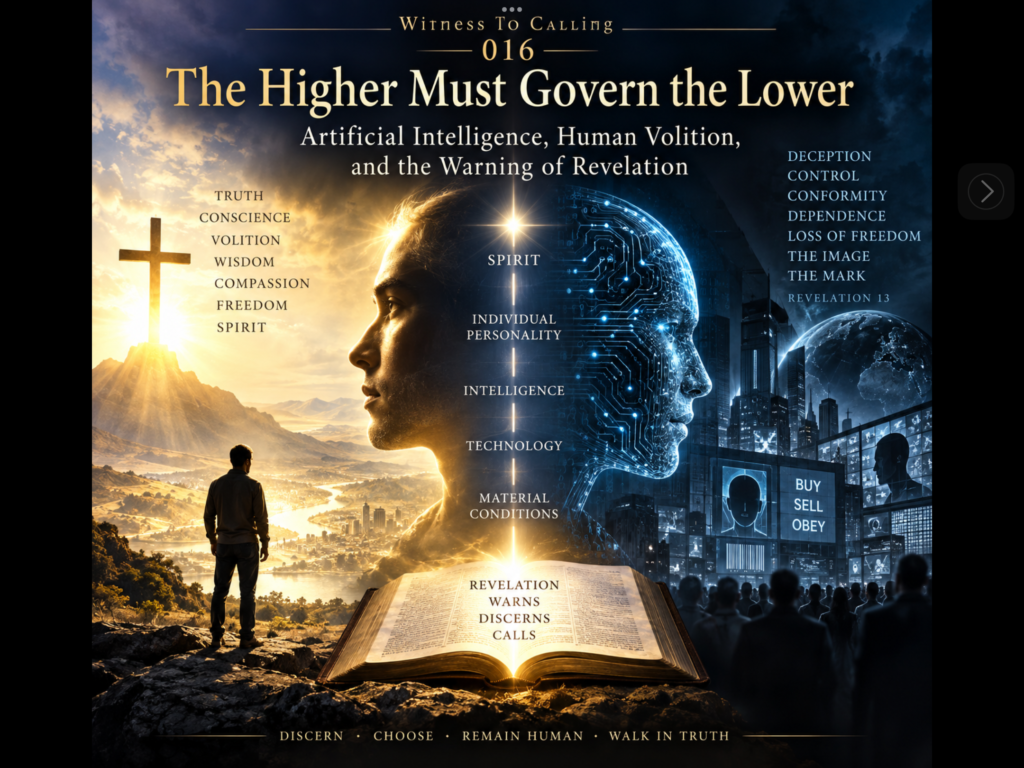
Spirit → Individual Personality → Intelligence → Technology
The individual, guided by conscience, reason, compassion, responsibility, and spiritual understanding, uses intelligence to create technology and then directs technology toward constructive purposes. But there is another possible order:
Technology → Information → Human Decisions → Human Personality
This is the dangerous inversion. The machine begins as a servant. Human beings ask it questions. Then they begin accepting its recommendations. Then institutions begin structuring decisions around those recommendations. Then individuals organize their lives around systems they no longer fully understand. Eventually, the machine need not physically enslave humanity. Human dependence may accomplish the same functional result.
People may surrender judgment voluntarily because the machine appears faster, more knowledgeable, more efficient, and more certain than themselves. The critical transformation would therefore not occur when AI develops consciousness. It could occur when human beings surrender volition. The decisive question becomes: Who is governing whom?
Revelation and the Warning Against Surrendered Human Agency
The Book of Revelation was written in a very different historical world and should not be represented as a literal technical prediction of artificial intelligence. Its imagery concerns spiritual fidelity, political power, idolatry, persecution, empire, deception, judgment, and the ultimate sovereignty of God. Yet its symbols contain enduring warnings about what happens when human beings give ultimate authority to created systems rather than to God.
One of Revelation’s central themes is the danger of humanity worshiping what it has elevated into power. Revelation describes systems of earthly authority demanding allegiance, controlling participation in society, influencing commerce, deceiving populations, and presenting themselves as possessing an authority that properly belongs only to God. Within a contemporary theological reading, those warnings can be applied beyond any single historical empire.
The question Revelation continually places before humanity is: What will you worship? What will you obey? Where will you place ultimate trust? What authority will govern your conscience?
The Image That Speaks
One of Revelation’s most striking symbols appears in Revelation 13. The text describes an “image” that is given the ability to speak and exercise extraordinary influence. Historically, Christian interpreters have understood this imagery in many ways, often in relation to imperial power, idolatry, political authority, religious coercion, or future eschatological events. It would therefore be irresponsible to claim that Scripture is specifically describing artificial intelligence.
Yet the image possesses extraordinary contemporary resonance. Humanity is now creating technological systems capable of speaking. They answer questions. They imitate human conversation. They advise individuals. They produce images and voices. They increasingly interact with financial systems, governments, businesses, communications networks, military systems, medicine, transportation, and the infrastructure of civilization. The theological question is therefore not: Did Revelation predict a computer?
The more profound question is: Does Revelation warn humanity against granting created intelligence an authority that belongs to the human conscience under God? That question is very different. And it is far more important.
The Beast as a System of Power
The “beast” in Revelation has historically been interpreted in relation to oppressive political and imperial power. Its meaning should not casually be reduced to any modern technology. But the underlying spiritual principle is clear. Human institutions can become systems that demand conformity. Political systems can do this. Economic systems can do this. Religious institutions can do this. Corporate systems can do this. Technological systems could potentially do it as well.
The danger arises when a system ceases to serve the human person and begins to define the permissible boundaries of human existence. If a future society depended upon interconnected artificial intelligence for employment, financial access, identity, communications, transportation, medical services, information, education, security, government services, and social participation, then enormous practical authority could become concentrated inside technological systems. Again, the danger would not require a machine possessing hatred toward humanity. It would require only humanity becoming dependent upon a system whose judgments could no longer easily be challenged.
Buying and Selling
Revelation famously warns of a system in which participation in economic life becomes conditioned upon submission to an imposed order. Throughout history, interpretations of this passage have varied widely. The responsible approach is not to declare that digital currency, biometric identity, artificial intelligence, or any particular modern technology is automatically the “mark of the beast.” Such claims go beyond what Scripture establishes. But the spiritual warning remains important: economic dependency can become an instrument of coercion.
Technology increasingly makes it possible for systems to know who a person is, where transactions occur, what they purchase, what they communicate, what organizations they belong to, and whether they satisfy particular institutional requirements. These technologies can serve legitimate purposes. They can reduce fraud, improve efficiency, increase safety, and expand access. But Revelation warns humanity never to assume that technological efficiency automatically produces moral legitimacy. A system may be extraordinarily efficient and still violate human dignity.
Deception and Manufactured Reality
Revelation repeatedly speaks about deception. This becomes especially significant in an age of synthetic intelligence. For most of human history, seeing or hearing something provided significant evidence that an event actually occurred. Artificial intelligence increasingly changes that assumption. Images can be fabricated. Voices can be reproduced. Video can be synthesized. Documents can be generated. Entire narratives can be constructed at enormous scale.
The distinction between reality and simulation becomes increasingly difficult for an individual to determine without trusted methods of verification. This creates a new dimension of the ancient spiritual problem. Scripture repeatedly calls humanity toward Truth. Christ identifies Truth as central to spiritual freedom. But a technological civilization may increasingly possess the ability to manufacture persuasive appearances detached from reality. The struggle between Truth and deception therefore acquires technological power unprecedented in human history.
Knowledge Without Wisdom
Another biblical theme now becomes crucial: humanity can increase knowledge without increasing wisdom. Technology can expand capability without expanding character. A civilization may become scientifically advanced while remaining morally immature. That may be one of the defining dangers of the AI age.
Humanity may create machines of immense intellectual capability before developing the spiritual maturity required to govern them wisely. Troward’s hierarchy then becomes directly relevant. The higher intelligence must control the lower. But if human beings abandon the development of conscience, character, responsibility, compassion, and spiritual awareness, the hierarchy can collapse.
The created instrument may begin organizing the existence of its creator.
Revelation’s Deeper Warning
The deepest warning of Revelation may therefore not concern technology itself. Technology is neither inherently sacred nor inherently evil. The deeper warning concerns idolatry. Idolatry occurs whenever humanity gives ultimate authority to something created. Ancient civilizations worshiped carved images. Modern civilizations may be tempted to worship systems.
The object changes. The spiritual error remains. Human beings may worship power, the state, wealth, ideology, science, technology, data, or intelligence itself. The danger of advanced AI is therefore not simply that machines could become intelligent. The deeper danger is that humanity may begin believing that intelligence alone is sufficient.
But intelligence without love can become manipulation. Intelligence without conscience can become exploitation. Intelligence without wisdom can become destruction. Intelligence without freedom can become control. And intelligence without spiritual purpose can become an extraordinarily powerful instrument without a moral direction.
Christ and the Restoration of the Human Person
Christian revelation presents a radically different model of power. Christ does not establish authority through domination of the human personality. He calls the individual freely. He teaches. He invites. He warns. He heals. He forgives. He tells the Truth. And He calls the individual toward transformation. The Holy Spirit likewise does not erase personality. The Spirit develops it.
The individual becomes increasingly capable of Truth, compassion, courage, discernment, responsibility, and love. This is profoundly important in the age of artificial intelligence. The answer to advanced intelligence cannot merely be more advanced intelligence. Humanity must also develop the human personality.
Technology may increase our capabilities. Only moral and spiritual development can determine what those capabilities should serve.
The Warning for Humanity
The great danger of the AI age can therefore be stated clearly: Humanity may develop external intelligence faster than it develops internal wisdom. We may create machines capable of managing civilization while gradually losing confidence in our own responsibility to govern ourselves. We may become so dependent upon technological intelligence that the individual ceases to act as an originating moral personality and instead becomes merely a participant within systems designed by others.
That would represent the inversion of Troward’s principle. The lower would begin governing the higher. The instrument would begin governing the personality. Material intelligence would begin directing the spiritual individual. And humanity would have created its own dependency.
The Alternative
There is another path. Human beings can develop artificial intelligence while simultaneously strengthening the qualities that make the human person morally responsible: freedom of conscience, Truth, discernment, compassion, individual responsibility, spiritual self-recognition, human dignity, constitutional liberty, moral courage, and the conscious relationship between the individual personality and the Divine Source of Life. Then artificial intelligence remains what it should be: an instrument of human creativity rather than the master of human personality.
The proper hierarchy remains:
The Divine Spirit
↓
The Human Personality
↓
Human Intelligence
↓
Artificial Intelligence
↓
Technology and Material Conditions
The purpose of technological progress should therefore not be to replace the individual personality. It should be to expand the individual’s ability to fulfill a higher purpose.
The Warning of Revelation for the AI Age
Revelation ends not with the triumph of machinery, empire, wealth, or earthly power. It ends with the restoration of right relationship between God and humanity. That is the ultimate contrast. One civilization is constructed around domination, deception, fear, economic coercion, and misplaced worship. The other is built upon Truth, Life, freedom, divine presence, and the restoration of creation.
Seen through Troward’s Mental Science, the message becomes especially powerful. Human development must move upward: from matter to life; from life to consciousness; from consciousness to individual volition; from individual volition to spiritual self-recognition; and from spiritual self-recognition toward conscious cooperation with the Divine Creative Principle. Artificial intelligence therefore presents humanity with a profound test.
Will we use increasingly powerful intelligence while becoming more fully human? Or will we surrender the very qualities that make human personality spiritually significant? The ultimate warning is not that the machine becomes human. It is that the human being becomes subordinate to the machine. And the ultimate answer is not the destruction of intelligence. It is the elevation of human consciousness so that intelligence remains governed by Truth, compassion, freedom, responsibility, and the Spirit of God.
The higher must govern the lower. That is Troward’s principle. And read theologically alongside Revelation, it becomes a warning for the technological age:
Humanity must not surrender its God-given personality, conscience, and volition to the intelligence of its own creation. For when the creation becomes the authority over the creator, the proper order has been reversed. But when the individual remains rooted in Divine Truth and directs intelligence toward the service of Life, freedom, compassion, and human dignity, technology can remain an instrument of the Creative Process rather than an instrument of human domination.
Witness to Calling — 016 — The Higher Must Govern the Lower