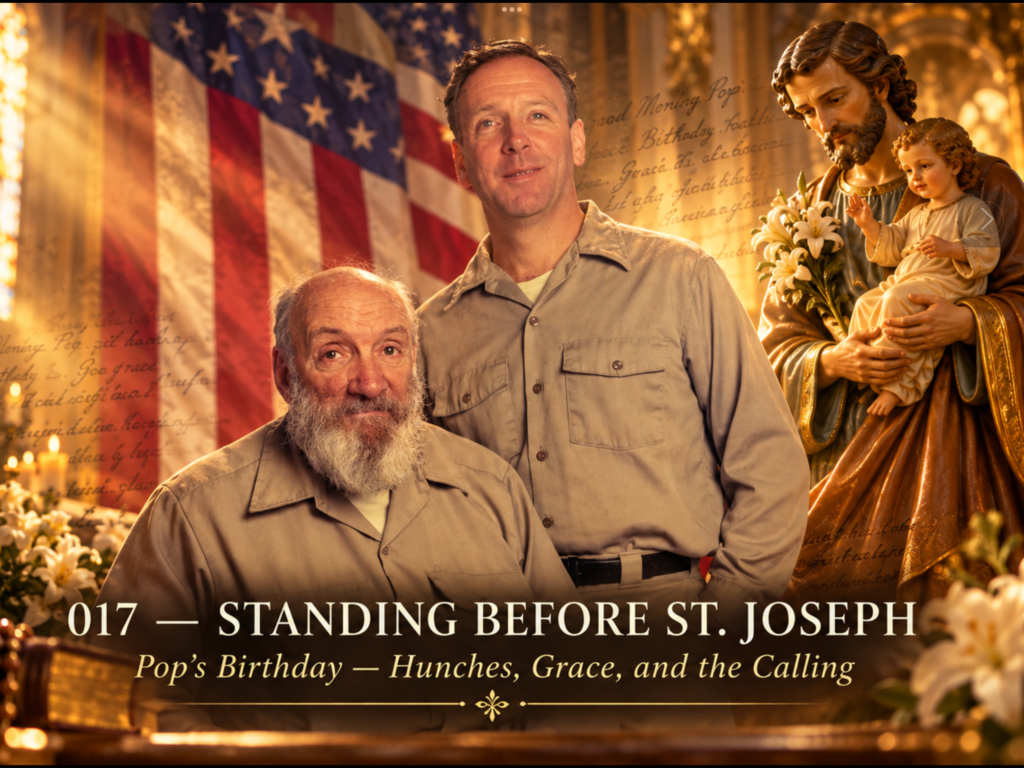
STANDING BEFORE ST. JOSEPH
Pop’s Birthday – Hunches, Grace, and the Calling
A Witness to Calling Reflection
September 25, 2026
Standing before St. Joseph says it all: love gave the answer that argument could not.
Happy Birthday, Pop
When I picture Pop today, I do not first see a distant photograph or a formal family occasion. I see the two of us sitting together on the porch during those early years when family, home, and business were all being built at the same time. We were listening to Napoleon Hill’s Think and Grow Rich. Nearby were his grandchildren, who would become part of the family I would help care for and carry forward, waiting for the sound of the ice-cream truck coming down the street.
Looking back, that porch was much more than a place to sit. Three generations were together. The children were experiencing the ordinary joy of childhood. Pop carried within him an extraordinary education of survival, work, war, responsibility, and family. And I was somewhere between those generations – learning from the man who came before me while beginning the work of building the home, caring for family, and building a business.
The significance of listening to Think and Grow Rich with Pop became clearer only later. Pop did not have the benefit of much formal education. He had to work from an early age. He learned to survive in Hell’s Kitchen, New York. He worked in the Civilian Conservation Corps and fought forest fires. He told me of surviving a crown fire by burying himself for protection. Later came combat training and service in the Philippines as a Bushmaster Scout, where instinct, knowledge of people, and awareness of the environment could become matters of survival.
Pop therefore relied upon something he called his ‘hunches.’ I came to call it intuition. Napoleon Hill gave intellectual language to a faculty Pop had already been forced to develop through life itself. He had learned to pay attention when something inside him said that a person, a situation, or an environment was not what it appeared to be.
“YOU DON’T STUDY PEOPLE.”
I remember a passing moment when Pop observed a businessman and somehow knew that the man was dishonest. I did not know what Pop had noticed. I still do not know. I asked him how he knew, and he answered with the sentence that stayed with me: ‘You don’t study people.’
At the time, I did not fully understand what he meant. Looking back, I believe Pop had been studying people his entire life. Not academically. Practically. He had learned to observe people because at different times in his life the ability to read character, danger, intention, and environment mattered. Experience had become instinct.
What Pop called a hunch, I called intuition. As my spiritual understanding developed, I came to interpret that intuition in another way as well. I began to see the possibility that grace can work through human experience, conscience, perception, and that unexplained inner recognition that sometimes tells us to pay attention.
Standing Before St. Joseph
There was another moment in my life when this understanding of intuition and grace became deeply personal. I was at St. Kilian Church, standing before a statue of Saint Joseph holding the child Jesus. At that time I was struggling with a decision: whether I should leave my father’s home and get an apartment of my own.
A woman had told me, in substance, that I needed to move out of the family home in order to become a man. The thought stayed with me. I went to a priest and asked for his advice. He told me that she was right. I then went to a rabbi, partly because I hoped he might give me the answer I wanted. He also told me that I should move out, warning that otherwise I might one day resent my father.
By conventional reasoning, the answer seemed settled. Two religious men had independently told me to leave. Yet something in me was still unsettled.
Then I stood before Saint Joseph with the child Jesus in his arm – an image of fatherhood, protection, responsibility, and love. While I was looking at the statue, a deacon came out and asked me what I was thinking about.
I told him that I was thinking about moving out of my father’s house because a woman had told me, essentially, that I was not really a man unless I left home.
“Do you love your dad?”
“Yes. I love my dad.”
“Do you want to live with him now and be in his company?”
“Yes. I do.”
“Then that is your answer.”
Standing before St. Joseph says it all.
The deacon did not give me another rule about what a man was supposed to do. He asked me about love. He brought the decision back to the actual human relationship in front of me: Did I love my father? Did I want to remain in his company while I still had the opportunity? My answer was yes.
I stayed.
I built my business out of the home. I remained close to Pop. We shared time that could never have been recovered later. I was able to receive from him not simply advice, but his presence – the accumulated wisdom, character, habits, instincts, and love of a man whose principal language had always been action.
Looking back, I interpret that moment at St. Kilian as another movement of grace. I believe the grace of the Holy Spirit helped me make the decision that was right for my life. Had I left simply because other people believed adulthood required a different address, I might have lost a period with Pop that became foundational to everything that followed.
The grace did not come to me as a voice from Heaven commanding me what to do. It came through a question: Do you love your dad? The answer was already inside me.
A Man of Action
Pop very rarely spoke the language of emotion. He was a man of action. His love was expressed in what he did – working, surviving, providing, protecting, enduring, repairing, building, and remaining responsible for his family.
That is important to me now because I understand that many of the greatest things Pop gave me were never delivered as speeches. They were demonstrated. I watched a man who had been formed by hardship continue to create stability for the people he loved. I watched a man with little formal schooling possess an intelligence that life itself had trained into him. I watched him rely upon his hunches, study people, and act.
Perhaps this is also why the porch memory remains so alive. Pop and I were listening to a book about thought, desire, persistence, and the unseen sources of human achievement. Yet the real lesson was sitting beside me. Pop’s philosophy was not primarily written. It was lived.
That became one of his deepest lessons to me: truth is not only something we speak. Truth must eventually become action. Love must become action. Faith must become action.
The Sign Is Joy
Today, when I think about Pop, Margie, Aunt Amy, and the Blessed Mother, I experience something that is difficult to reduce to argument or explanation. The word that comes closest is JOY.
Not excitement. Not denial of loss. Joy.
It is a sense of warmth, gratitude, presence, and connection. I believe the grace of the Holy Spirit watched over Pop through the dangers and responsibilities of his earthly life. In my own life, I experience the love of Pop, Margie, Aunt Amy, and Mary as something that continues to shape me. I cannot prove such a spiritual experience to another person. I can only bear witness to how I experience it.
Memory, therefore, no longer means only loss. Memory can become presence. Love can become gratitude. Gratitude can become joy. And joy can become a call to action.
What the Joy Calls Me Toward
When I ask what that joy now requires of me, my answer is that I must fulfill my calling as a Witness to the Truth. I believe my life has called me to testify, from my own experience and faith, that Jesus Christ is real, that Mary is real, that Holy Grace is real, and that something of Heaven on Earth becomes visible whenever human beings truly love one another.
I do not mean that Earth has already become Heaven. Human suffering, injustice, war, selfishness, and failure remain painfully real. What I mean is that there are moments when love, compassion, sacrifice, forgiveness, courage, and grace reveal what human life can become.
For me, this is inseparable from the hope of peace on Earth. I believe humanity can move toward a future in which peace is more than a temporary pause between wars. I also believe the United States carries a calling within that unfinished human story – a responsibility to live more fully by the ideals of liberty, human dignity, justice, freedom of conscience, and service.
That national calling and my personal calling have become connected in my own understanding. I am not called to command a nation. I am called to bear witness: to preserve what I have learned, to tell the truth as I understand it, to love others, to serve where I can, to build what I am able to build, and to leave behind testimony that another generation can examine for itself.
If Pop Were Sitting Beside Me Again
If Pop were sitting beside me on that porch again today, on his birthday, I do not think I would begin with a long explanation of everything that happened after those early years.
I would put my arms around him.
I would kiss him.
Because Pop was a man of action, I think he would understand that better than a speech.
In that embrace I would want him to know: I understand more now. I understand your hunches differently. I understand why you studied people. I understand something of what Hell’s Kitchen, the forest fires, war, work, and family required of you. I understand why staying in your company mattered. And I understand that much of what you gave me was never spoken.
It was lived.
So the greatest way I can honor Pop on his birthday is not merely by remembering him. It is by continuing to live what he gave me: to love, to act, to serve, to build, to study people and circumstances carefully, to remain open to grace, and to fulfill the calling I believe still lies before me.
Pop called it a hunch.
I came to call it intuition.
Through faith, I came to recognize grace.
Standing before St. Joseph, love gave me my answer.
Happy Birthday, Pop. I love you.
Witness to Calling – Pop’s Birthday – September 25, 2026