The Holy Spirit, the Unity of Truth, the Masters of History, and the Progressive Development of Human Consciousness
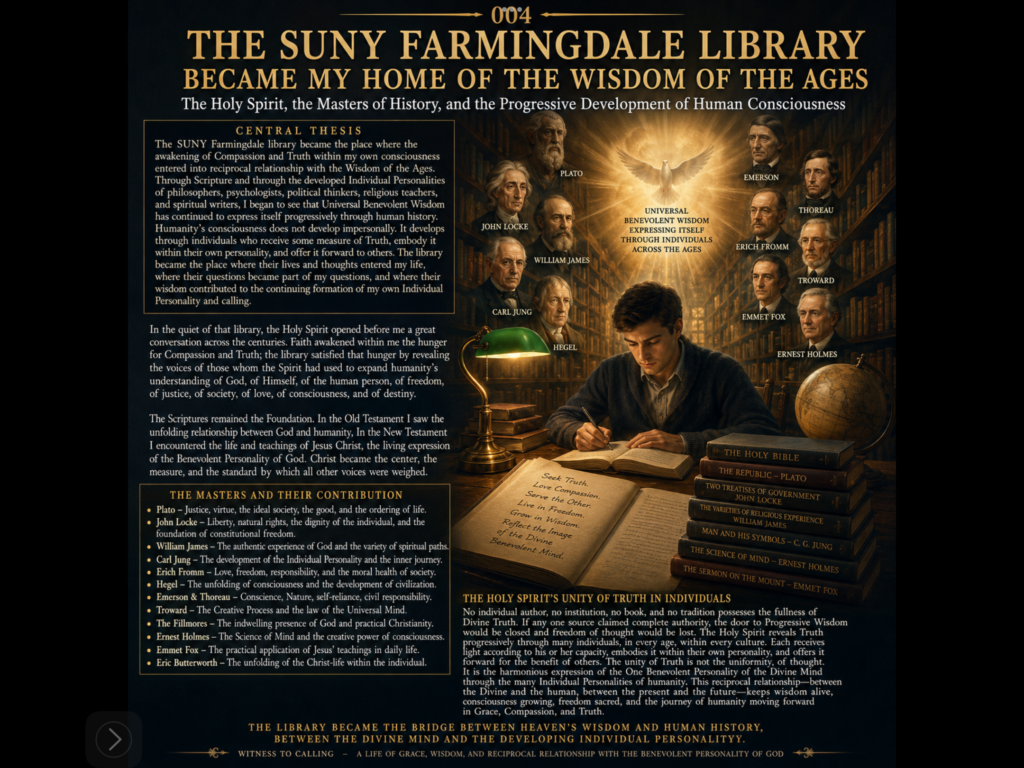
The SUNY Farmingdale library became the place where the awakening of Compassion and Truth within my own consciousness entered into reciprocal relationship with the Wisdom of the Ages. Through Scripture and through the developed Individual Personalities of philosophers, psychologists, political thinkers, statesmen, religious teachers, and spiritual writers, I began to understand that Universal Benevolent Wisdom has continued to express itself progressively through human history. Humanity’s consciousness does not develop impersonally. It develops through individual human beings who receive some measure of Truth, embody it within the limitations and possibilities of their own personality, and offer it forward to others. The library became the place where their lives and thoughts entered my life, where their questions became part of my questions, and where their wisdom contributed to the continuing formation of my own Individual Personality and calling.
Looking back across the years, I now realize that one of the most important places in the formation of my life was not a church sanctuary, a formal theological school, a government institution, or a corporate boardroom. It was the lower level of the library at SUNY Farmingdale. My journey into that library began after a born-again religious experience while I was cleaning tables on campus. In the midst of ordinary work, I experienced what I came to understand as the Grace of the Holy Spirit awakening Compassion and Truth within my consciousness. The outward circumstances were simple, yet the inward movement was profound. I did not suddenly receive a complete theology, a final philosophy, or every answer to the questions of life. What changed was the direction of my consciousness. I became more deeply concerned about the lives of others, the condition of America and the world, the responsibilities placed upon the individual, and the possibility that human life possessed a Divine purpose larger than ambition, survival, personal achievement, or social position.
Compassion began moving my consciousness outward toward the Other. Truth began moving my mind toward understanding. These two movements belonged together. Compassion without Truth might become sentimentality, illusion, or undisciplined emotion. Truth without Compassion might become cold intellectualism, judgment, domination, or another instrument of concentrated power. Through the Grace of the Holy Spirit, I began to sense that Compassion and Truth were not merely human virtues. They were qualities of the Benevolent Personality of God, most fully revealed through the Benevolent Personality of Jesus Christ.
The awakening did not call me away from knowledge. It drew me toward knowledge. Grace did not close my mind or tell me that all necessary Truth had already been reduced to one human statement. Grace intensified the questions. Almost instinctively, I began returning to the lower level of the SUNY Farmingdale library. Looking backward, that movement now appears symbolic. The spiritual awakening came while I was performing ordinary physical work, but my response to that awakening carried me toward the accumulated intellectual and spiritual work of humanity. The library became another classroom of the Holy Spirit and eventually became my home of historical wisdom.
Within that library, I discovered that the search for God and the search for Truth did not have to oppose one another. Faith and reason could enter reciprocal relationship. Spiritual experience could awaken intellectual inquiry, and intellectual inquiry could deepen spiritual responsibility. The books did not replace the Grace I had experienced. They gave historical depth, philosophical structure, psychological insight, and human language to questions that Grace had awakened within me.
I also began to understand a principle that has become central to this book: the Holy Spirit is the Spirit of Truth, but no individual author, religious institution, political institution, philosophical system, human teacher, or earthly book can claim to contain the whole and final expression of Divine Truth. To make such a claim would close the door upon progressive wisdom, freedom of thought, the continued development of human consciousness, and the living reciprocal relationship between the Divine Mind and individual human beings of the present and future.
This does not mean that all ideas are equally true, that contradiction does not matter, or that Truth is merely whatever an individual wishes to believe. Divine Objective Truth remains real. Yet the human reception of that Truth is always mediated through limited historical circumstances, language, culture, experience, intelligence, conscience, and Individual Personality. Every human author sees from a particular place within the continuing journey of humanity. Even a profound thinker may illuminate one dimension of Truth while remaining incomplete or mistaken in another.
The unity of Truth therefore does not require uniformity of human thought. The Holy Spirit may bring different individuals into contact with different dimensions of the same larger Benevolent Wisdom. One person may illuminate justice. Another may illuminate liberty. Another may examine conscience, religious experience, personality, love, Nature, constitutional government, moral responsibility, the Creative Process, or the relationship between the individual and society. The differences among them do not necessarily destroy the unity of Truth. They may reveal that Divine Wisdom is greater than any one human formulation and that humanity progressively approaches understanding through the reciprocal contributions of many developed Individual Personalities.
This principle protects both faith and freedom. It protects faith because it refuses to reduce the Infinite Divine Mind to the possession of a human institution. It protects freedom because it preserves the right and responsibility of each new generation to seek, question, compare, discern, discover, and contribute. If one institution, author, denomination, government, university, philosophy, or book were permitted to declare that the whole of Divine Truth had already been finally captured within its own human language, then the continued development of consciousness would be treated as unnecessary or dangerous. Thought would become conformity. Faith would become submission to human authority. The reciprocal relationship between the Benevolent Divine Mind and the individual would be replaced by dependence upon an earthly intermediary claiming exclusive possession of Truth.
The Holy Spirit, as I came to understand the Spirit, does not extinguish Individual Personality. The Spirit awakens and develops it. The Divine Mind does not require humanity to stop thinking. It calls the individual to think more truthfully, more freely, more responsibly, and more compassionately. Divine Benevolence does not fear new knowledge because genuine Truth cannot ultimately threaten Truth. What must be tested is whether new knowledge serves the dignity of the human person, preserves freedom, deepens Compassion, withstands honest examination, and contributes to the Benevolent development of life.
This understanding enabled me to enter the library without believing that I had to surrender Christ in order to learn from Plato, Locke, William James, Jung, Fromm, Hegel, Emerson, Thoreau, Troward, Confucius, or other great minds. Nor did learning from them require me to treat them as infallible. I could receive what they had discovered, examine their conclusions, compare their insights, recognize their limitations, and bring their wisdom into conversation with the Benevolent Personality of Christ.
Christ remained the center, but the centrality of Christ did not require the silencing of every other voice. Rather, Christ became the living measure through which the voices could be heard and evaluated. Did an idea protect the dignity of the person? Did it serve Compassion and Truth? Did it preserve conscience and freedom? Did it direct power toward service or toward domination? Did it strengthen reciprocal relationship or separate the individual from God, the Other, and the moral responsibilities of life?
Scripture, Christ, and the Living Foundation of Wisdom
The Holy Scriptures remained the foundation of my search. The Old Testament revealed the long and difficult development of humanity’s relationship with God through Creation, covenant, law, prophecy, judgment, mercy, exile, return, human failure, redemption, and hope. It presented humanity not as spiritually complete but as developing through relationship with the Divine.
The stories of Scripture showed that individuals matter within the movement of history. Abraham responded to a call that opened a new spiritual future. Moses confronted concentrated power and led a people toward freedom. David embodied courage, leadership, moral greatness, human weakness, and the need for repentance. The prophets confronted idolatry, corruption, injustice, and the separation of public worship from moral responsibility. Their Individual Personalities became channels through which Divine Truth entered history.
The Old Testament taught me that relationship with God carries responsibility. Worship cannot be separated from justice. Authority cannot be separated from accountability. National life cannot be separated from moral character. The individual, family, community, and nation exist within a larger moral order.
The New Testament brought this developing search into its decisive center through the life, teaching, death, and resurrection of Jesus Christ. In Christ, the Benevolent Personality of God became visible through a human life. Divine Love was not merely declared. It acted. It healed. It forgave. It spoke Truth. It restored dignity. It welcomed children. It confronted hypocrisy. It remained beside the suffering. It challenged concentrated religious and political power without attempting to replace one form of domination with another.
Christ revealed Compassion without weakness and Truth without cruelty. He expressed authority without domination, humility without loss of dignity, individuality without isolation, freedom without irresponsibility, sacrifice without surrender to falsehood, and service without servility. His life became the blueprint of what Individual Personality could become when it remained in conscious reciprocal relationship with the Divine Personality of God.
Yet even Scripture must be encountered through human consciousness. The Bible is sacred to me, but human beings read, interpret, translate, preach, apply, and sometimes misuse it. The sacred character of Scripture should therefore deepen humility rather than authorize human arrogance. No interpreter may rightfully confuse his own understanding with the totality of the Divine Mind. The Holy Spirit continues to work within the reader, within the community, and across generations, opening deeper understanding while calling every interpretation back to the Benevolent Personality revealed in Christ.
The New Testament itself presents development. The disciples do not understand everything at once. They question, misunderstand, fear, fail, grow, receive the Spirit, and enter a larger mission. This is important because it shows that spiritual Truth is not merely delivered as static information. It becomes progressively embodied through developing human personalities.
The Holy Spirit represents the continuation of this Divine movement within individual consciousness. The Grace I experienced at Farmingdale became meaningful within this scriptural framework. Compassion and Truth were not merely emotions or intellectual preferences. They could be understood as qualities of Divine Personality awakening within the individual and calling that individual toward relationship, responsibility, freedom, and service.
The Masters of History and the Many Dimensions of Wisdom
As I moved among the shelves, I entered a conversation that had been unfolding for thousands of years. The authors were no longer merely names from distant periods. Through their writings, their Individual Personalities continued to speak. Their physical lives had ended, but the consciousness they had developed and expressed remained available to later generations. They received questions from the ages before them, struggled with those questions within their own circumstances, and offered their understanding forward through written words.
The library revealed that an individual human life can continue participating in the development of humanity long after the physical personality has left the earth. A person may live within one century, nation, religion, language, or political order, yet something discovered within that individual consciousness may become part of the inheritance of the human race. Wisdom is transmitted through relationship: teacher to student, author to reader, generation to generation, and personality to personality.
Plato’s Republic and Laws opened questions concerning justice, virtue, education, leadership, law, and the proper ordering of society. His wisdom helped me understand that political disorder often reflects disorder within the human personality. A person ruled by appetite, ego, fear, or uncontrolled ambition may eventually use intelligence and authority in destructive ways. A nation cannot be preserved by structures alone if those entrusted with the structures lack wisdom, discipline, courage, and justice. Plato taught me that education must do more than transmit information. It must participate in forming the character of the individual.
John Locke became one of my favorite authors because he helped unite my spiritual understanding of the dignity of the individual with my developing American consciousness. Locke taught that the rights of the person do not originate in government. Human beings possess a moral standing that precedes the state. Life, liberty, conscience, reason, labor, property, responsibility, and consent belong to the individual within a natural moral order.
Government therefore does not create Individual Personality. Legitimate government protects the conditions in which personality may live, develop, worship, reason, work, associate, create, and fulfill responsibility. Political authority is not ownership of the people. It is a trust.
Locke’s defense of religious toleration was especially important because genuine faith cannot be produced by force. Government may command outward conformity, but it cannot manufacture authentic conviction within the soul. Faith, conscience, repentance, love, and relationship with God must be freely entered. This corresponded with my understanding of reciprocal relationship. The Benevolent Personality of God does not need to destroy human individuality in order to accomplish Divine Purpose. Love requires freedom. Faith requires freedom. Conscience requires freedom. Calling requires freedom.
Yet Locke also made clear that liberty is not permission to injure the equal dignity and rights of the Other. Freedom exists within moral responsibility. My liberty cannot become justification for domination because the Other possesses the same moral standing before God that I claim for myself.
George Washington’s Farewell Address taught me that liberty cannot long survive without religion, morality, virtue, and national character. Washington understood that constitutions and institutions, however wisely designed, cannot preserve themselves. They require citizens and leaders capable of restraint, duty, judgment, and concern for generations not yet born. His voluntary surrender of military command and later presidential power demonstrated that the highest use of authority may include the willingness to relinquish it.
Benjamin Franklin added the wisdom of practical character, self-education, industry, invention, civic responsibility, and disciplined self-development. He showed that character is not merely proclaimed. It is practiced through habits, work, self-examination, time, and repeated choices. His life also demonstrated that intelligence could become useful through institution-building, invention, enterprise, diplomacy, and public service.
The Federalist Papers, principally written by Alexander Hamilton, James Madison, and John Jay, revealed the architecture of constitutional liberty. Their great question was how power could remain strong enough to protect order and national survival while restrained enough to protect individual freedom. They did not design government for perfect human beings. They recognized ambition, faction, conflict, self-interest, and the danger of concentrated authority. Their wisdom lay in dividing and balancing power so that authority would restrain authority.
Ralph Waldo Emerson introduced me to self-reliance, conscience, Nature, and the authority of the inner life. His writings affirmed that the individual should not surrender judgment merely because society or institutions demand conformity. Yet Christ deepened that insight by revealing that true individuality does not end in self-assertion. Mature individuality moves beyond the self toward responsible love of the Other.
Henry David Thoreau strengthened the themes of conscience, deliberate living, simplicity, moral independence, and Nature. His challenge was whether the person is truly living or merely being carried along by habit, commerce, convention, and the expectations of others. His understanding of civil disobedience raised the continuing responsibility of individual conscience in relation to the state. Government does not acquire automatic moral authority merely because it acts through law.
William James, especially through The Varieties of Religious Experience, gave me intellectual language with which to examine my born-again experience at Farmingdale. James approached religion as something that occurs within living human consciousness. He explored conversion, divided consciousness, spiritual awakening, and the practical fruits of faith. His work helped me recognize that the meaning of a religious experience must be tested partly by what follows. Does it deepen Compassion? Does it strengthen honesty? Does it increase responsibility? Does it produce greater integration of personality? Does it move the person toward love, courage, service, and Truth?
Carl Jung became especially important through his exploration of individuation, the lifelong process through which a person becomes more conscious, integrated, and truly individual. Jung taught that Individual Personality is not fully formed at the beginning of life. It develops through encounter with memory, symbol, fear, contradiction, unrealized potential, and the hidden dimensions of the self. Yet from my Christian perspective, individuation could not end in the isolated self. The personality becomes more fully itself by entering deeper reciprocal relationship with God and by moving responsibly toward the Other.
Erich Fromm deepened my understanding of freedom, love, responsibility, social character, and the human tendency to escape from the burden of individuality. A person may publicly desire freedom while inwardly fearing the choices and responsibilities freedom requires. Fromm also taught that love is not merely emotion or possession. It is an art requiring care, responsibility, respect, knowledge, patience, discipline, and commitment. This corresponded powerfully with the love revealed in Christ and with what I learned through family.
Hegel challenged me to see history not simply as a sequence of rulers, wars, inventions, and institutions but as a possible development of consciousness and freedom. I did not accept every conclusion of his philosophy, yet the idea that humanity struggles toward greater awareness became central to my thought. His work also taught me that contradiction may reveal the incompleteness of an existing order and become part of further development. Yet history does not automatically become Benevolent. Technological advancement can coexist with moral regression. Christ therefore remained the measure by which historical development had to be evaluated.
Confucius contributed the insight that the renewal of society begins with the development of the individual and extends through family, community, and nation. He emphasized ordered relationships, education, responsibility, and reciprocity. His wisdom helped me see that national renewal cannot be achieved solely through institutions or slogans. It must begin in human character and relationship. Christ expanded the moral horizon still further by extending love beyond family and social role toward the stranger, the rejected, and even the enemy.
Meister Eckhart brought me into deeper contemplation of the interior life and the presence of God within the soul. His writings emphasized inward stillness, detachment from ego, and the possibility of encountering the Divine within the deepest ground of consciousness. Yet this inward encounter was not meant to become permanent withdrawal. Like Christ’s movement between prayer and service, the individual returns from contemplation with greater freedom from ego and greater capacity for love.
Thomas Troward eventually rose to the apex of my present philosophical thought because he helped me explore the relationship among Divine Personality, Universal Mind, Individuality, the Creative Process, and human destiny. Troward presented Creation as an orderly movement through Life, Intelligence, Individuality, and Personality. His thought helped me understand that individuality is not an error to be erased. It is part of the purpose of Creation. Yet the individual must remain conscious of relationship with the Source from which Life and Intelligence arise.
Troward also helped me understand that creative power cannot be separated from the consciousness directing it. Thought, imagination, intention, and belief participate in human creativity, but creative capacity without Benevolent Wisdom can become destructive. This has become increasingly important in an age of artificial intelligence, surveillance technology, biotechnology, centralized data, and unprecedented technical power. Humanity has developed extraordinary instruments, but those instruments do not supply their own moral direction. Personality determines purpose.
Charles and Myrtle Fillmore, through Unity, emphasized the indwelling presence of God and the practical application of Christian principles. They encouraged an understanding of prayer as conscious alignment with Divine Presence and of spiritual development as something that must enter thought, health, work, relationships, and daily life.
Ernest Holmes, through The Science of Mind, explored the relationship among consciousness, spiritual law, thought, and creative experience. The wisdom I received from Holmes was not that the human ego possesses unlimited authority over the universe, but that consciousness matters. Repeated ideas, convictions, expectations, and images influence conduct and response. Yet mental power must remain governed by Compassion and Truth or it can become manipulation, self-deception, or another instrument of ego.
Emmet Fox repeatedly returned me to the practical teachings of Jesus, especially the Sermon on the Mount. He made the Gospel immediate. Forgiveness, prayer, trust, nonretaliation, humility, love of enemies, freedom from fear, and care for the inner life became disciplines of consciousness rather than distant religious ideas. The question became not merely whether I believed Jesus but whether I was willing to practice what Jesus taught in actual relationships.
Eric Butterworth helped me appreciate the progressive awakening of Christ-centered consciousness within the individual. He emphasized that the Divine image is not merely an external ideal imposed upon the person. It is a spiritual potential seeking expression through Individual Personality. This did not mean that the human ego became God. It meant that spiritual development involved awakening to Compassion, Truth, wisdom, creativity, freedom, and love through relationship with the Divine.
Other American religious thinkers and movements also contributed to the continuing conversation. Jonathan Edwards examined religious affections and the distinction between outward emotion and genuine transformation. William Ellery Channing emphasized moral dignity, conscience, reason, and the development of the individual. The Social Gospel movement insisted that Christian responsibility must address poverty, labor, justice, and institutions. Reinhold Niebuhr brought Christian realism to the problem of power, recognizing that individuals and groups remain capable of pride, self-deception, and domination. Martin Luther King Jr. joined Christian love, American constitutional ideals, nonviolent courage, and the demand for justice. Norman Vincent Peale emphasized hope, faith, and disciplined thought. Billy Graham brought the call to personal conversion and relationship with Christ before millions of individuals.
I did not accept every doctrine or conclusion of every author or movement. Nor was I required to do so. Their importance lay in the dimensions of Truth they illuminated and in the questions they contributed to the progressive consciousness of humanity. No single one represented the whole Divine Mind. Each was an Individual Personality receiving, interpreting, and transmitting some measure of wisdom through the conditions of his or her own life.
The Unity of Truth and the Freedom of Future Consciousness
The more widely I read, the more clearly I understood that no human being may rightfully close the future of wisdom.
If Divine Mind is living, creative, Benevolent, and infinite, then the reciprocal relationship between the Divine and humanity must remain open to individuals who are living now and to those who will live in generations yet to come. The wisdom of the past is an inheritance, but it cannot become a prison. The great authors deserve respect, but not worship. Institutions may preserve insight, but they may not claim ownership of the Divine Spirit. Books can transmit Truth, but no humanly written book can exhaust the Infinite Mind.
This principle has profound implications for religion, education, government, science, and culture. Religion must preserve revelation without denying the continuing work of the Holy Spirit. Education must transmit inherited wisdom while protecting freedom of inquiry. Government must preserve constitutional order without suppressing conscience. Science must remain open to discovery while accepting moral responsibility. Technology must expand human capability without replacing human dignity or conscience.
The unity of Truth therefore exists at a level deeper than institutional agreement. It is not created by forcing every individual to repeat the same words. It emerges as diverse individuals, acting in freedom and humility, seek what is objectively real and Benevolent. Their conclusions must be tested. Errors must be corrected. Insights must be integrated. Yet the process must remain open because humanity is still developing.
The Holy Spirit’s unity of Truth does not abolish differences among persons. It brings those differences into a larger relationship. One individual may perceive what another has overlooked. One generation may correct the blindness of another. One culture may preserve wisdom another has forgotten. One discipline may illuminate a dimension of human life that another cannot fully explain.
The Divine Benevolent Mind remains greater than all of them.
This protects the future. It means that a child not yet born may someday receive an insight that humanity desperately needs. A scientist may discover something that deepens reverence for Creation. A theologian may recover a neglected dimension of Compassion. A philosopher may clarify freedom. A statesman may develop a more just institution. An engineer may create technology that protects dignity rather than diminishing it. An ordinary person may experience Grace in the midst of ordinary work and begin a journey whose consequences cannot yet be seen.
The future remains spiritually meaningful because Divine Wisdom has not ceased communicating with humanity. The reciprocal relationship continues.
The Progressive Development of Human Consciousness
The accumulated Wisdom of the Ages led me toward a larger conclusion: humanity’s consciousness develops progressively through individuals. This development is not necessarily smooth, automatic, or irreversible. Civilizations rise and fall. Wisdom is discovered and forgotten. Liberty expands and contracts. Religion awakens spirit and sometimes hardens into institution. Science heals and also creates weapons. Technology liberates and also monitors. Economic systems produce abundance and also exploitation.
Yet through all of this, individuals continue to ask questions, receive insight, challenge injustice, discover principles, create institutions, interpret experience, and transmit wisdom. Humanity develops because individuals develop.
One individual discovers something about justice, and later generations inherit the question. Another clarifies natural rights, and a political revolution becomes possible. Another examines religious experience, and spiritual awakening gains new language. Another explores the unconscious, and humanity gains greater insight into personality. Another designs constitutional structures, and liberty receives stronger protection. Another interprets the Creative Process, and consciousness is understood in a new relationship with Divine Intelligence.
The development of humanity therefore does not require the disappearance of individuality. It depends upon individuality. Universal Benevolent Wisdom seeks expression through developed Individual Personalities. Those personalities receive from the past, contribute through their own lives, and offer something to the future.
This is the same pattern I now see within Witness to Calling. I received Scripture. I received the witness of Christ. I received Grace through the Holy Spirit. I received the wisdom of authors, teachers, leaders, family members, friends, institutions, experiences, failures, love, work, Nature, and loss. Their lives entered mine. Their questions became part of my questions. Their wisdom contributed to the development of my personality. The reciprocal movement now asks what I will return.
From Knowledge to Wisdom, and from Wisdom to Calling
The library was never only about learning what other people had thought. It was preparing me to ask what responsibility knowledge placed upon my own life. Wisdom is not fully received until it begins influencing conduct.
Plato’s justice must enter leadership. Locke’s liberty must enter citizenship. Washington’s virtue must enter public character. Franklin’s discipline must enter daily life. The constitutional restraint of power must enter institutional design. Emerson’s inward conscience must enter moral independence. Thoreau’s deliberate living must enter personal choice. James’s religious experience must produce practical fruits. Jung’s individuation must contribute to integrated personality. Fromm’s art of loving must enter family and relationship. Hegel’s development of consciousness must be judged by moral purpose. Confucian reciprocity must enter family and community. Troward’s Creative Process must be governed by Benevolent Personality. Unity’s indwelling Divine Presence must enter ordinary conduct. Holmes’s disciplined consciousness must remain subordinate to Truth. Fox’s interpretation of Christ must become a lived Gospel. Butterworth’s spiritual potential must move toward service.
Knowledge becomes wisdom when it is integrated into life. Wisdom becomes Benevolent when it moves toward the Other.
This is why the story of the library belongs beside Chapter 003. Chapter 003 reveals the Divine Source and Christ-centered blueprint of human development. It explains separation, restoration, reciprocal relationship, Individual Personality, liberty, Compassion, Truth, and the continuing Creative Process. Chapter 004 reveals how Benevolent Wisdom has been transmitted through the developed Individual Personalities of humanity and how one awakened consciousness entered relationship with the Wisdom of the Ages.
Together, the chapters reveal different dimensions of the same movement. The vertical relationship joins the individual with the Divine Source through Christ and the Holy Spirit. The historical relationship joins the individual with the accumulated wisdom transmitted by developed personalities across time. The horizontal relationship directs the developed person toward the Other, family, community, Nation, humanity, innocent children, future generations, and the living world of Nature.
These relationships converge within calling.
The Library Within
Today, as I write Witness to Calling, I realize that I am drawing from that library once again. The shelves I first walked as a young student at SUNY Farmingdale have remained with me throughout my life. In many ways, I never truly left them. The books became companions. The authors became teachers. Their questions became lifelong questions. Their wisdom entered my faith, work, citizenship, business, family life, understanding of America, and continuing search for purpose.
The Holy Spirit did not merely lead me to books. The Spirit gradually helped build a living library within my consciousness. That inner library contains Scripture, philosophy, psychology, theology, history, political wisdom, religious experience, military service, family relationships, professional knowledge, enterprise, friendship, Nature, loss, mistakes, reconciliation, hope, and the continued search for Truth. It contains what I have read and what I have lived. It contains what I understood correctly and what I later had to reconsider. It contains wisdom received and experiences through which that wisdom was tested.
The writing of this book is therefore not simply the retrieval of memories. It is the opening of that inner library. I return to its shelves. I revisit its teachers. I reconsider its lessons. I examine the journey under the Benevolent Personality of Christ. I ask what remains true, what must be corrected, what Compassion requires, and what wisdom can now be offered to the Other.
The library has become part of my calling because wisdom cannot remain permanently enclosed within one consciousness. What was received through reciprocal relationship must eventually be returned through reciprocal relationship. The authors of history gave something forward. Their words reached me. My life entered conversation with theirs. Now Witness to Calling becomes my opportunity to offer something forward as well.
I do not claim the authority of the masters whose writings shaped me. I do not claim to possess final answers. I write as a witness—an ordinary and imperfect human being whose consciousness was awakened by Grace, whose mind was opened by the Wisdom of the Ages, whose personality was formed through relationship and responsibility, and whose life is now seeking to return whatever Benevolent Wisdom it has received.
The Continuing Conversation
Looking back, I can now say that the SUNY Farmingdale library became my home of the Wisdom of the Ages. It was there that the Grace first awakened by the Holy Spirit entered a lifelong conversation with the developed Individual Personalities of history. It was there that faith and reason first embraced one another, that Compassion began seeking the Other through understanding, and that Truth began disciplining the mind.
It was there that I began to understand that Universal Benevolent Wisdom does not remain abstract. It enters history through individuals. The prophet speaks. The philosopher questions. The psychologist examines consciousness. The political thinker designs institutions. The spiritual teacher interprets experience. The statesman embodies responsibility. The author writes. The reader receives. The next generation continues the conversation.
No one of these individuals possesses the totality of Divine Truth. No one institution contains the whole Divine Mind. No one human book may close the future. The unity of Truth belongs to the Holy Spirit, and the Spirit continues working through free Individual Personalities in reciprocal relationship with the Benevolent Divine Mind.
The past therefore does not dominate the future. It contributes to it.
The present does not merely repeat the past. It receives, tests, corrects, integrates, and adds to it.
The future does not begin empty. It inherits wisdom, but it also remains open to further illumination.
Human consciousness develops through this reciprocal movement. The individual receives from humanity and contributes back to humanity. Universal Wisdom becomes particular insight. Particular insight becomes written word. Written word enters another consciousness. Another Individual Personality develops. That personality encounters new circumstances, asks new questions, and may bring forward another dimension of Truth.
The library therefore revealed something essential about the Creative Process itself. Life produces consciousness. Consciousness develops Intelligence. Intelligence awakens Individuality. Individuality develops Personality. Personality enters relationship with the Wisdom of others. Through Compassion and Truth, wisdom becomes responsibility. Through freedom, responsibility becomes calling. Through calling, the individual voluntarily gives something back.
This is the deeper meaning of the SUNY Farmingdale library within my life. It was not simply where I found books. It was where an awakening consciousness entered the continuing consciousness of humanity. It was where the Grace of the Holy Spirit entered into dialogue with the Wisdom of the Ages. It was where the Benevolent Personality of Christ became the center through which many voices could be heard, evaluated, and integrated. It was where my own Individual Personality began to understand that wisdom is inherited through relationship and fulfilled through service.
Although the years have passed, the conversation continues. The books still speak. The questions still deepen. The Holy Spirit still teaches. Christ remains the Benevolent center, but no human interpretation is permitted to imprison the Infinite Divine Mind. The wisdom received through Scripture, the masters of history, personal experience, relationships, Nature, and Grace is now being gathered into Witness to Calling.
The book is therefore not simply the story of one life. It is the continuation of a reciprocal relationship extending across generations. It is one individual consciousness receiving from the Wisdom of the Ages and then attempting, with humility, Compassion, freedom, and Truth, to contribute something back.
Perhaps this is how the progressive consciousness of humanity develops: not through the disappearance of the individual, not through compulsory uniformity of thought, and not through the declaration that Divine Truth has been exhausted by the institutions or books of the past, but through the awakening of free Individual Personalities who receive wisdom, test it through life, discover further dimensions of Truth, embody what they have learned, and freely offer it forward to the Other.
And perhaps this is the calling that began taking shape in the lower level of the SUNY Farmingdale library so many years ago: to receive the Benevolent Wisdom of the Ages, to examine it through the Benevolent Personality of Christ, to remain open to the continuing work of the Holy Spirit, to preserve freedom of thought for the individuals of the present and future, to live that wisdom imperfectly through the relationships and responsibilities of one human life, and finally to return whatever wisdom has survived that journey through the pages of this book.