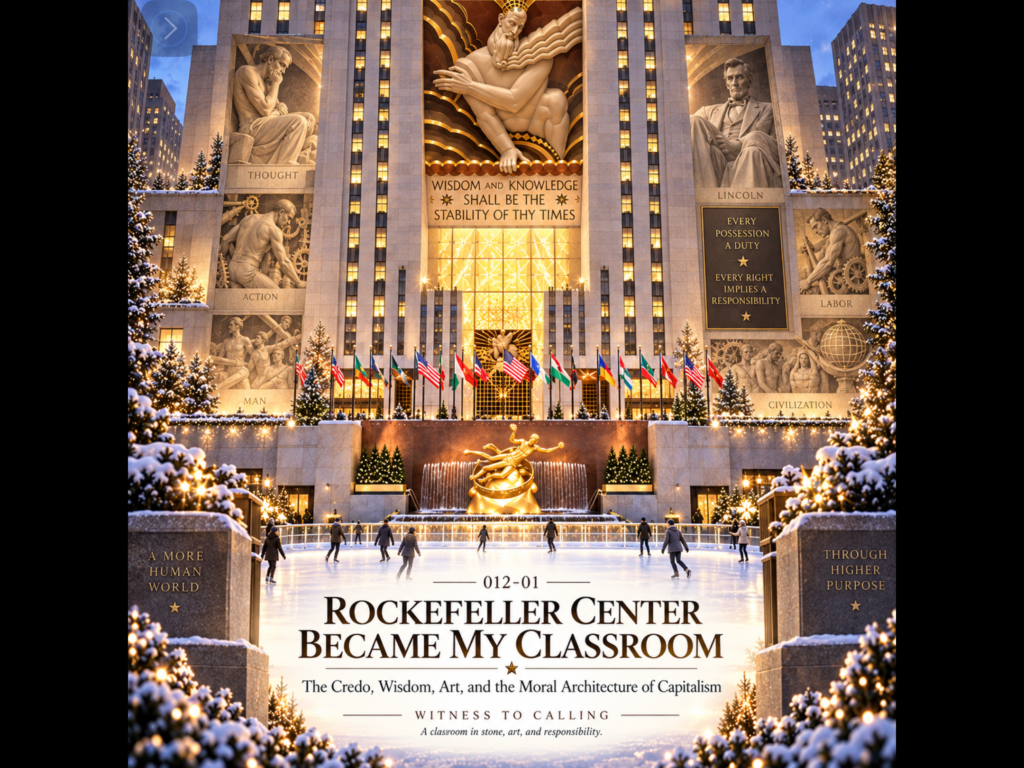
012-01 — ROCKEFELLER CENTER BECAME MY CLASSROOM
The Credo, Wisdom, Art, and the Moral Architecture of Capitalism
There was a period in my life when I was searching intensely for spiritual understanding. I was reading Scripture, philosophy, and the writings of those who had tried to understand the relationship between Man, God, society, suffering, truth, and the purpose of human existence. I was trying to understand what the Holy Spirit was asking of me and what kind of life I was supposed to live. During that period, I began to believe that poverty itself might represent a form of spiritual virtue. Simplicity, sacrifice, humility, and freedom from material possessions seemed to represent a way of living closer to God. I began to question whether the pursuit of wealth, possessions, business, and material success could separate a person from the spiritual life.
Yet during those same years, I found myself repeatedly drawn to Rockefeller Center. I did not completely understand why. I had visited Rockefeller Center before, as millions of people had, but now I began experiencing it differently. I stopped moving through it simply as another place in New York City. I began slowing down. I began looking upward. I began reading the words carved into the buildings and studying the figures placed above entrances and upon walls. I started looking at the sculptures, murals, symbols, and inscriptions not merely as decoration but as expressions of ideas. The Center gradually became a place where I would walk, stop, think, and return again.
There was something unusual about the experience because Rockefeller Center represented almost everything I had begun questioning. It had been created by extraordinary wealth. It represented private capital, business, commerce, real estate, communications, technology, construction, labor, and corporate America. Yet when I actually looked at the messages placed throughout the Center, they did not seem to be telling me that money was the purpose of life. They were speaking about Man, work, knowledge, wisdom, responsibility, machinery, civilization, thought, action, service, and the moral consequences of human power. The more closely I looked, the more I began to wonder whether I had misunderstood something important about wealth itself.
One of the things that affected me most was the Credo of John D. Rockefeller Jr. I would read those principles and think about them. Here I was standing within one of the most visible monuments to American capitalism, yet the words before me were not telling me that a person should accumulate as much as possible. They were not glorifying wealth or power. They were saying that every right carries a responsibility, every opportunity an obligation, and every possession a duty. They spoke about the dignity of labor, the importance of truth and justice, the value of character, the obligation of service, the meaning of sacrifice, and ultimately God and love.
The idea that every possession creates a duty stayed with me. It began challenging the way I had been thinking about poverty and wealth. I had been asking whether the person who possessed little might somehow be more spiritually pure than the person who possessed much. Rockefeller Center caused another question to enter my mind. What if the real issue was not how much a person possessed, but what the person did with what had been placed in his hands? What if possession itself created responsibility? What if wealth was not simply something to be enjoyed, protected, or accumulated, but something that created an obligation to act?
That thought gradually changed the meaning of capital for me. I began to see capital not simply as money. Capital was capability. Capital could become a school. It could become a laboratory. It could become a hospital. It could become a business that employed people. It could preserve land. It could support medical research. It could restore an historic place. It could finance art. It could educate a young person. It could allow an entrepreneur to take an idea that existed only in his mind and bring it into physical reality. Capital could be accumulated selfishly, but it could also be directed toward creation.
I began to understand that the beauty of capitalism was not simply that it could produce wealth. The beauty appeared when wealth became productive capability and when that capability was used to create something that improved human life. That realization did not come to me through an economics textbook. It came gradually as I walked through Rockefeller Center and looked at what had been placed there.
Prometheus became part of that understanding. I would look toward the lower plaza and see the golden figure associated with fire, knowledge, and the human ability to transform the world. The more I thought about Prometheus, the more the image seemed to represent the story of civilization itself. Fire gave Man power. With it he could warm himself, cook food, forge tools, and begin building a more complex civilization. But the same fire that warmed could also burn. The same knowledge that created could also destroy. Power itself did not determine whether the result would be good or evil. The moral question came afterward.
Then I would look upward toward the great figure of Wisdom and think about the words associated with it: wisdom and knowledge shall be the stability of our times. Those words began to take on greater meaning for me because I started recognizing that knowledge and wisdom were not the same thing. Knowledge tells Man how to do something. Wisdom asks whether it should be done. Knowledge gives Man capability. Wisdom gives that capability direction. Knowledge can build the machine. Wisdom must decide what the machine will serve. Knowledge can accumulate capital. Wisdom must decide what that capital should accomplish.
The more I reflected upon those words, the more I began to understand that human progress could become dangerous when knowledge advanced faster than wisdom. Man could become more capable without becoming more responsible. He could possess more power without developing the moral character necessary to govern that power. Rockefeller Center seemed to be warning me that civilization could not survive by knowledge alone.
That warning became even clearer to me when I encountered the idea of Man becoming both master and servant of the machine. That phrase stayed in my consciousness because it described something far larger than industrial machinery. Man creates the machine because he wants the machine to serve him. The machine increases his strength, increases his productivity, accelerates transportation, expands communication, and allows him to accomplish things that were previously impossible. But gradually the machine begins reorganizing the life of the person who created it. The factory controls his time. Transportation changes where he lives. Communications technology influences what he sees and hears. Computers change the way he works. Eventually the tools created to serve Man can begin determining the conditions under which Man lives.
I began to see that the same danger existed with capital, government, corporations, and almost every other powerful institution created by human beings. Capital could serve Man, or Man could become the servant of capital. Government could serve the citizen, or the citizen could become the servant of government. The corporation could be created to organize productive activity, yet eventually human beings could begin existing primarily for the requirements of the corporation. The question always returned to the same relationship: who is the master, and who is the servant?
As I continued walking through Rockefeller Center, the images of Thought and Action began speaking to another part of my personality. Everything that exists in the physical world begins first as an idea. A person imagines something that does not yet exist. At first it exists only in thought. Then someone decides to act. Plans are made. Drawings are created. Capital is assembled. Materials are purchased. Workers are organized. Something that existed only in the mind begins entering the physical world.
Rockefeller Center itself was an enormous example of that process. Before it became stone, steel, offices, broadcasting facilities, shops, plazas, art, and public space, it had first existed as thought. Someone had imagined what might be created. Then thought became planning, planning became capital, capital became work, and work became a physical place that would continue influencing generations of people.
That process spoke directly to my own entrepreneurial spirit. Throughout my life, I have often looked at something and believed that it could be made better. I might see a system that did not work properly and begin imagining another way. I might see several technologies and begin thinking about how they could be integrated. I might see a problem and begin imagining a solution. Entrepreneurship, I gradually came to understand, was not merely the pursuit of profit. It was the movement from thought into action. It was the attempt to take an idea and make it real.
That realization made Rockefeller Center even more important to me because I began to see capitalism not merely as an economic system but as one of the mechanisms through which human thought could enter physical reality. Capital could organize resources around an idea. Enterprise could convert imagination into something useful. Work could convert possibility into reality. When governed by character and responsibility, capitalism could become a vehicle of creation.
My visits to Rockefeller Center were also connected to another routine that became deeply important to me. I would cross Fifth Avenue and enter St. Patrick’s Cathedral. I moved regularly between these two places, and that physical movement eventually became part of my spiritual understanding. On one side of Fifth Avenue stood Rockefeller Center, representing capital, business, technology, labor, architecture, communications, art, and human achievement. Across the street stood St. Patrick’s Cathedral, representing Christ, Mary, sacrifice, compassion, faith, mortality, love, and eternity.
Inside St. Patrick’s, I was especially drawn to the image of Christ in the arms of Mary behind the altar. I would look at that image and think about suffering, love, sacrifice, and the fragility of human life. Then I would return outside and see Rockefeller Center again, with all of its stone, steel, art, business, machinery, and human accomplishment.
For a time, these two worlds seemed almost opposite to me. One seemed to represent the spiritual world and the other the material world. Yet as I continued moving between them, I began to see another possibility. Perhaps they did not have to oppose one another. Perhaps the material world could become an instrument of spiritual responsibility. Perhaps capital could serve compassion. Perhaps business could create dignity. Perhaps technology could improve human life. Perhaps wealth could become stewardship rather than simply possession.
That was a major transformation in my thinking. I began to understand that the danger was not wealth itself. The danger was allowing wealth to become the master. The danger was not technology itself. The danger was allowing technology to become the master. The danger was not power itself. The danger was losing the wisdom necessary to govern power.
The Credo began making more sense to me within that larger experience. Every right created a responsibility. Every opportunity created an obligation. Every possession created a duty. Those were not merely statements about capitalism. They were statements about how a human being should live when capability had been placed within his hands.
Years later, when I learned that the principles of the Credo had first been publicly expressed during the period when the United States was preparing for war and the USO was being created to support American service members, those words acquired another meaning for me. Responsibility, duty, character, service, and sacrifice were not merely economic ideas. They were principles of citizenship. They connected the world of Rockefeller Center with another place that had become deeply important in my life: West Point.
West Point had helped restore my faith in the honorable possibilities of military power. Rockefeller Center had helped restore my understanding of the honorable possibilities of economic power. At West Point, strength had to remain under Duty, Honor, and Country. At Rockefeller Center, possession had to remain under responsibility, character, service, and wisdom. Across Fifth Avenue, St. Patrick’s Cathedral reminded me that both forms of power remained subordinate to something still greater: truth, compassion, sacrifice, and love.
These understandings did not come to me all at once. They developed over years. I would return to Rockefeller Center, look again at the artwork, read the words again, and sometimes notice something I had missed before. The Center became part of my spiritual education because it forced me to keep asking questions. What is wealth for? What is knowledge for? What is power for? What is technology for? What does possession require from the person who possesses it?
The more I studied the Rockefeller family, the more I saw that these questions had also occupied their lives in different ways. John D. Rockefeller Sr. created enormous industrial wealth and power, and that history included controversies that must be understood honestly. Yet the same fortune eventually supported universities, medical research, public health, education, and institutions that continued serving people long after the original capital had been accumulated. John D. Rockefeller Jr. inherited extraordinary wealth and increasingly expressed the idea that possession created responsibility. Abby Aldrich Rockefeller demonstrated the importance of beauty and culture. Nelson Rockefeller carried the family’s tradition of capability into government, public institutions, higher education, international affairs, and the arts.
I began to see the Rockefeller story not simply as a story about wealth but as a story about what successive generations attempted to do with capability. The question was not whether they were perfect. They were human beings, and their history included failures, controversies, contradictions, and mistakes. The more meaningful question for me was whether people could learn, whether power could be redirected, whether wealth could become stewardship, and whether capital could be transformed into something that continued benefiting people after the person who originally possessed it was gone.
That was the lesson Rockefeller Center kept giving me.
The artwork and the Credo gradually became one conversation in my mind. Prometheus represented the acquisition of power. Wisdom reminded me that power required judgment. Thought represented the idea. Action represented bringing the idea into reality. Machinery represented the multiplication of human capability. The warning about master and servant reminded me that capability could eventually begin controlling the person who created it. The Credo supplied the moral principles needed to govern all of these forces.
I began to understand that capitalism at its best required more than markets and money. It required character. It required trust. It required responsibility. It required people who understood that possession created duty and that capability created obligation. It required entrepreneurs who wanted to build something useful, employers who understood the dignity of labor, citizens who understood that rights carried responsibilities, and leaders who recognized that power was never an end in itself.
This understanding eventually became part of my own entrepreneurial personality. I came to believe in the goodness of principle. I believed that business could solve problems. I believed technology could improve people’s lives. I believed enterprise could create useful work. I believed an entrepreneur could look at what existed and imagine something better. And I increasingly believed that the purpose of capability was not simply to possess more capability, but to use it in ways that helped other human beings develop their own capabilities.
Today, as I look at Artificial Intelligence and the extraordinary technological transformation now occurring, I find myself returning intellectually to the same place. Humanity has acquired another form of Promethean fire. We are creating systems capable of performing work, analyzing information, operating machines, influencing decisions, directing capital, and participating in areas that once belonged almost entirely to the human mind.
Once again, knowledge has given us power.
And once again, the question is whether wisdom will be strong enough to govern it.
The old warning remains alive. Will Man remain master of the machine, or will Man eventually become its servant? Will Artificial Intelligence expand the freedom and capability of the Individual Personality, or will human beings increasingly reorganize their lives around systems they no longer understand or control? Will capital use AI to develop human beings, or will human beings become increasingly reduced to variables inside economic and technological systems?
These are modern questions, but I first encountered their foundation years ago while walking through Rockefeller Center.
That is why the Center became so much more than a place to me. It became a classroom in stone, art, architecture, business, faith, and responsibility. It helped me move beyond the idea that the spiritual life required rejection of the productive world. It taught me that the more important challenge was to place the productive world under moral direction.
Rockefeller Center did not teach me to worship capitalism.
It taught me to understand its possibilities.
It taught me that wealth could become stewardship, that capital could become human capability, that knowledge required wisdom, that enterprise could become service, and that every form of power created a responsibility in the person who possessed it.
That was why I kept returning.
And that is why, after all these years, Rockefeller Center still remains one of the great classrooms of my life.
Witness to Calling — 012-01