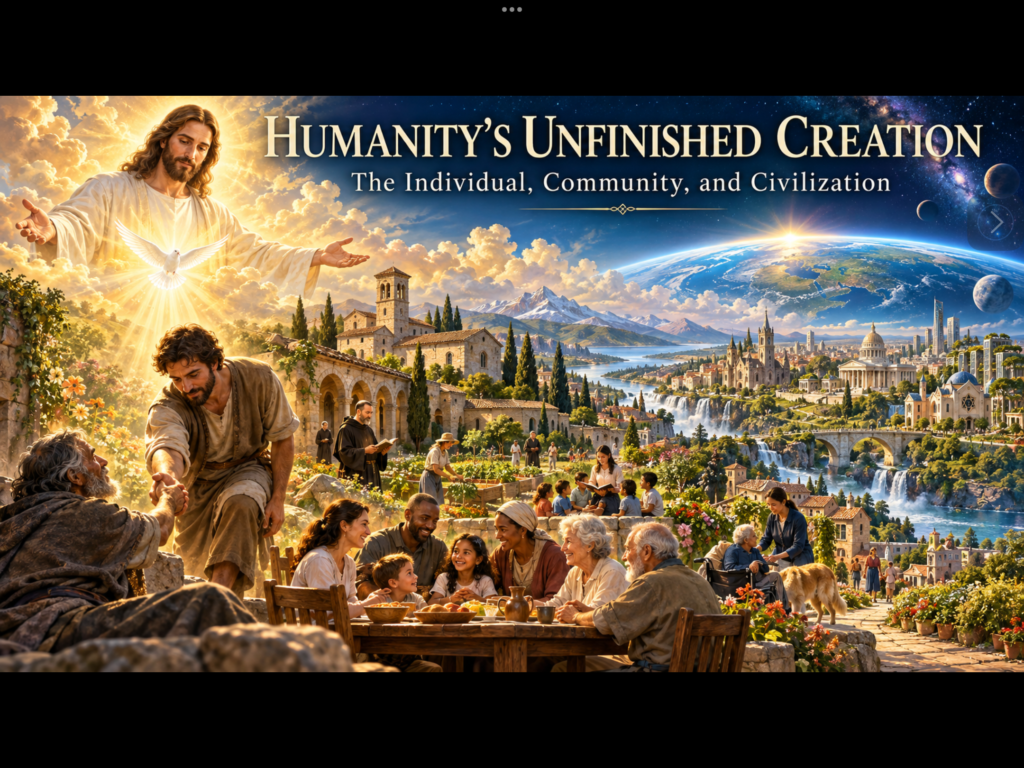
HUMANITY’S UNFINISHED CREATION
In the Christian interpretation developed here, the Divine consciousness is understood as the source of a movement that becomes visible through human lives: the individual awakens to compassion, compassion shapes the family, families and their members strengthen community, and communities influence the character of civilization. Troward supplies a philosophy of conscious individuality and reciprocity; Christ supplies the moral direction of love and service. Their connection in this narrative is a theological synthesis, expressed through the work of people who seek to make goodness visible in the world.
Our thesis is that, within this Christian understanding, the Spirit works through the developing individual by awakening compassion and calling forth a free, responsible response. That response enters family and community, influences the institutions of civilization, and enlarges humanity’s care for creation. The witness to this thesis is sought in the fruits of life: the love, truth, mercy, useful work, and peacemaking through which Christ’s teachings receive practical expression.
Chapter Seven of Thomas Troward’s The Creative Process in the Individual is titled “Race Thought and New Thought.” In this chapter, “race” principally refers to humanity collectively and its inherited patterns of thinking. The following narrative develops his spiritual philosophy into an interpretation of civilization; Troward himself describes his larger argument as speculative reasoning.
When we look upon the development of humanity on Earth, we see more than the succession of kingdoms, nations, inventions, and wars. We see human beings gradually discovering what they can do, while continuing to struggle with what they ought to do. Humanity learns to cultivate the soil, build cities, establish laws, organize commerce, and transmit knowledge. Yet beneath these visible achievements lies a more intimate development: the changing understanding of the human person. What am I? What is my relationship to other people? Am I merely a temporary instrument of the society into which I was born, or do I possess a creative responsibility that society must help me bring into expression?
Troward’s seventh chapter gives us a starting point for this reflection. He distinguishes our common human inheritance from a consciously developed spiritual individuality. The shared inheritance provides a foundation, but further development requires personal initiative and choice. He describes this awakening as a relationship with Divine Spirit expressed through meditation and action, bringing increasing freedom and usefulness. His argument also includes a speculative claim about overcoming bodily mortality, which should be understood as his metaphysical belief rather than an established scientific conclusion.
Applied to civilization, this distinction suggests that humanity’s accumulated experience can serve two purposes. It can become the foundation upon which new understanding grows, or it can become a boundary beyond which people are forbidden to think. The wisdom of earlier generations can nourish us. Their fears can also imprison us. Every child enters a world already furnished with language, customs, loyalties, institutions, and explanations. Before that child can examine these things, they have already begun shaping the child’s understanding of what is possible.
The developing person therefore inherits both gifts and unfinished work. We receive the knowledge that makes civilized life possible, but we also receive assumptions about authority, poverty, conflict, belonging, and human worth. Some assumptions contain hard-earned wisdom. Others survive because people have repeated them for so long that repetition has acquired the appearance of truth. Civilization advances when people learn to distinguish between the two.
Consider an imagined child growing up within an ancient city. The walls provide protection. The fields provide food. The temple gives meaning to the seasons, and the laws establish expectations among neighbors. All these arrangements help sustain life. Yet the same child may be taught that a person’s place is fixed forever by birth, that the stranger is naturally an enemy, or that the ruler’s power cannot be questioned. The civilization has developed considerable outward organization while leaving important inward possibilities unexplored.
Now imagine that someone within this society asks a different question. Could justice reach beyond the privileged? Could knowledge be taught more widely? Could the stranger become a trading partner? Could authority answer to a moral standard greater than its own power? Such questions introduce new possibilities into an inherited world. Their consequences depend upon courage, practical effort, cooperation, and the willingness of institutions to change.
This is one way to understand the creative individual’s relationship to humanity. The individual receives the civilization, examines it, and contributes something that was not fully present before. A teacher develops a better way to educate. A farmer improves the cultivation of the land. A physician investigates suffering that others have accepted as unavoidable. A parent interrupts a family’s habit of cruelty. A leader recognizes that lasting security requires more than the defeat of an opponent. Each begins within existing conditions, yet each brings judgment and responsibility to those conditions.
The significance of such development is easily overlooked because civilization often measures itself through what can be counted. It counts territory, wealth, production, population, and military strength. These measurements matter, but they cannot fully reveal the quality of human life. A society may possess magnificent buildings while diminishing the people who built them. It may accumulate knowledge while discouraging independent judgment. It may increase its capacity to command while weakening its capacity to care.
The deeper question is whether the civilization helps people become more capable of truth, responsibility, creativity, and fellowship. Does its education awaken judgment? Does its economy make room for useful work and initiative? Do its institutions protect the dignity of the person? Does its leadership welcome correction? These questions turn our attention toward the human purposes that outward development is meant to serve.
From this perspective, human history should not be imagined as an automatic ascent. Greater technical ability does not guarantee greater moral understanding. The same intelligence that discovers how to relieve suffering can discover how to inflict it more efficiently. Organization can sustain a community or enable oppression. Persuasive language can illuminate a difficult truth or conceal it. Humanity’s powers expand, but their direction remains a matter of choice.
War presents a particularly painful example of this problem. A civilization may devote extraordinary intelligence to preparing for destruction while giving less attention to the conditions that might make cooperation possible. Fear, ambition, insecurity, and grievance can become inherited habits of public thought. People begin treating recurring conflict as proof that conflict must always govern human affairs. A creative response would examine those assumptions while remaining attentive to actual threats, responsibilities, and the need to protect life.
Peace, in this interpretation, becomes work that must be developed. It requires arrangements through which people can pursue a future without depending upon the humiliation or destruction of others. It requires trustworthy institutions, practical economic opportunities, restraint, and the ability to recognize another people’s humanity. These conditions cannot be produced by wishing alone. They must take form through decisions, relationships, agreements, and sustained effort.
A Christian reading adds a further question: what kind of inward transformation equips the person to undertake this work? Here we move from explaining Troward into theological interpretation. Christ’s example provides a measure by which creative power can be examined. Does our initiative serve love? Does it respect truth? Does it protect the vulnerable? Can we acknowledge our own wrongdoing while asking others to change?
Within that Christian understanding, spiritual awakening carries responsibility. A person who believes that the Holy Spirit is guiding his life must continue examining the fruits of his judgment and conduct. Conviction needs humility. Vision needs discernment. Compassion needs practical expression. An inward sense of calling becomes meaningful in the lives of others through the work it produces.
Civilization, then, is shaped at the meeting point of inward life and outward action. The family teaches a child how to regard another person. The school develops habits of inquiry. The workplace establishes expectations about fairness and responsibility. Religious communities cultivate—or fail to cultivate—conscience. Governments translate judgments about human worth into public arrangements. Through these ordinary settings, humanity repeatedly teaches itself what being human means.
The creative individual has an important place within this process, but so does the community. No person develops entirely alone. We need affection, language, instruction, correction, and opportunities to contribute. A mature civilization creates conditions in which individuality can grow while remaining responsible to others. It makes room for difference without surrendering the shared obligations that sustain life together.
This also provides a useful way to think about humanity’s relationship with the Earth. Our creative activity depends upon a living world that we did not manufacture. Soil, water, climate, plants, and animals sustain the conditions of our existence. Responsible development therefore includes care for the foundations upon which civilization rests. The ability to transform our surroundings brings an obligation to consider what those transformations leave for others.
Troward’s chapter can thus inspire a searching interpretation of humanity’s future: our inherited condition is a beginning from which responsible development may proceed. The past supplies experience, but it does not relieve us of judgment. The existence of injustice does not establish its necessity. The repetition of war does not make every effort toward peace futile. The failure of earlier institutions does not remove our responsibility to build better ones.
For me, the central meaning of this reflection is that humanity’s unfinished creation calls for participation. We enter a world already shaped by countless lives, and through our own lives we help shape what follows. Our contribution may be a family strengthened, a useful enterprise established, a person protected, an understanding clarified, or a conflict patiently resolved. Its value lies in the life it makes possible.
Civilization develops most deeply when its expanding powers are joined to an expanding sense of responsibility—and when the individual recognizes that the freedom to create carries a calling to serve.
The history of civilization therefore brings us back to the inward life of the person. Before compassion can influence institutions, it must become a lived responsibility within individuals. We now turn toward that awakening and the reciprocal relationship through which, in this Christian interpretation, the person receives Divine life and responds through service.
THE AWAKENING OF COMPASSION
The Holy Spirit, the Reciprocal Relationship, and Humanity’s Place in Universal Life
There is a further development within the individual that gives the whole narrative its spiritual direction: the awakening of compassion. A person begins to recognize that the lives of others have a claim upon his conscience. Their suffering matters even when they belong to another nation, religion, or generation. Their hopes become part of his understanding of the future. He discovers that the development of his own life carries a responsibility toward the wider human family.
In my Christian reading of Troward, this awakening can be understood as an expression of born-again awareness: the individual becoming conscious of the Holy Spirit’s presence and allowing that relationship to transform how he sees and treats others. In John’s Gospel, Jesus speaks of birth through the Spirit. Compassion, within this interpretation, is a fruit of that transforming relationship—a growing capacity to respond to life through love, truth, and mercy.
Troward gives us a philosophical language for considering this relationship. Across his discussion of individuality and reciprocity, he understands the individual’s creative initiative as derived from the Originating Spirit and requiring harmony with its nature. The individual is to develop through a conscious relationship with a Divine source characterized by life, love, and beauty. The connection we are making between this philosophy, Christian rebirth, and compassion for all humanity is our theological interpretation of his framework.
What I call the benevolent Personality of the total universe is, in this understanding, the Divine Spirit from which creation receives its existence and meaning. I am speaking of God as the living source whose goodness supplies the moral direction for human creativity. The awakened individual begins to understand himself as a person within this greater life, capable of receiving, responding, and contributing.
The reciprocal relationship becomes a continuing movement of spiritual attention and practical response. The individual opens himself through prayer, contemplation, honest self-examination, and the willingness to be corrected. What he receives must then become visible through his choices: patience toward a difficult person, protection for someone vulnerable, fairness in his work, care for his family, and concern for people he may never meet.
This relationship also helps explain how inward awakening can have consequences beyond one life. A person’s response changes the quality of an encounter; repeated encounters shape relationships; relationships influence the habits and arrangements of a community. Through these human choices, spiritual conviction can acquire a durable place in the shared world.
Within this faith, reciprocity calls for participation. We receive life and answer by helping life flourish. We receive understanding and answer through responsible judgment. We receive love and answer by extending compassion. The relationship deepens as inward conviction becomes outward conduct, and the consequences of our conduct return us to reflection, learning, and prayer.
This awareness can help the individual take a conscious place in the development of civilization. He begins asking how his gifts might serve the future entrusted to humanity. His place may be within a household, a workshop, a school, a religious community, an enterprise, or public service. Wherever he works, compassion widens the circle of people whose lives he considers when making decisions.
A civilization shaped by such individuals would increasingly examine its achievements through their human consequences. Education would cultivate judgment alongside competence. Economic activity would create useful goods and opportunities while respecting the people whose labor makes them possible. Leadership would protect life and accept accountability. Scientific discovery would be accompanied by reflection upon how its powers should be used.
The same awakening extends our responsibility toward the Earth. Compassion for humanity includes concern for the conditions upon which humanity depends: water, soil, air, habitats, and the living relationships that sustain our common home. The Earth enters this narrative as a creation entrusted to our care, with a value that exceeds what any one generation can extract from it.
Paul’s description in Romans Eight connects humanity’s spiritual hope with the wider creation. In our interpretation, this encourages a vision in which human renewal carries responsibility toward the living world. Our growing awareness of the Spirit should enlarge our attentiveness to creation and strengthen our resolve to preserve the conditions of life.
The universality of this concern also invites us to look beyond Earth. If life exists on other planets, and if there are beings beyond our present knowledge, the compassion we profess should be broad enough to include them. This is a theological extension toward possible life elsewhere, rather than a claim that such beings have been discovered. A truly universal moral concern should remain open to life we have yet to encounter.
Humanity’s exploration of the heavens would then carry an obligation of humility. We would seek understanding with care for whatever environments or forms of life we might encounter. The principles we learn here—restraint, responsible inquiry, respect for life, and the willingness to acknowledge the limits of our knowledge—would accompany us wherever our capabilities allow us to travel.
The harmony envisioned here is a spiritual and moral vocation. It does not make suffering disappear or guarantee that every human desire will be fulfilled. It asks the individual to continue choosing compassion within a world where loss, conflict, uncertainty, and difficult decisions remain real. Benevolence becomes something we are called to express through faithful action.
This gives a deeper purpose to the family, the Benedictine community, and the constitutional republic already considered. The family can nurture the capacity to love. The community can give that love disciplined expression through work and mutual care. The republic can protect the freedom of conscience and association within which such development takes place. The individual must bring these gifts into conscious use.
For me, the awakening of compassion therefore marks an important movement from receiving life toward accepting responsibility within it. The Holy Spirit gives this movement its Christian meaning. Troward’s principle of reciprocity offers a philosophical way to reflect upon the relationship between the individual and the Divine source. Compassion gives that relationship an outward direction toward humanity, the Earth, and all life that creation may hold.
As the individual awakens to compassion, he can recognize his freedom as a calling to participate in the development of humankind. In conscious relationship with the Holy Spirit, he seeks to bring his thought, work, and conduct into harmony with Divine benevolence—serving humanity, caring for Earth, and extending his reverence toward every form of life the universe may contain.
This inward awakening reaches outward through relationships. The individual returns to the family table, the workplace, and the community with a deeper responsibility for what happens there. Divine consciousness, as understood in this narrative, becomes visible through the person’s growing capacity to love, listen, create, and care. The next movement considers the settings in which that responsibility can become a lasting common life.
THE INDIVIDUAL, THE FAMILY, THE COMMUNITY, AND THE REPUBLIC
Judaic-Christian Values, Benedictine Wisdom, and the Future of Humankind
When we carry this reflection into the civilizations of today, we encounter a question that belongs to every people: how can a society strengthen its common life while allowing the individual to develop? Nations answer through different religious, philosophical, and political traditions. Within the Western tradition, the Jewish and Christian inheritance offers an especially important language of human dignity, moral obligation, covenant, conscience, and care for one’s neighbor. These traditions are distinct, with differences that deserve respect, yet their shared scriptural inheritance gives us a foundation for considering the person’s relationship to God and to the community.
Western civilization also draws upon Greek philosophy, Roman law, constitutional struggles, scientific inquiry, and Enlightenment thought. Its history is therefore a meeting of influences, sometimes harmonious and sometimes deeply conflicted. Our purpose here is to examine how its Judaic-Christian inheritance can guide the use of freedom today. The strength of an inheritance is revealed through the lives it helps people lead.
Genesis presents humanity as created in the image of God. Deuteronomy calls upon families to transmit their sacred teaching through the ordinary activities of daily life. In Matthew, Jesus joins love of God with love of neighbor, drawing upon commandments already present in Jewish scripture. Read together, these passages place human dignity and responsibility within the same moral horizon. The person has worth, and that worth calls forth obligations toward other persons.
In this interpretation, the family becomes the first community in which the individual learns how freedom and responsibility belong together. A child encounters authority before understanding government, trust before understanding contracts, and cooperation before understanding economics. At the family table, the child learns whether another person’s voice matters, whether promises are kept, whether mistakes can be admitted, and whether affection survives disagreement. Civilization begins taking shape in these small encounters.
A family faithful to these values helps each child discover gifts and develop judgment. Parents provide guidance, boundaries, protection, and an example of service. As the child matures, that guidance should increasingly equip the person to choose wisely. The goal is an adult capable of contributing from an awakened conscience. Love helps individuality grow; responsibility gives it direction.
Here our interpretation meets Troward. His account of further development depends upon the person’s conscious initiative and selection. A family can support that development by teaching its members to examine motives, seek truth, practice useful work, and reflect upon their relationship with God. Yet neither a parent nor a teacher can perform another person’s inward awakening. Each person must gradually take responsibility for what he believes and what he creates.
The Rule of Saint Benedict brings this question into the daily organization of a community. In Chapter Three, Benedict requires the abbot to hear the whole community on important matters, including younger members, before deciding. Chapter Forty-Eight orders time for labor and sacred reading. Chapter Fifty-Three calls for hospitality toward guests, with particular care for the poor. Chapter Seventy-Two emphasizes mutual honor, patience with weakness, and concern for another’s good. These provisions make spiritual commitment practical through listening, work, welcome, and care.
Applied beyond the monastery, these principles invite us to build communities in which people have a voice, useful responsibilities, opportunities for reflection, and dependable relationships. A community should know how to cultivate its resources, maintain its property, educate its members, and care for people whose strength has diminished. Its productive life should help sustain its moral purposes.
This application requires discernment. Benedict’s Rule establishes a religious community under an abbot, with demanding commitments of obedience and common life. A constitutional republic serves people of different beliefs and protects their right to dissent. Their forms of authority are different. The harmony we are exploring concerns the virtues that can sustain community: listening, restraint, stewardship, faithful work, and accountability. Those virtues can inform public life without transferring monastic authority into government.
The community also gives something back to the individual. Its care, teaching, correction, and opportunities help him continue developing. We therefore see a reciprocal human relationship alongside the spiritual one: the person contributes to common life, and common life supports the person’s further growth. For our thesis, a community’s strength includes its ability to sustain this exchange without silencing conscience.
The distinctive American development enters at this point. The United States undertook to establish a durable constitutional union while preserving liberty. The Federalist Papers defended the proposed Constitution; the Bill of Rights subsequently added explicit protections against abuses of federal power. They belong to the same founding debate, but they perform different tasks. One explains and argues for the structure of government; the other places express limits upon what government may do.
Hamilton opens Federalist No. 1 by asking whether people can establish good government through deliberate judgment and choice. In the context of our narrative, that question becomes a public counterpart to individual responsibility: can a people examine its experience and consciously build arrangements worthy of its future? This is an interpretive connection, rather than a claim that Hamilton anticipated Troward’s later philosophy.
Federalist No. 10 gives this effort a realistic account of human disagreement. Madison recognizes that differences of opinion, interests, and property can generate factions. He rejects destroying liberty as a cure. The proposed republic instead seeks to manage faction’s effects through representation and a wider variety of interests. This suggests an important principle for our reflection: community must learn to govern disagreement while preserving the freedom that makes independent judgment possible.
The moral lesson I draw is that unity cannot depend upon everyone becoming the same. A healthy common life gives different people ways to contribute, challenge, and cooperate. It asks them to respect obligations they share even when their convictions differ. Individuality requires room to breathe, and community requires arrangements through which those individuals can live together.
Federalist No. 51 supplies another safeguard. Government must be able to govern, while its own power is restrained through constitutional checks. The argument recognizes that officeholders remain fallible human beings. In this light, public accountability supports moral responsibility: a leader’s confidence in his own virtue cannot replace institutions that allow others to question, examine, and limit his conduct.
Benedictine listening and constitutional checks are therefore related by a practical concern, though they operate differently. People entrusted with authority need correction and counsel. A parent needs the humility to hear a child. A community leader needs the patience to hear a member. A public official needs to answer within the lawful structures of the republic. Responsible authority helps others develop and accepts limits upon itself.
The Bill of Rights gives concrete protection to important conditions of personal and communal development. The First Amendment addresses religious liberty, speech, press, assembly, and petition. Other amendments protect against unreasonable searches, provide due process and fair-trial safeguards, and recognize retained rights and reserved powers. These protections establish boundaries around governmental action. Their connection to spiritual development is our interpretation: they help preserve space in which people can inquire, worship, associate, and challenge authority.
Religious liberty is especially significant for the harmony we are considering. A society can be deeply influenced by Jewish and Christian moral traditions while protecting people who understand God differently or hold no religious belief. The founding record itself contains both strong support for religion’s moral role and an effort to safeguard conscience from national religious coercion.
For a Christian, this protection can be understood as consistent with the responsibility of personal faith. Government can protect the freedom to seek truth, while families and religious communities teach, witness, and serve. Faith takes root through a person’s response. The constitutional order preserves room for that response without making one religious confession the price of citizenship.
America’s original arrangements also left profound exclusions unresolved. Slavery contradicted human freedom, and political participation was restricted. Later constitutional changes abolished slavery, established citizenship and equal-protection guarantees, and prohibited denial of voting rights on account of sex. These developments show that a founding principle can become a standard by which inherited arrangements are challenged and corrected.
That history gives our Troward-inspired reflection a necessary discipline. We must examine the traditions we inherit by the dignity and development they actually permit. Reverence for a founding ideal carries an obligation to confront failures in its application. The individual who identifies an injustice may be serving the community’s deepest commitments by calling it to greater fidelity.
Our reading of this history therefore asks for both gratitude and examination. We can cherish the moral and constitutional resources that support human development while continuing to ask whom they have failed to protect. A conviction about the Spirit’s benevolent purpose should deepen our willingness to hear those people and take responsibility for correction.
The present challenge is to make freedom fruitful within families, communities, and economic life. We should ask whether people have real opportunities to learn, develop competence, undertake useful work, and provide for those who depend upon them. Personal initiative needs more than admiration. It needs education, trustworthy relationships, fair treatment, and practical access to opportunities.
A community informed by Benedictine wisdom would value the daily work that sustains it. A republic informed by constitutional liberty would protect the person’s capacity to act and associate. A family informed by Judaic-Christian values would cultivate love, honesty, duty, and care. In our interpretation of Troward, the individual receives these supports and makes a conscious contribution through the development of his own gifts.
Each part has responsibilities the others cannot wholly assume. Law can restrain abuse, but daily relationships must cultivate trust. A family can encourage judgment, but the adult must exercise it. A community can offer belonging, but it must make room for growth. An individual can create something valuable, but should remain attentive to the people and conditions that make his work possible.
This is the balance humanity needs as its technical powers expand. The person who designs a system, directs an enterprise, educates a child, or governs a nation must consider the human consequences of what he creates. Intelligence becomes more valuable when joined to discernment. Freedom becomes more fruitful when joined to service. Power becomes more trustworthy when joined to accountability.
The future of humankind will require institutions and arrangements that protect life, support cooperation, and permit continued learning. It will also require people whose inward development equips them to use those arrangements wisely. No civilization can indefinitely substitute machinery, regulation, or command for the judgment of the people who operate its institutions.
From a Christian perspective, Christ provides the conscience by which this development is examined: love of God and neighbor, truthfulness, mercy, humility, and responsibility toward the vulnerable. From the constitutional perspective, freedom and accountability protect the conditions under which conscience can act. From Benedictine community, we learn to translate conviction into a disciplined daily life. From Troward, we draw the invitation to become conscious participants in our further development.
These connections offer a contribution to humanity’s shared future. They invite Western civilization, and America within it, to demonstrate the fruits of its professed values through the treatment of persons. Other civilizations bring their own moral insights and experience to that work. Cooperation requires the ability to learn from one another while retaining freedom of conscience.
For me, the family table, the community’s work, the citizen’s rights, and the individual’s calling now belong within one continuing narrative. At the table we learn that another person matters. Through work we discover that we can contribute. Within the republic we receive protections for conscience and initiative. In our inward life we confront the question of how we will use those gifts.
The family cultivates conscience. The community gives conscience daily practice. The republic protects the freedom in which conscience can act. The developing individual turns that freedom into creative responsibility. Through their cooperation, humanity can build a future worthy of the life entrusted to it.
The family, community, and republic now return us to the individual from whom this movement began. Their lasting value depends in part upon the conscience of the people who inhabit and administer them. At the same time, those settings can educate, protect, and strengthen conscience. This continuing relationship allows us to see how personal awakening and civilizational development can support one another.
THE WORDS OF CHRIST BECOMING VISIBLE IN CIVILIZATION
Divine Consciousness Through the Individual, Community, and Humankind
The movement running through this whole narrative can now be seen as a continuous relationship. Divine life is received within the person, recognized through an awakening conscience, expressed through compassion, practiced within community, and carried into the wider arrangements of civilization. In my Christian understanding, the Holy Spirit makes this relationship inwardly meaningful, while the words and life of Christ provide its direction.
The individual remains a person with particular gifts, experiences, and responsibilities. Spiritual awakening deepens the way he uses them. He becomes more attentive to the people affected by his decisions and more willing to place his abilities in the service of life. His contribution begins wherever he can act faithfully: a promise kept, a child encouraged, a neighbor helped, a useful task completed, or an injustice patiently challenged.
Christ’s command in John Thirteen is that his disciples love one another according to the love he has shown them. Love becomes the recognizable sign of discipleship. Within this narrative, that teaching joins inward awareness to outward relationship: what the person believes about Divine goodness must become visible in how he treats another person.
The family is one of the first places where this love can acquire daily expression. A parent listens before judging. A child learns that truth can be spoken without losing belonging. A family member accepts responsibility for a mistake and seeks reconciliation. Through such encounters, spiritual conviction becomes a pattern of living that others can experience and learn.
As those patterns enter community, they require cooperation and organization. Concern for a sick neighbor becomes practical care. Concern for children becomes education. Respect for another person’s gifts becomes an opportunity to contribute. Benedictine wisdom helps us consider how listening, useful work, hospitality, and patient care can give spiritual purposes an enduring daily form.
The movement into civilization requires another enlargement of responsibility. The people affected by our choices are now often strangers, distant neighbors, and future generations. Compassion must be joined to sound judgment about institutions, resources, laws, and consequences. A generous intention needs a workable arrangement through which its purpose can endure.
The constitutional republic has a particular place within this movement. It protects important conditions in which conscience, inquiry, association, and responsible initiative can develop. Its checks upon power also provide ways to confront the failures that accompany human freedom. In our synthesis, these protections allow individuals and communities to pursue moral purposes while remaining answerable for their conduct.
Here the teaching of Christ about light becomes especially meaningful. In Matthew Five, he calls his disciples to let their light become visible through good works that direct attention toward the Father. The light moves into the world through actions other people can recognize. It enters a household, a community, and the shared life of a people through what those disciples actually do.
This gives us a practical meaning of Divine consciousness moving through the individual. We recognize its hoped-for expression when love becomes care, truth becomes honest dealing, mercy becomes help for someone vulnerable, and peacemaking becomes the patient work of reconciliation. The consciousness we profess is examined through the life we bring into being around us.
Matthew Twenty-Five adds a searching measure. Christ identifies himself with those receiving food, drink, welcome, clothing, and care. Within our interpretation, a civilization’s spiritual claims must therefore be examined alongside its treatment of people in need. Buildings, wealth, and power cannot by themselves demonstrate faithfulness to this teaching.
Such examination begins with the individual and reaches into institutions. The person asks whom his work serves. The family asks how it cares for its members. The community asks who has been overlooked. The nation asks whether its arrangements protect dignity and provide opportunities for useful participation. Each becomes responsible for the lives within its reach.
Christ’s prayer in John Seventeen is for the unity of those who believe in him, grounded in relationship with the Father and the Son. Our wider civilizational application draws from that prayer an aspiration toward fellowship: people learning to cooperate without surrendering conscience or denying one another’s individuality. This application extends the reflection beyond the passage’s immediate focus on believers.
Troward’s contribution helps us retain the importance of the person within that fellowship. Each individual must consciously develop and exercise his own gifts. Community can nourish that development, and institutions can protect its conditions, while each person must make the choices through which freedom becomes responsible creation.
The words of the Lord’s Prayer give this movement its Christian aspiration: “Thy kingdom come, Thy will be done in earth, as it is in heaven.” In our interpretation, the prayer calls forth a life in which Divine goodness is increasingly expressed through human conduct. The individual responds with compassion, and compassion seeks an enduring form in family, community, and civilization.
This participation remains a continuing calling. We grow through correction, forgiveness, learning, and renewed effort. No nation or institution can assume that its power proves Divine approval. The measure remains the goodness it expresses, the dignity it protects, and the life it enables others to develop.
The widening circle finally includes the Earth and, as a theological possibility, any life humanity may encounter beyond it. Reverence for creation encourages humility about what we know and responsibility toward what we affect. The care we practice close to home prepares us for the care that greater knowledge and power will require.
For me, the harmony of these narratives lies here: the inward awakening and the outward work belong to the same calling. I receive life within a relationship that asks me to answer through love. My answer enters the lives of others, joins their contributions, and helps shape the civilization we leave to those who follow.
Divine consciousness is received within the individual and made visible through compassion. Compassion becomes faithful relationship, faithful relationship strengthens community, and responsible community helps civilization develop. As people live the love, mercy, service, and peacemaking taught by Christ, his words take practical expression within the human world—and humanity accepts a deeper responsibility for the life entrusted to it.
GIVING WITNESS TO OUR THESIS
The Spirit Received Within and Expressed Through Life
When I bring all these thoughts together, I understand witness as the relationship between what I profess and what my life helps bring into expression. I receive the teaching of Christ, reflect upon Troward’s philosophy, consider the wisdom of community, and examine the history of the republic. These encounters invite a response from me. The meaning I draw from them must enter the work I undertake and the way I regard other people.
My belief that the Spirit is working through human life asks me to become more attentive to its fruits. Where a person learns to care beyond his immediate interests, I see grounds for spiritual reflection. Where a family nurtures both belonging and responsible individuality, I see a human setting in which love can be practiced. Where a community listens, works, welcomes, and cares, I see conviction acquiring a common form. Where institutions protect dignity and permit correction, I see conditions in which this work can continue.
These are the experiences and practices through which I seek to give witness to our thesis. Their spiritual meaning belongs to this faith interpretation. They also have consequences that others can examine: whether someone received help, whether a promise was kept, whether a voice was heard, whether a person’s freedom was protected, and whether a harmful practice was changed.
This makes the witness accountable. If I speak of compassion, I must ask whom I have considered. If I speak of truth, I must remain willing to learn. If I speak of Divine guidance, I must examine my judgment with humility. If I speak of humanity’s future, I must consider the people who will inherit the consequences of our decisions.
The same responsibility reaches into civilization. A nation can honor its spiritual inheritance by making its professed commitments more dependable in the lives of its people. Communities can strengthen those commitments through daily practice. Individuals can contribute through the gifts, relationships, and work entrusted to them. Each participates within a larger life that also calls each to continued development.
For me, the Spirit’s movement through the individual is therefore a calling that grows outward while continually returning inward for reflection and renewal. Compassion opens my attention to another person. Service brings that attention into action. The encounter teaches me something further about patience, truth, and love. I return to prayer and contemplation, and then return again to the world with work to do.
This is how the narrative becomes a witness to calling. The individual’s spiritual awakening finds a place in the family. The family’s practices contribute to community. Community influences civilization. Civilization, through the opportunities and protections it provides, helps another individual develop. Across generations, these relationships can carry forward a growing responsibility for humanity and the Earth.
Christ’s words remain the measure and direction of this hope. We seek their fulfillment in the love we practice, the mercy we extend, the reconciliation we undertake, and the care we make possible. In this sense, the future begins wherever an individual freely receives the call to love and gives it an enduring expression in life.
Our witness is the continuing passage from inward awareness to outward responsibility: the Spirit received within the person, compassion expressed toward others, community strengthened through faithful work, and civilization called toward a fuller respect for life. This is the hope that holds the chapter together—the developing individual becoming a conscious participant in humanity’s future through a life increasingly responsive to the benevolence of God.