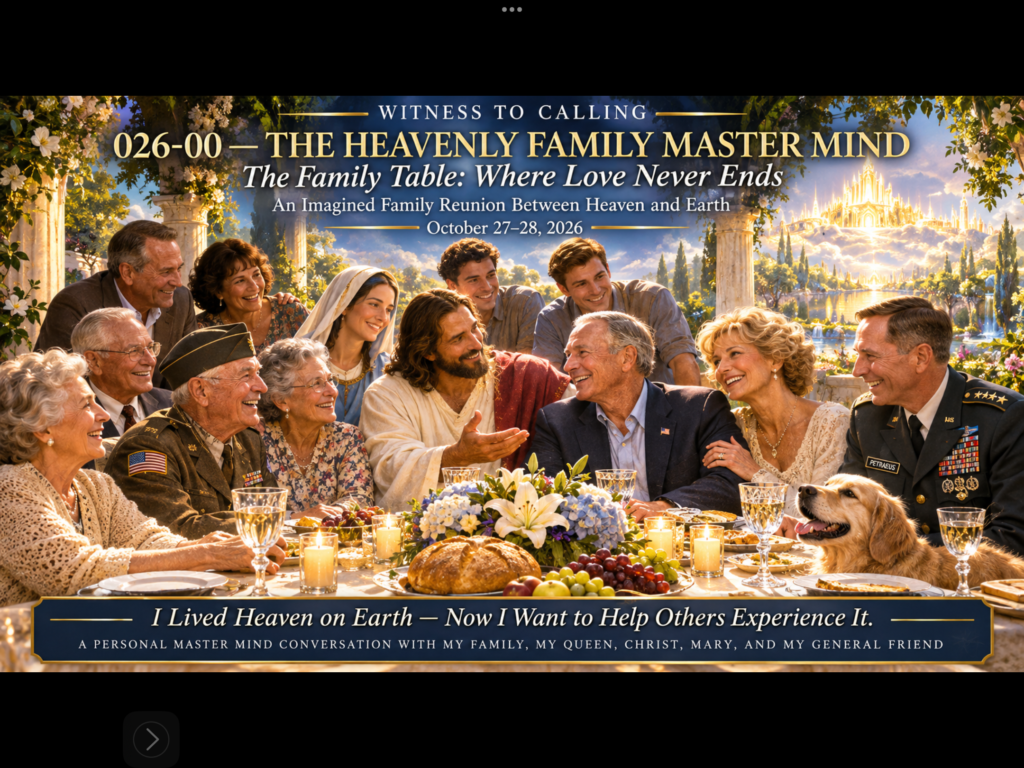
026-00 THE HEAVENLY FAMILY MASTER MIND — THE FAMILY TABLE: WHERE LOVE NEVER ENDS
Subtitle: An Imagined Conversation Between Heaven and Earth — A Family Reunion with Christ, the Blessed Mother, My Queen Margie, Pop, and Those I Love.
Date: October 27–28, 2026
Central Theme: I Lived Heaven on Earth. Now I Want to Help Others Experience It—While Learning to Enjoy My Own Life Again.
WITNESS TO CALLING
THE HEAVENLY FAMILY MASTER MIND
THE FAMILY TABLE — WHERE LOVE NEVER ENDS
A Visit Between Heaven and Earth — October 27–28, 2026
An imagined spiritual conversation by Edward F. Moore
Participants: Ed Moore; his Queen, Margie; Pop; Mom; Grandma and Grandpa; Uncle Frank; Aunt Amy; nephews Kenny and Chris; Lady, the family dog; Jesus Christ; the Blessed Mother Mary; and General David Petraeus, Ed’s General Friend.
Author’s note: This is a work of spiritual imagination inspired by my Christian faith, family memories, and personal experiences. The conversations are fictional, not claims of actual communication with those who have passed, or actual statements by Christ, Mary, or General Petraeus. My General Friend, who remains in the earthly world, participates as an imagined companion in this literary gathering.
CHAPTER ONE — THE INVITATION TO THE FAMILY TABLE
It was October 27, 2026.
Another beautiful autumn morning.
I had finished breakfast, listened to some of my favorite spiritual music, and spent time reflecting upon the extraordinary life I had lived.
This particular week was especially meaningful to me.
I called it our Holy Week.
It had begun on October 22, my daughter Emily’s birthday, and continued toward October 28, the anniversary of the morning my Queen, Margie, passed from this earthly world in my arms.
Ten years.
Ten years since the world I had known changed forever.
And yet, as I sat quietly, I realized that my love for Margie had never diminished.
Neither had my love for my father, my mother, my grandparents, my Uncle Frank, my Aunt Amy, or my nephews Kenny and Chris.
Even Lady, our beloved dog, remained part of the family memories that had shaped my consciousness.
I began thinking about something I used to do when caring for my loved ones.
Whenever I needed to leave Margie for a few minutes to go shopping or attend to something necessary, I would imagine that she was not alone.
In my mind, I would gather the family around her.
I pictured my aunt, my uncle, my grandmother, Pop, Jesus Christ, and the Blessed Mother Mary sitting with her in the living room.
I might only be away for ten or fifteen minutes.
But I found comfort in imagining her surrounded by love.
I had drawn upon that same sense of spiritual companionship during the years of family caregiving.
And now, ten years after Margie’s passing, I found myself wanting to return to that gathering.
Only this time, instead of imagining everyone gathered around Margie’s hospital bed, I would imagine visiting them at the great family dinner table.
The table that had become such an important symbol of my life.
The place where family came together.
Where we shared meals, stories, affection, arguments, laughter, celebrations, and plans for the future.
I closed my eyes.
“Lord,” I said quietly, “wouldn’t it be wonderful if I could sit with all of them again? Not to leave this world, but to visit in my imagination, to speak with the people I love, and perhaps understand my life more clearly?”
And in the language of my spiritual imagination, I heard a gentle response.
“Then come to the table, Edward.”
Suddenly, in my mind, I found myself standing before a beautiful garden.
Beyond the garden was a magnificent house, illuminated by a warmth unlike anything I could describe.
There were flowers, trees, birds, and a peaceful sky.
And from inside the house came something familiar.
Laughter.
Not the laughter of strangers.
The laughter of family.
Then I heard a voice.
“Well, Eddie, are you going to stand out there all morning?”
I recognized that voice immediately.
“Pop?”
And there he was.
My father.
Standing in the doorway, smiling.
The Bushmaster.
The man who had survived the Great Depression and World War II.
The man who had worked so hard to raise his children.
The man who had helped me build our home, our businesses, and our family life.
I walked toward him.
“Pop!”
He opened his arms.
And in the embrace of my imagination, I was once again a son standing with his father.
“Come on, Eddie,” he said. “Everybody’s waiting for you.”
I looked past him.
And there was the table.
The most beautiful family dinner table I had ever seen.
And seated around it were the people who had made my life what it was.
CHAPTER TWO — EVERYONE IS HERE
Before I could take another step, I heard a familiar voice.
“EDDIE!”
I turned.
There was Margie.
My Queen.
She was smiling.
Not as I remembered her during the final years of illness, when Parkinson’s disease had taken so much of her physical strength.
But as I remembered her through the fullness of our life together.
My beautiful Margie.
The woman with whom I had shared our home, our children, our businesses, our vacations, and the simple joy of everyday living.
“My Queen!”
In my imagination, we embraced.
I held her close.
And for a moment, there was no need for conversation.
Then I looked into her eyes.
“Margie, I have so much to tell you.”
She smiled.
“Ed, I know you have plenty to say. You always did.”
Everybody laughed.
Then I heard another voice.
“Edward, come here and give your mother a hug.”
“Mom!”
There was my mother, smiling with that familiar affection I remembered from our family life.
Beside her stood Grandma and Grandpa.
Uncle Frank rose from the table.
Aunt Amy smiled and reached toward me.
And then I saw two younger faces.
“Kenny? Chris?”
My nephews.
Both of whom had left this earthly world far too early.
I looked at them.
“You boys!”
They laughed and welcomed me.
And then something brushed against my leg.
I looked down.
“Lady!”
Our dog looked up at me, her tail wagging enthusiastically.
I bent down and embraced her.
“Well, at least somebody around here doesn’t want to talk about politics!”
The family erupted in laughter.
Then I looked toward the head of the table.
Seated among us was Jesus Christ.
Beside him was the Blessed Mother Mary.
The presence of Christ in this imagined gathering was gentle and welcoming.
Mary smiled with the affection of a mother who understood the importance of family.
And there was another chair.
A familiar figure sat there.
My General Friend.
General David Petraeus.
I laughed.
“GENERAL! What are you doing here?”
He smiled.
“Ed, I heard you were organizing another Master Mind. I figured somebody had better keep the discussion focused.”
Everybody laughed again.
I looked around the table.
I understood, of course, that my General Friend and I were both still living in the earthly world. His presence here was part of my imagined gathering, just as my own visit was.
But that was the beauty of this exercise.
I could bring together the people whose examples, friendships, teachings, and love had shaped my life.
Living and departed.
Family and friends.
The earthly and the spiritual.
And through imagination, reflection, and faith, I could invite them into one meaningful conversation.
Christ gestured toward the empty chair beside Margie.
“Edward, your family table has always been important to you. Come and sit.”
I took my seat.
Margie reached for my hand.
Lady settled beside my chair.
And our family Master Mind began.
CHAPTER THREE — MARGIE, WE LIVED HEAVEN ON EARTH
I looked toward my Queen.
“Margie, do you know what I’ve been thinking about lately?”
She smiled.
“Tell me, Ed.”
“I’ve been thinking about our life. Not simply the last six years when I cared for you, but everything that came before.”
I paused.
“Our family. Our home. Our businesses. Our vacations. Everything we enjoyed together.”
I looked around the table.
“And I’ve come to understand something that I wish I could express to the whole world.”
Margie waited.
“We lived heaven on earth.”
The room became quiet.
“Margie, I don’t mean that every day was perfect. We had responsibilities and problems like everybody else. We worked hard. We had to make decisions. We had difficulties.”
I smiled.
“But we had each other.”
I continued.
“We built a life together. We enjoyed our children. We enjoyed our family. We enjoyed the business. We traveled. We enjoyed our home. And we shared everything.”
I looked into her eyes.
“I never needed some greater heaven than the life I enjoyed with you.”
In my imagined conversation, Margie squeezed my hand.
“Ed, do you remember what made those experiences wonderful?”
“Being together.”
“Exactly.”
She looked around the table.
“It wasn’t only the house, the vacations, or the business accomplishments. It was sharing those experiences.”
She paused.
“Think about how many ordinary days we enjoyed.”
I nodded.
“Breakfast together. Making plans. Driving somewhere. Coming home. Having the family over.”
“And sometimes just sitting together,” she added.
I laughed.
“Yes, my Queen.”
Margie continued.
“You spent so many years trying to understand what heaven means. But perhaps one reason our life was so meaningful was that you learned to recognize love in everyday experiences.”
I turned toward Christ.
“Lord, that’s what I’ve been trying to explain in my writing. I believe that love is an eternal reciprocal relationship.”
In our imagined conversation, Christ answered.
“Edward, love finds expression in relationships, but also in the freedom and responsibility of the individuals who participate in them.”
He looked toward Margie.
“You loved one another not merely through your thoughts, but through your daily choices.”
Mary joined the discussion.
“And you experienced the joy of giving and receiving affection, companionship, and care.”
I considered that.
“So the heaven on earth I experienced was not simply something that happened to me?”
“In your story,” Christ answered, “it was also something you helped create through the way you lived.”
Margie smiled.
“And don’t forget, Ed, we enjoyed creating it.”
I laughed.
“Oh, we certainly did, my Queen.”
Then I became quiet.
“Margie, I’ve spent ten years wondering whether I could ever enjoy life like that again.”
She looked toward me with tenderness.
“Ed, you don’t need to replace our life to enjoy the one you still have.”
I looked at her.
“That’s something I’ve only recently begun to understand.”
She continued.
“What we shared will always be part of your story. But there are still places for you to visit, people for you to love, and experiences for you to enjoy.”
I felt the meaning of those words.
“And perhaps,” I answered, “I can honor our life by helping other people create something like it.”
Margie smiled.
“Now you’re beginning to understand what you’ve been trying to say.”
CHAPTER FOUR — POP, THE GREATEST SOLDIER I EVER KNEW
My father had been listening quietly.
Then he leaned forward.
“Well, Eddie, now I want to hear something.”
I turned.
“What is it, Pop?”
“You’ve been talking about heaven on earth. What do you think it takes to build a life like that?”
I considered the question.
“Love. Family. Opportunity. Freedom. Work. Responsibility.”
He nodded.
“And where do you suppose you learned some of those things?”
I laughed.
“From you, Pop.”
I turned toward everyone.
“There’s something I want to tell this table about my father.”
Pop smiled, but I could imagine him looking a little embarrassed.
“Here we go.”
“Pop, I have always considered you one of the greatest soldiers who ever lived.”
I paused.
“Not because you were a famous general. Not because the world knew your name. But because of what you survived and what you accomplished.”
I looked toward my General Friend.
“General, my father grew up in Hell’s Kitchen, New York, during extraordinarily difficult times. He lost his parents when he was young.”
Then I looked back toward Pop.
“You were shining shoes and selling bananas when you were just a boy.”
He nodded.
“That’s what you did when you had to earn your way.”
“You went into the Civilian Conservation Corps. You fought forest fires. And then you became a Bushmaster in World War II.”
I continued.
“The 158th Regimental Combat Team. The jungles of the Pacific. The Philippines. The fighting. The hardship. The men who didn’t return.”
Pop became quiet.
“You survived. You earned decorations. And then you came home.”
I leaned toward him.
“But the greatest thing you ever did in my eyes was what came next.”
He watched me.
“You never abandoned your children.”
The table became still.
“You worked hard. You brought us up in Nassau County. You helped give us a home and opportunities you never had as a child.”
I paused.
“And after I returned from military service in 1973, we began developing a whole new relationship.”
Pop smiled.
“Yes, we did.”
“We worked together. We built our business activities. We worked on our home. And we built our family.”
I looked toward Margie.
“Then Margie came into our lives, and together we made that family even greater.”
My father smiled at her.
In my imagination, he raised his glass.
“To Margie.”
Everybody responded.
“To Margie!”
I raised my own glass.
“And to Pop.”
The family answered again.
“To Pop!”
My General Friend now entered the conversation.
“Ed, there’s an important lesson in your father’s story.”
I turned.
“What’s that, General?”
In this fictional exchange, he answered.
“Your father demonstrated that service doesn’t end when a soldier takes off the uniform.”
He looked toward Pop.
“Returning home, establishing a productive life, providing for a family, and contributing to a community are all meaningful forms of service.”
I nodded.
“Exactly, General.”
My father looked at him.
“And don’t forget, General, the men who come home need a chance to build something.”
The General answered.
“That’s an important point.”
Pop continued.
“A man can survive a war and still face a difficult struggle when he returns. He needs work. He needs opportunity. And he needs people who believe he can build a future.”
I looked at both men.
“And that is one of the reasons I started developing THL SCI.”
Christ looked toward me.
“Tell us about that, Edward.”
I took a moment before answering.
CHAPTER FIVE — THE HONOR FOUNDATION AND THE SOLDIER COMING HOME
“Lord, I’ve spent more than forty years working in electronics, alarm systems, integrated security, technology, and business development.”
I looked around the table.
“I’ve been a technician, contractor, business owner, consultant, and systems integrator. And I’ve learned that protecting people and critical infrastructure involves far more than installing equipment.”
My General Friend nodded.
“You have to understand the mission.”
“Exactly.”
I continued.
“Years ago, I became interested in the idea of helping Special Operations veterans transition from military service into civilian life.”
I looked toward Pop.
“People like you, Dad. Soldiers who have dedicated themselves to serving their country and who now need an opportunity to build a civilian future.”
My father listened.
“I became interested in The Honor Foundation and its work with transitioning Special Operations personnel.”
Then I explained my vision.
“I wanted THL SCI to become a platform where experienced veterans could develop new professional capabilities.”
I began describing them.
“Security consultants. Risk-assessment specialists. Integrated-system architects. Technology experts. Project managers. Business owners.”
I paused.
“But not simply employees.”
Pop leaned forward.
“What do you mean, Eddie?”
“I want them to have the opportunity to become independent entrepreneurs.”
I looked toward my General Friend.
“General, imagine a Special Operations veteran who has spent years planning missions, leading teams, assessing risks, managing technology, and operating under difficult conditions.”
The General answered.
“Those can be highly transferable abilities, provided they’re matched with the appropriate civilian technical qualifications and business skills.”
“Exactly!”
I continued.
“Why shouldn’t such a person learn the security industry, develop technical and commercial expertise, establish an independent consulting business, and eventually create opportunities for other veterans?”
My father smiled.
“That’s building something.”
“Yes, Pop. Just as you came home and built something.”
Uncle Frank joined the conversation.
“But Ed, wouldn’t these veterans need training in the civilian industry?”
“Of course.”
I explained.
“Security systems, licensing, technical standards, specifications, contracts, procurement, project management, and business operations all require professional knowledge.”
My General Friend nodded.
“Then you need a practical model that proves the concept.”
I smiled.
“General, you’re already getting ahead of me.”
He laughed.
“Somebody has to.”
I continued.
“The first step is to develop THL SCI Consulting into a functioning business. We need paying clients and successful projects. Then we can demonstrate how the consulting model operates.”
Pop nodded.
“First build the business.”
“Yes, Pop.”
“Then help the next man build one.”
“That’s the vision.”
Christ entered the imagined discussion.
“Edward, there is a constructive principle in what you describe. You wish to help people develop their own capacities rather than make them permanently dependent upon you.”
I looked toward him.
“Yes, Lord. Individual human agency.”
“And freedom joined with responsibility,” Christ answered.
Mary smiled.
“And remember that every veteran has a family, a personal history, and an individual future.”
I nodded.
“That’s why this means so much to me.”
I looked toward Pop.
“My father came home and created the opportunity for me to experience heaven on earth.”
Then I looked toward the table.
“I want other soldiers to have the opportunity to come home and build heaven on earth for their own families.”
My father raised his glass once more.
“Now that, Eddie, is a mission I understand.”
CHAPTER SIX — MOM, GRANDMA, GRANDPA, AND THE MEANING OF FAMILY
My mother had been listening to our conversation.
She now looked toward me.
“Edward, you’ve talked a great deal about soldiers, businesses, and accomplishments.”
I smiled.
“Yes, Mom.”
“But what about the family that made all those accomplishments worthwhile?”
I looked at her.
“That’s a good question.”
She continued.
“Your father worked hard to provide for his family. But remember that building a family requires more than earning money.”
Grandma nodded.
“A family needs people who make one another feel that they belong.”
Grandpa added.
“And it needs people willing to show up, not just when everything is going well, but when life becomes difficult.”
I thought about my childhood.
The family gatherings.
The meals.
The conversations.
The relatives visiting.
The familiar experiences that become part of a person’s identity.
“Mom,” I said, “I think I’ve only recently understood how important all of that was.”
She smiled.
“When you’re young, you often take family life for granted. You assume it will always be there.”
I nodded.
“And then one day you discover how much of your world was held together by the people you loved.”
Aunt Amy spoke.
“That’s why the family table is so important to you, Eddie.”
I turned toward her.
“Yes, Aunt Amy.”
She gestured toward the gathering.
“Look around. What are we doing?”
“Talking.”
“Exactly. We’re listening to one another. We’re sharing experiences. We’re laughing. We’re remembering.”
Uncle Frank joined in.
“And sometimes disagreeing, Eddie!”
Everybody laughed.
I smiled.
“Yes, Uncle Frank. I certainly remember some family disagreements.”
He laughed.
“Well, you never lacked an opinion.”
My General Friend smiled.
“I’ve noticed that myself.”
The table erupted in laughter.
I looked toward Christ.
“Lord, it seems to me that a family is almost a civilization in miniature.”
In our imaginary conversation, Christ answered.
“That is an interesting way of understanding it, Edward. Within a family, people learn how to cooperate, share responsibilities, resolve disagreements, and care for others.”
Mary added.
“And children begin learning what it means to be loved and to recognize the needs of another person.”
I considered those words.
“Then perhaps the foundation of a peaceful civilization begins with how human beings treat one another in their homes.”
Christ answered.
“A person’s concern for the larger world should not cause him to neglect the people immediately before him.”
My mother looked at me.
“And that includes yourself, Edward.”
I smiled.
“Mom, everyone seems determined to bring this conversation back to Ed.”
Pop laughed.
“Well, somebody has to!”
CHAPTER SEVEN — KENNY AND CHRIS: THE GENERATIONS THAT FOLLOW
I looked across the table toward my nephews.
“Kenny. Chris. I’ve been wanting to talk with you boys.”
In my imagined gathering, they leaned forward.
I felt that familiar sadness that comes when thinking of younger family members whose earthly lives ended too soon.
“You know, boys, I’ve been spending an enormous amount of time thinking about the future of civilization.”
Kenny smiled.
“Uncle Ed, that sounds like you.”
Chris laughed.
“Are we going to talk about artificial intelligence now?”
I laughed.
“Maybe a little.”
Then I became serious.
“But there’s something more important.”
I looked toward both of them.
“When I think about America’s future, I don’t think only about presidents, generals, economists, or technologies.”
I paused.
“I think about the young people who should have opportunities to build their own lives.”
Chris looked toward me.
“What kinds of opportunities?”
“To learn. To work. To establish businesses. To own homes. To fall in love. To raise families. To travel. To enjoy their lives.”
Kenny nodded.
“Like you and Aunt Margie did.”
“Exactly.”
I looked toward Margie.
“That’s the civilization I want to help preserve.”
Then I continued.
“And I don’t want young people to spend their whole lives working without ever being able to enjoy the rewards of their efforts.”
My General Friend joined in.
“That’s why productive economic development matters, Ed. Technology and economic growth are most meaningful when they generate real opportunities.”
Pop looked toward us.
“Opportunity means a man can work and actually build something with what he earns.”
I nodded.
“And that’s why I keep returning to my father’s generation.”
I turned toward Kenny and Chris.
“Your grandfather’s generation returned from World War II and helped build communities, families, businesses, and homes.”
I paused.
“Now I want to understand how we can create similarly meaningful opportunities in a completely different technological age.”
Chris considered that.
“But Uncle Ed, aren’t you also one of the people who still needs those opportunities?”
I smiled.
“Now that is a good question.”
Kenny leaned forward.
“You talk about helping young people establish businesses. But you’re still trying to rebuild your own business.”
I laughed softly.
“Yes, I am.”
“Then maybe,” Kenny said, “the first example you can give us is showing how someone can start another productive chapter later in life.”
I looked toward my father.
Pop was smiling.
“That’s my boy,” he said.
I laughed.
“Pop, you really enjoy hearing everybody tell me to get back to work.”
He answered.
“Not just work, Eddie. Build a life.”
Those words stayed with me.
CHAPTER EIGHT — OUR HOLY WEEK: THE BEAUTIFUL SILENCE
As our imagined family dinner continued, I became quiet.
Margie noticed.
“What’s on your mind, Ed?”
I looked toward her.
“Our Holy Week.”
The atmosphere changed.
Not into sadness alone, but into something tender and deeply personal.
“Margie, this is October 27.”
I held her hand.
“Ten years ago, we were approaching the final hours of your earthly life.”
I looked around the table.
“October 22 was Emily’s birthday. It was also the beginning of our final week with hospice care at home.”
I continued.
“We had a hospital bed placed in the living room.”
I paused.
“And I slept on the couch beside you.”
The memories became vivid.
“Those final days were unlike anything I had ever experienced.”
I looked toward Christ and Mary.
“I had spent years praying for Margie’s healing. Listening to my monks’ music. Thinking about spiritual healing. Believing that somehow we might overcome the disease.”
I looked back toward my Queen.
“But during that final night, something changed.”
The room became quiet.
“During the evening of October 27 into the morning of October 28, I climbed into the hospital bed beside Margie.”
I took a moment before continuing.
“I put my arm around her.”
I looked into her eyes.
“And I told her something.”
My voice softened.
“You can leave now Margie, your body is shot, and you can come live in my body with me.”
I paused.
“Then a beautiful silence came over both of us.”
No one spoke.
“And my Queen passed in my arms.”
I looked down at our joined hands.
“Lord, I have thought about that moment for ten years.”
Within the framework of my imaginary conversation, Christ answered gently.
“Edward, you remember that moment as an expression of profound love.”
“Yes, Lord.”
“You had spent years trying to protect and care for Margie. And during those final hours, you expressed your willingness to let her go.”
I considered those words.
Mary looked toward me.
“There is tenderness in being present with someone during the final moments of life.”
I nodded.
“Yes.”
Then I looked toward Margie.
“My Queen, I want you to know something.”
She smiled.
“Tell me.”
“I don’t regret caring for you.”
My voice grew stronger.
“I brought you everywhere I could. I cared for you day and night. I hoped for your healing.”
I paused.
“And I loved you through all of it.”
In my imagined conversation, Margie answered.
“Ed, love was never measured by whether you could prevent everything that happened to my body.”
I listened.
“Think instead about the companionship you gave, the care you provided, and the life we shared.”
I felt my emotions rising.
“But Margie, when you left, so much of my life seemed to disappear with you.”
She looked toward me.
“And that’s why you’ve spent these years learning to live as Ed again.”
I nodded.
“Yes, my Queen.”
Then I looked toward Christ.
“Lord, I believe in heaven. I believe that love continues beyond this earthly life. And I look forward, in my faith, to being reunited with those I love.”
The Christ of my literary imagination answered.
“Then allow that hope to give meaning to the life before you, Edward. Do not make the hope of eternity a reason to neglect today.”
I became quiet.
He continued.
“You have children, a grandson, a nephew, friends, abilities, and opportunities that still belong to your earthly responsibilities.”
Margie nodded.
“Ed, remember how much we enjoyed living?”
I smiled.
“Every day we could, my Queen.”
“Then don’t forget how.”
CHAPTER NINE — THE GENERAL FRIEND: BUSINESS FIRST
My General Friend had remained quiet during our conversation about Margie.
Then he leaned forward.
“Ed, may I say something?”
“Of course, General.”
In this imagined exchange, he spoke with the directness I had come to appreciate.
“You’ve had extraordinary experiences. You’ve built businesses. You’ve cared for your wife. You’ve developed ideas about economics, technology, national security, and world peace.”
I nodded.
“But what are you doing to establish the financial independence you need for your own life?”
I laughed.
“General, I knew that was coming.”
Pop joined in.
“And so did I!”
The table laughed.
I looked toward my General Friend.
“General, I’ve spent a great deal of time creating the THL SCI Consulting website.”
“Good.”
“I’ve written descriptions of our security assessments, integrated-system design, technical specifications, RFP services, and project management.”
“Good.”
“And I’ve been promoting my economic Master Mind narratives through LinkedIn, YouTube, and my Witness to Calling website.”
The General smiled.
“Ed, what about paying clients?”
I paused.
“That’s what I need to focus on.”
In my imagination, he nodded.
“Precisely.”
My father leaned forward.
“Eddie, remember when we were building things together?”
“Of course, Pop.”
“What happened if we spent all day talking about the building but never picked up a tool?”
I laughed.
“We wouldn’t get much built.”
“Exactly.”
My General Friend continued.
“Your experience has commercial value. You need to identify organizations that need your consulting services, make contact, develop proposals, and obtain engagements.”
I nodded.
“Business first.”
I remembered the actual guidance he had given me in our earthly correspondence.
He had emphasized business, financial independence, and the importance of earning the ability to travel and enjoy life.
Now, in my fictional family gathering, I heard the same underlying lesson.
I turned toward Christ.
“Lord, sometimes I think that concentrating on making money is taking me away from my calling.”
In our imagined discussion, Christ answered.
“Edward, providing responsibly for your own needs need not conflict with your desire to help others.”
Mary added.
“And a person who has learned to care for others must also learn to accept care and maintain his own well-being.”
Margie smiled.
“Ed, we enjoyed our businesses.”
I laughed.
“Yes, we did!”
“And we enjoyed what those businesses made possible.”
“That’s right.”
“Then why shouldn’t you enjoy creating another productive business?”
I thought about that.
“Because somewhere along the way, I began to feel that I had to accomplish something enormous for civilization.”
My General Friend looked at me.
“And who’s carrying the weight of civilization while you’re trying to pay the rent?”
I laughed loudly.
“General, that sounds like something you would say!”
Pop joined in.
“Eddie, the whole world isn’t waiting for you to solve its problems before you can enjoy breakfast.”
Everyone laughed again.
I looked toward the table.
“Perhaps the lesson is that I can pursue a meaningful calling while building a productive, financially independent life.”
My General Friend nodded.
“That’s a much more sustainable approach.”
CHAPTER TEN — THE FAMILY I STILL HAVE ON EARTH
My mother now returned to a subject I had been thinking about for several days.
“Edward, what about your family?”
I turned toward her.
“Mom, that’s something I want to work on.”
She waited.
“After Margie passed, my family relationships changed profoundly. I went through years in which I felt separated from much of the family life we had built.”
My father looked toward me.
“I know those relationships mean a lot to you.”
“Yes, Pop.”
I paused.
“But I also believe that during those years I learned something important about becoming an independent individual.”
Mom considered that.
“Being independent doesn’t mean you stop loving your family.”
“I understand that now.”
I continued.
“I think I had become so accustomed to defining myself through family relationships, caregiving, and helping other people that I needed to rediscover who I was.”
Mary looked toward me.
“And what have you discovered?”
I thought about the question.
“That I am still Ed.”
I smiled.
“A businessman. A veteran. A father. A grandfather. An uncle. A writer. A lifelong learner. A man of faith.”
I looked around the table.
“And someone who still wants to enjoy life.”
My mother smiled.
“Then what would you like to do about the family relationships you still have?”
I answered.
“I want to reconnect with my son, Michael. My daughter, Emily. My grandson, Robert. And my nephew.”
I paused.
“I want opportunities for conversation, visits, and shared experiences.”
Grandma spoke.
“Relationships grow through time and attention.”
Grandpa added.
“And they cannot be built by one person alone.”
I nodded.
“That’s something I need to remember.”
Aunt Amy joined in.
“You can offer affection without demanding that the other person respond exactly as you hope.”
Uncle Frank added.
“And sometimes rebuilding a relationship begins with something simple.”
“Such as?”
“A phone call. A lunch. A visit. An invitation.”
I smiled.
“Yes.”
Then Margie looked toward me.
“Ed, don’t make every family relationship carry the expectation of recreating our old family life.”
I considered that.
“Because the family has changed.”
“Yes. And you’ve changed too.”
She continued.
“You can build new relationships with the people who are part of your life today.”
I looked toward Christ.
“Lord, I have often thought that God allowed the difficult circumstances of these ten years so that I could become stronger and more independent.”
The Christ of my imagined narrative answered.
“You may find meaning and growth in difficult experiences, Edward. But be careful about claiming to know why every painful circumstance occurred.”
I listened.
“Other people possess freedom, and relationships are shaped by many decisions and conditions. What matters now is how you choose to act.”
I nodded.
“Then perhaps I should concentrate less on why things happened and more on what I can constructively do next.”
“That,” my father answered, “is something you can work with.”
I smiled.
“Pop, you’re beginning to sound like the General.”
The General laughed.
“Or perhaps I’m beginning to sound like Pop.”
CHAPTER ELEVEN — THE UNIVERSITY I ALWAYS WANTED
I looked toward Margie.
“My Queen, something wonderful happened in my thinking yesterday.”
“What was that, Ed?”
“I remembered something I’ve said for years.”
I smiled.
“If I ever retired, I would love to live near a university.”
Margie laughed softly.
“Because you love being around people who are learning.”
“Exactly!”
I turned toward the rest of the table.
“And now I realize I have Stony Brook University practically in my backyard.”
Pop raised his eyebrows.
“Isn’t that just a short train ride?”
“One stop from St. James!”
I continued enthusiastically.
“I can walk to the train station. Take the train to Stony Brook. And arrive right beside the university campus.”
My General Friend looked interested.
“And what do you intend to do there?”
“Enjoy the university atmosphere.”
I smiled.
“Walk around. Attend public lectures. Visit the library. Meet people. Learn things.”
Then I added.
“And use appropriate university business and technology resources to develop THL SCI.”
The General nodded.
“Now that’s a useful connection.”
I continued.
“Stony Brook has a Small Business Development Center, a College of Business, engineering and technology resources, student talent, and programs supporting veterans.”
I turned toward Pop.
“And wouldn’t it be wonderful if I could use my business experience to encourage students and transitioning veterans to become entrepreneurs?”
My father smiled.
“Helping the next generation build something.”
“Exactly.”
Margie leaned toward me.
“And, Ed, you can also go there just to enjoy yourself.”
I laughed.
“Yes, my Queen. That’s the part I’m learning.”
Aunt Amy smiled.
“Imagine that! Eddie taking a day to enjoy himself!”
Everyone laughed.
I raised my hands.
“All right, all right. I get the message!”
My General Friend added.
“Just remember, Ed, networking is useful, but it should support a practical commercial plan.”
“Yes, General.”
Pop joined in.
“And have a good lunch while you’re there.”
That brought another round of laughter.
Then Grandma spoke.
“Perhaps the university reminds you of something you loved about your family.”
I turned.
“What do you mean, Grandma?”
“A place where people gather, exchange ideas, and help one another grow.”
I looked around the table.
“Just like our family dinners.”
She smiled.
“Exactly.”
For the first time, I recognized another connection.
The university was not simply an educational institution to me.
It represented a living community.
A place of conversation, curiosity, relationships, and shared learning.
And perhaps that was one reason I had always wanted to live near one.
CHAPTER TWELVE — THE PRESIDENT’S MASTER MIND AND THE WEIGHT OF THE WORLD
The conversation now turned toward the subject that had occupied so much of my attention during recent months.
I looked toward Christ.
“Lord, there is something that has been exhausting me.”
He listened.
“I’ve been deeply concerned about the condition of America and the world.”
I continued.
“International conflict. Political divisions. Economic insecurity. Artificial intelligence. The possibility of technologies becoming so powerful that human beings can no longer control their consequences.”
My General Friend nodded.
“Those are serious subjects.”
“Yes, General. And I’ve devoted a great deal of time to writing about them.”
I explained my recent work.
“I created The President’s Master Mind, bringing together historical and contemporary economic thinkers in an imaginary discussion about America’s productive economy.”
I looked toward Pop.
“I wanted people to understand what economic development means to families like ours.”
Then I described another Master Mind.
“And I’ve been writing about world peace, Christ consciousness, prophecy, artificial intelligence, and the responsibility of leaders to avoid catastrophic conflict.”
I paused.
“But recently I’ve become tired.”
Mary looked toward me.
“Why, Edward?”
“Because sometimes it feels as though the world is moving in the wrong direction.”
I continued.
“I’ve tried to promote constructive dialogue across political differences. I’ve posted my narratives on LinkedIn and in different groups.”
Then I smiled faintly.
“And sometimes the response isn’t particularly welcoming.”
My father laughed.
“Eddie, not everybody wants to sit through one of your two-hour discussions!”
Everybody laughed.
“Pop, you may have a point.”
My General Friend joined in.
“Ed, you have to choose your audience carefully. And you have to recognize when a particular organization or communication channel isn’t appropriate for your message.”
I nodded.
“Yes, General.”
Then I looked toward Christ.
“Lord, I believe the American Republic can make an important contribution to peace and human freedom. I want to preserve the constitutional principles that helped give my father, my family, and me the opportunities we enjoyed.”
I paused.
“But I also recognize that I cannot control the decisions of nations or the future of civilization.”
In this imagined discussion, Christ answered.
“Edward, caring deeply about humanity is different from assuming personal responsibility for every event in the world.”
I listened.
“You are one individual among billions, each possessing responsibility within the circumstances of life.”
He continued.
“Your concern for peace can guide your conduct, your work, and your contributions. But it need not become a burden that deprives you of the ability to live.”
The General nodded.
“That’s the distinction, Ed. A mission needs a defined scope and achievable objectives.”
Pop added.
“And a man needs to know when to put down his tools and go home to dinner.”
My mother smiled.
“Preferably with his family.”
Margie squeezed my hand.
“And perhaps take a vacation once in a while.”
I laughed.
Then I said something that had only recently become clear to me.
“I can care deeply about the future of civilization without personally carrying the weight of civilization.”
For a moment, everyone at the table became quiet.
Then my father raised his glass.
“Now there’s something worth remembering.”
CHAPTER THIRTEEN — CHRIST, DIVINE LOVE, AND THE DEVELOPMENT OF THE INDIVIDUAL
I turned toward Christ.
“Lord, I want to ask you something that brings together almost everything we’ve discussed.”
In my imagined conversation, he invited me to continue.
“I have spent much of my spiritual life exploring the relationship between the individual consciousness and the divine mind of the universe.”
I continued.
“Through Swedenborg, Troward, Scripture, and my personal experiences, I’ve developed an understanding of divine love and wisdom as the higher principles that should govern human intelligence and conduct.”
I looked around the table.
“But I want to understand how these ideas relate to my own life.”
Christ answered.
“Then begin with the human being before us.”
He gestured toward the table.
“Consider what you have been remembering today.”
I looked around.
“My father. My mother. My Queen. My family. My friends.”
“And what made these relationships important?”
“Love.”
“Only love as a feeling?”
I thought.
“No. Love expressed through actions.”
I continued.
“My father provided for his children. Margie and I shared our lives. I cared for her during her illness. My General Friend encouraged me to continue moving forward.”
Christ nodded.
“Then your understanding of love includes responsibility, compassion, freedom, and constructive participation in another person’s life.”
“Yes, Lord.”
He continued.
“Now consider the individual person. If you believe each human being possesses dignity and the capacity to develop, how should that belief influence your conduct?”
I considered the question.
“I should respect their freedom.”
“And?”
“Encourage their development.”
“And?”
“Help create opportunities without trying to control their lives.”
Christ smiled within the literary scene.
“And should you deny those same opportunities to yourself?”
I became quiet.
“No, Lord.”
Mary joined in.
“Edward, you have spent years caring for others. You can continue doing so. But love also involves recognizing your own human needs.”
I thought about that.
Then I looked toward Christ again.
“Lord, there is another part of my spiritual understanding that matters deeply to me.”
“Tell us.”
“I believe the individual, through compassion and a reciprocal relationship with divine love, can influence the circumstances of life and contribute constructively to the collective consciousness of humanity.”
I paused.
“Not by controlling others, but through the thoughts, words, decisions, and actions that influence the world around us.”
Christ answered.
“Then let that belief encourage humility and responsible action, rather than the expectation that you must determine every outcome.”
I considered those words.
“Perhaps that is what I’ve meant when I say, ‘Let God be God.’”
My father smiled.
“And let Ed be Ed.”
Everybody laughed.
I turned toward Pop.
“That’s right, Pop.”
Then I looked around the table.
“I’ve spent years trying to understand how the higher governs the lower.”
I continued.
“Divine love and wisdom should govern intelligence. Intelligence should govern technology. And technology should serve life.”
I paused.
“But perhaps I’ve missed another essential point.”
Margie looked toward me.
“What’s that, Ed?”
“That my own individual life is one of the lives all those higher principles are supposed to serve.”
Christ smiled in my imagination.
“Then perhaps your understanding is becoming more complete.”
CHAPTER FOURTEEN — THE QUEEN’S QUESTION
As the evening continued in our imagined heavenly gathering, Margie turned toward me.
“Ed, may I ask you something?”
“Anything, my Queen.”
“When you return to your earthly life, what are you going to do differently?”
I smiled.
“Margie, you sound like the General.”
She laughed.
“Well, I’ve been listening.”
Everyone smiled.
I thought carefully before answering.
“First, I’m going to concentrate on building THL SCI Consulting into a financially productive business.”
My General Friend nodded.
“Good.”
“Second, I’m going to make Stony Brook University part of my life.”
Margie smiled.
“Not just for business?”
“No, my Queen. Also because I enjoy being there.”
“Good.”
“Third, I’m going to work toward reconnecting with our family.”
I paused.
“Michael. Emily. Robert. My nephew.”
Margie listened.
“I want to create opportunities for us to enjoy time together again.”
My mother smiled.
“That would be meaningful.”
“Fourth,” I continued, “I want to travel.”
My General Friend smiled.
“Once the financial foundation is there.”
I laughed.
“Yes, General. I understand.”
Then I looked toward Margie.
“And fifth, I want to continue writing and sharing the lessons I’ve learned.”
“About what?”
“Love. Family. Faith. Freedom. Business. America. And the future of civilization.”
Margie smiled.
“That still sounds like a lot, Ed.”
I laughed.
“It is.”
Then she asked another question.
“But where does enjoying your own life fit into that plan?”
I became quiet.
“Everywhere, my Queen.”
She waited.
“I want the business to give me the resources and freedom to enjoy life.”
I continued.
“I want the university to give me opportunities for learning, conversation, and friendship.”
“I want renewed family relationships because I love my family, not because I need them to define who I am.”
“And I want to write because I enjoy exploring ideas and sharing experiences.”
Margie smiled.
“Now that sounds like the Ed I remember.”
I reached for her hand.
“There’s one thing I need you to understand, my Queen.”
“What is it?”
“No one can replace you.”
She looked at me with tenderness.
“I don’t expect anyone to replace you.”
I continued.
“We experienced something extraordinary together. And I will always be grateful.”
I paused.
“But I am beginning to understand that gratitude for our life should not prevent me from enjoying the life that remains.”
In my imagined conversation, Margie smiled.
“Then take that understanding home with you.”
CHAPTER FIFTEEN — THE FAMILY’S FINAL ADVICE
The table had become wonderfully lively again.
Uncle Frank was sharing a story.
Aunt Amy and Mom were laughing.
Grandma and Grandpa were enjoying the conversation.
Kenny and Chris were teasing one another.
Lady rested beside my chair.
And my father was sitting with the quiet satisfaction of a man surrounded by family.
I looked toward everyone.
“Before I leave, I would like to hear one final thought from each of you.”
Pop laughed.
“Another Master Mind roundtable!”
“Yes, Pop!”
“Well, all right,” he said. “But keep it moving.”
Everybody laughed.
My father spoke first.
“Eddie, remember where you came from. Remember the opportunities you’ve been given. And build something worthwhile with what you have.”
Mom followed.
“Remember that family relationships need attention. Don’t allow years to pass without making an effort to express your love.”
Grandma smiled.
“Keep a place in your life for tenderness.”
Grandpa added.
“And for simple pleasures. Don’t make life more complicated than it needs to be.”
Uncle Frank spoke.
“Enjoy the people around you, Eddie. Sometimes a good conversation is worth more than an elaborate plan.”
Aunt Amy followed.
“And don’t forget to laugh.”
Kenny smiled.
“Uncle Ed, keep creating your videos and stories. But make time for experiences you can tell stories about.”
Chris added.
“And when you go to Stony Brook, meet some people who can challenge your ideas. That’s part of learning.”
I laughed.
“Good advice, boys.”
Then I looked down.
“Lady, what do you think?”
Lady wagged her tail.
Everyone burst into laughter.
“All right,” I said. “More walks. I understand.”
The Blessed Mother Mary spoke gently.
“Remember that compassion begins with recognizing the dignity and needs of the individual person.”
I nodded.
Then Christ spoke within my imagined gathering.
“Edward, allow your faith to be expressed through the way you live. Seek truth, act responsibly, respect freedom, and care for the people whose lives intersect with yours.”
I listened closely.
“And remember that a meaningful life is not measured only by the scale of the mission you undertake.”
I considered that.
“It is also measured by the good you accomplish in the circumstances before you.”
Then my General Friend spoke.
“Ed, you’ve developed an ambitious vision. Now you need to execute.”
I smiled.
“Yes, General.”
“Establish priorities. Concentrate on commercial results. Develop the consulting business. Build financial independence. And make the most of the opportunities you have.”
I nodded.
“Message received.”
Then I looked toward Margie.
“My Queen?”
She smiled.
“Ed, remember our life.”
I waited.
“Remember how much we enjoyed being together.”
“Yes.”
“Remember how we laughed, worked, traveled, and shared everything.”
“Yes, my Queen.”
“And remember that you are still capable of enjoying life.”
I felt my emotions rising.
“Thank you, Margie.”
She continued.
“Take care of Ed.”
I smiled.
“That’s what I’m learning to do.”
CHAPTER SIXTEEN — THE VISITOR MUST RETURN TO EARTH
As our imagined dinner came to an end, the beautiful golden light outside the windows began to change.
I knew it was time for me to return to my earthly world.
I looked around the table one more time.
There was Pop.
The Bushmaster.
The father who never abandoned his children.
There was Mom.
Grandma and Grandpa.
Uncle Frank and Aunt Amy.
Kenny and Chris.
Lady, resting contentedly near the family.
There was my General Friend, whose earthly friendship and example had helped me develop the strength to move forward after losing my Queen.
And there were Christ and the Blessed Mother Mary, representing the divine love, wisdom, and compassion at the center of my spiritual understanding.
Then I looked at Margie.
My Queen.
I rose from my chair.
“Well, everybody, I guess I should be going.”
Pop laughed.
“You’re always welcome at the family table, Eddie.”
Mom smiled.
“Take care of yourself.”
I turned toward my General Friend.
“General, I think I’ve finally understood what you’ve been trying to tell me.”
In my imagined conversation, he smiled.
“Then put it into practice, Ed.”
I laughed.
“Yes, General.”
I looked toward Christ.
“Lord, thank you for allowing me, within my imagination and faith, to bring together all these people who have meant so much to me.”
I paused.
“Sometimes I wonder whether I have spent too much of my life trying to understand the future of civilization and not enough time enjoying the extraordinary life I was given.”
Within my story, Christ answered.
“Then let this gathering remind you that love, wisdom, and responsibility are meant to guide the life you are living.”
I nodded.
I looked at Mary.
“Thank you, Blessed Mother.”
Then I turned toward Margie.
“My Queen, there is something I want to say before I go.”
She waited.
“I am profoundly grateful to God for the heaven on earth we experienced.”
I paused.
“And I believe that the greatest way I can honor that gift is to use what I’ve learned to help others build meaningful lives.”
I smiled.
“But I also want to enjoy my own.”
Margie smiled back.
“Then go live, Ed.”
I embraced her.
In this imagined farewell, I did not need to ask her to come back to earth with me.
Nor did I need to remain at the table.
The love we had shared was already part of who I was.
And I could carry that love into the life that still awaited me.
I looked toward Pop.
“Love you, Dad.”
“Love you, Eddie.”
Then I heard one last comment.
“Now go get some work done!”
Everybody laughed.
I laughed too.
“Yes, Pop!”
And with that, I turned toward the garden.
I walked through the beautiful doorway.
The light changed.
The sounds of the family gathering faded.
And slowly, I opened my eyes.
EPILOGUE — BACK AT THE POND, OCTOBER 28, 2026
I was back in my earthly world.
The pond was peaceful.
The swans moved quietly across the water.
And the autumn trees reflected the changing colors of the season.
I thought about the imaginary gathering I had just experienced.
I knew that I had not actually traveled to heaven.
I had used imagination, memory, faith, and the love I carry for my family to create a conversation that helped me understand my life.
And what a life it had been.
My father had shown me what responsibility and perseverance could accomplish.
My mother and extended family had helped create the sense of belonging I treasured.
Margie had shared with me a life of extraordinary love, companionship, productivity, and joy.
My General Friend had helped inspire me to move forward during some of the most difficult years of my life.
And my faith had given me a framework through which to reflect upon suffering, love, individual freedom, divine compassion, and the purpose of human development.
Now, as I approached the tenth anniversary of Margie’s passing, something became clear.
I had spent much of my life looking toward the future of humanity.
Thinking about America.
Thinking about the Republic.
Thinking about war and peace.
Thinking about artificial intelligence.
Thinking about the possibility of higher intelligence in the universe.
Thinking about Christ consciousness and the spiritual development of civilization.
And those interests remained meaningful to me.
But I had also been given something extraordinary.
A personal life.
A life filled with family, love, businesses, opportunities, friendships, accomplishments, and experiences that I would always treasure.
I had been blessed to live heaven on earth.
And now I recognized that I did not need to recreate that exact life in order to begin enjoying another chapter.
I could create something new.
I could establish THL SCI Consulting as a productive enterprise.
I could spend mornings at Stony Brook University, enjoying the intellectual atmosphere I had always loved.
I could develop professional relationships and encourage students and veterans to become independent entrepreneurs.
I could work toward financial independence.
I could travel.
I could renew relationships with my son, daughter, grandson, and nephew.
I could enjoy conversations, friendships, music, nature, and the beauty of ordinary days.
And I could continue my spiritual and intellectual development without becoming consumed by the problems of the world.
I looked once more toward the swans.
Then I spoke quietly.
“Thank you, Pop, for teaching me how to serve and build.”
“Thank you, Mom, and all my family, for the love and belonging I experienced.”
“Thank you, Kenny and Chris, for remaining part of the love I carry for our family.”
“Thank you, my General Friend, for encouraging me to move forward.”
“And thank you, my Queen, for the extraordinary heaven on earth we lived together.”
I paused.
“Thank you, Lord, for the life I have been given.”
Then I remembered something.
My father had grown up in hardship.
He had survived war.
He had built a home and provided for his children.
Margie and I had built upon that foundation.
And now, through THL SCI and my writing, I hoped to create opportunities for others to build meaningful lives.
Perhaps that was the central continuity running through all these generations.
The purpose of service was to protect life.
The purpose of economic development was to create opportunity.
The purpose of freedom was to allow human beings to develop their abilities.
And the purpose of love was not merely to contemplate something beautiful, but to participate in creating it.
I smiled.
I could hear Pop’s practical voice in my imagination.
“Well, Eddie, what are you going to do now?”
I answered.
“Pop, I’m going to build my business.”
I looked toward the water.
“I’m going to enjoy the university.”
“I’m going to reconnect with my family.”
“I’m going to travel.”
“And I’m going to continue writing about the things I’ve learned.”
Then I added something especially important.
“And I’m going to enjoy being Ed.”
The swans continued across the pond.
Another morning had begun.
And I had another day to live.
I thought of Margie and the words I had spoken to her ten years earlier.
Then I thought about the words I wanted to speak to myself today.
“Ed, you can live now. You can build. You can love. You can travel. You can enjoy the life before you.”
I stood beside the pond.
There was work to accomplish.
People to contact.
Places to visit.
Relationships to strengthen.
And a future I still had the opportunity to shape.
I looked toward the sky.
“Thank you, Lord.”
Then I smiled.
“Thank you, my Queen.”
And I began walking home.
I HAVE LIVED HEAVEN ON EARTH.
I HAVE BEEN BLESSED WITH LOVE, FAMILY, FREEDOM, AND OPPORTUNITY.
I WANT TO HELP OTHERS EXPERIENCE THOSE BLESSINGS.
BUT I WILL NO LONGER FORGET THAT MY OWN LIFE IS PART OF THE LIFE I AM CALLED TO LOVE.
THE FAMILY TABLE REMAINS — AND ED’S EARTHLY JOURNEY CONTINUES.
End of imagined narrative — The Heavenly Family Master Mind, Working Edition, October 27–28, 2026.
This is a new companion narrative for Witness to Calling, intended for personal reflection and potential voice narration. It preserves the family history and personal experiences you described while presenting the imagined conversations as literary fiction. It does not replace your original journal entries or Holy Week testimony.