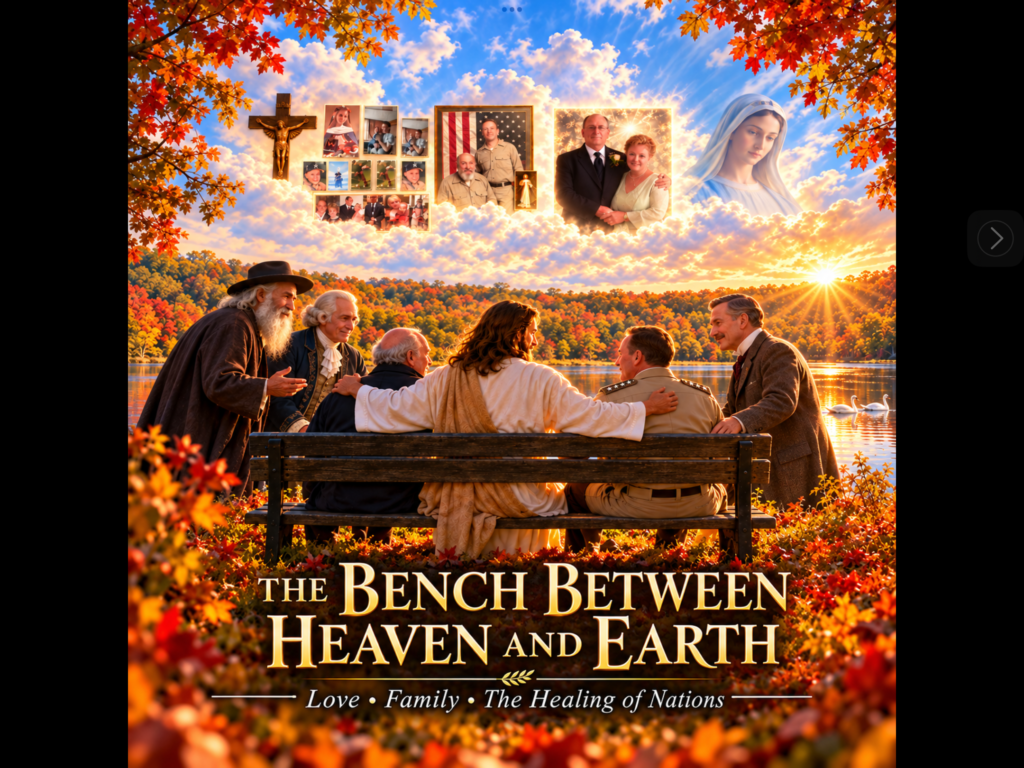
THE BENCH BETWEEN HEAVEN AND EARTH
Love, the Healing of the Nations, and the World We Are Becoming
I returned to the pond carrying photographs of my Queen.
For years, the pictures throughout my house had brought me back to our vacations, our children, and the life we had built together. Now I was looking more closely at the last six years of her life. I had expected those photographs to bring sorrow, and sometimes they did. But what came forward most strongly was how much I had enjoyed her presence.
I had enjoyed loving her.
I remembered the preparations for an outing, the things we needed to bring, the small adjustments that made her comfortable. Then I remembered arriving somewhere and looking beside me. She was there. We were together.
In this imagined gathering, the General was waiting on the bench. Christ sat between us, one arm around my shoulders and the other around his. We faced the water while the autumn light moved across it.
The General looked at the photograph in my hands.
“What are you discovering, Ed?”
“That those years belong fully to our love story. I enjoyed being with her through all her conditions. I miss her physical presence, but loving her continues to form me.”
I paused, searching for the words.
“And in my faith, that relationship continues beyond what I can see. I believe love connects us across death, and that both of us continue developing through it. That is the principle I carry.”
The General listened.
“Then tell us how it influences the life you are living.”
Before I could answer, two men approached along the path. Walt Whitman walked with an easy attention to everything around him. Emanuel Swedenborg was beside him, thoughtful and quiet.
Whitman noticed the photograph.
“We heard you speaking of becoming,” he said.
“Yes,” I answered. “The people we love become part of who we are.”
Whitman looked toward the pond.
“When I wrote of a child going forth, I followed the world entering a life. The plants, the animals, the parents, the streets, the voices—all became part of the child. And he continued going forth. There was always another encounter.”
“Does that continue when we grow old?”
“You are looking at familiar photographs and discovering something you had not fully expressed before,” he replied. “You are still meeting your own life.”
Swedenborg stood beside the bench.
“In my religious thought, our loves are central to our spiritual character. What we cherish and repeatedly choose helps shape what we become. I also wrote of married love and its continuation beyond earthly life.”
“That is why your work speaks to me,” I said. “I want to explore the relationship as living and reciprocal.”
“Then consider love together with wisdom,” he answered. “Ask what your understanding leads you to do, how it affects other people, and where you still have something to learn.”
Christ’s hand rested upon my shoulder.
“What has loving her taught you to notice?”
“When someone needs help. When someone should be included. How much it can mean simply to have a person beside you.”
“And who might need that attention today?”
I thought of my family, of people I had not called, and of the clients whose problems I hoped to help solve.
The General nodded. “That gives the conversation somewhere to go.”
A man had joined us near the path. Thomas Troward introduced himself and listened as I explained my belief in a reciprocal relationship with a benevolent universe.
“You are looking for a principle that brings coherence to your experience,” he said.
“Yes. Something that connects love, consciousness, creation, and useful work.”
“In my philosophy, the individual participates in a larger creative life,” Troward answered. “But a person must still direct intention, make decisions, and undertake the work through which an idea acquires form.”
I looked down at the photograph.
“I have plenty of ideas.”
Pop’s voice entered the scene before I saw his face.
“And how is the business doing?”
I laughed.
Above the pond, the sky in my imagination became a gathering of people I loved. Pop stood with Margie, my mother, Aunt Amy, and my nephews. The Blessed Mother was among them. They appeared like figures in a great family painting, held within the changing light.
“There you are,” I said.
For a moment, I had nothing more to say.
Margie looked toward the photograph.
“You have been remembering our days together.”
“Yes. And how much I liked having you with me.”
“Tell us about one.”
I described an ordinary afternoon outside. Nothing remarkable had happened. We had sat together, and I had been happy that she was there.
Whitman listened closely.
“A lifetime reaches us through such particulars,” he said. “The light, the chair, the familiar face. Give those things your attention.”
My mother looked down at me.
“And have you eaten today?”
The General smiled. “That is a useful question.”
“She knows her audience,” I answered.
Aunt Amy’s presence brought back memories of Boca Raton and the family table. I could almost hear the movement of dishes and the voices of people arriving.
“I want to create some of that warmth again,” I said.
“Who could you invite?” she asked.
I began thinking of names.
My nephews drew nearer within the imagined sky.
“Tell the funny stories too,” one said.
“Let people remember what we enjoyed,” said another.
“I will need other people’s memories,” I answered. “There are parts of your lives I didn’t know.”
“A family has more than one witness,” Whitman said.
The General looked across the pond. “So does history.”
That brought us toward the question that had been waiting beneath our conversation.
“What is happening to humanity?” I asked. “We can communicate across the world, build extraordinary machines, and gather knowledge from every century. Yet people are frightened, divided, and struggling. Nations threaten one another. Families struggle to afford a home. Technology advances while our judgment struggles to keep pace.”
The General leaned forward.
“Begin by separating the problems enough to understand them. Conflict, economic insecurity, political mistrust, and technological disruption influence one another, but each requires evidence, expertise, and decisions.”
“And where does love enter?” I asked.
“In remembering what security and public service are for,” he replied. “People need to live, work, learn, raise children, and return home safely. A strategy should explain how its actions serve those ends.”
Christ looked toward the path.
“Whose life becomes invisible when you discuss the problem?”
I thought of the language we used: populations, casualties, markets, labor, migration.
Whitman spoke quietly.
“Each of those words can contain a face. Someone waiting for news. Someone wondering whether the money will last. Someone trying to get a child through the night.”
“And someone on the other side of a conflict,” I added.
“Yes,” the General replied. “Understanding another population’s fears and interests can improve judgment. It does not require accepting aggression. It helps us assess intentions, communicate, and avoid preventable miscalculation.”
Pop folded his arms.
“And who answers when the plan fails?”
“Someone must,” the General said. “Authority and accountability belong together. So do the ability to question a decision and the obligation to listen.”
I watched the water.
“My security work keeps bringing me back to those same questions. Who owns the system? Who can make a decision? Who responds? How do independent people coordinate when their responsibilities overlap?”
Troward nodded. “Your experience gives you a practical language for larger concerns.”
“That is part of why I am optimistic about my nation,” I said. “I see what Americans know how to do. We can build, invent, organize, educate, and solve problems. I see workers, veterans, engineers, teachers, caregivers, and entrepreneurs whose abilities could contribute so much more.”
The General turned toward me.
“What would make that optimism productive?”
“Investment in real capability. Manufacturing. Infrastructure. Training. Businesses that create useful work. Communities where families can live with some stability.”
“And what would you measure?” he asked.
I considered it.
“Whether people can afford housing. Whether useful jobs are available. Whether small businesses can survive. Whether our infrastructure endures. Whether young people can imagine a future and older people can still contribute.”
“Then those become questions you can investigate,” he said. “Hope becomes more useful when you can recognize progress and identify failure.”
Whitman looked toward the distant road.
“Leave room in your picture of America for people whose experience differs from yours. A country contains many accounts of itself.”
“I can love my nation and still ask it to do better,” I said.
“That kind of love requires attention,” Swedenborg answered. “A person must learn the actual needs of the neighbor he wishes to serve.”
I turned toward Christ.
“And the world beyond my nation?”
The imagined Christ looked across the water.
“Your neighbor will not always share your language, your citizenship, or your account of history.”
The words left me quiet.
Then I asked about the Book of Revelation.
“People look at war, upheaval, powerful technologies, and moral confusion and think of Revelation. Sometimes I wonder whether humanity is passing through something that scripture helps us understand.”
Swedenborg answered first.
“Christian readers have approached Revelation differently. My own interpretations emphasized spiritual meanings. We should be careful about treating every image as a label to attach to a contemporary person or invention.”
“I do not want to live by fear,” I said.
“Then read carefully enough to encounter more than catastrophe,” he replied. “The book also carries visions of renewal, the ending of tears, and the healing of nations.”
Whitman looked toward the trees on the opposite bank.
“The healing of nations,” he repeated. “That is an image large enough to ask something of us.”
The General spoke.
“Whatever interpretation a person holds, predictions of inevitable disaster should not replace assessment. If we want to prevent war, we must study the conditions that could produce it. We must maintain channels for communication and understand where decisions could go wrong.”
“And avoid deciding that an entire people embodies evil,” I said.
“That kind of certainty can narrow judgment dangerously,” he answered.
Christ’s arm remained around my shoulders.
“Attend to the person before you. Seek peace with patience. Protect those entrusted to your care. Be willing to examine your own conduct.”
I thought about the closing vision of Revelation—the holy city, the river, the tree whose leaves are for the healing of the nations.
“I am drawn to that ending,” I said. “I want my faith to help me participate in healing.”
The Blessed Mother looked toward the families walking along the path.
“Then let the scale of the vision deepen your attention to a life within reach.”
My mother nodded. “There will still be someone who needs a meal.”
Pop added, “And someone who needs a job.”
The General smiled. “Both deserve a plan.”
I laughed again, but the next question was serious.
“What about artificial intelligence? We are placing intelligence into systems that influence what people see, what they believe, how they work, and sometimes whether they receive an opportunity.”
Troward watched me thoughtfully.
“Your instruments extend your capacity. You must examine the purposes directing them.”
“Who checks the information?” the General asked. “Who can stop a harmful process? Who can challenge its result? Does the person responsible understand the system well enough to exercise judgment?”
Whitman added, “And can an ordinary person still reach someone who will listen?”
Swedenborg said, “Efficiency is one consideration. Justice, privacy, and human dignity require attention too.”
“I want AI to help humanity bring its accumulated wisdom into conversation,” I said. “That is what I am trying to do here.”
“Then preserve the differences among the voices,” Whitman answered. “Let the conversation surprise you.”
“And distinguish evidence from interpretation,” the General said. “A useful discussion becomes stronger when people can see how a conclusion was reached.”
I looked toward Christ.
“This brings me to what I call Christ consciousness. I mean a growing awareness of love, responsibility, forgiveness, and our connection with one another. I believe that kind of transformation could help save the world.”
“What would someone see you doing?” he asked.
The question made me slow down.
“Listening before I condemn. Telling the truth. Protecting people. Helping someone become capable. Taking responsibility for the consequences of my work.”
“And when you disagree?” he asked.
“Trying to understand. Keeping boundaries where they are needed. Leaving room for correction.”
Swedenborg nodded. “You are giving an inward conviction an outward practice.”
“I know Christians understand salvation and the nature of Christ in different ways,” I continued. “I am speaking about how his life and teachings might become active in human conduct. I do not want the phrase to become something grand that leaves the suffering person unattended.”
Whitman looked pleased.
“Then the person matters more than the impressive sound of the phrase.”
The General turned toward me.
“And moral commitment still needs competent institutions. Compassion should inform diplomacy, engineering, public health, economic policy, and defense. People also need those fields to be practiced well.”
“So Christ consciousness, as I am using the words, would lead us to learn what helping actually requires.”
“Yes,” Swedenborg said. “Love has much to learn.”
For a while, we watched the swans.
I thought of the people gathered above us, and of those living elsewhere whose names I would never know. I thought about the affection I had received and the responsibilities I still carried.
Then Pop returned to his question.
“How is the business doing, Ed?”
“I need clients.”
“What will you do next?”
“I can define one service clearly. Contact people who may need it. Explain what I deliver and what it costs.”
“Put it on the calendar,” the General said.
“And rest,” my mother added.
“And call someone,” Aunt Amy said.
“And allow yourself some pleasure in their company,” Whitman said.
I looked toward Margie.
“That is something I learned with you.”
In the imagined scene, she smiled. I let that expression remain without trying to fill every silence with words.
Christ rose, and the General and I stood with him.
I had come to the pond wanting to connect my love, my faith, my nation, and humanity’s future. I was leaving with questions I could carry into actual work. What needed protection? Who needed attention? What could I contribute? Where did I need to learn?
The family figures softened within the sky of the story. I raised my hand toward them, then placed the photograph securely in my pocket.
My hope for America remained. It was a hope that people could build, repair, learn, cooperate, and hold one another accountable. My hope for humanity reached beyond national borders. I wanted the moral vision I found in Christ to influence the uses of power and knowledge.
And I wanted to live my own small portion of that hope honestly.
Before leaving, I sat once more upon the bench.
The pond was still there. A family passed along the path. Somewhere beyond the trees, a vehicle started. The afternoon continued.
I took out my phone.
There was someone I wanted to call, a proposal I needed to finish, and a life in which love could still become useful.