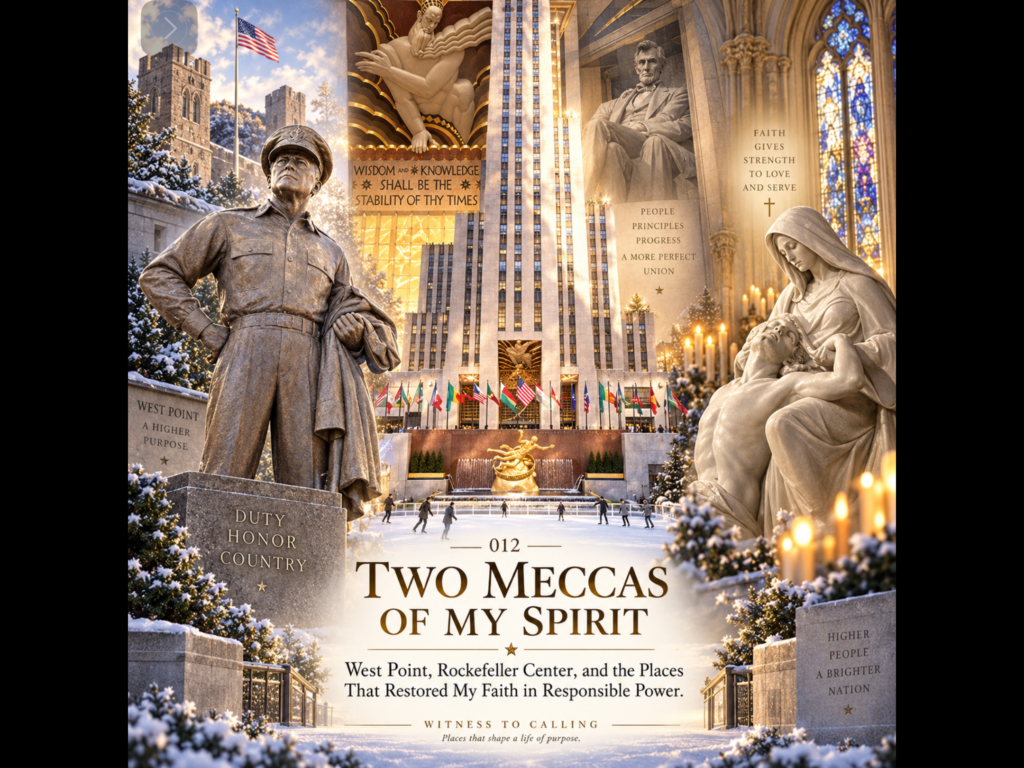
012 — TWO MECCAS OF MY SPIRIT
West Point, Rockefeller Center, and the Places That Restored My Faith in Responsible Power
There have been certain places in my life that became more than destinations. They became places of spiritual instruction. I returned to them because something within me was being restored there. West Point became such a place for me because it helped restore my faith in the military traditions of this nation. Rockefeller Center became another because it helped restore my understanding of capitalism and the good that capital can accomplish when it is governed by wisdom, character, responsibility, and service. I came to think of both almost as Meccas of my spirit—not in the literal religious sense, but as places of pilgrimage where I went searching for meaning and where my understanding of power began to change.
During my religious experience, while I was reading Scripture and philosophy and trying to understand what the Holy Spirit was asking of me, I went through a period in which I believed poverty itself might be a virtue. I saw simplicity, sacrifice, humility, and detachment from material possessions as evidence of spiritual seriousness. I began to wonder whether wealth itself separated Man from God. Yet over time, something changed in me. I was repeatedly drawn to Rockefeller Center, and the more I walked through that place, the more I began to see a different possibility. Wealth did not have to be worshiped, but neither did it have to be rejected. Capital could become a responsibility. Possession could become stewardship. Material capability could be directed toward the benefit of other people.
Rockefeller Center Became My Classroom
I did not experience Rockefeller Center merely as a collection of buildings. I experienced it as a place filled with ideas. I would read the Credo in stone. I would look at the artwork above the skating rink. I would study the figures on the walls and entrances. I would see the words about wisdom and knowledge being the stability of our times. I would encounter images of Man, Thought, Action, labor, machinery, progress, and civilization. The more I looked, the more I began to feel that John D. Rockefeller Jr. had tried to place a moral philosophy into the very architecture of the Center.
The Credo especially affected me. Its principles did not glorify wealth. They disciplined wealth. They said that every right carries a responsibility, every opportunity an obligation, and every possession a duty. That single idea began to change my thinking. I started to understand that possession itself was not the moral problem. The problem was whether possession controlled the person or whether the person accepted responsibility for what possession made possible.
Capital, I began to see, could be used for education, medicine, art, parks, public service, research, opportunity, historic preservation, and the creation of institutions that would continue helping people long after the original wealth had been created. This was a different understanding of capitalism. It was not capitalism as greed. It was not capitalism as accumulation for its own sake. It was capitalism as capability, and capability as responsibility.
Across Fifth Avenue
My visits to Rockefeller Center were also connected to another routine in my life. I would visit St. Patrick’s Cathedral, directly across Fifth Avenue. That physical relationship became spiritually important to me. On one side of the avenue stood Rockefeller Center, representing capital, commerce, architecture, labor, communications, technology, art, and human achievement. Across the street stood St. Patrick’s Cathedral, representing Christ, Mary, sacrifice, compassion, faith, eternity, and the moral life.
Inside St. Patrick’s, I was especially drawn to the image of Christ in the arms of Mary behind the altar. That image affected me deeply. I could move from Rockefeller Center into the Cathedral and feel as though I was moving between two dimensions of the same question. What can Man build, and what should Man ultimately serve?
Over time, those two places stopped appearing to me as opposites. I began to see that the material and spiritual worlds did not necessarily have to be enemies. The material world could become an instrument of spiritual responsibility. Wealth could serve compassion. Technology could serve dignity. Capital could serve human development. The real question was whether Man possessed enough wisdom and character to govern what he had created.
West Point Became My Other Mecca
West Point became another place that restored something in me. There were periods when I had questions about military institutions, leadership, and the direction of the nation. Yet West Point represented something deeper than any individual failure. It represented a tradition of Duty, Honor, Country. It represented sacrifice, discipline, service, and the idea that military power must be governed by principles higher than power itself.
West Point became so important to me that I deliberately decided to walk there from Farmingdale, Long Island. I set out intending to reach West Point on foot. I continued north and eventually made my way along Route 9, walking mile after mile, up and down the road, continuing toward the Hudson Valley. I kept moving because the destination meant something to me. I was not simply traveling to a military academy. I was making a pilgrimage to a place that had come to represent the restoration of my faith in honorable service.
I came close to reaching it. I made it to the area just outside the town leading into West Point before my physical condition became serious. A traveling bus driver saw me and recognized that I needed help. He stopped, took responsibility for another human being he did not know, and personally drove me all the way back to Farmingdale.
That event has remained with me because it seemed to contain its own lesson. I had been walking toward a place associated with duty and service, yet before I reached the gates, a stranger demonstrated those very principles to me. I had gone searching for service, and service found me on Route 9.
Power Must Serve Something Higher
Eventually I began to see the common lesson behind both places. West Point taught me that military power is not evil simply because it is power. It becomes honorable when it is directed toward duty, defense, sacrifice, and the protection of freedom. Rockefeller Center taught me that economic power is not evil simply because it is wealth. It becomes constructive when capital is directed toward creation, stewardship, opportunity, education, culture, science, and the development of human beings.
Both places taught me the same principle in different forms: power must serve something higher than itself.
Military power without moral direction can become destruction. Capital without moral direction can become exploitation. Technology without moral direction can become domination. Government without moral direction can become tyranny. But each can also become an instrument of human progress when governed by wisdom, truth, responsibility, and compassion.
Nelson Rockefeller and My Own Transition
My connection to the Rockefeller story was not only philosophical. Nelson Rockefeller entered my own life in a practical way. In 1973, while he was Governor of New York, a request was made that helped enable my transition from Active Duty into Reserve status. That experience gave Nelson Rockefeller a personal meaning to me long before I later studied his writings and public career in greater depth.
Years later, when I read more about Nelson Rockefeller, including his thinking about federalism, public service, development, education, and government, I began to recognize that the Rockefeller spirit had also become connected to my own entrepreneurial spirit. I came to believe that enterprise could be principled. Business could solve problems. Capital could build. Technology could improve lives. Entrepreneurship could be an expression of service.
That belief in the goodness of principle became one of the forces that shaped my personality. I have often been driven by the idea that something can be made better. A system can be improved. A problem can be solved. A person can be helped. A technology can be integrated. A business can create value and opportunity. Entrepreneurship, at its best, is not merely the pursuit of profit. It is the act of seeing possibility and bringing it into the physical world.
The Rockefeller Spirit and the Meaning of Stewardship
The more I studied the Rockefeller family, the more I became interested not only in the negative stories that are commonly told, but also in the constructive story. John D. Rockefeller Sr. created enormous industrial wealth and power, and that history includes serious controversies that must be acknowledged. Yet the fortune was also transformed into universities, medical research, public health, education, and philanthropy on an extraordinary scale.
John D. Rockefeller Jr. inherited wealth but increasingly interpreted it as stewardship. His Credo placed character above wealth and position. He supported parks, historic preservation, religious institutions, international cooperation, and the creation of Rockefeller Center itself. He demonstrated that inherited wealth could become responsibility.
Nelson Rockefeller carried that tradition into public service. He helped expand higher education in New York, supported arts and culture, worked in international development, and eventually became Vice President of the United States during one of the most difficult constitutional periods in modern American history. His career showed another form of stewardship: the movement from private capability into public responsibility.
Man, Capital, Wisdom, and Freedom
These experiences gradually brought me to a larger understanding. The real question is not simply whether capitalism is good or bad. That question is too small. The deeper question is whether Man remains master of capital or becomes its servant.
Capital is a tool. A corporation is a tool. Government is a tool. A machine is a tool. Artificial Intelligence is a tool. None of these possess moral wisdom by themselves. The person using them must supply the moral purpose.
Rockefeller Center taught me that knowledge alone is not enough. Wisdom must govern knowledge. West Point taught me that strength alone is not enough. Duty must govern strength. St. Patrick’s Cathedral reminded me that even wisdom and power must ultimately remain connected to compassion, sacrifice, truth, and love.
Today, as Artificial Intelligence becomes one of the most powerful forces ever created by Man, the warning becomes even more important. The old question written into Rockefeller Center remains alive: will Man remain master of the machine, or will he become its servant?
The answer will depend upon whether our civilization can unite knowledge with wisdom, capital with responsibility, power with duty, and freedom with character.
That, I believe, is the larger meaning of the two Meccas of my spirit.