WHO ARE WE, AND WHAT SHALL WE CREATE?
Listening to the Master Mind of the Republic
Learn. Adapt. Transform.
An Imagined Conversation Across Generations on Individual Liberty, National Identity, Constitutional Government, Creative Leadership, Intelligence, Capital, Artificial Intelligence, and the Governance of Power
The Reader Enters the Room
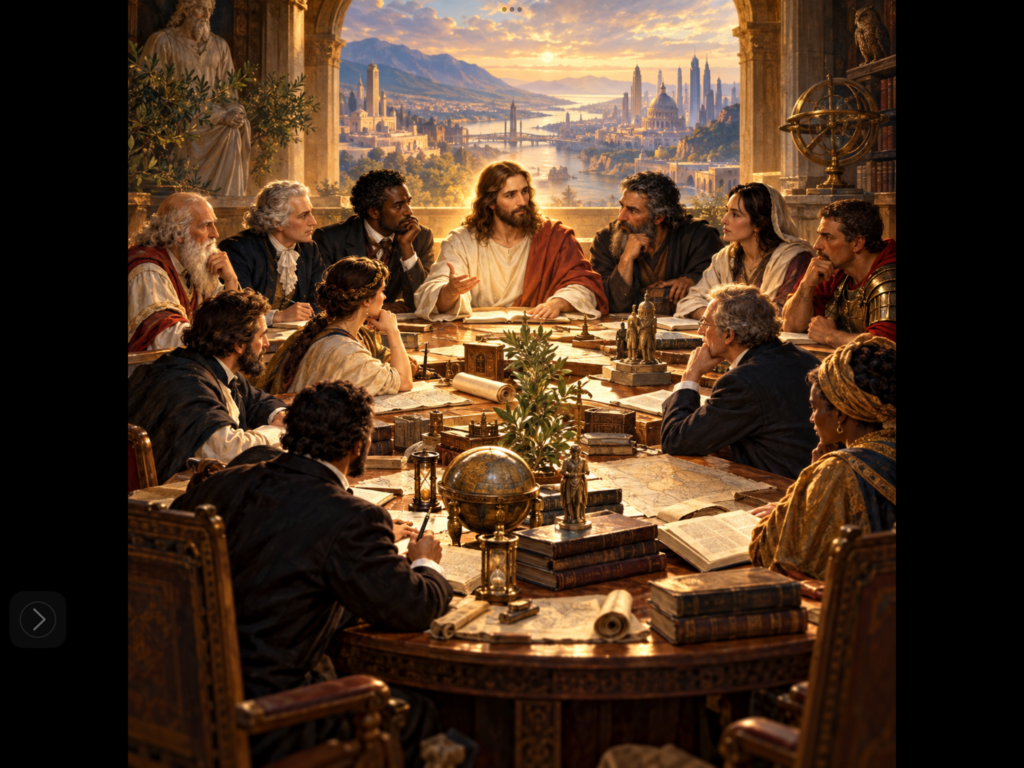
Imagine that the room already exists and that we have been invited only to listen. No one at the table claims possession of the whole truth. No one possesses the entire answer. Some are philosophers, some soldiers, some historians, some psychologists, and others understand government, institutions, finance, intelligence, civilizational change, reconciliation, or the development of human personality. They lived centuries apart and could never literally have met, yet in this imagined Master Mind, history has removed the barriers of time so that their ideas can meet one another. We take our place just beyond the table. We do not interrupt. We listen.
General David Petraeus is already seated among them. He does not occupy the head of the table. He is one member of the council, bringing more than thirty-seven years in uniform, six consecutive commands as a general officer, five of them in combat, experience in Haiti, Bosnia, Iraq, Afghanistan, CENTCOM, leadership of the Central Intelligence Agency, and later experience in classrooms, boardrooms, investment discussions, geopolitical analysis, and KKR. He brings the contemporary practitioner’s perspective, but he sits as an equal and will be questioned just as he questions others. Arnold Toynbee sits nearby, carrying the history of civilizations and the problem of Challenge and Response. Thomas Troward waits with the question of whether consciousness merely reacts to conditions or participates creatively in producing new ones. Carl Jung watches the personalities around the table almost as carefully as he listens to their ideas. Viktor Frankl brings responsibility and the freedom to choose one’s response. George C. Marshall represents character, people, discipline, and institution building. Wild Bill Donovan brings intelligence, imagination, and unconventional thought. Pierre Teilhard de Chardin brings convergence and the development of human consciousness. Martin Luther King Jr. and Nelson Mandela bring the possibility that conflict need not end only in domination or retaliation. John D. Rockefeller Jr. brings capital and stewardship. Napoleon Hill provides the very architecture that allows us to imagine this meeting—the Master Mind organized around a Definite Purpose.
John Locke sits beside Alexander Hamilton. Their disagreement already seems visible before either speaks. Locke carries the rights of the individual, consent, conscience, and the limits of arbitrary authority. Hamilton carries the problem of institutional strength, public credit, national capacity, and how a constitutional Republic becomes sufficiently capable to endure. Samuel P. Huntington sits with three words already written on a page before him: WHO ARE WE? Petraeus has written three others: LEARN. ADAPT. TRANSFORM. Hill has placed the central question before them: What is our Definite Purpose? Troward has not yet written anything. His sheet remains blank.
And Christ is present. But Christ does not occupy another specialist’s chair. He is not there to compete with Locke on political philosophy, Hamilton on institutions, Marshall on military organization, Donovan on intelligence, Rockefeller on capital, Jung on psychology, Toynbee on civilizations, Huntington on identity, or Petraeus on contemporary strategic leadership. Within the Christian theological framework of this narrative, Christ serves as the Leadership Conscience of the Master Mind. He listens. He allows disagreement. He does not erase individuality. And when the discussion begins to confuse capability with purpose, power with legitimacy, success with goodness, or adaptation with moral progress, His questions return the group to first principles. The reader soon realizes that Christ’s most important contribution may not be an answer. It is the question that none of the instruments of power can answer for themselves: What does the power serve?
Petraeus — When the World Changes Faster Than the Institution
Petraeus is the first to speak at length. “If I had to compress decades of leadership into one lesson,” he tells the council, “I would begin here. An organization can possess courageous people, enormous resources, advanced technology, extraordinary intelligence, and tremendous firepower and still fail if the intellectual concepts directing those instruments no longer correspond to reality.” Toynbee nods immediately as Petraeus continues. “The problem is that even when the big ideas are right today, they cannot become sacred objects. Tomorrow the enemy adapts. Technology advances. Markets move. Political conditions change. Capital moves. Alliances strengthen or weaken. New leaders emerge. New technologies disrupt established industries. Old grievances return in new forms. Yesterday’s successful answer can become tomorrow’s failure.”
Petraeus writes three words again: LEARN. ADAPT. TRANSFORM. Learning that produces no change, he explains, is incomplete. Adaptation that merely preserves an institution may eventually become another form of resistance to reality. There are moments when the institution itself must change. Christ has been listening, and then the first question comes. “David,” He asks, “transform toward what?” The room grows quieter. Petraeus looks again at the three words. Christ continues: “An army can learn. A corporation can adapt. An authoritarian state can transform. An intelligence service can become more effective. An artificial intelligence system can become more capable. Capability does not tell us whether the direction is good.” Petraeus nods. “That is exactly why getting the big ideas right is not enough. We also have to ask whether the ideas are worthy.” Hill leans forward. “Then,” he says, “we are already approaching the Definite Purpose.”
Hill — The Definite Purpose and the Master Mind
Hill explains that the Master Mind is not simply a gathering of intelligent people. It is the coordination of knowledge and effort among multiple minds working toward a definite purpose. No individual possesses enough experience. No commander understands every domain. No chief executive understands every technology. No intelligence officer sees every part of the picture. No investor understands every country, company, culture, market, and political system. No philosopher possesses every dimension of human experience. “One of the first marks of developed leadership,” Hill says, “may be recognizing that no one mind is enough.”
Hill continues that information is not intelligence, intelligence is not strategy, strategy is not execution, capital is not investment wisdom, and technology is not purpose. Specialized knowledge becomes powerful only when it is organized and intelligently directed. He writes the progression before the group: Definite Purpose → Specialized Knowledge → Master Mind → Organized Planning → Persistent Action → Result. Marshall studies the sequence, Donovan looks particularly interested in Specialized Knowledge, Rockefeller notices where capital might enter, and Petraeus sees the architecture of a modern headquarters, intelligence agency, investment organization, or national-security institution.
Christ then asks Hill a quiet question: “And Napoleon, if the Definite Purpose itself is corrupt?” Hill stops. “Then,” Christ continues, “the efficiency of the Master Mind only magnifies the corruption.” No one argues. A Master Mind can organize knowledge brilliantly around conquest, manipulation, exploitation, or domination just as easily as around human flourishing. Christ therefore adds no new box to Hill’s sequence. Instead He places a question above all of them: IS THE PURPOSE WORTHY? Hill slowly underlines it.
Toynbee — When the Challenge Changes
Toynbee turns toward Petraeus. “You speak of adaptation,” he says. “Then the first responsibility is correctly identifying the challenge.” Petraeus agrees. His doctoral work examined Vietnam and its influence on American military thinking. Haiti, Bosnia, Iraq, Afghanistan, CENTCOM, and the CIA later reinforced the same lesson. Historical knowledge matters, but history must improve judgment rather than imprison it. Toynbee explains his recurring pattern of Challenge and Response. Civilizations are confronted by conditions that demand response, but the challenge does not automatically determine the outcome. The response matters.
Petraeus remembers Iraq. “The central question,” he says, “could not simply be how to apply more force. We had to ask what kind of conflict we were actually fighting.” Toynbee points toward him. “Exactly. Institutions often fail not because they possess no intelligence but because they remain loyal to an answer after the question has changed.” Then Toynbee writes: HAS THE CHALLENGE CHANGED?
Christ asks another question: “And if fear becomes the response?” Toynbee pauses. Christ continues, “Can a civilization convince itself that every challenge is proof that it must become harder, more coercive, more fearful, and less human?” Jung looks up. “That,” he says, “takes us directly toward the shadow.”
Huntington — Who Are We?
Before Jung can continue, Huntington speaks. “Toynbee has asked whether the challenge has changed, but before a nation responds, another question must be answered.” He turns the page toward the group: WHO ARE WE? Nations, Huntington explains, are not interchangeable pieces on a strategic map. They inherit histories, institutions, cultures, religions, political traditions, languages, memories, loyalties, and understandings of themselves. Those identities influence what nations fear, what they value, what they sacrifice for, and what they consider legitimate.
He moves through the subjects that occupied his career: military professionalism and civilian authority, political order and institutional capacity, civilizations and culture, and finally national identity. “A soldier swears an oath, but to what larger community? A general commands an army—but what is the army defending? A diplomat represents a nation—but what makes that nation something more than territory? An intelligence service protects national security—but what values define the nation whose security it protects?” The room is silent as Huntington repeats: WHO ARE WE?
Christ answers with another question: “And who is included in the word ‘we’?” That question changes the tone. Huntington knows his own arguments about American identity have been debated and criticized. He had placed great weight on the country’s English and Protestant historical inheritance and on the American Creed—liberty, equality, individualism, constitutional government, representative institutions, rule of law, and private property. Others emphasized additional traditions: Native peoples, enslaved and free African Americans, Catholics, Jews, immigrants from every part of the world, Hispanic and Asian American communities, religious dissenters, civil-rights movements, women, workers, entrepreneurs, soldiers, reformers, and generations whose experiences also became part of America.
Christ does not resolve the historical debate. Instead He asks, “Can a ‘we’ remain strong without turning those outside a preferred historical image into permanent outsiders?” Locke shifts in his chair. King looks toward Huntington. Huntington responds carefully: “A national identity cannot survive if it means nothing, but neither can it remain legitimate if belonging becomes impossible for citizens who do not fit one ancestry or tradition.” King says, “Then perhaps the Creed must become not merely what America claims about itself, but the standard by which America judges itself.” Huntington nods, and the conversation moves deeper.
Locke — The Individual Within the “We”
Locke enters because he senses the danger inside every collective pronoun. “A nation may require a ‘we,’” he says, “but the ‘we’ must never completely consume the individual.” He begins with the person. Government does not manufacture the entire moral standing of the human being. Political authority exists for purposes connected with civil order, protection of rights, and the common good. Political power therefore cannot become unlimited merely because it calls itself government.
Locke turns toward Huntington. “You ask, ‘Who are we?’ I ask, ‘What remains protected within the we?’” He turns toward Petraeus: “A soldier remains a moral agent.” Toward Rockefeller: “A worker and citizen remain more than economic units.” Toward Donovan: “A person remains more than an intelligence target.” And finally toward the conceptual place artificial intelligence will later occupy: “A human being must never become merely a data point inside a system.”
Christ listens and asks Locke, “Does liberty create responsibility?” Locke knows immediately where the question leads. Freedom cannot simply mean the absence of obligation. A society composed of people claiming rights while rejecting every reciprocal responsibility would eventually consume the institutions protecting those rights. Frankl smiles slightly. “The freedom to choose,” he says, “does not eliminate responsibility. It creates it.” Christ turns toward the group. “So the individual must remain free enough to develop, but freedom itself must mature into responsibility.” Locke agrees.
Hamilton — Power Under Law
Hamilton has been waiting. “Locke is correct about the danger of arbitrary authority,” he says, “but rights written on paper are not self-executing.” He explains the other half of the constitutional problem. A Republic incapable of governing, financing legitimate obligations, maintaining public credit, administering law, defending itself, and responding to national challenges may possess admirable principles while lacking the capacity to preserve them.
Hamilton looks toward Locke. “You ask how power must be limited. I ask how legitimate power becomes effective.” Locke answers quickly: “And I ask what prevents effective government from becoming arbitrary government.” Hamilton replies, “Law, constitutional structure, divided authority, accountability, and political culture. But weakness is not liberty.” Now the Master Mind is functioning exactly as Hill intended. Neither man needs to defeat the other. Locke represents limitation. Hamilton represents capacity. The constitutional problem becomes EFFECTIVE POWER UNDER LAW.
Hamilton explains public credit, fiscal capacity, financial institutions, commerce, industry, and national strength. The early Republic needed more than ideals. It needed durable institutional forms. “The Republic,” Hamilton says, “must be strong enough to govern.” Locke immediately adds, “And never so unchecked that it forgets why it governs.”
Christ has listened to both. Then comes the question: “What is authority for?” Hamilton answers first: “To secure the Republic and enable legitimate national action.” Locke adds, “While protecting the individual from arbitrary power.” Christ responds, “Then authority is neither the enemy of freedom nor its master. Properly ordered, authority is a form of service.” Marshall looks toward Christ. “That,” he says, “is also true of command.”
The Oath — What Are We Defending?
Huntington turns toward Petraeus. “General, what exactly were you defending?” Petraeus could simply answer, “The United States,” but Huntington presses further: “What is that?” Petraeus considers the question. The United States is territory, but more than territory. It is a constitutional system, but more than a document. It is a market economy, but more than markets. It is a military power, but military power does not explain why military power should exist. It is a collection of citizens, but citizenship has meaning only if citizens believe they belong to something together.
Petraeus replies, “A commissioned officer does not swear personal loyalty to a president, a political party, a general, or an ideology. The oath is to support and defend the Constitution.” Huntington nods. “That distinction is fundamental.” Civilian constitutional authority remains higher than the military institution. The military serves the Republic. The Republic does not exist to serve the military. Hamilton recognizes constitutional structure, Locke recognizes limitation of power, Marshall recognizes professional duty, Huntington recognizes civilian supremacy, and Petraeus recognizes the obligation of command.
Christ listens and asks, “What happens when loyalty to an institution is confused with loyalty to a person?” No one needs the answer explained. Christ continues, “Leadership becomes dangerous when the leader wants what properly belongs to the mission, the Constitution, the institution, or the people directed toward himself.” Marshall looks down at the table. He understands.
The Creed That Judges the Nation
King returns Huntington’s American Creed to the center of the discussion. “A nation’s ideals,” King says, “should not exist merely to congratulate the nation.” He reminds the council that American history contains long periods in which professed ideals of liberty and equality were denied to many people. Huntington agrees that the tension between ideals and reality belongs within American political development. King continues, “The Creed becomes morally significant when people who have been denied its promises can appeal to those promises.”
Toynbee sees Challenge and Response. Jung sees confrontation with the national shadow. Frankl sees responsibility. Troward sees the existing condition confronted by a higher conception. King sees the possibility of reform. Christ asks, “If an ideal cannot criticize the people who profess it, is it still an ideal—or merely self-praise?” No one answers immediately. Then Huntington says, “Perhaps the Creed is strongest when it remains capable of judging the nation itself.”
Belonging Without Sameness
The conversation moves toward national cohesion. Huntington says, “A nation cannot survive indefinitely if citizens increasingly see one another only as members of hostile tribes.” Locke adds, “But unity cannot require extinguishing conscience.” King adds, “Nor can unity require silence about injustice.” Hamilton says, “And common citizenship must still produce institutions capable of action.” Teilhard, who has been listening closely, finally speaks. “Then perhaps the objective is not uniformity.” Huntington agrees, and the phrase emerges: BELONGING WITHOUT SAMENESS.
A Catholic need not become Protestant. A Jew need not become Christian. A Muslim need not surrender Islam. People of Mexican, African, Asian, Irish, Italian, Polish, Caribbean, Middle Eastern, Native American, or any other ancestry need not erase family memory to become American. Yet a durable Republic requires something in common. Can the Constitution become our Constitution? Can liberty become our liberty? Can the rights of political opponents remain rights even when disagreement becomes intense? Can a citizen lose an election without deciding the nation is no longer his country? Can a citizen win without concluding that victory grants unlimited authority? Can different religions flourish without demanding possession of one another’s conscience? Can people celebrate ancestry without converting ancestry into separate political nations?
Donovan speaks quietly: “An adversary will study every fracture.” Jung adds, “And every collective shadow.” Marshall says, “An institution cannot operate without trust.” Hill says, “A Master Mind collapses when the members cease believing in the Definite Purpose.”
Christ finally speaks. “Then perhaps unity is not the erasure of difference. Perhaps mature unity is the ability to remain in relationship through difference without denying one another’s human dignity.” Teilhard nods. That phrase will return later.
Troward — What Shall We Create?
Troward finally reaches for his blank page. He has listened to Huntington ask who we are. Locke has defended the individual. Hamilton has defended institutional capacity. King has forced the Creed to confront injustice. Teilhard has introduced relationship without uniformity. Troward writes only one question: WHAT SHALL WE CREATE?
He explains the Progressive Affirmative. Creative consciousness does not merely submit to existing conditions. It can conceive another possibility and begin creating conditions through which that possibility becomes manifest. Petraeus immediately recognizes the connection: “Get the big ideas right.” Troward nods. The idea shapes strategy. Strategy shapes organization. Organization shapes action. Action changes conditions. Changed conditions create new challenges. The process begins again. Petraeus says, “Doctrine cannot become dogma.” Troward replies, “Because form must remain subordinate to principle.”
Christ looks at the blank page. “What if the thing you intend to create is magnificent in scale and destructive in purpose?” Troward understands. Creative power alone cannot become the highest principle. Christ continues, “The ability to create increases the responsibility to discern.” Troward adds a second line beneath his question: WHAT SHALL WE CREATE—AND WHY?
Jung — Who Commands the Commander?
Jung has been waiting for the discussion to turn inward. “You speak of transforming nations and institutions,” he says, “but what of the personality attempting the transformation?” People become emotionally attached to the methods that once made them successful. Professional identity becomes attached to doctrine. Status becomes attached to programs. Ambition becomes attached to office. Fear disguises itself as prudence. Pride disguises itself as certainty.
Jung asks: WHO COMMANDS THE COMMANDER? An unexamined shadow can become operational behavior. Anger can become indiscriminate force. Fear can become excessive control. Pride can prevent adaptation. Ambition can transform a mission into a vehicle for personal significance. The leader therefore fights two battles: the one outside and the one within.
Christ turns directly toward the entire group. “What good is command over others without command over oneself?” Marshall nods. Petraeus does too. Christ continues, “A leader may command an organization and still be governed by vanity. He may direct armies and remain unable to govern anger. He may manage billions in capital and remain mastered by greed. He may create extraordinary technology and remain unable to answer why he wants the power it gives him.” Jung says quietly, “That is why the shadow matters.”
Huntington adds a national version. “Who am I?” Jung asks the individual. “Who are we?” Huntington asks the nation. A nation can also romanticize its history, demonize outsiders, reduce identity to grievance, and confuse patriotism with self-worship. Christ asks, “Can a nation love itself enough to care for itself, but remain humble enough to tell itself the truth?” King answers first. “It must.”
Frankl — Freedom and Responsibility
Frankl speaks next. “Conditions are real, but conditions are not commands.” A deteriorating situation does not command despair. A failed strategy does not command repetition. A market collapse does not command surrender. An adaptive enemy does not compel intellectual paralysis. Technological disruption does not automatically determine who benefits from it. There remains a space for human judgment, and that is where responsibility lives.
Frankl asks: WHAT DO YOU DO NOW? Toynbee calls it Response. Troward calls it Creation. Hill calls it organized action toward Definite Purpose. Locke calls it responsible liberty. Hamilton asks whether the response can be institutionalized. Petraeus calls it leadership.
Christ asks, “And who remains responsible when everyone claims the system made the decision?” Frankl looks toward the future place where AI will soon join the conversation. “That question may become increasingly important.”
Marshall — Leadership Multiplies Judgment
Marshall speaks without drama. “Who are your people?” The entire conversation immediately becomes practical. Ideas do not execute themselves. Institutions do not think apart from the people operating them. Technology does not determine its own purpose. Capital does not allocate itself wisely. Leadership therefore becomes selection, development, empowerment, and coordination of people.
Petraeus says, “The higher the level of leadership, the less the answer can be to make every decision personally.” Marshall agrees. “The strategic leader multiplies judgment.” A leader cannot conduct every patrol, analyze every intelligence report, understand every nation, evaluate every technology, or run every company. The task is to develop people capable of good decisions without waiting constantly for the leader.
Christ asks Marshall, “Then is leadership possession of authority—or development of others?” Marshall answers without hesitation: “The second, if leadership is to endure.” Christ looks toward the group. “The leader who makes everyone dependent upon himself may appear powerful, but he has built weakness.” Petraeus recognizes the connection immediately. “That is disciplined initiative.”
Donovan — Intelligence Requires Imagination
Donovan leans forward. “You can develop excellent people and still fail if you do not understand the environment.” Modern conflict involves intelligence, economics, propaganda, resistance networks, diplomacy, psychology, technology, unconventional operations, and information. Strategy without information is helpless. Information without purpose is useless. But Donovan adds another requirement: IMAGINATION.
He assembled soldiers, lawyers, academics, economists, linguists, scientists, immigrants, women and men from radically different backgrounds into the OSS because no single professional type could understand the environment. Hill recognizes the Master Mind immediately: different knowledge, different personalities, different capabilities, one purpose. Donovan says, “The adversary is always searching for what you failed to imagine.”
Christ asks, “And intelligence used to manipulate rather than understand?” Donovan pauses. Christ continues, “Knowledge gives power over another person. That makes truthfulness and restraint more important, not less.” Donovan nods. “The better our intelligence becomes, the greater the obligation to remember why we seek it.”
The Strategic Lieutenant — Disciplined Initiative
Petraeus returns to a principle born from operational experience. “The Master Mind cannot exist only at headquarters.” A lieutenant or corporal can make a decision whose effects become strategic almost instantly. A checkpoint incident can become global news. A successful local initiative can reveal a method worth adopting across an entire theater. Authority and resources must therefore move downward far enough for the people closest to reality to act.
Marshall calls it mission command. Troward recognizes the Personal Factor. Jung sees developed individuality. Teilhard sees distinct personalities acting coherently. Donovan sees intelligence from the closest observer. Huntington sees the requirement that individuals understand the values of the institution they represent. Locke sees individual judgment. Hamilton sees coordinated institutional action. Petraeus calls it DISCIPLINED INITIATIVE.
Initiative without discipline becomes chaos. Discipline without initiative becomes paralysis. Christ asks, “What gives the initiative its discipline?” Petraeus answers, “Understanding the mission, the commander’s intent, the values of the institution, and the limits within which authority is exercised.” Christ adds, “And conscience.” Petraeus agrees. “And conscience.”
Teilhard — Convergence Without Erasure
Teilhard studies the table itself. “This,” he says, “is convergence.” Military experience, psychology, history, political philosophy, intelligence, finance, spirituality, institutional leadership, capital, technology—different disciplines communicating without becoming identical. Teilhard insists that convergence need not mean uniformity. The ambassador need not become the general. The general need not become the intelligence officer. The investor need not become the theologian. The technologist need not become the statesman. Distinct personalities can become more deeply related without losing personality.
Hill recognizes his Master Mind at one scale. Teilhard sees the Noosphere at another. The question becomes whether greater connection can produce greater wisdom rather than merely greater speed. Huntington introduces his warning: “Connection does not eliminate identity.” Globalization can produce cooperation and friction simultaneously. Civilizations may become more aware of differences precisely because they are brought more closely together. Locke adds, “Convergence cannot extinguish conscience.” Hamilton adds, “Cooperation requires structures capable of action.” Petraeus adds, “Networks still require purpose and decision.”
Then Christ asks Teilhard, “If humanity becomes completely connected but not more compassionate, has it truly converged?” Teilhard considers the question. “No. It has merely become connected.” Christ replies, “Then communication is not communion.” The phrase settles over the table. Teilhard smiles. “Relationship without erasure.” Christ adds, “And relationship without love remains incomplete.”
King and Mandela — What Happens After Victory?
King turns toward Petraeus. “You have spoken of winning.” Mandela adds, “But suppose you win. Then what?” A strategy that knows only how to defeat opponents can unintentionally manufacture opponents indefinitely. Some adversaries remain irreconcilable. Others can become participants in a new order. King and Mandela therefore introduce a different kind of strategic imagination: the possibility that the relationship itself can change.
Companies compete. Nations compete. Political movements compete. But civilization cannot exist if every competitive relationship becomes permanent total war. Huntington asks whether reconciliation can occur without erasing identity. Teilhard believes it can. Locke insists conscience remain free. Hamilton insists a shared political structure still requires enforceable law. Petraeus sees the strategic value of transforming relationships where possible.
Christ asks the question that has been waiting beneath the discussion: “Do you seek victory because you want your opponent destroyed, or because you want justice restored?” King looks toward Him. “That distinction changes everything.” Christ continues, “Justice without truth becomes sentimentality. Truth without love becomes a weapon. Reconciliation without justice becomes avoidance. But power exercised only for humiliation creates the seeds of the next conflict.” Mandela nods slowly. “Then the highest victory is not always possession of the field.”
Rockefeller Jr. — What Is Wealth For?
Rockefeller Jr. speaks. “What is wealth for?” The room shifts again. He inherited enormous wealth but devoted much of his life to the responsibilities attached to it. Wealth could become institutions—education, medicine, scientific research, religion, conservation, housing, historic preservation, civic projects, international cooperation. Capital can make ideas physical. Troward recognizes the creative instrument. Hill recognizes organized resources directed toward purpose. Hamilton sees national capacity. Rockefeller asks what happens when capital becomes detached from purpose.
Petraeus answers, “The same thing that happens when military power becomes detached from strategy. The instrument begins searching for its own justification.” Christ asks Rockefeller, “Does possession create ownership without obligation?” Rockefeller understands immediately. “No. Possession creates stewardship.” Christ asks, “Then wealth is not simply the power to acquire?” “No,” Rockefeller answers. “It is also the capacity to build.” “And what determines whether what you build is worthy?” Rockefeller smiles. “We have returned to the Definite Purpose.” Hill looks toward Christ. “And whether that purpose is worthy.”
Hamilton, Rockefeller, and the Architecture of Capital
Hamilton joins Rockefeller. Long before modern private capital, Hamilton understood the relationship among public credit, finance, industry, commerce, government, and national capacity. Rockefeller moved the question from national financial architecture toward private stewardship. Modern investment carries the question farther still. Hamilton asks: How can financial capacity strengthen the Republic? Rockefeller asks: What should accumulated private capital build? Modern investors ask: How can capital create sustainable value in an interconnected global economy?
Christ asks all three: What does the capital serve? No one at the table believes profit itself is illegitimate. Sustainable enterprise requires economic viability. But capital possesses enormous creative power. It builds factories, infrastructure, housing, medicine, technology, energy, data centers, companies, research, employment, defense production, and artificial intelligence. The higher question therefore cannot simply be how much capital can be accumulated. It becomes: What does accumulated capital enable civilization to build?
From Rockefeller Center to KKR
The conversation moves toward the present. Petraeus speaks again, this time not as narrator but as participant. “I joined KKR in 2013. The instruments are different from military command, but the strategic problem remains familiar.” Investment decisions occur inside geopolitical environments. Companies operate inside technological environments. Supply chains cross borders. Cybersecurity affects corporate value. Artificial intelligence affects productivity, competition, and national power. Energy affects economics and security. Demographics alter markets. Wars affect investment. Politics affects markets. Markets affect political stability.
The KKR Global Institute operates at this intersection of geopolitics, international growth, companies, capital, and global conditions. Hill sees the Master Mind. Toynbee sees Challenge and Response. Troward sees capital creating new conditions. Jung sees cognitive bias and ambition. Frankl sees responsibility under uncertainty. Marshall asks whether the right people are in the right positions. Donovan asks whether conventional analysis is missing something. Teilhard sees interconnected systems. Rockefeller asks whether capital is stewardship. Huntington asks whether the investor understands national identity, culture, political legitimacy, and historical memory. Hamilton sees finance and national capacity interacting again at a scale unimaginable in his own age. Locke asks what happens to individual liberty as institutions become more powerful.
Petraeus listens to all of them. Christ asks him, “And when capital, geopolitical intelligence, technology, and influence converge, does greater capability create greater responsibility?” Petraeus answers, “It has to.” Christ asks, “Why?” Petraeus replies, “Because the consequences grow with the power.” Christ nods. That answer will matter even more when artificial intelligence enters.
The Modern Institutional Master Mind
Hill observes that the modern institution increasingly resembles an enormous Master Mind. A consequential decision may require geopolitical analysis, macroeconomics, industry knowledge, technology expertise, cybersecurity, operations, management judgment, finance, regulation, local cultural understanding, and increasingly artificial intelligence. No single person possesses all of it. Competitive advantage therefore belongs increasingly to organizations capable of integrating specialized intelligence.
But Hill warns that harmony does not mean agreement. Donovan demands unconventional thought. Jung warns about collective blindness. Marshall demands candor. Toynbee demands that the response fit the actual challenge. Huntington demands knowledge of culture and identity. Locke asks whether freedom remains protected. Hamilton asks whether the institution possesses enough capacity to act. Petraeus asks whether it is learning rapidly enough.
Christ listens to the entire exchange and then says, “A group can become collectively intelligent and collectively wrong.” That stops the conversation. “What protects the Master Mind from merely becoming a sophisticated mechanism for rationalizing what its members already want?” Jung answers first: “Self-examination.” Donovan says, “Dissent.” Marshall says, “Candor.” Hill says, “A genuine Definite Purpose.” Frankl says, “Responsibility.” Christ adds one word: “Humility.” No one objects.
Artificial Intelligence Takes a Seat
Then the strangest participant enters. Artificial intelligence has no human biography to tell, no childhood, no family table, no battlefield memory, no conscience formed by suffering, no citizenship, no oath, no mortality in the human sense. Yet its capabilities command the attention of everyone present. AI can process enormous quantities of information, identify patterns, translate languages, generate scenarios, analyze documents, assist intelligence, improve logistics, support investment analysis, accelerate scientific research, enable autonomous systems, reshape business, military operations, education, government, and potentially civilization.
Teilhard sees unprecedented connectivity. Donovan sees extraordinary analytical power. Hill sees specialized knowledge at enormous scale. Troward sees a powerful instrument through which ideas can become action. Toynbee sees a civilizational Challenge. Marshall asks who commands it. Jung asks what humans will project onto it. Frankl asks whether people will surrender responsibility to it. Rockefeller asks who owns it and how capital directs it. King and Mandela ask whose dignity it will increase or diminish. Petraeus sees a system capable of accelerating military, intelligence, geopolitical, corporate, and institutional decision-making.
Locke speaks first. “What happens to liberty when decisions previously made by identifiable human authorities are increasingly delegated to complex systems?” Surveillance, employment, finance, military targeting, information, education, public administration, opportunity—who delegated the authority? Under what law? For what purpose? Can the decision be questioned? Who remains responsible?
Hamilton answers from the other direction. “A free society cannot govern technologies it lacks the institutional competence to understand.” AI leadership requires research, semiconductor production, data centers, energy, telecommunications, universities, skilled labor, capital, defense capabilities, supply chains, and competent public institutions. Hamilton asks how the Republic becomes strong enough to govern advanced technology. Locke asks how that strength remains governed.
Huntington asks, “What happens to national identity when machines increasingly mediate how citizens understand their country, their history, and one another?” A nation requires some shared reality. What happens when every citizen increasingly inhabits an individually curated informational environment? What happens when political disagreement becomes algorithmically accelerated identity warfare? Donovan recognizes information warfare. Jung recognizes projection. Hill recognizes collapse of common purpose. Marshall recognizes institutional distrust. Huntington recognizes erosion of the national we. Petraeus recognizes speed outrunning institutional adaptation.
Then Christ speaks to the entire table. “Does the tool serve the person, or does the person begin serving the tool?” No one speaks. Christ continues. “Artificial intelligence can calculate possibilities. Can it tell you what is worth loving? It can optimize a system. Can it tell you whether the system should exist? It can imitate language about compassion. But who accepts responsibility when compassion becomes costly?” Frankl listens carefully.
Christ asks one final question: “If you surrender judgment because the machine appears more intelligent, have you increased intelligence—or surrendered responsibility?”
Petraeus answers: “Human judgment has to remain in command.”
Christ looks around the table.
“Then the Higher must govern the Lower.”
The Higher Must Govern the Lower
The principle finally becomes explicit: THE HIGHER MUST GOVERN THE LOWER. Spirit must govern power. Character must govern ambition. Conscience must govern impulse. Judgment must govern intelligence. Human judgment must govern artificial intelligence. Strategy must govern operations. Political purpose must govern military force. Stewardship must govern capital. Leadership must govern institutions. Service must govern authority. And the pursuit of peace must ultimately govern the instruments of war.
Locke adds that government must not become higher than the person whose rights legitimate government exists to protect. Hamilton adds that constitutional government must possess enough power to perform its legitimate responsibilities. Marshall adds that authority exists to accomplish the mission and develop the institution, not glorify the commander. Rockefeller adds that wealth exists under stewardship. Donovan adds that intelligence must remain attached to legitimate purpose.
Petraeus adds another principle: THE HIGHER MUST CONTINUOUSLY LEARN FROM THE LOWER. The general must listen to the lieutenant. Headquarters must learn from the patrol. The investor must listen to the operator. The board must listen to the customer. The strategist must listen to the technologist. The intelligence analyst must listen to the person closest to the source. Human judgment can learn from AI without surrendering judgment to AI. Doctrine must learn from experience. Strategy must respond to reality. Otherwise hierarchy becomes blindness.
Christ listens and says, “Yes. The Higher must govern the Lower. But governing is not the same as refusing to listen.” Petraeus recognizes his own principle. Christ continues, “True authority listens without surrendering responsibility.” That may be one of the clearest definitions of leadership the group has produced.
The Master Mind of the Twenty-First Century
Hill surveys the table. His idea has expanded far beyond anything available in his age. The modern Master Mind can contain historical knowledge, psychology, military judgment, intelligence analysis, financial expertise, science, technology, global communications, human experience, and artificial intelligence. But greater collective intelligence creates greater responsibility. The question is no longer whether humanity can create extraordinary power. It already can. The question is whether human personality can develop rapidly enough to govern the power being created.
Locke says, Preserve the liberty and dignity of the individual. Hamilton says, Build institutions capable of protecting liberty and sustaining the Republic. Huntington says, Remember who you are. Jung says, Know yourself. Frankl says, Accept responsibility for your response. Troward says, Create consciously. Hill says, Establish a worthy Definite Purpose and organize knowledge around it. Marshall says, Develop the people. Donovan says, Expand intelligence and imagination. Toynbee says, Recognize the Challenge and respond creatively. Teilhard says, Converge without destroying personality. Rockefeller says, Treat capital as stewardship. King and Mandela say, Seek the transformation of conflict where reconciliation is possible. Petraeus says, Learn. Adapt. Transform.
The council turns toward Christ. He does not add another specialized discipline. He asks: Toward what? The question gathers every contribution into one moral test. Toward greater domination? Toward greater manipulation? Toward the accumulation of power for its own sake? Toward fear? Or toward Life, Truth, Justice, Compassion, dignity, responsible freedom, Love, reconciliation, and peace? The reader begins to understand why Christ has become the Leadership Conscience of the group. He does not replace their knowledge. He tests its direction.
What Moves History Now
Petraeus returns to something learned from war. “The surge of ideas can matter even more than the surge of forces.” Toynbee broadens it. History moves not merely through armies but through responses to challenge. Hamilton sees institutions. Rockefeller sees capital. Donovan sees information. Teilhard sees networks. Troward sees consciousness. Jung sees personality. Huntington sees identity. Hill sees organized knowledge.
Modern history moves through military power, economic power, financial power, technological power, information systems, human networks, artificial intelligence, private enterprise, governments, universities, and capital markets. The leader of the future cannot understand only one domain. He must participate in a Master Mind capable of seeing relationships among them.
Christ asks, “And if all these forms of power converge faster than moral development?” No one gives a quick answer. That may be the central danger. The human race may become extraordinarily capable before becoming sufficiently wise.
Challenge, Identity, Liberty, Institutions, Purpose, and Response
The conversation now begins to organize itself. Toynbee asks, What has changed?Huntington asks, Who are we? Locke asks, What must remain free? Hamilton asks, What institutions must we build? Hill asks, What is our Definite Purpose? Troward asks, What shall we create? Jung asks, Who within us is doing the creating? Frankl asks, What response will we choose? Marshall asks, Who are our people, and have we developed them? Donovan asks, What do we not yet understand? Rockefeller asks, What shall our capital build? Teilhard asks, How shall we converge without destroying individuality?King and Mandela ask, Can conflict become reconciliation? Petraeus asks, Are we learning, adapting, and transforming rapidly enough?
And after every question, Christ asks the one that gives all the others direction:
What does it serve?
The Definite Purpose is clarified. The Master Mind is assembled. Specialized knowledge is gathered. The Big Idea emerges. Developed personalities convert ideas into judgment. People are selected. Intelligence is integrated. Capital is directed. Technology is employed. Institutions are transformed. Coordinated action follows. Experience produces learning. Learning produces adaptation. Adaptation creates a new condition. The new condition produces another Challenge.
But now the process contains a moral checkpoint that had previously been missing.
Before capability becomes action, the Leadership Conscience asks:
Should we?
Growing Wise Enough to Govern Power
Hill looks again at his Master Mind. Perhaps the greatest evolution of his idea is now clear. The Master Mind is not merely a method for becoming wealthy, nor merely a technique for assembling intelligence. At its highest level, it becomes a method for growing wise enough to govern power.
Not because everyone agrees. A serious Master Mind should contain disagreement. Not because any member possesses the complete answer. No human member does. Petraeus has a chair, not the chair. Locke has a chair. Hamilton has a chair. Huntington has a chair. Marshall, Donovan, Troward, Jung, Frankl, Toynbee, Teilhard, Rockefeller, King, Mandela, and Hill each have chairs. Each contribution is partial. Each can correct another. Each can be corrected.
And Christ remains the Leadership Conscience of the group, continually preventing the Master Mind from confusing collective intelligence with collective wisdom.
Petraeus looks toward Christ. “Then perhaps my three words are still incomplete.”
Christ waits.
Petraeus reads them again: LEARN. ADAPT. TRANSFORM.
Christ asks, “Toward what?”
Petraeus answers differently now. “Toward a condition in which greater power is governed by greater responsibility.”
“And greater intelligence?”
“Governed by greater judgment.”
“And greater authority?”
“Governed by greater service.”
“And greater wealth?”
“Governed by stewardship.”
“And greater technology?”
“Governed by the human person.”
“And victory?”
Petraeus looks toward King and Mandela. “Where possible, governed by the purpose of creating a more durable peace.”
Christ says nothing more.
The group has answered itself.
America Must Ask Itself — Who Are We?
Huntington returns to the first national question. Before America attempts to answer questions for the world, it must ask them of itself. Who are we? What principles unite us? What inheritance should be preserved? What injustices must be corrected? What obligations accompany citizenship? What does liberty demand of the person who possesses it? Can political opponents remain fellow Americans? Can diversity exist inside genuine national belonging? Can the American Creed remain strong enough to unite people whose ancestry, religion, race, culture, and political opinions differ profoundly?
Locke asks, Can that unity preserve conscience and individual liberty? Hamilton asks, Can those free individuals sustain institutions capable of preserving the constitutional order? Troward asks, What new condition shall they create? Petraeus asks, Can those institutions learn, adapt, and transform rapidly enough to remain effective? Hill asks, Do they still share a Definite Purpose? Jung asks, Can they confront their collective shadow? Frankl asks, Will they accept responsibility for their response? Donovan asks, Can they distinguish truth from manipulation? Teilhard asks, Can greater connection become genuine relationship? King asks, Can justice and belonging coexist? Rockefeller asks, What will their wealth build? Marshall asks, What kind of people will lead their institutions?
And Christ asks:
What shall all of it serve?
These are not separate from national security. They are part of national security. A military can defend borders. An intelligence service can identify threats. Economic power can supply resources. Financial systems can mobilize capital. Government can organize collective action. Technology can multiply capability. Artificial intelligence can multiply analytical power. But none of them alone can manufacture national purpose.
Purpose must live within the people.
The Conversation Reaches Its Final Question
The room has become quieter. The members of the Master Mind have spoken long enough that their questions have begun to converge. Who are we? What must remain free? What institutions must endure? What shall we create? Who commands the commander? What response will we choose? Who are our people? What do we not understand? What shall capital build? How shall humanity converge? Can conflict become reconciliation? Can institutions learn? Can technology remain a servant? And finally: What does the power serve?
The reader is no longer simply listening to historical personalities. The reader has been brought into the question, because the Master Mind is not ultimately about them. It is about us.
The council therefore leaves us with the command:
LEARN. ADAPT. TRANSFORM.
But Christ, serving as the Leadership Conscience of the Master Mind, refuses to allow those words to stand alone. He adds the question that must accompany them:
TOWARD WHAT?
Get the big ideas right. Establish the Definite Purpose. Build the Master Mind. Know who you are. Protect the individual. Build institutions strong enough to preserve liberty but never permit those institutions to become greater than the constitutional purpose they serve. Seek specialized knowledge. Invite disagreement. Develop the people. Empower initiative. Gather intelligence. Direct capital intelligently. Use technology without becoming subordinate to it. Build institutions capable of learning. Transform when adaptation is no longer enough. Never allow doctrine to become dogma. Never allow technology to become a substitute for judgment. Never allow power to become detached from purpose. Never allow political disagreement to erase common citizenship. Never allow the national “we” to extinguish the individual “I.” Never allow individual freedom to become an excuse for abandoning responsibility to the community. Never allow an information system to define the human personality it was created to assist. Never allow collective intelligence to convince itself that intelligence alone is wisdom. And never permit the instruments we create—armies, intelligence agencies, governments, corporations, markets, capital, or artificial intelligence—to become higher than the human beings they were created to serve.
The council rises, but the final words do not belong to any philosopher, general, investor, historian, psychologist, or technologist. They remain as the conscience of the conversation:
THE HIGHER MUST GOVERN THE LOWER.
THE HIGHER MUST CONTINUOUSLY LEARN FROM THE LOWER.
THE INDIVIDUAL MUST REMAIN FREE ENOUGH TO DEVELOP.
THE REPUBLIC MUST REMAIN STRONG ENOUGH TO PROTECT THAT FREEDOM.
A NATION MUST REMEMBER WHO IT IS BEFORE POWER CAN KNOW WHAT IT IS FOR.
LEARN. ADAPT. TRANSFORM.—BUT ALWAYS ASK: TOWARD WHAT?
POWER MUST REMAIN GOVERNED BY CONSCIENCE.
AND THE MASTER MIND MUST REMAIN GOVERNED BY A DEFINITE PURPOSE WORTHY OF THE POWER IT CREATES.