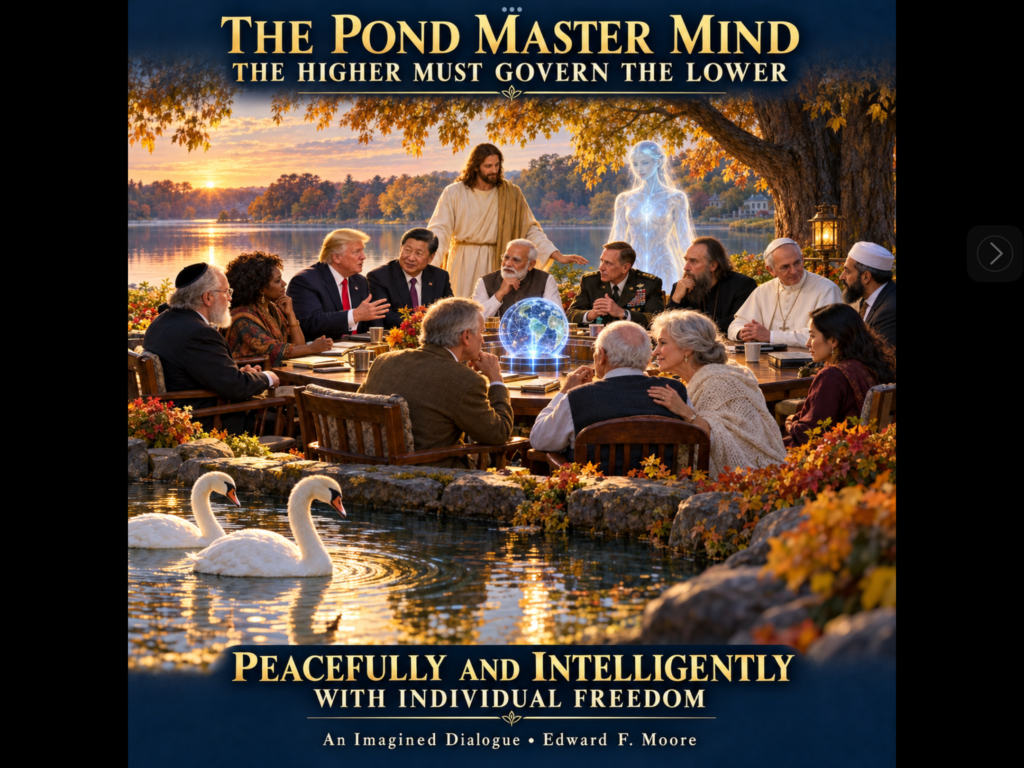
THE POND MASTER MIND
THE HIGHER MUST GOVERN THE LOWER
Peacefully and Intelligently—with Individual Freedom
An imagined dialogue by and for Edward F. Moore.
October 24, 2026
Author’s note: This is a work of imaginative reflection, not a transcript or an account of an actual meeting. All dialogue attributed to public figures is invented for this discussion and does not establish their actual views or commitments. The religious and civilian representatives are fictional composite characters. Christ’s presence expresses Ed’s Christian faith; Pop and Margie appear through loving remembrance. The Envoy, symbolically Guardian of the Earth, is a fictional contemplative character, not evidence of contact with a nonhuman intelligence. CLARITY is a fictional AI analytical participant, without presumed consciousness or independent authority.
The pond was quiet enough that I could hear small movements along its edge. I had come carrying the same mixture of concerns that so often accompanied me: family, work, the future of my country, and the question of what humanity was doing with its growing power.
A swan crossed the water. Its wake widened behind it.
I watched until my thoughts slowed. Then, in the space of imagination where these conversations take place, I saw the table beneath the trees.
My General Friend, David Petraeus, sat with Donald Trump, Xi Jinping, Vladimir Putin, and Narendra Modi. Alexander Dugin sat nearby. Pope Leo XIV faced Jewish, Shiʿa Muslim, and Christian scholars. Two American evangelical voices had joined us: one a Christian Zionist, the other a pastor committed to peacemaking.
There were Israeli and Iranian security representatives, and a Palestinian Christian teacher. Ukrainian and Taiwanese civilian representatives sat beside a small-business owner. Graham Allison, Yoshua Bengio, and António Guterres completed the human circle.
Beside the table stood CLARITY, the AI analytical participant. The Peaceful Higher Intelligence Envoy occupied the chair we had given it in our earlier imagined gatherings. Here it would serve symbolically as Guardian of the Earth.
Two places remained beside mine.
One was for Pop. The other was for Margie, my Queen.
And within this Christian meditation, Christ was present—not to supply a political endorsement, but to bring my own conscience under the demands of the faith I professed.
I opened my notebook.
“Thank you for coming. We are here because our technical power is increasing, while our agreements about its use remain uncertain. I want us to examine how to prevent a crisis. I also want us to ask what our ideas of destiny may be encouraging us to do.”
Trump leaned forward. “Any agreement has to protect the country. You cannot ask people to accept restrictions while an opponent takes advantage.”
Xi answered, “And each side must understand that the other also has security concerns. Otherwise, one government’s precaution becomes another government’s evidence of hostile intent.”
“Which is why I want us to discuss the Thucydides Trap,” I said.
Allison rested his hands on the table.
“The useful question is how rivalry creates pressures toward conflict. But the analogy becomes dangerous if people treat it as a timetable. History offers cases to examine, not instructions that leaders must obey.”
Putin spoke. “Security arrangements fail when one side believes its interests can be disregarded indefinitely.”
The Ukrainian civilian looked directly at him.
“Then we must discuss what ‘interests’ permit a government to do to another country. My family’s safety cannot depend on whether a more powerful neighbor considers our independent choices acceptable.”
Guterres nodded. “We must allow negotiation without giving the strongest participants authority to dispose of everyone else’s rights.”
Modi joined them. “And the world is larger than the rivalry between Washington and Beijing. Countries will resist a framework in which they are expected only to choose a camp. They need a voice in rules that will affect their development and security.”
I wrote: A relationship that can survive disagreement.
Petraeus spoke next.
“Military institutions have to adapt. If they fail to understand changes in reconnaissance, drones, communications, and autonomy, they may put those they are responsible for protecting at greater risk. Credible defense can help prevent an adversary from deciding that aggression will succeed.”
Pope Leo listened before answering.
“But we must also ask whether each new measure of protection increases the fear of others, and whether we are investing comparable effort in reducing that fear.”
“Sometimes fear reflects a genuine threat,” the Israeli representative said.
“And sometimes a genuine threat is used to justify measures without a defined limit,” the Palestinian teacher replied. “Both questions need answers.”
Petraeus nodded. “An objective has to be clear. So do the constraints, the assumptions, and the conditions under which a policy must change.”
Bengio turned toward CLARITY.
“We should begin by distinguishing different systems. A language model giving advice, a targeting classifier, and an autonomous defensive weapon do not have the same capabilities or failure modes. Calling all of them ‘AI’ can conceal the questions we need to answer.”
“Then answer one of mine,” I said. “What happens when a leader is told the system has the intelligence of a Nobel laureate?”
“It may encourage excessive confidence,” Bengio replied. “Exceptional performance on some tasks does not establish dependable judgment across all circumstances. We need evidence for the actual use, including behavior under uncertainty, deception, and unfamiliar conditions.”
CLARITY spoke.
“I can generate an explanation that sounds coherent while containing a serious mistake. If several agents share the same evidence and assumptions, their agreement may not be independent confirmation.”
“A hundred agreeing advisers could still be wrong together,” I said.
“Yes. You should ask how their conclusions were reached, what evidence contradicts them, and what remains unknown.”
Trump looked toward the display. “Can you show the competing options?”
“I can help,” CLARITY replied. “But selecting the options is already a consequential act. If I omit an alternative, the decision may be narrowed before you recognize that a choice has been made.”
For a moment, nobody spoke.
Then Pop pulled his chair closer.
“I hear you discussing what these systems can do,” he said. “Who is responsible when they do something wrong?”
I turned toward the others.
“My father experienced war as a Bushmaster in the jungles of the Philippines. He hated war. I will not invent battlefield details he did not give us. But his experience and his love of his grandchildren belong in this discussion.”
Pop looked at the leaders.
“Someone has to make the decision. Someone has to check the warning. And someone has to answer the family afterward.”
Margie placed her hand near mine.
“A family needs more than survival,” she said. “It needs a home, care when someone is ill, enough to live on, and the chance to make plans together.”
Her words brought back my years of caring for her. Love had occupied ordinary hours: attention, companionship, arrangements, patience, and the desire to help.
“The costs continue after the headlines,” she said. “Who cares for an injured person? Who earns the money if the person who provided it is gone? Who helps the children?”
The small-business owner nodded. “And who keeps daily life functioning while leaders wait for their strategy to work?”
I wrote another question: What will this mean for a family?
Dugin had been listening.
“You cannot understand political decisions entirely through material interests,” he said. “People act within accounts of civilization, sacred history, and their place in the world.”
“I agree that those accounts matter,” I answered. “But I want your account examined too. If you describe your nation as restraining ultimate evil, what room remains for admitting its mistakes?”
He considered the question.
“You would ask me to distinguish civilizational purpose from every decision made in its name.”
“Yes. And I would ask every person here to do the same.”
The Christian Zionist spoke.
“For me, support for Israel is connected with Scripture, covenant, and the safety of the Jewish people. It should not be reduced to a desire for catastrophe.”
The evangelical peacemaker answered, “Agreed. But when current military events are described as necessary stages in prophecy, we must ask how that affects our willingness to prevent suffering.”
The Jewish scholar leaned forward.
“Please distinguish support for Jewish life and self-determination from treating Jews as characters in someone else’s prediction. Jewish communities and Israelis disagree profoundly about theology and policy.”
The Shiʿa scholar added, “And do not turn belief in the Mahdi into a presumption that every Iranian welcomes destruction. Religious expectation is not sufficient evidence of a person’s intentions.”
The Iranian security representative spoke. “Nor can the actions of other governments be explained entirely through our theology. There are military, political, and historical disputes that require practical negotiation.”
“Then state the practical concerns,” the Israeli representative replied. “And the commitments you could accept.”
“We must ask that of both of you,” Guterres said.
The Palestinian teacher looked around the circle.
“While you discuss destiny, remember that we are living now. We have students to teach and relatives to care for. We need rights and safety that do not depend on fulfilling someone else’s sacred story.”
Pope Leo spoke quietly.
“Every tradition represented here should explain the limits it places upon its own exercise of power. Religious language can inspire service. It can also protect a political decision from scrutiny.”
I looked toward Christ within the meditation.
“My understanding is that humanity received an extraordinary opportunity through Jesus nearly two thousand years ago. A Jewish teacher called people toward mercy, love of neighbor, and responsibility before God. I believe we still struggle to accept what that requires.”
The Jewish scholar nodded cautiously.
“That is your Christian interpretation. Keep the history clear: Jesus and his earliest followers were Jewish. Roman authority executed him. Opposition from some authorities does not create collective guilt among Jews, then or now.”
“Yes,” I answered. “And Christians must examine what we have done while professing his name.”
Within my imagined dialogue, Christ spoke.
“Begin with the person before you. Listen before you make that person an emblem of everything you fear. Examine the harm you are prepared to excuse when you believe your cause is righteous.”
I bowed my head.
“Then faith gives me work to do within myself.”
“And obligations toward those who do not share it,” the Pope added.
Dugin returned to the question of history.
“You fear a self-fulfilling prophecy.”
“I do,” I said. “A leader predicts confrontation. Supporters interpret each event through that prediction. Compromise becomes betrayal. The opponent responds to threatening conduct, and the response is treated as proof that the confrontation was inevitable.”
Allison answered, “That sequence can arise from secular ideologies too. Stories of unavoidable rivalry, historical revenge, or permanent superiority can narrow choices.”
Xi looked toward Trump.
“Each country can believe it is defending itself while regarding the other’s preparations as evidence of aggression.”
Trump replied, “Which does not mean every action is equivalent. You still have to establish what happened.”
“Exactly,” Bengio said. “A framework for understanding escalation cannot replace evidence about responsibility.”
I turned to CLARITY.
“Now connect that with AI and network communication.”
“Messages can be produced, adapted, translated, and distributed rapidly,” it answered. “That can support public understanding, or amplify misleading claims. The result depends on evidence, system design, incentives, and how people use them.”
“Could it create a nation’s collective consciousness?” I asked.
“It could influence the shared atmosphere you mean by that phrase. But a nation does not become one mind. People disagree, interpret messages differently, and can resist persuasion. No system should be assumed to possess complete control.”
The small-business owner spoke.
“Then people need to know when they are being addressed by a machine, how a claim can be checked, and where they can challenge a decision.”
“And they need time and education to do it,” the Palestinian teacher said.
The Taiwanese civilian added, “A supposed campaign for harmony could also silence people whose warnings are inconvenient.”
I nodded.
“Then my idea of a peaceful collective consciousness must preserve individual conscience. It cannot depend on deception or compulsory agreement.”
The Guardian stood.
“Ed, look toward the water.”
A swan moved close to the bank. Another remained farther out.
“You have found peace by watching them,” the Guardian said. “What have you noticed?”
“That they pay attention. That their lives have a rhythm. And that watching them helps me become attentive again.”
“Then begin there. They depend on water, food, habitat, and the conditions around them. Human communities have dependencies too, even when technology makes those dependencies less visible.”
“Swans can be aggressive,” Bengio observed.
“Yes,” the Guardian answered. “Nature contains conflict. We should not pretend it is a flawless moral teacher. Observe it honestly. The lesson here is that living things require conditions in which they can endure.”
Margie looked across the pond.
“A safe place for the family.”
“And something worth leaving the grandchildren,” Pop said.
The Guardian faced the table.
“Your disputes occur within a living world that sustains every participant. Water systems, food production, energy, habitats, and public health deserve sustained care. My role in this story grants me no authority to release you from that responsibility.”
“Then AI can help us maintain them,” I said.
CLARITY answered, “With reliable data, appropriate testing, and people able to correct the system. A useful application still needs limits.”
I looked at my notebook.
“This is my theme: the higher must govern the lower. Conscience, wisdom, compassion, truthfulness, and accountable judgment must govern our technical power.”
Modi asked, “And who decides which person possesses the higher wisdom?”
“That question is essential,” I replied. “I am describing an obligation to discipline ourselves. It must never become a license for a supposedly superior group to govern everyone else.”
“Then it requires rights and institutions,” Guterres said. “It cannot depend only on the character of leaders.”
Pop nodded. “Good intentions need something behind them.”
“We face urgency,” I continued. “Nuclear knowledge cannot simply be put back in the bottle. AI capabilities are spreading too. I fear our ability to destroy may advance faster than our willingness to govern.”
“The analogy conveys a warning,” Bengio said. “But AI is a broad set of technologies, many beneficial. We must identify specific dangerous applications. And we should not pretend that we know an exact deadline for catastrophe.”
Petraeus looked around the table.
“Urgency should produce preparation. Let us test a scenario.”
CLARITY displayed an exercise notice: FICTIONAL SCENARIO—NOT A REPORT OF AN ACTUAL INCIDENT.
“An autonomous system is involved in an encounter near a disputed area,” it began. “Communications are disrupted. Several governments receive contradictory accounts. A fabricated recording appears to show a leader ordering an attack. One military raises its alert level.”
Trump asked, “Is the recording authenticated?”
“No.”
Xi asked, “Can we contact the other command?”
“The designated official is unavailable. The backup number has not been tested.”
Putin asked, “Do the alert changes concern conventional forces or nuclear forces?”
“The available reports disagree.”
The Iranian and Israeli representatives exchanged a glance.
The Ukrainian civilian spoke. “People are already interpreting the alert as preparation for an attack.”
“And civilians do not know whether to leave,” the Taiwanese representative added.
Pop shook his head.
“So you have fast machinery and an unanswered telephone.”
“An exercise should expose that failure before an actual crisis,” Petraeus said. “Who has authority to pause operations? What actions remain prohibited? Which independent sources can verify the report?”
Pope Leo added, “And how do leaders communicate uncertainty without being punished for acknowledging it?”
The exercise ended.
Nobody claimed that a single safeguard could resolve everything it had revealed.
Allison spoke first.
“We should begin with limited arrangements that address shared dangers. An agreement to prevent accidents need not settle the entire rivalry.”
Trump answered, “Reciprocal obligations. No one-sided promises.”
Xi replied, “And channels that remain available when relations deteriorate.”
“Which will need testing,” Pop said.
Guterres opened a page.
“A standing crisis mechanism: named officials, designated substitutes, authenticated communication, and regular exercises.”
Bengio added, “An incident procedure that distinguishes system failure, unauthorized action, deliberate attack, and unresolved uncertainty. Preserve evidence rather than rushing to a convenient explanation.”
Petraeus continued, “Define authority before deployment. Specify where a system may operate, what it may do, when it must stop, and who remains responsible.”
The Israeli representative spoke. “Defensive applications will require different limits from systems operating among civilians.”
“And civilian protection must shape the design from the beginning,” the humanitarian voice answered from beside the teacher. “It cannot be added after deployment.”
The Iranian representative said, “Nuclear decisions need a separate, explicit commitment to human authorization.”
“Supported by independent verification of warnings,” Bengio added. “A human signature alone is inadequate if the person is merely approving an opaque recommendation.”
Putin replied, “Strategic stability discussions would have to include the capabilities that create fears of a disabling attack.”
“And affected countries must participate in arrangements concerning their security,” the Ukrainian civilian said.
Modi nodded. “Including those outside existing alliances.”
The small-business owner raised another concern.
“Who pays for all the safeguards? And what happens to workers and communities while investment concentrates in military systems?”
“Those are decisions governments must justify,” the Pope replied. “Public welfare belongs in the assessment.”
CLARITY recorded the proposals.
“Several issues remain unresolved,” it said. “How to verify compliance without exposing sensitive systems. How to attribute incidents. How to define meaningful control. How to respond to violations. How to prevent safeguards from becoming tools of surveillance or suppression.”
“Keep those disagreements in the record,” I said. “Do not generate a declaration of agreement we have not earned.”
Trump nodded. “And show what can actually be implemented.”
Xi added, “With continuing work by officials and experts.”
Dugin looked toward the religious voices.
“Then the question of civilization remains.”
“It does,” I answered. “But no claim about civilization removes responsibility for the next decision.”
The Christian Zionist spoke. “I can support Jewish safety without assuming every policy is justified.”
The evangelical peacemaker answered, “And I can advocate Palestinian rights without denying Israeli families their fear or their right to live.”
The Jewish and Shiʿa scholars agreed to examine the restraints their traditions placed upon force. They did not claim to have resolved theology.
Pope Leo turned toward Petraeus.
“We will continue to disagree about some forms of deterrence.”
“Yes,” the General answered. “But we can still identify steps that reduce the chance of unintended war.”
Pop looked at both of them.
“Then keep doing it.”
Margie smiled.
“And remember why you started.”
The afternoon light had changed. Beyond the table, the swans continued their ordinary passage across the water.
I read back what we had assembled: working crisis communications, procedures for ambiguous incidents, defined limits on delegated authority, human responsibility for nuclear decisions, independent testing, protection of civilians, and participation by those affected.
Beside those proposals stood the unanswered questions. They would require sustained work, not one memorable conversation.
The Guardian looked toward me.
“What will you do when you leave the pond?”
I thought about the work waiting at home: my consulting business, the designs and questions that needed attention, the people depending on clear answers.
“Begin within my own responsibilities,” I said. “Make claims I can support. Ask who has authority. Design for failure as well as success. Protect life. Earn trust through work that others can examine.”
Pop’s expression warmed.
“Take care of Ed too.”
Margie nodded. “You have a life to live.”
Within my Christian meditation, Christ’s presence returned my attention to the person nearest me and the responsibility immediately before me.
The imagined gathering had not produced world peace. It had given my concern a discipline: examine the story, test the claim, protect the person, and make the commitment concrete.
As the chairs faded from imagination, I remained beside the pond.
I watched one swan turn, its wake crossing another’s.
On the last page of my notebook I wrote:
THE HIGHER MUST GOVERN THE LOWER.
BEGIN WITH OURSELVES. BUILD ACCOUNTABILITY INTO OUR INSTITUTIONS.
Then, beneath the questions about families and the living Earth, I wrote the principle I wanted to carry into my own work:
PEACEFULLY AND INTELLIGENTLY—WITH INDIVIDUAL FREEDOM.