019 — THE FAMILY TABLE
Where Love Becomes Family, Family Becomes Calling, and Earth Touches Heaven
When I think back to Boca Raton, Florida, I can still see Aunt Amy’s family table as clearly as if I were walking into the room again. Those years came after one of the most important religious periods of my life, a time connected in my memory with Uncle Frank, my grandmother Margie, and a growing sense that there was something sacred moving through ordinary human life. Aunt Amy, to me, was a saintly person, and living in that home became part of the religious experience itself. I would sit down with the family for a meal and feel surrounded by love, belonging, faith, and peace. Then, when the meal was over, I would get up, walk out the door, cross an entire golf course, and continue on to a construction site where I worked. At the time, I did not think of those moments as a lesson. I was simply living. Yet when I look back now, I can see that something was being shown to me. The family table gave me meaning, the work gave me responsibility, and the two were never really separate. I did not have to choose between spiritual life and ordinary life. I could sit at a table filled with family, feel that I belonged to something larger than myself, and then go out into the physical world and work. That memory has stayed with me almost every day of my life.
Years later, with Margie beside me, I began to understand what Aunt Amy’s table had really given me because Margie and I started building one of our own. We created Thanksgiving dinners where my Mom and Dad could look around and see children and grandchildren gathered together. We created Christmas tables filled with food, noise, gifts, stories, and people moving from room to room. We created Easter tables and family vacations and ordinary meals that, at the time, did not always seem extraordinary. We simply lived them. But looking back now, I understand that we were doing something much larger than preparing meals or celebrating holidays. We were creating a place where generations could be together. We were giving my Mom and Dad the joy of seeing the family continue beyond them, and Margie—my Queen Margie—was the person who helped me make that family table larger than anything I had imagined when I first sat at Aunt Amy’s table in Florida.
When I think about my greatest earthly achievements, I naturally remember business, construction, security, technology, entrepreneurship, and the professional work that has occupied so much of my life. I am proud of many of those things, and I still believe I have work left to do. But none of those accomplishments gives me quite the same feeling as remembering a table filled with family. Looking back now, I can say something more clearly than I ever could when I was younger: we built family. Margie and I created room in our lives for children, grandchildren, nephews, relatives, holidays, vacations, responsibilities, arguments, forgiveness, laughter, and memory. We made room at the table and, in doing so, we made room in our lives. That may be my greatest earthly achievement.
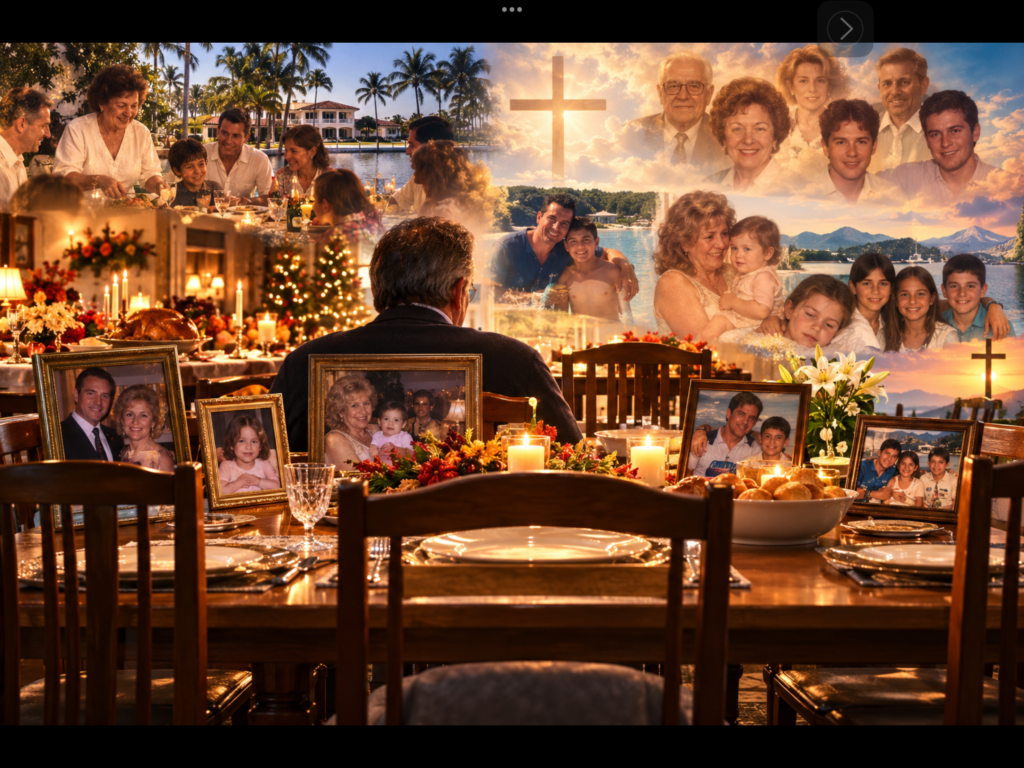
The photographs in my home tell that story better than any list of accomplishments ever could. Robert is there in Margie’s arms. In another picture, my arm is around him. In another, he is standing between Margie and me. My daughter appears as a child, asleep and safe. Justin appears in the old family-vacation photographs, and when I look carefully, I keep seeing the same thing: my arm around him. I had not thought much about that gesture at the time. I simply loved him and felt protective of him, especially during the years when he was still very much a child. Yet now that gesture seems to say something important about the kind of family I was trying to help create. I wanted people to know they belonged. I wanted them to feel that someone was there for them. The photographs are not random memories. They are evidence of the family table.
The table, of course, was never only a physical table. Sometimes it was Thanksgiving. Sometimes Christmas. Sometimes Easter. Sometimes it was a restaurant or a vacation or a family room filled with people who had traveled from different places to be together. Sometimes it was nothing more than a photograph taken before everyone moved on to the next thing. But the meaning was the same. We belonged to one another. The family table was where generations met, where children were cared for, where grandchildren were enjoyed, where older people could look across the room and see that life was continuing beyond them. It was where stories were repeated, where people disagreed and eventually forgave, where birthdays and holidays became markers of continuity, and where the ordinary moments of life became important simply because they were shared.
That is why I miss the family vacations so much. They were another form of the family table. We traveled together, ate together, saw new places together, and watched the children grow from one trip to the next. For a period of time, everyone was physically present in the same experience. I often had my arm around someone I loved. At the time, I was too busy living those moments to understand what they would later mean to me. Now I understand that some of the deepest meaning of my life was being created during those ordinary days.
The family itself has changed greatly since then. Some relationships remain close. Some have become distant. Some people I loved are no longer physically here. In my faith, I think of them as having entered the heavenly world. Kenny and Chris are gone. Justin is still living nearby, but there is presently no relationship between us by his choice. My brother’s daughter Jennifer remains part of my life, and through her the family has continued into another generation. Nicole, whom I remember enjoying when she was around two years old, is now married and has a son of her own. Bosco’s life took a different path and he is incarcerated. Michael and Emily, Margie’s children, came into my life when Michael was about eight and Emily about four. I have never thought of them as stepchildren. They became part of the family Margie and I were building. Michael now lives only about half a mile from me here in Smithtown. All of these relationships remind me that family does not move forward in a straight line. It changes. It separates. It grows. It suffers. It reconnects. It continues.
One relationship that has come back into my life is with my cousin Maryann, the daughter of Aunt Amy. That reconnection means more to me than simply recovering contact with a relative. Maryann carries me back to Boca Raton, to Aunt Amy, to Uncle Frank, to my grandmother, and to those years when the spiritual and the ordinary seemed to come together around one family table. Her presence in my life again reminds me that some relationships can return. Not every distance is permanent. Not every separation remains exactly as it was. I cannot force reconciliation with anyone, but I do not have to surrender the hope that relationships can be renewed.
That hope matters especially when I think about Robert and my daughter. Robert is moving toward adulthood and college. I cannot decide what he will choose or what kind of relationship he may want with me, but I can remain available. I can leave the door open. My daughter is an adult and married, living her own life. I cannot recreate the years that have passed between us, and I cannot make decisions for her. What I can do is continue building stability in my own life, becoming more capable, more secure, and more ready to receive relationship if the opportunity comes. The past cannot simply be restored, but perhaps a new relationship can one day be built by people who meet each other again as adults.
This is where I begin to understand something about the joy I once helped give Pop and Margie. I watched what children and grandchildren meant to them. I saw the happiness those relationships created. I helped give them that joy, and Margie helped me build the family life that made it possible. Perhaps now I must allow myself to want that same kind of joy. Perhaps I am allowed to receive some of what I once worked so hard to give to others. If I helped build the family table, perhaps I am also allowed to sit at it.
For much of my life, meaning came through giving. I gave time, care, protection, work, love, and family. I learned to measure meaning by what I could give to other people. Now I am beginning to understand that receiving joy is not selfish. The happiness of sitting with family, of knowing the next generation, of hearing stories, sharing a meal, and simply being together can also be a gift. I gave that gift to Pop and Mom. Margie and I gave it to ourselves and to the people around us. Maybe part of my calling now is to remain open enough to receive some of that gift again.
I know I cannot force it. That is important. The family table must remain an invitation, not a demand. I cannot control Justin’s decision to remain distant. I cannot decide what Robert will want when he is fully independent. I cannot determine what my daughter may or may not want from a future relationship. I cannot erase the years that have passed. What I can control is whether I remain capable of welcoming them. I can keep a place open. I can continue to work on my own life. I can try to become the kind of man who can sit at that table without bitterness, without demanding that the past be restored exactly as it was, and without expecting other people to carry my hopes for me.
That is also where business begins to take on a different meaning for me. I still want to build THL SCI. I still believe security, technology, consulting, entrepreneurship, and service are real callings. I still believe I have talents developed over a lifetime that should be used while I am still here. But I now see more clearly that business is not the final destination. It is part of the structure that may help me live the life I still hope to live. If I can build the business, improve my financial stability, use my experience well, and create more freedom in my life, then perhaps I am also creating the conditions in which family relationships can become more possible again.
That gives the work a different purpose. I do not want success merely to say that I succeeded. I want enough stability to participate fully in the relationships that matter most. I want to be able to travel if needed. I want to be able to invite people. I want to be able to sit at the table without worrying that everything depends upon tomorrow’s uncertainty. I want the work to support life rather than replace it.
When I think about my nation, the same image returns. I have spent much of my life thinking about America, service, security, freedom, responsibility, and the future. Those are large ideas. Yet when I ask myself what kind of country I actually hope for, I do not first see an institution. I see families. I see grandparents knowing grandchildren. I see children learning where they came from. I see older people being remembered rather than forgotten. I see younger people knowing that there is a place where they belong. I see disagreements that do not automatically become permanent separation. I see people sitting down together. I see tables.
That is why the family table has become such a powerful symbol for me. It connects the spiritual experiences of my early life with the family Margie and I later built. It connects Aunt Amy’s home in Boca Raton with Thanksgiving, Christmas, and Easter in our own family. It connects Pop and Mom with the grandchildren who gave them so much joy. It connects the people who are still here with the people I believe are now in the heavenly world. It connects my memories with the hope that there may still be new memories ahead.
And perhaps this is what Witness to Calling has been leading me toward all along. It is not merely a witness to religious experiences, and it is not merely a witness to business accomplishments, history, national service, security, technology, or the changing world. It is also a witness to the place where love becomes visible in ordinary human life. It is a witness to children being held, to grandchildren sitting with grandparents, to families gathering at Thanksgiving, Christmas, and Easter, to vacations, laughter, photographs, arguments, forgiveness, and memory. It is a witness to people going away and sometimes finding their way back. It is a witness to love surviving absence and to one generation giving something meaningful to the next.
When I look at the dining-room table in Smithtown now, I see photographs where people once sat. I see Robert in Margie’s arms. I see my daughter as a child. I see family vacations. I see reminders of my Holy Family. I see people who are still here and people who are no longer physically present. The table is quieter now, but it is not empty. It is filled with memory, and memory, if I allow it, can become hope.
Sometimes I imagine what it might feel like to sit at a family table again before I leave this Earth. I do not picture an exact recreation of the past. I picture something new. Maybe Robert walks through the door as a grown man. Maybe my daughter sits down and we meet each other again as the people we have become. Maybe Maryann is there and reminds me simply by her presence that relationships can return. Maybe another generation asks about Pop or Margie, and I tell the story. Perhaps the table is set for Thanksgiving, with the familiar smells of a meal that once brought generations together. Perhaps it is Christmas, with people arriving, coats being hung up, voices filling the room, and memories forming almost without anyone noticing. Perhaps it is Easter, carrying the spiritual meaning that has always been part of my life. Or perhaps it is nothing more than an ordinary Sunday meal, without a special occasion at all. That would be enough, because the deepest meaning was never really in the holiday itself. The holiday simply gave us a reason to gather. The real meaning was in the people who came through the door, the people who sat down, the people who laughed, remembered, disagreed, forgave, and shared the same afternoon. It was in seeing them together and knowing that, for one meal, one afternoon, one photograph, one moment in time, we belonged to one another.
That is what I once received in Aunt Amy’s home. That is what Margie and I later built in our own life. That is what we gave to my Mom and Dad, to Pop, to children, grandchildren, nephews, and the people who became part of the family story. We created a place where people could gather and know that there was room for them. We made the table larger, sometimes literally and sometimes simply by opening our lives wider. And before I leave this Earth, I hope I am blessed to experience that feeling again—not by pretending that the years between then and now never happened, but by sitting with the people who may still choose to come and allowing a new family memory to be created in the present.
So when I look at the family table now, surrounded by photographs and reminders of the people who shaped my life, I do not see only what has been lost. I see what was built. I see Robert in Margie’s arms and remember the joy she received from knowing her grandson while she was still physically here. I see my daughter as a child and remember the years when family responsibilities gave shape to my days. I see Justin in the old vacation pictures, often with my arm around him, and remember the love and protectiveness I felt toward him. I think about Kenny and Chris, Aunt Amy, Uncle Frank, Pop, Margie, and the others who, in my faith, have entered the heavenly world. I think about Maryann and the relationship that returned. I think about Jennifer, Nicole, Robert, Michael, Emily, and the generations that are still moving forward. The table in front of me may be quiet, but the story surrounding it is very much alive.
In my faith, I believe that the love we form here matters beyond the moment in which it is experienced. I cannot prove exactly how those relationships continue beyond earthly life, but I believe they do. I believe Pop, Margie, Aunt Amy, Uncle Frank, Kenny, Chris, and the others I carry in my heart remain part of a larger spiritual story that I do not completely understand. That belief changes the way I look at family relationships that are still possible here. If love has an eternal dimension, then every relationship I preserve, every relationship I rebuild, every act of forgiveness, every moment of genuine connection, and every new memory created around a family table becomes part of something larger than one afternoon.
Perhaps that is why the family table matters so much to me. It connects the people who came before me with the people who are still living and the people who may come after me. It connects my memories of Boca Raton with the tables Margie and I later built. It connects Thanksgiving, Christmas, Easter, vacations, and ordinary Sunday meals into one continuing story. It connects Earth and Heaven in the way I understand my faith. It connects the love I received with the love I was able to give, and it reminds me that there may still be love waiting to be received again.
I do not know exactly who will sit around my table in the years ahead. I cannot decide that for anyone else. I cannot command reconciliation or erase the distance that time and circumstances have created. What I can do is make sure there is still a place available. I can remain open to the possibility that Robert may one day walk through the door as a grown man, that my daughter and I may meet again as the adults we have become, that another generation may sit down and ask me about the people in the photographs. I can remain capable of welcoming them without demanding that they recreate the past.
That, perhaps, is the deepest meaning of the family table for me now. I received it before I even understood what it was. With Margie beside me, I helped build it. We watched it grow as children and grandchildren entered our lives. We gave its joy to others and received its joy ourselves. Then I watched some of it change, some of it scatter, and some of its chairs become empty. Yet I have come to understand that my calling is not to mourn the empty chairs forever. My calling is to keep the table open for the living.
And perhaps that is what Witness to Calling has been trying to tell me all along. My story is not only about the religious experiences I have had, the businesses I have built, the work I have done, or the ideas I have carried about my country and the world. At its deepest level, it is a witness to the place where all of those things become human. It is a witness to the people for whom we work, the people we love, the people we forgive, the people we remember, and the people for whom we continue to make room.
It is a witness to the family table.
And while I remain here on Earth, I want there to be a chair beside mine.