There comes a time in a human life when the questions we ask begin to change.
When we are young, we naturally ask what we are going to do with our lives. We think about education, work, marriage, family, achievement, security, and the future. We try to discover where we belong in the world. We make decisions, mistakes, commitments, and sacrifices. We encounter people who influence us, people whom we love, people whom we lose, and sometimes people from whom we become separated. Through all of this, whether we recognize it at the time or not, something within us is being formed.
As the years have passed, I have increasingly come to believe that the deeper question is not simply, What do I want from life?
It is: What is life asking of me?
That question has followed me through much of my journey—from my family and childhood in Farmingdale, through military service, enterprise, marriage and caregiving, faith and spiritual searching, success and failure, relationships and estrangement, loss and rebuilding, and my continuing concern for America and the world.
Looking backward, experiences that once seemed separate no longer appear entirely separate. They increasingly seem like parts of one continuing formation of the soul.
And that has brought me to a question that I believe is not mine alone.
It is a question for America—and perhaps for every human being willing to ask it.
The Question of Individual Purpose
At a time when our Nation and our World face extraordinary technological, economic, social, environmental, and human challenges, perhaps one of the most important questions is not simply what our governments, institutions, businesses, universities, churches, or leaders should do.
Those questions certainly matter. Institutions matter. Leadership matters. Laws and policies matter.
But institutions are ultimately created, directed, sustained, and sometimes corrupted by individual human beings.
Therefore, beneath the institutional question lies a more fundamental human question:
What responsibility belongs to each of us?
For me, that question has gradually taken this form:
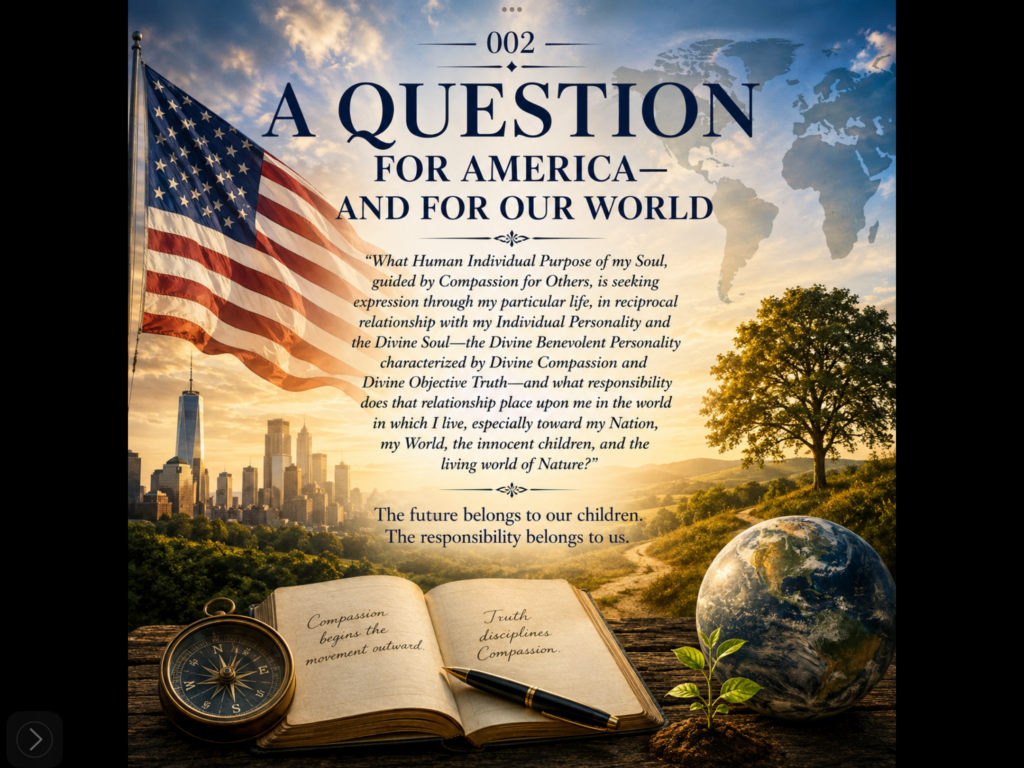
“What Human Individual Purpose of my Soul, guided by Compassion for Others, is seeking expression through my particular life, in reciprocal relationship with my Individual Personality and the Divine Soul—the Divine Benevolent Personality characterized by Divine Compassion and Divine Objective Truth—and what responsibility does that relationship place upon me in the world in which I live, especially toward my Nation, my World, the innocent children, and the living world of Nature?”
I do not present this as a theological formula that others must accept. It is the language through which I have come to understand my own spiritual journey.
It attempts to describe a relationship between the individual human person, the soul, and the Divine—and then to ask what practical responsibility should follow from that relationship.
Because spirituality that never reaches the world around us risks becoming merely an inward experience.
If Compassion is real, it must eventually move outward.
If Truth is real, it must influence how we see ourselves and the world.
And if calling is real, it must eventually become responsibility.
Compassion and Truth
Two words have become increasingly important in my understanding of this journey: Compassion and Truth.
Compassion begins the movement outward.
It asks us to recognize that another person’s suffering matters. It expands the boundaries of concern beyond ourselves. It can begin within the family, but it does not necessarily end there. Properly developed, Compassion reaches toward the neighbor, the stranger, the nation, humanity, the innocent child we will never meet, and even the living natural world that cannot speak for itself.
But Compassion by itself is not enough.
Compassion must be accompanied by Truth.
Truth disciplines Compassion.
Without Truth, even good intentions can become misguided. We can convince ourselves that we are helping when we are actually avoiding difficult realities. We can confuse sentiment with wisdom. We can protect ourselves from uncomfortable facts because acknowledging them might require something from us.
Truth asks us to see reality as objectively as we are capable of seeing it.
Compassion asks us to care about what we see.
Together they create responsibility.
This understanding has become central to my conception of the Holy Spirit and the Gospel of Christ. I have increasingly understood Divine Personality through these qualities—not as an abstraction separated from human existence, but as a benevolent spiritual orientation toward Compassion and Objective Truth that can become progressively expressed through individual human personality.
The Importance of Individual Personality
Yet I do not believe that spiritual development requires the destruction of individuality.
Quite the opposite.
Individual Personality gives the soul a particular means of expression.
Every person enters life with a different combination of abilities, circumstances, relationships, opportunities, limitations, experiences, and choices. We do not encounter the world from identical positions, and therefore responsibility will not look exactly the same for everyone.
One person may express Compassion through raising a family. Another through medicine. Another through teaching. Another through engineering, farming, public service, enterprise, art, science, ministry, military service, caregiving, or simply being the person who refuses to abandon another human being during a difficult time.
The question is not whether everyone receives the same assignment.
The question is whether each person is willing to discover what his or her particular life makes possible—and what it therefore makes responsible.
Freedom becomes essential here.
A human being cannot genuinely love through coercion. Compassion compelled from outside is not the same as Compassion freely embraced from within. Individual Personality therefore provides not only uniqueness but freedom: the possibility that a person may consciously choose whether and how to respond to the responsibilities placed before him.
In this sense, Divine Personality provides the transcendent orientation, while Individual Personality provides the human means through which that orientation may become expressed in the world.
From the Individual to the Nation
My own journey has repeatedly brought me back to America.
My concern for the Nation did not begin as an abstract political philosophy. It became particularly intense during the closing period of the Vietnam era and my concern for the condition of American military service. Something happened within me during that period. Concern for those who served widened into concern for the country they served, and concern for the country gradually became part of a much larger spiritual concern for humanity.
Over the years, I came to understand Americanism not merely as nationalism and certainly not as allegiance to a political party.
At its best, America represents an extraordinary proposition about the human person: that individuals possess dignity; that freedom matters; that government exists under law; that conscience cannot simply be commanded; that enterprise and productive work can improve human life; and that liberty carries responsibilities as well as rights.
America has never perfectly fulfilled those principles.
Neither have I perfectly fulfilled the principles by which I have tried to live.
But imperfection does not invalidate an ideal. It creates the continuing responsibility to move closer to it.
The renewal of America therefore cannot be accomplished solely in Washington, in state capitals, in corporate boardrooms, universities, churches, military headquarters, or laboratories.
It must also occur within individual human beings.
The person influences the family.
The family influences the community.
The community influences the Nation.
And the character of the Nation influences the world.
The Widening Circle of Responsibility
This progression has become increasingly important to me.
Responsibility begins close to us, but it should not necessarily remain there.
We begin with responsibility for ourselves—not selfishness, but stewardship of the life we have been given.
Then comes family.
Then community.
Then Nation.
Then humanity.
And eventually we must recognize responsibility toward those who possess the least power over the decisions being made in their name: children and future generations.
A child born twenty or fifty years from now has no vote in the decisions we make today.
That child cannot participate in today’s elections, corporate decisions, technological developments, wars, environmental choices, public debts, infrastructure investments, or applications of artificial intelligence.
Yet that child will inherit their consequences.
That creates a profound moral asymmetry.
We possess power that future generations do not.
Therefore, we possess responsibility that future generations cannot yet exercise for themselves.
And beyond humanity lies the living world of Nature itself—the soil, water, air, forests, animals, oceans, and ecosystems upon which human civilization depends.
Nature has been one of my own teachers.
There are times when sitting beside a pond, watching the swans and ducks, observing the changing light upon the water, or simply becoming quiet among living things has taught me something that activity could not.
Nature reminds us that human civilization exists within life, not outside it.
Technology may become extraordinarily powerful. Artificial intelligence may transform civilization. Human beings may create machines and systems beyond anything previous generations imagined.
But no technological achievement eliminates our dependence upon the living Earth.
Progress that destroys the conditions necessary for life cannot ultimately be called progress.
Spiritual Consciousness Must Become Action
This brings me back to the central issue of calling.
A calling cannot remain forever an idea.
Responsibility converts spiritual consciousness into action.
That action need not always be dramatic. Much of the good accomplished in the world occurs quietly—in homes, workplaces, neighborhoods, classrooms, hospitals, businesses, houses of worship, laboratories, workshops, military units, farms, and countless ordinary relationships.
Most people will never become presidents, generals, billionaires, famous scientists, religious leaders, or historical figures.
That does not make their lives insignificant.
Perhaps we have sometimes misunderstood significance.
The worth of a life may not ultimately be measured by how many people know our name. It may be measured by whether the particular life entrusted to us became an instrument through which something good entered the world.
Did we protect someone?
Did we teach someone?
Did we build something worthwhile?
Did we reconcile when reconciliation was possible?
Did we speak truth when silence was easier?
Did we create rather than merely consume?
Did we leave something useful for those who came after us?
Did we become more compassionate without surrendering truth?
Did we become more truthful without surrendering compassion?
These are questions I increasingly ask myself.
A Question, Not a Claim
I am still working through these ideas.
Witness to Calling is not the story of a man who discovered all the answers.
It is the story of a man who lived an ordinary and imperfect human life and gradually began to recognize that the events of that life might contain a question larger than himself.
Perhaps calling is not always a voice telling us exactly what to do.
Perhaps calling can emerge gradually through conscience, relationships, suffering, responsibility, study, prayer, work, failure, love, loss, and the persistent recognition that something remains for us to give.
That possibility has become increasingly important to me as I have grown older.
The question is no longer how much time has passed.
The question is what responsibility remains within the time that remains.
And perhaps nations must ask a similar question.
America has accumulated extraordinary power, knowledge, wealth, technology, and influence. What purpose should those capabilities serve?
Humanity itself now possesses powers our ancestors could scarcely have imagined. What kind of civilization will we use them to create?
Will knowledge outrun wisdom?
Will technology outrun Compassion?
Will ideology replace Truth?
Will individual freedom become detached from individual responsibility?
Or can human beings consciously bring freedom, knowledge, enterprise, technology, Compassion, and Truth into a more benevolent relationship with one another?
I cannot answer those questions for America.
I cannot answer them for the world.
I can only attempt to answer them through my own life.
And perhaps that is where the answer must begin for each of us.
Not merely:
What should they do?
But:
What is mine to do?
What Human Individual Purpose is seeking expression through the particular life I have been given?
What responsibility follows from the freedom I possess?
What can I contribute to my family, my community, my Nation, and my World?
And what will the children who inherit what we leave behind someday say about what we chose to do with the extraordinary powers entrusted to our generation?
Perhaps the renewal of America—and ultimately the possibility of a more peaceful and benevolent world—does not begin only in institutions.
Perhaps it begins within individual human beings who freely ask what responsibility their own lives place upon them and then find the courage to act upon that responsibility with Compassion and Truth.
The future belongs to our children.
The responsibility belongs to us.