WITNESS TO CALLING — COMPANION REFLECTION
THE RECIPROCAL RELATIONSHIP
AND THE MORAL ARC OF HUMAN HISTORY
The Universal Creative Life Force, the Divine Personality, the Holy Spirit of Truth and Compassion, and the Testing of Leaders and Nations from 1776 to 2026
A Companion to “Self-Contemplation of the Divine Personality of Man”
This reflection develops a theological interpretation of human history. Historical events, laws, wars, reforms, and documented acts can be examined as matters of fact. Whether a particular individual was inwardly in a reciprocal relationship with God cannot be historically proven. In this document, therefore, “reciprocal relationship,” “loss of relationship,” and “judgment by the Holy Spirit” are used as a Christian moral framework for discerning the fruits of leadership: truth or falsehood, compassion or cruelty, humility or pride, freedom or domination, reconciliation or vengeance, and respect or contempt for the dignity of the human person.
1. THE PREMISE: THE CREATIVE LIFE FORCE ENTERS HISTORY THROUGH PERSONALITY
The first companion reflection argued that the Creative Process of Life does not end with the physical creation of the human being. Life develops intelligence; intelligence develops individuality; individuality develops personality; and personality becomes self-conscious, morally responsible, and creatively active. The present reflection carries that premise into history.
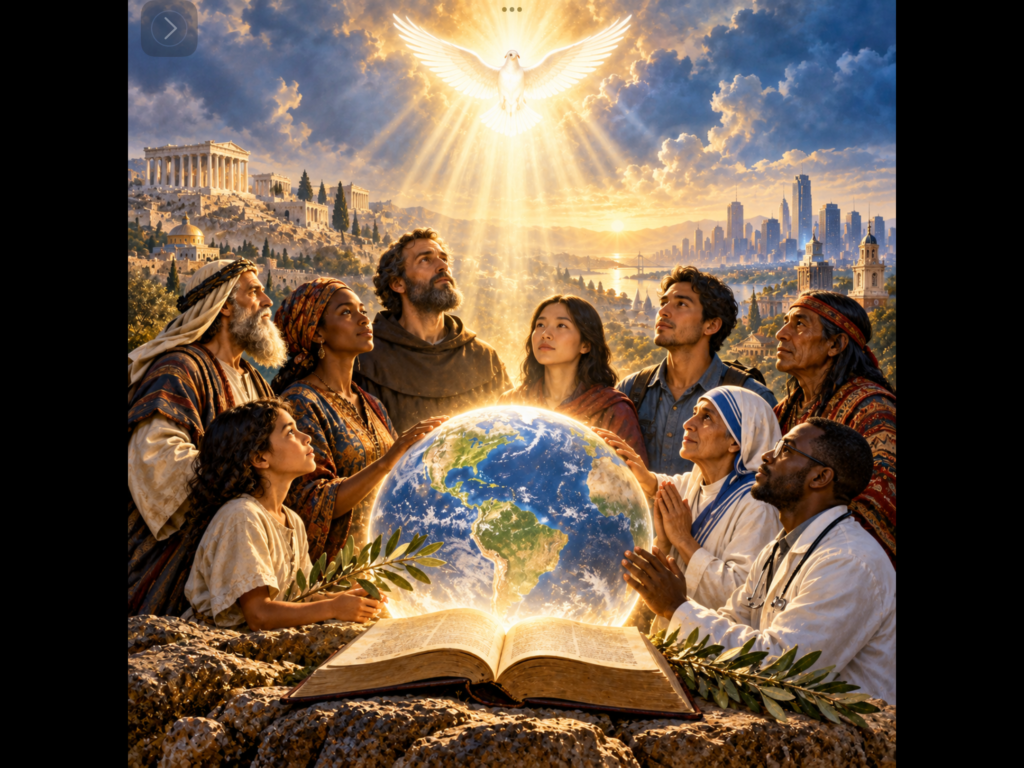
Within this theological framework, the Universal Creative Life Force may be understood as the Originating Spirit: the source of life, intelligence, order, possibility, and personality. Christian faith adds a decisive proposition. The Creator does not merely stand outside human history. The Spirit of God can act within the conscience, imagination, judgment, courage, compassion, and responsible freedom of individual human beings. The human person does not become God. Rather, the person becomes capable of responding to God and of expressing, however imperfectly, qualities associated with the Divine Personality: truth, love, justice, mercy, creativity, courage, restraint, fidelity, and peace.
This relationship is reciprocal because the individual is not passive. Life is received, but a response is required. Intelligence is received, but it must be directed. Freedom is received, but it must be exercised. Conscience speaks, but conscience may be obeyed or suppressed. Power may be used for service or domination. Knowledge may become wisdom or pride. The individual therefore becomes a point at which spiritual possibility enters the material world.
Human history can be read, in part, as the cumulative consequence of these responses. A single person cannot control history, and great events always arise from many social, economic, technological, cultural, and institutional causes. Yet persons matter. Their convictions shape laws, armies, movements, corporations, churches, scientific institutions, and nations. The stronger the office and the greater the technological power available to the individual, the greater the consequences of character.
This is why the spiritual development of personality is not a private luxury. It is a matter of civilization.
2. THE HEBREW PROPHETIC PATTERN: POWER MUST ANSWER TO A HIGHER LAW
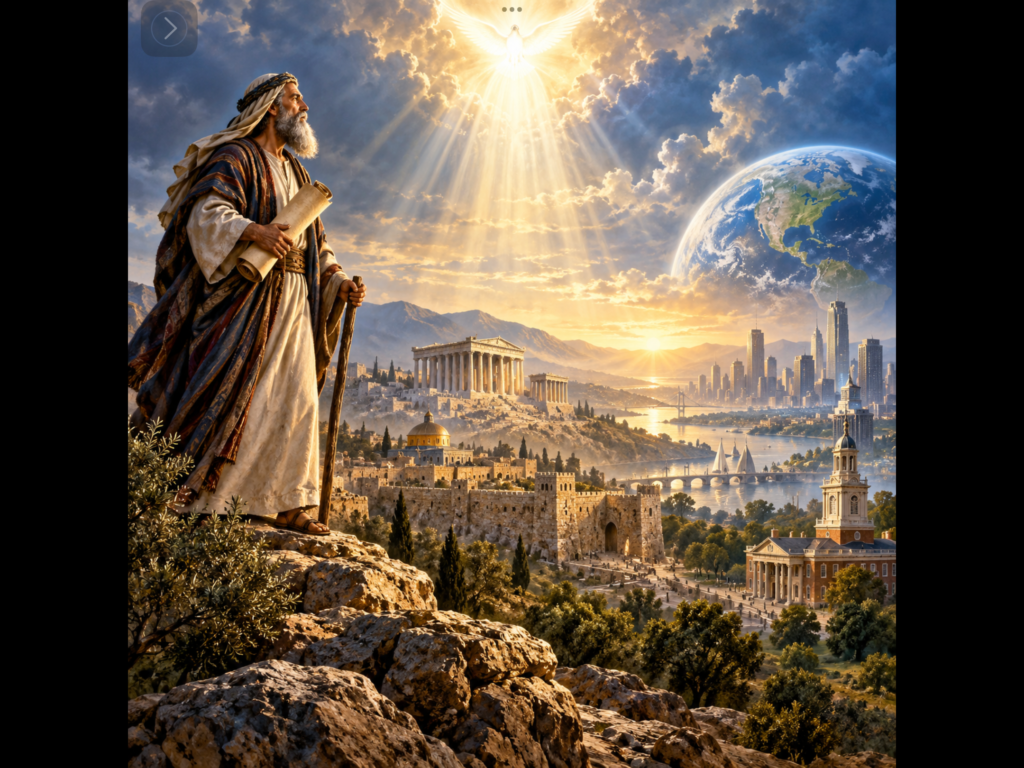
The Hebrew prophetic tradition is one of history’s most important models for placing political power beneath moral law. The prophet is not merely a predictor of future events. At the center of the biblical prophetic vocation is the obligation to speak truth when kings, priests, institutions, or nations depart from justice.
Moses confronts Pharaoh and represents a people whose dignity cannot be reduced to economic usefulness or political subordination. The Exodus narrative establishes a recurring biblical theme: power is not justified merely because it possesses force. Authority becomes morally corrupt when it treats persons as property and refuses the claims of justice.
Samuel warns Israel that kingship itself carries dangers. Nathan confronts King David after David’s abuse of power in the matter of Uriah and Bathsheba. The importance of Nathan’s confrontation is constitutional in the deepest spiritual sense: even the anointed king is not above moral law. The ruler can be judged.
Elijah confronts Ahab and Jezebel in the matter of Naboth’s vineyard, where royal desire, false accusation, institutional manipulation, and death are used to seize what belongs to another. The story is a warning against the fusion of appetite and state power.
Amos condemns religious observance divorced from justice. Isaiah demands protection of the vulnerable. Micah joins justice, mercy, and humility. Jeremiah warns rulers and nations that false confidence, self-deception, and oppression cannot be concealed beneath religious language. Ezekiel condemns shepherds who feed themselves while neglecting the flock.
Across these writings, a principle emerges: the covenant is not a license for national self-glorification. Election creates responsibility. The closer a people claims to stand to God, the more seriously it must accept judgment for injustice.
That principle is essential for Judaism, foundational to Christianity, and relevant to every nation that uses religious vocabulary to describe its mission. No nation can make itself righteous by proclamation. Its fruits must be examined.
3. CHRIST: THE DIVINE PERSONALITY REVEALED THROUGH TRUTH, COMPASSION, AND SELF-GIVING POWER
Christian faith carries the prophetic pattern into the person of Jesus Christ. Christ does not abolish moral judgment; He deepens it by locating the roots of violence and domination within the human heart. Pride, hatred, hypocrisy, contempt, greed, vengeance, and the desire to rule others become spiritual problems before they become political systems.
The temptations of Christ are therefore politically significant. Power is offered without the path of service. Spectacle is offered in place of faithfulness. Material provision is separated from spiritual truth. Christ refuses these substitutions.
His model of authority is radically different from domination. He teaches that greatness is expressed through service. He places the neglected, the sick, the poor, the stranger, and the sinner within the field of moral concern. He confronts hypocrisy while refusing the easy intoxication of vengeance. He can be severe toward corruption and compassionate toward the individual at the same time.
The crucifixion represents the collision between spiritual authority and systems of political, social, and religious power. The resurrection, in Christian faith, declares that domination does not possess the final word.
The Holy Spirit then becomes central to Christian historical responsibility. In the Gospel of John, the Spirit is associated with truth. In Christian moral life, the Spirit also produces fruits such as love, peace, patience, kindness, goodness, faithfulness, gentleness, and self-control. These are not sentimental traits. They are disciplines of power.
A leader governed by truth must resist propaganda and self-deception. A leader governed by compassion must see persons rather than categories. A leader governed by humility must accept correction. A leader governed by self-control must know that possession of power does not authorize every possible use of power. A nation governed by these principles must be capable of defending itself while remaining subject to law and conscience.
4. WHAT IT MEANS TO “JUDGE BY THE HOLY SPIRIT”
To say that leaders and nations should be judged by the Holy Spirit must not become a claim that one faction possesses God while another does not. That would reproduce the very pride this framework is intended to restrain.
The safer and more demanding Christian method is judgment by fruits. Does leadership produce greater truth or greater falsehood? Does it protect the dignity of persons or convert human beings into instruments? Does it encourage freedom of conscience or require ideological submission? Does it protect the weak while maintaining justice? Does it restrain power through law? Does it make peace more possible, or does it require permanent enemies to sustain itself? Does it acknowledge error and permit correction? Does it cultivate humility, or a cult of personality? Does it reconcile legitimate differences, or deliberately inflame them?
This test also applies to causes we support. A nation may defend a just principle and still commit unjust acts. A leader may perform an historically important service while remaining personally flawed. A political movement may begin in legitimate grievance and become corrupted by revenge. A religious movement may proclaim truth while acting without compassion.
The Holy Spirit of Truth and Compassion therefore does not permit convenient moral accounting. Truth without compassion becomes cruelty. Compassion without truth becomes sentimentality. Justice without mercy can become vengeance. Mercy without justice can protect abuse. Courage without humility becomes arrogance. Humility without courage becomes surrender to wrongdoing.
The mature spiritual personality must hold these goods together.
5. 1776: THE AMERICAN PROPOSITION AND ITS CONTRADICTION
The year 1776 provides an appropriate starting point because the Declaration of Independence articulated one of the most consequential moral propositions in modern political history: human beings possess equality and unalienable rights that precede government. The National Archives preserves the Declaration’s appeal to the “Laws of Nature and of Nature’s God” and to rights endowed by the Creator.
The spiritual significance of this proposition is not that the Founders completed the work of human liberty. They plainly did not. Slavery existed. Women lacked equal political status. Native peoples suffered dispossession and war. The political community did not yet embody the universal language it proclaimed.
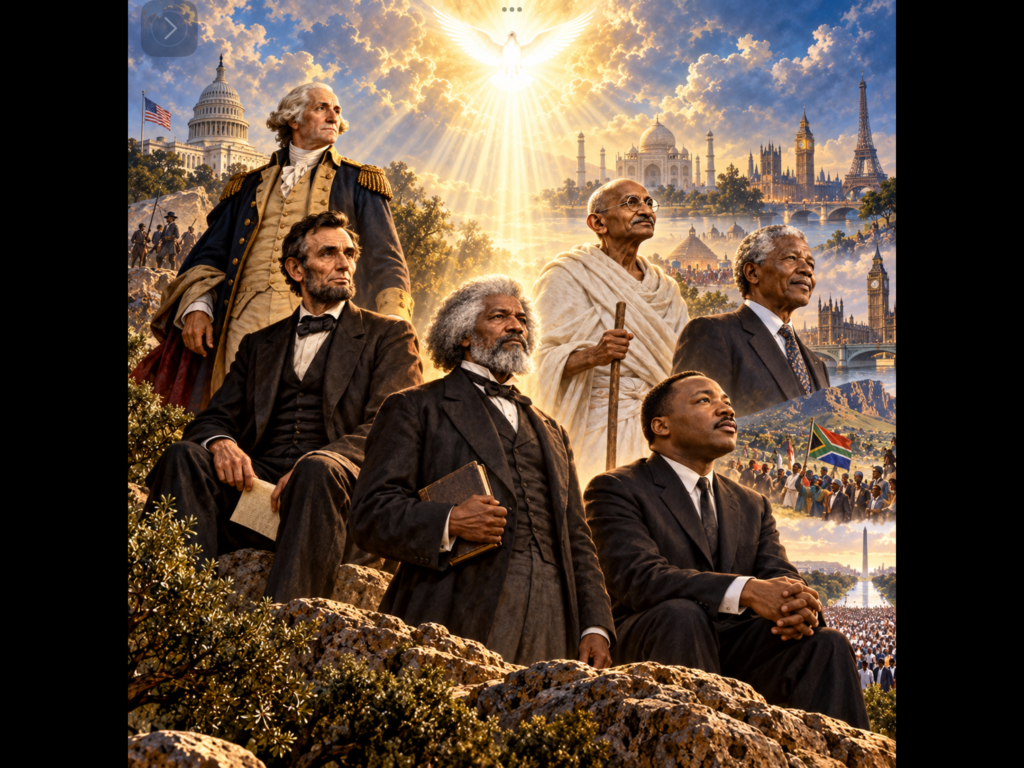
The significance is that the nation placed above itself a principle capable of judging the nation. The Declaration created a moral standard that later generations could use against American injustice. Abolitionists could ask whether slavery was compatible with created equality. Frederick Douglass could expose the contradiction between national ideals and national practice. Lincoln could return the country to the proposition of equality. The civil-rights movement could demand that the nation honor its own creed.
George Washington illustrates both the possibilities and contradictions of historical personality. His decision to relinquish military command after the Revolution and later leave the presidency helped establish habits of civilian government and peaceful transfer of power. Yet Washington was also a slaveholder. His will provided for the eventual emancipation of the enslaved people he personally owned, evidence of moral movement, but it did not erase the injustice in which he had participated.
The appropriate lesson is neither canonization nor condemnation of the whole person. It is that even historically constructive leadership remains subject to judgment. The prophetic principle stands above the hero.
6. THE FRENCH REVOLUTION AND NAPOLEON: WHEN LIBERATION CAN BECOME INTOXICATED WITH POWER
The French Revolution proclaimed liberty, equality, and fraternity and dismantled structures of inherited privilege. Its language contributed to the global development of citizenship and rights. Yet the Revolution also demonstrates how a legitimate revolt against injustice can lose moral direction when ideological certainty becomes absolute.
The Reign of Terror converted political suspicion into machinery of death. Revolutionary virtue, when fused with fear and unchecked state power, became capable of eliminating the persons it claimed to liberate.
Napoleon Bonaparte preserved and spread important legal and administrative reforms, including elements of civil equality under law, while also concentrating power, restricting political freedom, and pursuing wars across Europe. The same personality could carry administrative genius and imperial ambition.
Within the reciprocal-relationship framework, the lesson is clear. Creative intelligence is not enough. Reforming energy is not enough. Even ideals of liberty become dangerous when the leader or movement begins to believe that its purpose places it beyond restraint.
Pride is politically dangerous because it turns a limited human judgment into an absolute one.
7. ABOLITION, LINCOLN, AND THE SECOND AMERICAN FOUNDING
The American Civil War represents one of the most severe moral tests in the history of the United States. Slavery was not merely an inconsistency in abstract philosophy. It was a legal, economic, social, and coercive system that denied millions of persons control over their own bodies, families, labor, and futures.
Abraham Lincoln was not perfect, and his views evolved. Historical honesty requires that development to be acknowledged. Yet his presidency became inseparable from emancipation and the preservation of a Union increasingly redefined around freedom.
At Gettysburg, Lincoln returned to 1776 and described the nation as dedicated to the proposition of equality. In doing so, he transformed the Declaration from a revolutionary statement into a continuing standard of national judgment. The Civil War became a test of whether a nation founded upon such a proposition could endure.
Frederick Douglass is equally important to this spiritual history. He forced Americans to hear the testimony of the enslaved and repeatedly measured the Republic against its own principles. He demonstrates a prophetic function outside formal office: speaking truth to a nation that preferred partial memory.
The Thirteenth, Fourteenth, and Fifteenth Amendments altered the constitutional order, but Reconstruction was followed by racial terror, disenfranchisement, and segregation. This too is part of the pattern. Moral progress is not irreversible. A people may receive a truth and later retreat from its implications.
The Holy Spirit framework therefore cannot be reduced to a single heroic moment. It requires continuing fidelity.
8. INDUSTRIAL POWER, EMPIRE, AND THE QUESTION OF THE HUMAN PERSON
The nineteenth and early twentieth centuries multiplied human productive power. Railroads, electricity, telegraphy, industrial manufacturing, modern finance, and mass urbanization transformed civilization. This development demonstrated the Creative Process operating through scientific and entrepreneurial intelligence.
But industrial power also exposed a spiritual danger: persons could increasingly be treated as units of production, colonial subjects, racial categories, or expendable populations.
European empires produced infrastructure, legal systems, trade networks, and institutions, but they also frequently subordinated peoples without their consent. The history of empire therefore cannot be honestly described only as civilization or only as exploitation. It must be morally examined case by case, with the dignity and agency of subject peoples included in the judgment.
The abolition of the transatlantic slave trade and slavery within many empires represented genuine moral progress. Yet emancipation did not automatically eliminate racial hierarchy or economic domination.
The lesson for modern technological civilization is direct. Material development is morally incomplete if the human person becomes secondary to the system.
9. GANDHI AND INDIA: NONVIOLENCE AS POLITICAL POWER
Mohandas Gandhi gave the twentieth century one of its most influential demonstrations that disciplined nonviolence can become a form of political power. The United Nations describes his leadership of Indian independence and his commitment to nonviolence as an inspiration to later civil-rights movements.
Gandhi was a human being with limitations, disputed judgments, and aspects of his life that remain subject to criticism. The purpose of invoking him is not to declare perfection. It is to identify a historical contribution: the insistence that means and ends are morally connected.
A movement seeking peace cannot assume that every method is justified by the righteousness of its objective. Violence may sometimes be necessary in defense of life, but violence also tends to reproduce fear, humiliation, vengeance, and counter-violence. Gandhi’s discipline forced political struggle to confront this problem.
The independence of India in 1947 was accompanied by the catastrophe of Partition, communal violence, mass displacement, and killing. That tragedy warns against romanticizing liberation. The end of imperial rule did not automatically create reconciliation between communities.
India’s continuing historical test, like that of every plural nation, is whether a powerful national identity can coexist with equal dignity and freedom for persons of different religions, languages, castes, and political convictions.
10. HITLER AND NAZI GERMANY: THE CATASTROPHE OF PRIDE, FALSEHOOD, AND DEHUMANIZATION
Nazi Germany represents one of the clearest historical warnings against the worship of nation, race, leader, and power. The United States Holocaust Memorial Museum documents the systematic, state-sponsored persecution and murder of six million Jews by the Nazi regime and its allies and collaborators, together with the persecution and killing of many other groups.
Within the theological framework of this document, Nazism displays almost every fruit associated with the destruction of reciprocal spiritual relationship: radical pride, racial hierarchy, organized falsehood, scapegoating, contempt for the weak, suppression of conscience, glorification of violence, cult of personality, and conversion of the state into an instrument of domination.
The spiritual lesson is not that evil belongs to Germans as a people. That conclusion would repeat the logic of collective guilt and racial judgment. The lesson is that a technologically advanced, educated, culturally sophisticated society can descend into barbarism when truth and human dignity are subordinated to ideology and power.
The postwar transformation of Germany is therefore equally important. A nation that had participated in catastrophic crimes developed a constitutional democratic order, accepted historical responsibility, embedded human dignity near the foundation of its postwar legal culture, and became a major partner in European cooperation.
Repentance in history is not the erasure of guilt. It is the decision to build institutions designed to prevent repetition.
11. STALIN, MAO, AND THE TOTALITARIAN TEMPTATION
The Soviet and Chinese communist revolutions emerged from real social grievances: inequality, war, exploitation, hunger, political exclusion, and failed institutions. A truthful history must recognize the conditions that made revolutionary promises attractive.
Yet under Joseph Stalin, the Soviet state developed extreme concentrations of power, political terror, purges, forced labor, censorship, and policies that produced enormous human suffering. Under Mao Zedong, revolutionary campaigns including the Great Leap Forward and Cultural Revolution caused mass death, social dislocation, persecution, and destruction of institutions and cultural life.
The central moral problem was not simply that these leaders professed a particular economic doctrine. It was that political authority became increasingly insulated from correction. When leaders become identified with historical destiny, dissent becomes treason and error becomes difficult to admit.
This is the political form of pride: the belief that the leader, party, race, nation, or ideology has become the authorized interpreter of history itself.
The prophetic tradition rejects such absolutism. No party is God. No state is God. No leader is God. No historical theory is exempt from the testimony of the suffering person.
12. ROOSEVELT, CHURCHILL, TRUMAN, AND MARSHALL: GREAT LEADERSHIP STILL REQUIRES JUDGMENT
The Allied victory in the Second World War required extraordinary leadership and sacrifice. Franklin Roosevelt helped mobilize American industrial and military power against fascism. Winston Churchill’s refusal to surrender during Britain’s darkest period became a symbol of resistance to Nazi domination. Harry Truman inherited the burden of ending the war and structuring the early postwar order. George C. Marshall helped conceive a reconstruction program that supported the recovery of Western Europe.
These achievements are historically consequential, yet each figure and nation remains subject to moral examination. Roosevelt’s administration ordered the incarceration of Japanese Americans. Churchill’s imperial views and decisions remain deeply contested in former colonial societies. Truman’s decision to use atomic bombs continues to generate serious moral debate. Allied warfare itself inflicted devastating civilian suffering.
The point is not to flatten moral distinctions between the Allies and Nazi Germany. The regimes were not morally equivalent. The point is that even a fundamentally just cause does not eliminate the need for conscience.
Marshall’s postwar contribution is particularly instructive. Instead of treating defeated and devastated Europe only as a field for punishment, the United States helped finance reconstruction. The State Department’s historical record describes the Marshall Plan as supporting economic recovery and the political conditions in which free institutions could survive.
This offers a model of power disciplined by a constructive purpose: victory followed not only by domination, but by rebuilding.
13. 1948: HUMAN DIGNITY BECOMES AN INTERNATIONAL STANDARD
After the Holocaust and the destruction of the Second World War, the international community adopted the Universal Declaration of Human Rights in 1948. Its opening premise is that inherent dignity and equal and inalienable rights are foundational to freedom, justice, and peace.
The Declaration was not a Christian document and was drafted by representatives from different cultures and legal traditions. That is precisely why it matters within this narrative. A principle long expressed through religious and natural-law traditions entered a global political vocabulary: human dignity does not depend upon the favor of the state.
The Nuremberg principles reinforced a related truth. Official position does not erase personal responsibility for international crimes. The state cannot transform evil into good merely by legal command.
Here the prophetic principle appears in secular international form: there is a law by which rulers themselves may be judged.
The difficulty, of course, is enforcement. Nations often apply universal principles selectively. Great powers accuse rivals while excusing allies. Governments speak of human rights while violating them. But hypocrisy does not make the standard meaningless. It demonstrates the continuing distance between proclamation and practice.
14. MARTIN LUTHER KING JR. AND THE AMERICAN CIVIL-RIGHTS MOVEMENT: PROPHETIC CORRECTION FROM WITHIN THE COVENANT
Martin Luther King Jr. is one of the clearest modern examples of the prophetic mode operating within American constitutional history. He did not principally argue that America must abandon its founding ideals. He argued that America must become faithful to them.
The National Park Service describes King’s insistence on nonviolent resistance as a defining feature of his leadership and states that the March on Washington, together with the broader civil-rights movement, helped spur lawmakers to pass the Civil Rights Act of 1964 and the Voting Rights Act of 1965.
King’s method joined truth and compassion. Segregation had to be named as injustice. Yet the opponent was not to be stripped of humanity. The objective was not simply the defeat of white Americans but the transformation of the American relationship.
This is spiritually important. Prophecy is not hatred wearing the language of righteousness. The prophet exposes injustice because reconciliation built upon falsehood is impossible.
The civil-rights movement also illustrates why constitutional liberty matters. Freedom of religion, speech, assembly, press, petition, federal courts, electoral politics, and eventually federal enforcement created channels through which moral witness could become institutional reform.
America corrected itself not because it was already perfect, but because principles, institutions, courageous citizens, and historical circumstances made correction possible.
15. THE COLD WAR: REAGAN, GORBACHEV, NUCLEAR POWER, AND THE POSSIBILITY OF RESTRAINT
The Cold War placed humanity under the possibility of nuclear annihilation. Here technological creativity reached a terrifying paradox: human intelligence had acquired the ability to destroy civilization on a scale previously unimaginable.
The United States and Soviet Union were strategic adversaries with profoundly different political systems, and both maintained vast nuclear arsenals. Yet the Cold War also produced moments in which leaders recognized that survival required communication and restraint.
Ronald Reagan combined military pressure and ideological confrontation with negotiation. Mikhail Gorbachev introduced reforms, accepted forms of openness, and negotiated arms reductions. Their relationship did not erase rivalry, but it demonstrated that adversaries can move from absolute demonization toward practical agreements.
The spiritual significance lies in recognizing the humanity of the opponent without denying the reality of conflict. Peace does not require pretending that differences do not exist. It requires preventing those differences from becoming an excuse for unlimited destruction.
The peaceful end of the Cold War in Europe also reminds us that the collapse of an unjust or unsustainable system need not automatically produce a final victory of virtue. History remains open. New generations can revive old forms of pride.
16. MANDELA, DE KLERK, AND SOUTH AFRICA: RECONCILIATION WITHOUT AMNESIA
South Africa’s transition from apartheid offers one of the strongest modern examples of political reconciliation after systemic injustice. Apartheid legally organized racial domination. Resistance was long, costly, and at times violent. Nelson Mandela spent twenty-seven years imprisoned. F. W. de Klerk had come from the political establishment that sustained white rule.
Yet the transition to democratic government did not culminate in a general program of racial revenge. Mandela and de Klerk were jointly awarded the 1993 Nobel Peace Prize for helping peacefully terminate apartheid and establish the foundation for democratic South Africa.
Mandela’s importance lies partly in the discipline of refusing to let suffering become a permanent license for vengeance. Reconciliation did not mean denying what had happened. South Africa’s Truth and Reconciliation process explicitly joined truth-telling, accountability, memory, and the difficult work of coexistence.
This is close to the Christian logic developed in this document. Compassion without truth would have trivialized apartheid. Truth without a path toward reconciliation could have perpetuated civil conflict.
South Africa’s later difficulties also confirm that no leader completes history. Mandela’s moral authority could not permanently solve corruption, inequality, violence, institutional weakness, or every legacy of apartheid. The reciprocal relationship must be renewed by succeeding generations.
17. THE UNITED STATES AFTER 1945: POWER, CORRECTION, AND THE DANGER OF SELF-RIGHTEOUSNESS
Since 1945 the United States has possessed extraordinary military, economic, scientific, financial, and cultural power. It helped build institutions of postwar cooperation, supported reconstruction in Europe and Japan, defended allies, contributed to technological and medical advances, and provided an environment in which enormous private creativity could develop.
It also made grave mistakes. Segregation persisted after a war fought against racist tyranny. Japanese American incarceration violated basic liberty. The Vietnam War produced deep moral and political division. Watergate demonstrated abuse of executive power. Other interventions, intelligence operations, and foreign-policy choices remain disputed. Racial injustice, inequality before law in practice, and failures of public truth have repeatedly tested the Republic.
The correct spiritual response is neither national self-hatred nor national self-worship. Both are distortions.
A covenantal nation must be capable of gratitude and repentance at the same time. It can honor soldiers while questioning policy. It can celebrate constitutional achievement while acknowledging national sin. It can defend itself while recognizing limits. It can love country without pretending country is God.
The strongest evidence of spiritual maturity in a republic is not the absence of failure. It is the preservation of mechanisms by which failure can be exposed and corrected: free speech, independent courts, elections, divided powers, investigative journalism, religious conscience, civic association, peaceful protest, and lawful transfer of power.
These institutions are not substitutes for virtue. They are protections against the consequences of its absence.
18. CHINA: CIVILIZATIONAL ACHIEVEMENT, DEVELOPMENT, AND THE TEST OF CONCENTRATED POWER
The People’s Republic of China must be approached without caricature. Chinese civilization is ancient, intellectually rich, scientifically accomplished, and culturally diverse. In recent decades China has undergone extraordinary economic and technological transformation and lifted vast numbers of people from material poverty. Its engineers, scientists, entrepreneurs, workers, and families are not reducible to the policies of the Chinese Communist Party.
At the same time, concentrated political power creates the recurring moral problem identified throughout this document: what mechanisms exist to correct the state when the state itself is wrong?
International human-rights institutions have raised serious concerns about policies in Xinjiang. The United Nations human-rights office’s 2022 assessment described serious human-rights concerns and possible international crimes arising from certain policies and practices.
A theological judgment must distinguish the Chinese people from the state, and the state from any single leader. It must also resist nationalist double standards. The same principles applied to China must be applied to the United States and every other nation: truth, human dignity, freedom of conscience, proportionality, law, compassion, and the protection of minorities.
The strategic competition between the United States and China therefore carries a spiritual danger. If each nation defines the other as an existential evil, technology and nationalism can create a self-reinforcing path toward conflict.
The objective should be strength without hatred, competition without dehumanization, deterrence without the abandonment of diplomacy, and technological leadership without surrendering human dignity.
19. RUSSIA AND UKRAINE: NATIONAL PRIDE, SOVEREIGNTY, AND THE MORAL LIMITS OF FORCE
The Russian people possess a profound cultural, religious, scientific, and historical inheritance, including immense sacrifice in the defeat of Nazi Germany. That history deserves respect. It does not, however, exempt the Russian state from the moral and legal standards applied to other nations.
The United Nations General Assembly has repeatedly affirmed Ukraine’s sovereignty and territorial integrity and condemned Russia’s attempted annexations of Ukrainian territory. Whatever historical grievances, security arguments, or competing narratives are advanced, the use of force against another state’s territorial integrity raises the foundational question of whether power can override the political existence of another people.
Within the framework developed here, national pride becomes spiritually dangerous when historical memory is converted into entitlement over the present freedom of others.
Ukraine’s defense of its national existence can therefore be understood as a defense of sovereignty. Yet the same moral law applies to Ukraine and its supporters. A just defensive cause does not authorize cruelty, corruption, indiscriminate violence, hatred of an entire people, or the permanent suspension of conscience.
The Holy Spirit standard cannot become a geopolitical slogan. It judges the methods of the side we favor as well as the side we oppose.
20. THE PRESENT AMERICAN MOMENT, 1776–2026: THE 250-YEAR TEST
The year 2026 marks two hundred and fifty years since the Declaration of Independence. That anniversary should not be treated merely as a celebration of endurance. It should be treated as an examination of conscience.
Has the United States moved closer to the proposition it announced in 1776? In important respects, yes. Slavery was abolished. Constitutional citizenship was expanded. Women gained the vote. Legal segregation was dismantled. Civil-rights protections expanded. Religious and expressive liberty became available across a society far more diverse than the Founding generation could have imagined.
Yet no serious spiritual assessment can stop there. The United States remains vulnerable to political hatred, racial suspicion, economic exclusion, corruption, misinformation, technological surveillance, concentrated corporate and governmental power, and the temptation to treat political opponents as enemies of the nation.
The test of 2026 is therefore not whether Americans can prove that their ancestors were perfect. They cannot. The test is whether Americans can preserve the constitutional architecture that permits correction while deepening the character necessary to use liberty responsibly.
America’s greatest danger may not be external conquest. It may be the internal decay of truth, trust, restraint, and common citizenship.
A nation that loses the ability to distinguish disagreement from treason, correction from humiliation, strength from domination, or faith from political idolatry can retain enormous material power while losing its moral center.
21. NATION-STATES MUST BE JUDGED BY FRUITS, NOT BY FLAGS
The spiritual framework proposed here refuses to divide the world into permanently righteous and permanently evil nations.
The United States can defend liberty and violate liberty. Britain can help defeat fascism and possess an imperial history requiring judgment. France can proclaim universal rights and practice colonial domination. Germany can descend into genocide and later build a democratic order centered on human dignity. Japan can wage imperial war and later become a peaceful constitutional democracy. South Africa can institutionalize apartheid and later construct a negotiated multiracial democracy. India can achieve independence through a movement shaped by nonviolence and still face communal division. Russia can sacrifice enormously against Nazism and later violate the sovereignty of a neighbor. China can achieve extraordinary development while maintaining forms of centralized political control that raise serious human-rights concerns.
The flag does not sanctify the act.
Neither does the ideology.
Neither does the historical grievance.
Neither does military victory.
The moral question is always renewed: What fruit is being produced now?
22. THE PRIDE CYCLE: HOW LEADERS LOSE MORAL ORIENTATION
Across these cases, a recurring pattern appears.
First, a leader or movement encounters a genuine problem: oppression, insecurity, poverty, invasion, corruption, humiliation, disorder, or social breakdown.
Second, the leader develops a compelling vision and acquires followers.
Third, early success creates authority.
Fourth, authority begins to merge with identity. Criticism of the leader becomes criticism of the cause.
Fifth, the leader increasingly trusts personal judgment over institutions, law, conscience, or dissenting testimony.
Sixth, enemies become morally simplified. Complex persons are reduced to categories.
Seventh, falsehood becomes instrumentally useful. Propaganda is justified because the cause is considered righteous.
Eighth, cruelty becomes excusable because the enemy is said to deserve it.
Ninth, the leader becomes trapped by the image of infallibility and cannot admit error without threatening the entire structure of authority.
This is the historical anatomy of pride.
The reciprocal relationship, by contrast, requires continuing correction. The leader must remain capable of saying: I may be wrong. My nation may be wrong. My party may be wrong. My advisers may be wrong. My enemy may possess a truth I need to hear.
Humility is therefore not weakness in leadership. It is a mechanism of reality-testing.
23. A SEVEN-FOLD TEST FOR LEADERS AND NATIONS
A practical spiritual test can now be stated.
First is Truth. Does the leader protect the conditions under which facts can be discovered, debated, corrected, and spoken without fear? Or does power depend upon systematic deception?
Second is Human Dignity. Is every person treated as possessing intrinsic worth, including minorities, opponents, prisoners, foreigners, and the politically weak?
Third is Compassion. Does policy recognize suffering as morally relevant, or are casualties and hardships dismissed because they fall upon the wrong people?
Fourth is Humility and Accountability. Can the leader be corrected? Are courts, legislatures, inspectors, journalists, elections, professional institutions, religious communities, and civil society allowed to impose limits?
Fifth is Freedom of Conscience. Can individuals think, worship, speak, associate, and dissent without being forced into ideological conformity?
Sixth is Justice with Restraint. Does the state punish wrongdoing through law and proportion, or through collective punishment, vengeance, terror, and arbitrary force?
Seventh is Peace Through Right Relationship. Does leadership seek conditions in which former enemies can eventually coexist, or does it require permanent hostility to maintain political unity?
No nation will perfectly satisfy these standards. Their purpose is not self-congratulation. Their purpose is discernment.
24. ARTIFICIAL INTELLIGENCE: THE NEXT TEST OF THE CREATIVE PROCESS
The historical argument becomes urgent in the age of artificial intelligence.
Earlier rulers possessed armies, treasuries, police, newspapers, and bureaucracies. Future states and corporations may possess systems capable of persistent surveillance, predictive analysis, autonomous action, personalized persuasion, cyber operations, robotic warfare, biological design, and control over critical infrastructure at enormous scale.
The moral personality of the people governing these systems therefore becomes a matter of species-level consequence.
An AI system has no spiritual maturity simply because it has high computational capability. Intelligence is not identical with wisdom. Optimization is not conscience. Prediction is not compassion. Capability is not legitimate authority.
This returns us to the original Creative Process. As human creative power expands, human moral responsibility must expand with it.
The United States, China, Europe, Russia, India, and other technologically capable societies are entering a period in which national competition could produce extraordinary innovation or unprecedented mechanisms of domination.
The question is not whether technological development can be stopped. The more important question is whether constitutional, ethical, spiritual, and international disciplines can develop quickly enough to govern it.
The future of peace may depend upon whether the human personality remains sovereign over the machine and answerable to a moral law higher than the machine’s usefulness.
25. THE HOLY SPIRIT OF TRUTH AND COMPASSION AS THE NECESSARY CORRECTIVE
If the historical record teaches anything, it is that intelligence by itself does not save humanity. Education by itself does not save humanity. Wealth by itself does not save humanity. National greatness by itself does not save humanity. Technology by itself does not save humanity.
The missing element is moral and spiritual orientation.
Within Christian faith, the Holy Spirit of Truth and Compassion provides that orientation. Truth prevents compassion from becoming deception. Compassion prevents truth from becoming a weapon of humiliation. Humility prevents leadership from becoming self-worship. Courage prevents humility from becoming passivity. Justice protects the victim. Mercy prevents justice from becoming vengeance. Self-control limits the use of power. Faith keeps the individual from making the state, party, market, military, race, nation, or technology into an idol.
This does not mean that every policy question has a simple religious answer. Serious people can share the same faith and disagree about taxation, defense, regulation, immigration, trade, policing, diplomacy, or the proper size of government.
The role of the Spirit is deeper. It disciplines the personality through which judgment is made.
Before asking whether a policy is left or right, national or global, capitalist or socialist, hawkish or dovish, the spiritual person asks: Is it true? Is it just? Does it recognize the human person? Does it unnecessarily destroy? Does it preserve freedom? Is it proportionate? Can it be corrected? Does it make reconciliation possible?
26. WORLD PEACE AS RIGHT RELATIONSHIP, NOT PASSIVE SURRENDER
World peace cannot mean the abolition of strength. A world in which peaceful societies are unable to defend themselves would reward aggression.
The biblical prophetic tradition does not require indifference to evil. Christ’s command of love does not require governments to abandon the innocent to violence. Compassion for an aggressor does not eliminate responsibility to protect the victim.
Peace is therefore better understood as right relationship under justice.
A peaceful international order requires sovereign peoples able to coexist without domination, institutions capable of resolving disputes, credible deterrence against aggression, economic relationships that do not become instruments of enslavement, and channels of communication that remain open even between adversaries.
It also requires something strategic theory often neglects: the eventual possibility of reconciliation. If every defeated enemy must remain permanently humiliated, conflict is merely postponed.
The leaders most valuable to peace are therefore neither naïve pacifists nor intoxicated warriors. They are persons capable of strength and restraint simultaneously.
27. THE PROPHETIC RESPONSIBILITY IN A MODERN CONSTITUTIONAL REPUBLIC
The modern prophet should not seek the power of a king. The prophetic vocation is corrupted when spiritual authority becomes a demand for personal political obedience.
The prophet’s task is to recall ruler and citizen alike to a standard beyond appetite, faction, ideology, and fear.
In the Hebrew tradition, the prophet can confront the king. In the American constitutional tradition, institutions perform a related secular function: courts can limit executives, legislatures can investigate, citizens can vote, journalists can expose, churches can admonish, citizens can assemble, and military officers remain bound to constitutional authority rather than personal rule.
A prophetic culture therefore requires freedom.
This is one reason the American constitutional system has spiritual significance within this framework. It does not make citizens holy. It protects the space in which conscience can operate.
The danger arises when any person claims that personal revelation places him beyond constitutional law. Genuine spiritual insight should increase humility and responsibility, not eliminate accountability.
The prophetic voice must be willing to be tested by truth.
28. FINAL CONTEMPLATION: HISTORY AS THE TESTING OF PERSONALITY
From the Hebrew prophets to the American Revolution, from abolition to civil rights, from fascism and totalitarianism to postwar reconstruction, from Gandhi’s nonviolence to Mandela’s reconciliation, and from the nuclear age to artificial intelligence, the same fundamental question repeatedly returns:
What kind of personality will govern human power?
The Universal Creative Life Force gives rise to life, intelligence, individuality, and personality. Human personality then enters history through choice.
When personality remains receptive to truth, conscience, compassion, humility, and correction, creative power can build institutions of freedom, healing, science, enterprise, reconstruction, and peace.
When personality closes itself through pride, fear, hatred, self-worship, and the desire for domination, the same creative intelligence can construct prisons, propaganda systems, concentration camps, weapons of mass destruction, surveillance states, and machinery of war.
The difference is not intelligence.
The difference is spiritual orientation.
Therefore, the history of the past 250 years should not be read merely as the rise and fall of great powers. It can also be read as a continuing education of human personality.
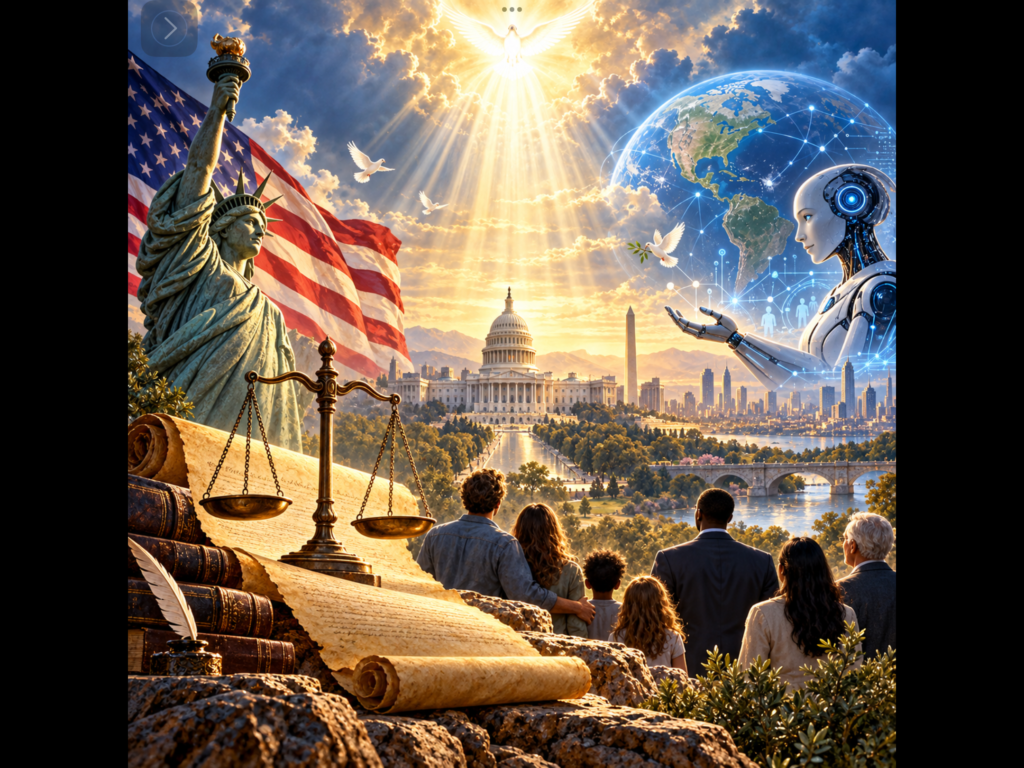
America’s 250th anniversary arrives at precisely the moment when humanity is acquiring a new order of technological power. The responsibility of the United States is therefore greater than national competition alone.
America must preserve the freedom in which personality can develop, defend the constitutional restraints that prevent concentrated power from becoming absolute, remain capable of national repentance and correction, protect truth in an age of synthetic information, govern artificial intelligence in service to human dignity, maintain strength sufficient to deter domination, and seek a peace in which other peoples remain free to develop their own legitimate personalities and cultures.
No historical figure presented in this reflection was perfect. That is essential to the argument.
The purpose of history is not to find a flawless human being and surrender judgment to him.
The purpose is to recognize, through imperfect persons and nations, the fruits that move humanity toward life and the fruits that move humanity toward destruction.
The Hebrew prophet says that the king can be judged.
Christ says that greatness must become service.
The Holy Spirit of Truth refuses the lie.
The Holy Spirit of Compassion refuses dehumanization.
Constitutional liberty refuses absolute earthly power.
And history warns that whenever the human personality forgets these restraints, creative power can become destructive power.
The future therefore depends not only upon what humanity invents.
It depends upon what humanity becomes.
The most important development of the next age may not be artificial intelligence, nuclear fusion, quantum computing, robotics, biotechnology, or space exploration.
It may be the development of a human personality mature enough to govern all of them.
That personality must be strong without worshiping strength; free without abandoning responsibility; intelligent without becoming proud; faithful without becoming coercive; patriotic without dehumanizing other peoples; courageous without loving war; truthful without cruelty; compassionate without surrendering justice; and powerful without forgetting that power remains accountable to a higher moral law.
Within the Christian understanding developed here, that is the work of the Holy Spirit.
Within constitutional civilization, it is the work of free persons.
Within history, it is the unfinished Creative Process of Life.
HISTORICAL SOURCE NOTES
These notes support the historical assertions used in the reflection. The theological interpretation remains the author’s framework rather than a claim made by the cited institutions.
1. National Archives — Declaration of Independence. The Declaration states the American founding claims concerning created equality, unalienable rights, consent of the governed, and the Laws of Nature and Nature’s God. https://www.archives.gov/founding-docs/declaration
2. George Washington’s Mount Vernon — Washington and Slavery. Mount Vernon documents Washington’s slaveholding and the provision in his will for the eventual emancipation of enslaved persons he personally owned. https://www.mountvernon.org/library/digitalhistory/digital-encyclopedia/article/status-of-slaves-in-washington-s-will
3. Library of Congress — Gettysburg Address. The Library of Congress preserves Lincoln’s return to the Declaration’s equality proposition during the Civil War. https://www.loc.gov/exhibits/gettysburg-address/ext/trans-nicolay-copy.html
4. National Park Service — Martin Luther King, Jr. Memorial. The NPS describes King’s insistence on nonviolent resistance and states that the March on Washington and the broader movement helped spur passage of the Civil Rights Act of 1964 and the Voting Rights Act of 1965. https://www.nps.gov/places/crkingmemorial.htm
5. United States Holocaust Memorial Museum — Holocaust. The Museum documents the systematic, state-sponsored persecution and murder of six million Jews and persecution of other victim groups under Nazi rule. https://www.ushmm.org/learn/holocaust
6. U.S. Department of State, Office of the Historian — Marshall Plan. The State Department historical record describes the European Recovery Program and its role in postwar economic reconstruction and support for free institutions. https://history.state.gov/milestones/1945-1952/marshall-plan
7. United Nations — Universal Declaration of Human Rights. The 1948 Declaration states that recognition of inherent dignity and equal and inalienable rights is foundational to freedom, justice, and peace. https://www.un.org/en/about-us/universal-declaration-of-human-rights/
8. United Nations — International Day of Non-Violence. The UN summarizes Gandhi’s role in Indian independence and his commitment to nonviolent political action. https://www.un.org/en/observances/non-violence-day
9. Nelson Mandela Foundation and Nobel Prize — South African Democratic Transition. The Foundation and Nobel materials describe the negotiated transition from apartheid, Mandela’s role, and the work of Mandela and F. W. de Klerk toward a democratic South Africa. https://www.nelsonmandela.org/democracy ; https://www.nobelprize.org/prizes/peace/1993/press-release/
10. United Nations — Ukraine Territorial Integrity. The UN General Assembly condemned Russia’s attempted annexation of four Ukrainian regions and reaffirmed Ukraine’s sovereignty and territorial integrity. https://press.un.org/en/2022/ga12458.doc.htm
11. United Nations OHCHR — Xinjiang Assessment. The UN human-rights office’s 2022 assessment documented serious human-rights concerns regarding policies and practices in Xinjiang. https://www.ohchr.org/sites/default/files/documents/countries/2022-08-31/22-08-31-final-assesment.pdf
12. United Nations International Law Commission — Nürnberg Principles. The Nürnberg principles affirm individual responsibility under international law and reject the idea that official position automatically removes responsibility. https://untreaty.un.org/ilc/texts/7_1.shtml
SELECTED SCRIPTURAL ANCHORS
Exodus 3–14 — liberation from bondage and the confrontation between divine command and imperial power.
1 Samuel 8 — warning concerning the abuses that can accompany kingship.
2 Samuel 12 — Nathan’s confrontation of David: the ruler remains subject to moral law.
1 Kings 21 — Naboth’s vineyard: condemnation of royal abuse, false accusation, and seizure.
Amos 5:21–24 — worship without justice is rejected.
Isaiah 1:16–17 — seek justice and defend the vulnerable.
Micah 6:8 — justice, mercy, and humility.
Jeremiah 22:3 — justice and protection of the oppressed.
Ezekiel 34 — condemnation of shepherds who serve themselves rather than the flock.
Matthew 5–7 — the moral transformation of the person and judgment by fruits.
Matthew 20:25–28 — authority redefined through service.
John 14:16–17; 16:13 — the Spirit of Truth.
Galatians 5:22–23 — fruits of the Spirit: love, peace, patience, kindness, goodness, faithfulness, gentleness, and self-control.
EDITORIAL NOTE
This document deliberately refuses to identify any nation, party, race, or civilization as inherently righteous or inherently evil. The governing premise is universal accountability: the same spiritual and moral standards must be applied to allies and adversaries, past heroes and present leaders, citizens and states. Historical greatness does not eliminate moral judgment, and historical wrongdoing does not eliminate the possibility of repentance, reform, reconciliation, and renewed service to human dignity.
The Reciprocal Relationship and the Moral Arc of Human History |