The Stories I Live With Each Day — Photographs, Memory, Service, and the Heavenly Presence in My Apartment
In the apartment where Margie passed from this world into the Heavenly World, I do not live alone with empty walls and scattered furniture. I live surrounded by witnesses. Every room holds photographs, devotional images, family portraits, framed memories, military honors, prayer cards, little shrines of love, and visible reminders that a human life does not disappear simply because the body has left the earth. These photographs and objects are not decorations to me. They are companions. They are memory made visible. They are part of the living spiritual environment through which I continue my relationship with Margie, with Pop, with Mom, with Aunt Amy, with Chris and Kenny, and with the larger family whose love and suffering helped form my own soul. In this apartment, the past is not dead. It remains present through image, memory, prayer, service, sacrifice, and spirit.
One of the most powerful places in the apartment is the memorial wall beneath the crucifix. There, Christ hangs above the gathered photographs, as though presiding over the whole human story of our family. Beneath Him are images of Margie, of children, of sacred figures, of nature, of family life, and of the long unfolding journey that carried us through earthly years into spiritual memory. That wall says something important without using words. It says that our lives were lived under God, that our joys and sorrows belong beneath the Cross, and that the people pictured there are not isolated fragments of time, but part of one sacred history. When I look at that wall, I do not merely see pictures. I see a family placed under Christ. I see human love gathered beneath Divine Love.
The crucifix itself changes the meaning of everything around it. Without Christ above those photographs, they might simply be sentimental keepsakes. But with Christ above them, they become witnesses to a deeper truth. They remind me that suffering does not have the final word, that love and sacrifice are not wasted, and that death itself must be understood in light of resurrection. Margie’s passing in this apartment was one of the deepest sorrows of my life, but because the Cross remains above these memories, that sorrow is never separated from hope. The photographs beneath the crucifix become part of a larger testimony: that the people we love live before God, and that our earthly love for them is gathered up into a larger Heavenly reality.
On each side of the crucifix are images that join family memory with sacred imagination. The Blessed Mother appears holding photographs and flowers, as if receiving into her maternal care those whom we love. Beside her are photographs of younger life, family bonds, and generations still unfolding. Beneath them are images of Jesus, cardinals, nature, and personal prayer cards. Together they create a language of faith that does not need formal explanation. They express the conviction that our family story belongs within the care of Heaven, that the innocent and the suffering are not forgotten, and that those whose earthly lives ended remain within the compassion of God.
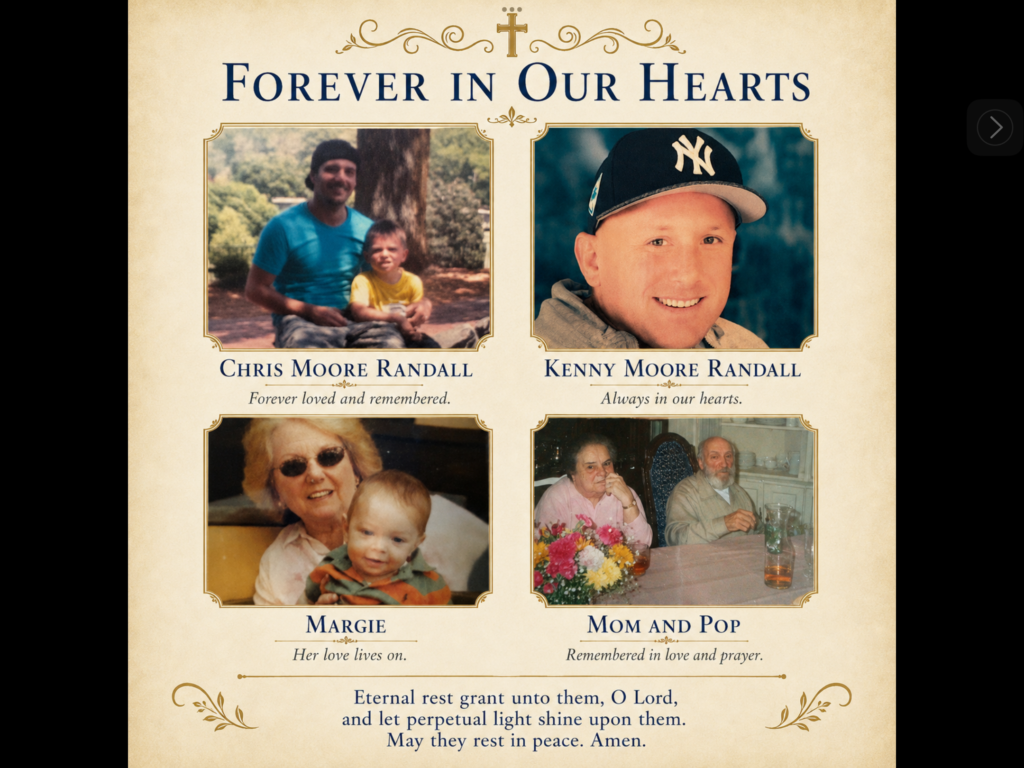
The prayer cards beneath the crucifix carry particular meaning because they represent the loss of my two nephews, Chris and Kenny, whom Margie and I loved dearly. Their deaths were not distant events in the lives of other people. They entered the center of our own family story. We carried their memory, their personalities, their struggles, and the sorrow of their absence within our marriage. The prayer cards now stand beside Margie’s own Mass card, placing the three of them together within the visible spiritual life of the apartment. When I look at those cards, I do not see only death notices. I see Chris, Kenny, and Margie gathered within the same Heavenly family.
Those prayer cards tell a story of love that survived loss. They remind me that Margie did not love Chris and Kenny as names or obligations, but as our boys, members of the family whose lives mattered to us deeply. Their joys mattered. Their struggles mattered. Their futures mattered. When their earthly journeys ended, the grief became part of the interior life Margie and I shared. Now, with Margie also in the Heavenly World, I picture their relationship continuing beyond what I can physically see. The cards beneath the Cross symbolize that continuation. They say that the bonds of family are not erased by death, and that the compassion we carried for them on earth remains alive in Heaven.
Margie’s Mass card beside the prayer cards of Chris and Kenny is especially meaningful. It unites the griefs that marked our family and also unites the people we believe are now together. I imagine Margie, who carried such fierce love and loyalty within her, continuing to care for them in the Heavenly World. In my heart, she remains Queen Margie, but she also remains a maternal and protective presence. I believe that the same love she gave on earth has not been diminished. It has been freed from bodily suffering and now continues in a fuller spiritual form.
Another wall tells the story of Pop and me. The large framed photograph shows us together in uniform before the American flag. Beneath it are Pop’s Bronze Star certificate and the medals that represent his military service. This display is not merely patriotic decoration. It is a family history of duty, courage, sacrifice, and formation. It tells the story of a father and son standing within the same current of service to country. It shows that my own military identity did not arise in isolation. It was connected to Pop, to his example, to his experiences, and to the meaning that service carried within our family.
Pop’s Bronze Star certificate and medals remind me that military service is never fully contained in official documents. Behind each citation is a human being who endured uncertainty, danger, fatigue, responsibility, and the moral weight of service. The framed certificate records a formal recognition, but the photograph above it reveals the person. Pop stands there not only as a decorated veteran, but as the man whose life helped shape mine. The medals are symbols of national service, yet for me they are also personal relics of fatherhood, character, endurance, and the standards against which I measured my own conduct.
Standing beside Pop in uniform, I see two generations joined by more than blood. We are joined by service, discipline, patriotism, and the understanding that freedom carries obligation. The American flag behind us is not merely a background. It represents the Nation whose history entered our family through military service. It also represents the constitutional freedom that later became central to my understanding of individual calling, human dignity, and responsibility. In that photograph, Pop and I stand within both a family inheritance and a national inheritance.
The presence of a Divine Mercy image within that military display adds another layer of meaning. It reminds me that service, courage, and patriotism must remain under the judgment and mercy of God. Military honors can recognize bravery, but they cannot by themselves explain the full moral meaning of sacrifice. The image of Christ beside Pop’s photograph and medals says that even honorable earthly service belongs within a larger spiritual order. Courage must serve compassion. Strength must serve life. Patriotism must never become separated from truth, mercy, or responsibility before God.
The wall of Pop’s service and the wall beneath the crucifix therefore belong together. One tells the story of earthly duty. The other tells the story of eternal hope. One honors the obligations of citizenship and national defense. The other places all human struggle beneath Christ. Together they express an important truth about my own life: that service to country and service to God are not identical, but they can enter into a responsible relationship when patriotism is disciplined by compassion, truth, and the sacred worth of the human person.
Another story lives on the glass table, where framed photographs stand among statues, prayer images, and objects of remembrance. That table is not simply a table. It is a small world of relationship. There are photographs of Margie and me together, photographs of children and grandchildren, devotional figures, angelic images, and sacred reminders of the Heavenly companionship that continues to surround my life. The arrangement reveals something about how I actually live. I do not keep memory hidden away in a drawer. I live in dialogue with it. I place it before my eyes. I let the faces of those I love remain visible in the course of ordinary daily life. In that sense, the table becomes a meeting place between the earthly and the Heavenly. To an outsider, it may appear crowded. To me, it is full of presence.
One framed photograph on that table, showing Margie and me together, carries the quiet dignity of a shared life. We are not portrayed there as abstractions or symbols, but as two people who actually built a life together, endured together, celebrated together, and aged together. The photograph says that our marriage was real. It was lived in time, through responsibilities, disappointments, illness, family struggles, work, sacrifice, and affection. It says that love is not merely romance at the beginning. Love is the long staying power of human devotion. It is the willingness to keep showing up, to keep carrying burdens, and to keep giving oneself to another person across changing seasons. When I see that photograph, I do not simply miss Margie; I remember what we actually accomplished together as husband and wife.
The photographs of Margie with the children and our grandson open another chapter of the story. In them, I see her tenderness, her warmth, and the natural way her love extended outward. She was not only my wife; she was also a woman whose heart moved toward family, toward younger life, and toward the nurturing and protecting instinct that belongs to motherhood and grandmotherhood. Those photographs preserve a version of Margie that must never be lost beneath memories of illness or the sorrow of her final years. They remind me that she laughed, she held children, she smiled with joy, and she participated in the flow of family life. They restore balance to memory by keeping alive not only what was painful, but also what was radiant and affectionate.
There are also photographs in the apartment that tell the story of Pop, of parents, and of the older generation from which much of my own character and memory emerged. These are especially moving because they show that my life with Margie was not separated from the larger family stream. Pop was not just a relative in the background. He was a real presence in our lives, a man whose memory continues to live within me and within the spiritual atmosphere of this home. The photographs where family members appear together remind me that marriage does not join only two individuals; it joins histories, loyalties, burdens, and inheritances. It weaves one life into another until an entire world of relationships is created. That world now continues through photographs, but it still speaks.
The living room and dining area, filled with framed memories, sacred images, military honors, and familiar furniture, tell a story of continuity. This is not a sterile memorial space arranged for display. It is the actual environment in which life continues. The table, the chairs, the mirror, the walls, the framed photos, the devotional figures—all of them together form the setting of a lived spirituality. Here memory is not confined to anniversaries. It is woven into breakfast, prayer, conversation, silence, study, and reflection. Each time I move through the apartment, I move through a landscape of relationship. The mirror reflects the room, but it also reflects the truth that my present life is inseparable from the lives that helped form me. The room itself becomes a visible metaphor for memory: everything is connected, everything reflects everything else, and nothing stands entirely alone.
The small dresser displays and shelf arrangements tell more intimate stories still. There are photographs carefully placed beside candles, prayer cards, holy images, little statues, and devotional objects. These are not accidental groupings. They represent acts of remembrance. Each arrangement says: these people matter; this relationship matters; this grief matters; this love continues. A photograph standing beside an image of Jesus or the Blessed Mother speaks of my conviction that earthly affection belongs within a sacred frame. It expresses my belief that Heaven is not an abstraction but a living order of relationship. When I place a family photo beside a holy image, I am not confusing the human and the Divine. I am affirming that the human belongs within the Divine, and that those we have loved are held within a reality larger than physical death.
One especially moving dimension of these displays is that they show how memory has become organized around prayer. The small lights, candles, crosses, angels, and Marian figures reveal that remembrance for me is not passive nostalgia. It is active spiritual companionship. These displays are places where I think, pray, speak inwardly, and remain open to grace. They represent the continued reciprocal relationship between my soul and the Heavenly World. In that sense, the apartment has become something more than a residence. It has become a domestic sanctuary. It is the place where my earthly life continues in conscious relationship with those who have entered eternity.
The family photographs grouped on the bedside furniture tell a quieter and more tender story. There I see children, grandchildren, family snapshots, and traces of several generations gathered within one frame of vision. This part of the apartment says that the story did not end with Margie and me alone. It extends through Michael, Emily, Robert, Justin, and the wider family network, including those relationships that are joyful and those that are wounded or incomplete. The presence of these photographs near where I sleep suggests something profound: that family remains with me not only in public memory, but also in the private hours of rest, vulnerability, and inward reflection. Even there, I am not spiritually alone. The generations remain near.
The pictures of Chris and Kenny, along with their prayer cards, carry a particular tenderness within this family landscape. They remind me of two young lives that Margie and I loved, worried about, prayed for, and continued to carry within our hearts. Their loss created wounds that could never simply be explained away. Yet within the apartment, their images are not placed in darkness or isolation. They are surrounded by Jesus, Mary, the crucifix, family photographs, and Margie’s own Mass card. Their memory has been placed within love. Their lives have been entrusted to the Heavenly World.
There is also something deeply significant about the fact that these photographs remain in the very apartment where Margie passed into the Heavenly World. That gives every image a second dimension. It is not only a reminder of what once was. It is also a reminder of transition. This is the place where earthly companionship passed into spiritual companionship. It is the place where caregiving reached its final earthly expression. It is the place where I climbed into bed with Margie, held her, and released her to God. Because of that, every photograph in this apartment exists in the shadow and the light of that moment. The whole apartment carries the memory of passage—of love refusing to end even when the body can no longer remain.
The photographs therefore do not simply preserve the past; they interpret the present. They teach me how to understand my own life. They remind me that who I am today has been shaped by all these people, all these loves, all these sacrifices, and all these wounds. They remind me that memory is not weakness. It is part of moral and spiritual identity. A man who remembers truthfully does not remain trapped in the past; he learns what the past gave him and what responsibility it now places upon him. When I look at these photographs, I am being called not merely to remember, but to live worthily of those whose lives continue within me.
Each cluster of images also contains its own little stories. A wedding photograph tells the story of covenant. A family portrait tells the story of belonging. A picture of Margie with a child tells the story of tenderness. A picture of Pop tells the story of inheritance. A Bronze Star certificate tells the story of duty. A medal tells the story of sacrifice. A prayer card for Chris or Kenny tells the story of grief carried within love. Margie’s Mass card tells the story of earthly marriage becoming spiritual companionship. A devotional image beside a family photo tells the story of Heaven touching home. A candle beside a frame tells the story of ongoing prayer. Even the arrangement of many images together tells the story that life was never one-dimensional. We were at once husbands and wives, children and parents, uncles and nephews, grandparents and caregivers, soldiers and citizens, workers and believers, suffering people and rejoicing people. The apartment reflects that complexity honestly.
In a deeper sense, these photographs help explain the phrase I have used: Heaven on Earth. Heaven on Earth was not perfection. It was the gift of real love lived through real time with real people. It was the accumulation of thousands of moments—formal photographs, casual snapshots, family gatherings, sacred symbols, military service, shared meals, nursing care, holiday memories, children growing, parents aging, nephews loved and mourned, and marriage enduring. That is what now fills this apartment. It is why the apartment remains alive with presence. The visible photographs are like doors through which the invisible meanings of my life continue to speak.
And so, when I say that I live with these photos today, I mean much more than physical proximity. I mean that I live among continuing witnesses. I live among reminders of covenant, compassion, family, service, sacrifice, loss, spiritual continuity, and Divine companionship. The apartment where Margie passed into the Heavenly World has become a living archive of the soul. It is filled with the images of those I love, but more than that, it is filled with the meanings their lives carried into mine. Through these photographs, prayer cards, medals, Mass cards, and sacred images, they continue to teach me, comfort me, and call me forward.
These are not just pictures in an apartment. They are chapters on the wall, prayers on the dresser, honors of service beneath the flag, sacraments of memory on the table, and visible signs that love remains stronger than death. They tell the story of Pop and me, of duty and country, of Chris and Kenny, of grief and family love, of Margie and our marriage, of those who went before us, of those still here, and of the Heavenly companionship that continues to surround my earthly pilgrimage. In this apartment, memory has become a form of presence, and presence has become part of my calling. That is why I can say, with both sorrow and gratitude, that I do not merely remember these people. In a real spiritual sense, I still live with them.