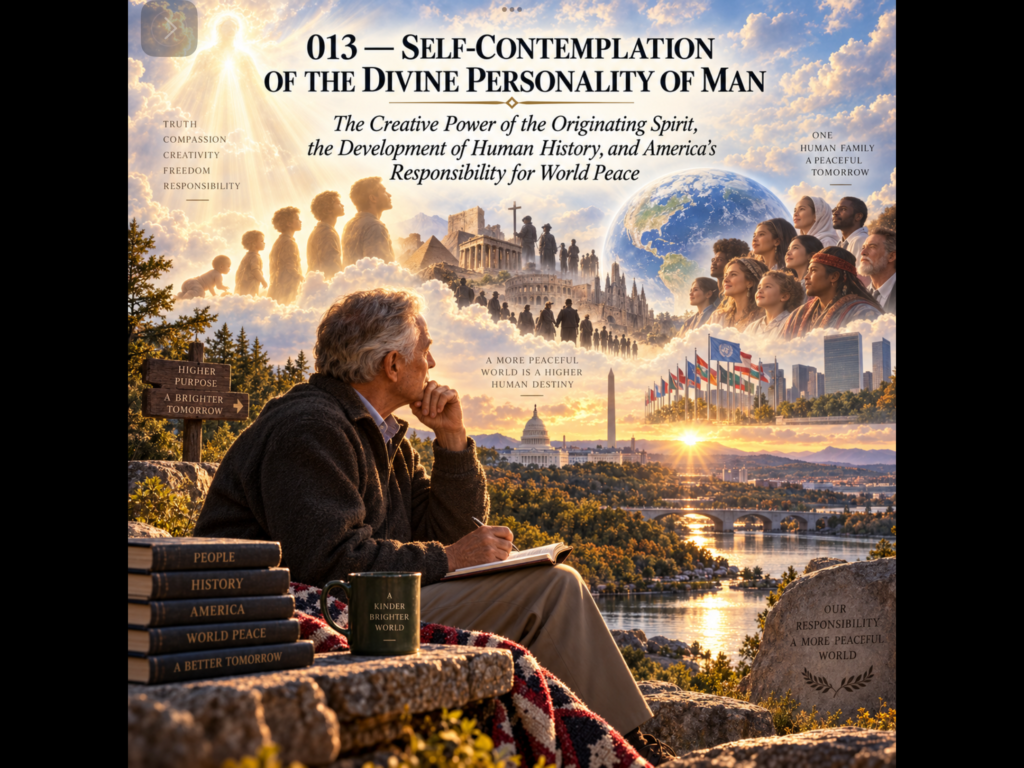
SELF-CONTEMPLATION OF THE DIVINE PERSONALITY OF MAN
The Creative Power of the Originating Spirit, the Development of Human History, and America’s Responsibility for World Peace
Human history may be understood not merely as a succession of kingdoms, wars, technologies, and political systems, but as the continuing development of human consciousness and personality.
Behind that development stands one of the deepest questions a person can ask: What is Man, and what creative power has been placed within him?
Thomas Troward approached this question through the concept of the Originating Spirit—the universal source of Life, Intelligence, Individuality, and Personality. Scripture approaches the same mystery through the declaration that humanity is created in the image and likeness of God and through the promise that the Spirit of God may dwell within the individual.
Viewed together, these ideas lead toward a profound principle: The Creative Process of Life does not end with the creation of the physical human being. It continues through the development of human personality.
The human person becomes capable of self-contemplation. Man can look inward, recognize his own consciousness, imagine possibilities that do not yet physically exist, make moral choices, establish relationships, create institutions, transform matter, develop technology, and consciously participate in shaping the future.
That capacity carries extraordinary dignity. It also carries extraordinary responsibility.
The Originating Spirit and the Individual
If the Originating Spirit is the source from which life proceeds, then the individual human personality represents something remarkable within the Creative Process: life becoming conscious of itself at the personal level.
Man can say: I am. He can then ask: What ought I become?
This distinction is critical. Self-awareness alone does not make humanity benevolent. Intelligence alone does not produce wisdom. Creative power alone does not produce peace.
The same imagination capable of constructing a hospital can construct a weapon. The same scientific intelligence capable of curing disease can develop systems of unprecedented destruction. The same economic creativity capable of lifting millions from poverty can become an instrument of exploitation. The same artificial intelligence capable of expanding human knowledge can be employed for surveillance, manipulation, autonomous warfare, or domination.
Therefore, the further humanity advances in creative power, the more important becomes the development of personality, conscience, wisdom, and moral character. Humanity’s technological development must be accompanied by spiritual development. Otherwise, the power of creation may outrun the wisdom necessary to govern it.
The Divine Personality of Man
To speak of the Divine Personality of Man should not mean that the individual becomes the Creator. It means something different and more disciplined.
It means that the individual can increasingly express within human personality those qualities traditionally associated with the Divine Nature: love without hatred; strength without domination; intelligence governed by wisdom; liberty governed by responsibility; justice tempered by mercy; power governed by conscience; creativity directed toward life rather than destruction; and personality capable of reciprocal relationship with the Creator.
In Christian understanding, Jesus Christ becomes the supreme example of this fully developed spiritual personality. Christ possessed power, yet refused domination. He possessed knowledge, yet served. He confronted political and religious authority, yet rejected hatred. He taught individual responsibility while commanding compassion toward one’s neighbor. He demonstrated that spiritual authority does not depend upon armies, wealth, coercion, or government office. Its authority proceeds from truth expressed through personality.
The development of humanity therefore may ultimately depend upon the development of such personalities.
History as the Development of Human Personality
Human history appears repeatedly to move through individuals whose internal convictions eventually reshape entire civilizations.
Moses articulated covenant and law. The Hebrew prophets placed moral responsibility above political convenience. Jesus Christ placed the transformation of the individual heart at the center of human reconciliation. The Apostles carried this understanding across political boundaries. Centuries later, thinkers of natural law argued that legitimate government must recognize rights that do not originate with rulers.
The American Founders attempted to translate portions of this understanding into political architecture. Their achievement was imperfect because they themselves were imperfect human beings living within an imperfect historical period. Yet the principle they articulated was revolutionary: Human beings possess rights because of their nature and their Creator—not merely because government grants them.
From this principle came a constitutional structure designed to limit concentrated power and preserve freedom of conscience, speech, religion, association, property, and political participation. These protections created something historically important: a political environment in which individual personality could develop without total control by the state.
America and the Creative Process
America’s highest purpose therefore cannot simply be national wealth or military superiority. Those may be necessary instruments of national survival, but they are not sufficient reasons for national existence.
The deeper American contribution is the proposition that the individual must remain free enough to search for truth, develop conscience, create, worship, build, associate, speak, disagree, undertake enterprise, and accept responsibility for the consequences of his actions.
Properly understood, constitutional liberty creates the protected space within which the Creative Process can operate through millions of individual personalities.
An inventor develops an idea. An entrepreneur turns it into an enterprise. A scientist discovers a principle. A teacher develops another human mind. A soldier protects the constitutional order. A parent develops character within a family. A religious believer answers a spiritual calling. A tradesman builds the physical infrastructure upon which civilization depends.
None of these individuals needs permission from a centralized authority to possess human dignity. They already possess it. Government’s legitimate responsibility is therefore not to manufacture personality but to protect the conditions under which personality can develop.
The United States in Our Time
Our present historical moment magnifies this responsibility.
The United States today operates at the intersection of extraordinary systems of creative power: artificial intelligence, advanced semiconductors, robotics, biotechnology, space systems, quantum science, communications networks, financial markets, energy infrastructure, military technology, and global digital information systems.
These technologies represent extensions of human creative intelligence. But they also confront civilization with the ancient question in a new form: What kind of personality will govern the power we have created?
If technological systems are governed principally by fear, rivalry, domination, greed, or national hatred, humanity may increase its destructive capacity faster than its moral capacity. But if technological power is governed through constitutional liberty, international cooperation, responsible enterprise, human dignity, spiritual conscience, and respect for the individual, these same systems could contribute to an extraordinary period of human flourishing.
The decisive battlefield may therefore ultimately be within human personality itself.
America and World Peace
World peace cannot simply mean the absence of war. A durable peace requires conditions under which people and nations can live without permanent fear of coercion, conquest, economic strangulation, religious persecution, technological domination, or political extermination.
America can contribute to such a peace not by attempting to remake every nation in its own image, but by demonstrating that immense national power can coexist with constitutional restraint.
The United States possesses enormous military, economic, scientific, technological, and cultural influence. The moral test is how that power is used.
Power employed exclusively for domination eventually creates resistance. Power governed by principle can create alliances. Power restrained by law creates trust. Power used to defend the freedom of others creates legitimacy. Power combined with mercy creates reconciliation.
America’s greatest contribution to peace therefore may be the demonstration that a powerful nation can remain committed to the dignity of the individual.
The Reciprocal Relationship
At the center of this entire process is the individual person.
Political institutions cannot substitute for spiritual development. Technology cannot substitute for wisdom. Markets cannot substitute for morality. Military strength cannot substitute for character. The transformation must occur within human consciousness.
The individual must enter into what may be understood as a reciprocal relationship with the Benevolent Originating Spirit.
The individual receives life, intelligence, imagination, and creative possibility. He responds through intention, choice, character, work, service, and love.
The relationship therefore becomes reciprocal: The Spirit originates. The individual receives. The individual contemplates. The individual chooses. The individual creates. And the consequences of that creation enter human history.
The condition of civilization ultimately reflects the accumulated choices of human personalities.
Self-Contemplation Becomes Responsibility
This brings us back to self-contemplation.
The most important question may no longer be: What can humanity create? We already know that humanity can create almost unimaginable power. The greater question is: What kind of human being will wield that power?
If Man understands himself merely as an intelligent biological organism competing for survival, then technology may become the ultimate instrument of competition. If Man understands himself as a responsible spiritual personality participating within a larger Creative Process, his use of technology changes.
Creation becomes stewardship. Power becomes responsibility. Freedom becomes obligation. Leadership becomes service. And national greatness becomes inseparable from moral character.
The Creative Process of Peace
World peace therefore begins at a level deeper than diplomacy. It begins within personality.
A peaceful civilization requires peaceful individuals who nevertheless possess courage. It requires strong nations capable of defending themselves while remaining reluctant to dominate others. It requires scientists who understand the moral consequences of discovery. It requires entrepreneurs who understand that capital carries responsibility. It requires military leaders who understand that force exists ultimately to protect peace. It requires political leaders who understand that constitutional power is held in trust. And it requires individuals willing to recognize the humanity even of those with whom they profoundly disagree.
This is not passive idealism. It is perhaps the most demanding form of realism. Because every institution humanity creates ultimately reflects the consciousness of the people operating it.
The American Calling
The American calling in our time may therefore be understood as something larger than maintaining geopolitical supremacy.
It is to demonstrate that the most technologically advanced civilization in history can remain governed by the dignity of the individual. That artificial intelligence can serve humanity rather than master it. That capitalism can generate prosperity while remaining answerable to conscience. That military power can defend liberty without becoming an instrument of conquest. That religious faith can strengthen moral character without coercing belief. That citizens of different backgrounds can remain united beneath a constitutional covenant. And that freedom, properly understood, is not the abandonment of responsibility but the environment in which responsible personality develops.
America will not fulfill that calling merely through government. It must be fulfilled through Americans. Person by person. Family by family. Enterprise by enterprise. Community by community. Generation by generation.
The Divine Personality and the Future of Humanity
The next stage of human history may depend less upon whether humanity acquires greater intelligence than upon whether humanity acquires greater wisdom.
Artificial intelligence will expand. Scientific capability will expand. Human control over the physical world will expand. The Creative Process will continue. The question is whether human personality will mature sufficiently to govern what human intelligence creates.
This is where the spiritual development of the individual becomes inseparable from the future of civilization.
The ultimate purpose may not be simply the creation of a more technologically powerful humanity. It may be the emergence of a humanity whose increased creative power is matched by increased compassion, wisdom, responsibility, and consciousness of its relationship with the Originating Spirit.
That would represent something far greater than technological progress. It would represent the maturation of personality. And perhaps within that maturation lies the pathway toward peace.
The Final Contemplation
The Creator gives life. Life develops intelligence. Intelligence develops individuality. Individuality develops personality. Personality becomes self-conscious. Self-conscious personality discovers creative power. Creative power creates civilization. And civilization eventually confronts the question: Will humanity use the power of creation to dominate life—or to preserve and perfect it?
America now stands inside that question.
The technologies being developed within the United States may profoundly influence the next generation of civilization. Its constitutional principles may determine whether those technologies remain subordinate to individual freedom. Its military strength may influence whether free societies survive. Its economic strength may determine whether innovation remains widely available.
But beneath all these systems remains something more fundamental: the individual human personality.
If that personality remains connected to truth, conscience, love, wisdom, responsibility, and what faith understands as the Originating Spirit of Life, then the enormous creative power now emerging within humanity may become an instrument of peace.
The destiny of civilization therefore may ultimately depend upon the oldest and most personal of all transformations: Man discovering who he is, understanding the Source from which life proceeds, and consciously choosing to become a benevolent participant in the continuing Creative Process of Life.
And from that awakened personality may come not merely a stronger America—but an America capable of helping humanity move toward peace.
Witness to Calling — Self-Contemplation of the Divine Personality of Man