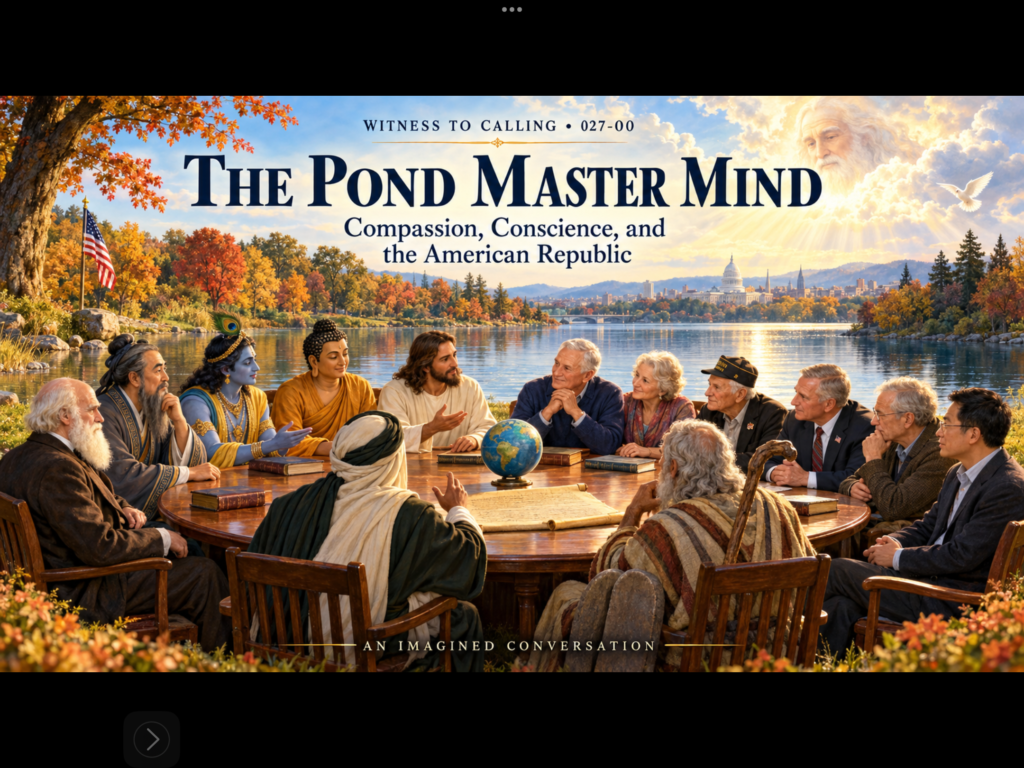
027-00 — THE POND MASTER MIND
Compassion, Conscience, and the American Republic
By Edward F. Moore
Witness to Calling
November 1, 2026
An imagined philosophical and spiritual conversation. All dialogue attributed to God, Christ, religious and historical figures, Margie, Pop, and living friends is fictional. It expresses the author’s interpretation rather than verified statements, endorsement, revelation, or communication from deceased loved ones. The participants retain their differing beliefs. Current-event context reflects the reports consulted on November 1, 2026. Reference links follow the complete narrative.
PART ONE — THE HUMAN BEING, COMPASSION, AND THE CONTINUING WORK OF CREATION
The pond was quiet that morning. A faint breeze moved across its surface, breaking the reflection of the trees into patterns of light. Near the bank, a bird stood almost motionless, watching the water. I had come carrying the question that had occupied our writing: what makes the human being capable of becoming a conscious participant in creation?
Around the familiar table stood chairs for the Master Mind. Christ was there as the Messiah and the guiding conscience of the conversation. Moses and Muhammad joined him as prophetic voices from their respective traditions. The Buddha sat quietly beside Confucius. Krishna watched the movement of the water, while Charles Darwin examined a small leaf resting near his hand.
A cloud passed above the pond. Sunlight illuminated its edges, and in the imagination of this gathering, the voice of God the Father came from the sky.
“Edward, you have been asking what humanity may become. Begin with the life before you. What do you see?”
“I see the pond, Father. The trees, the birds, the people walking on the path. I see a world that was here before me and will continue after me.”
“And what happens when you look more carefully?”
I paused. “I begin to recognize relationships. The bird depends upon the water and what lives within it. The trees depend upon the soil. People depend upon one another. My own life belongs within those relationships.”
Christ leaned forward. “And when someone walking beside this pond is troubled, what changes when you become aware of that trouble?”
“The person becomes more than someone passing by,” I answered. “I begin to feel that I should listen.”
“Then your understanding has begun to ask something of you,” Christ said.
The Father’s voice continued. “This is where your reflection upon consciousness becomes practical. You inhabit a reality greater than your own concerns. As you attend to it, you discover lives whose meaning does not depend upon their usefulness to you. Compassion makes you willing to receive that discovery.”
Darwin turned the leaf over between his fingers. “I should begin by distinguishing the questions before us. My work concerns the development and diversity of living organisms through natural processes. It does not establish a conversation with a Divine Mind. But human beings do possess capacities for reflection, cooperation, and the deliberate alteration of their circumstances. Those capacities give this discussion consequences in the observable world.”
Moses nodded. “A people must learn how to live together. It is possible to possess intelligence and yet fail in responsibility. The stranger, the vulnerable, the person without influence—how they are treated reveals something about the community.”
Muhammad answered, “Compassion must enter conduct. Prayer and generosity belong within a life of accountability. A person who speaks reverently of God must also consider the obligations he owes to other people.”
The Buddha looked toward the bird at the water’s edge. “Attention can reveal suffering we had overlooked. But attention also reveals the habits of our own minds. We may approach another person carrying expectations, attachments, and judgments. Compassion asks us to understand more carefully.”
Confucius placed his hands upon the table. “And understanding must become a practice. The person who wishes to improve public life should examine how he behaves in his immediate relationships. Does he listen? Does he keep his word? Can others depend upon him?”
Krishna added, “A person may also become so attached to the importance of his own contribution that he loses clarity about the work itself. Let him examine the motives with which he acts. Responsibility requires steadiness.”
I looked around the table. “Then compassion is more than feeling sorrow for another person.”
“Yes,” Christ said. “It asks whether you will make room for that person’s reality. Listening may be required. So may help, patience, protection, or a difficult truth. The response must attend to the person before you.”
The Father spoke again. “You have compared compassion to a frequency. The image may help you understand receptivity, provided you remember what it asks of you. Consider an instrument being brought into tune. Its responsiveness develops through careful attention. In a human life, that attention includes humility, honesty, and a willingness to be corrected.”
“So the greater my compassion,” I asked, “the closer I may come to harmony with your consciousness?”
“The deeper your compassion becomes, the more willing you may become to understand a life beyond your own,” the Father answered. “Bring that willingness into prayer, inquiry, and action. Let it deepen your responsibility. Let the quality of your response remain open to examination.”
The Buddha lifted his eyes. “A person can become attached to the thought that he has reached a higher state. That attachment may make him less attentive to the person beside him.”
Christ smiled gently. “Then let him return to the person beside him.”
There was a moment of quiet. Across the pond, a child called to an older man, pointing toward something moving beneath the water.
Confucius watched them. “Here is a beginning. One person notices something and invites another to see. Much of education takes place through such encounters.”
“And much of character,” Moses added. “The child learns from what the elder does next.”
I turned toward the cloud. “Father, we have spoken of the objective universe as the body of Divine Mind. Is that a way of understanding our responsibility toward creation?”
The Father answered, “In this conversation, let that image lead you toward reverence. The world you encounter exceeds what you presently understand. Study it carefully. Care for the conditions that sustain life. Receive another person as someone whose existence deserves attention. Let the image enlarge your responsibility.”
Darwin set the leaf down. “That must include allowing observation to correct our ideas. Concern for a woodland is a beginning. Understanding what sustains it requires investigation. A benevolent intention can still produce harm if it ignores the relationships at work.”
“Then scientific inquiry can help compassion act wisely,” I said.
“It can inform action,” Darwin replied. “It can also disclose consequences we did not anticipate. That is one reason to remain willing to revise a conclusion.”
Muhammad nodded. “There is humility in recognizing the limits of one’s knowledge.”
Moses added, “And responsibility in accepting what those limits require.”
The Father’s voice came softly across the water. “Your freedom carries the obligation to learn. Compassion can move you toward a need; wisdom helps you discern a response. Their cooperation requires patience.”
I rested my hands on the table. “This brings me back to Troward. He describes the individual becoming conscious of a reciprocal relationship with the Originating Spirit. I have been trying to understand how that relationship can develop.”
Christ answered, “Consider what happens when you pray for greater compassion. You return to the world. Someone needs your attention. You choose how to respond. The encounter may disclose impatience, fear, or an assumption you had not examined. You bring that discovery back into prayer. Your relationship develops through the life you actually lead.”
“So I receive and answer,” I said.
“And continue learning how to answer,” Christ replied.
The Father continued. “You receive life through relationships you did not establish. Your response enters those relationships and changes something within them. A promise kept may strengthen trust. A patient explanation may open understanding. A fair decision may protect someone who had little power. These consequences become part of the world others inhabit.”
Krishna considered this. “The individual must undertake the work available to him. Yet he should recognize that the result depends upon more than his own effort. Other people act. Circumstances change. The work calls for commitment and humility together.”
The Buddha added, “Compassion can remain present even when the desired outcome does not occur. Otherwise, disappointment may quickly turn concern into resentment.”
“That is difficult,” I said. “Especially when I feel responsible for the outcome.”
Christ looked directly at me. “Responsibility asks for faithfulness within your reach. It also asks you to recognize the freedom of others. You may offer care without possessing their response.”
The breeze moved a few fallen leaves across the path.
“Father,” I asked, “is this where the human being moves from evolution toward active creation?”
Darwin responded first. “We should preserve the meaning of evolution as a biological process. Deliberate planning and cultural development involve additional questions. Human beings can consciously organize activities, transmit knowledge, and change institutions. Calling that active creation is a philosophical description of their agency.”
The Father answered, “Let your phrase express the responsibility you deliberately undertake. You inherit a world, and your actions contribute to what follows. You can recognize an injury and seek to repair it. You can imagine an opportunity and work with others to establish it. You can examine an inherited practice and choose whether to continue it.”
Moses spoke. “A generation receives an inheritance that includes both wisdom and failures. Its responsibility includes discernment.”
Confucius added, “And the cultivation of people capable of exercising that discernment. Institutions are administered through human conduct.”
“Then civilization begins within the individual?” I asked.
“It begins in many relationships,” Confucius replied. “The individual learns within a family and community. What he becomes then affects those relationships. A community educates its members, and its members sustain or change the community.”
The Father continued. “Your narrative has recognized this exchange. The person contributes to common life, and common life helps the person develop. Ask whether your arrangements nourish that relationship. Do they permit learning? Do they protect dignity? Do they offer opportunities for useful contribution?”
Muhammad said, “Ask also whether those with resources remember people in need.”
Moses added, “Whether power remains accountable.”
The Buddha said, “Whether suffering is heard.”
Krishna continued, “Whether duty is undertaken with integrity.”
Christ looked around the table. “And whether love becomes something another person can experience.”
I considered the differences among the participants. “We are speaking together, yet your traditions do not understand God, spiritual life, or Christ in the same way.”
Muhammad answered, “Those differences matter. My tradition honors Jesus as Messiah and prophet while understanding his nature differently from Christian belief. Respectful conversation should allow that distinction to remain visible.”
The Buddha said, “My teaching also approaches suffering and liberation through a different framework from your account of Divine Mind.”
Confucius added, “My contribution here concerns the cultivation of character and relationships. Agreement about every metaphysical question is not required for us to examine conduct together.”
Christ listened and then said, “Let the conversation remain truthful. Listen carefully enough to understand where agreement exists and where it does not. The care you extend should include that honesty.”
The Father’s voice returned. “Compassion gives you a reason to encounter one another faithfully. It asks for the patience to understand before answering.”
I looked toward Christ. “In my own Christian understanding, you provide the personality through which I seek harmony with God. I see compassion as opening my consciousness toward that relationship.”
“Then examine what follows from it,” Christ answered. “Does your growing conviction make you more attentive? Are you willing to acknowledge an error? Can you care for someone who does not share your understanding? What responsibilities are you prepared to undertake?”
I thought of the family table, of work, of the people whose trust had shaped my own life.
“The relationship has to become visible,” I said.
“Yes,” Christ replied. “Through the life you lead.”
“Father, what of humanity’s possible destiny beyond its present condition? We spoke of angels, of guardians, and of the possibility that human beings might develop toward a spiritual life greater than we presently comprehend.”
The cloud moved slowly above the trees.
“Let that hope deepen the care you practice here,” the Father answered. “The full ordering of spiritual life remains beyond this gathering’s knowledge. The person who contemplates an extraordinary destiny still has a neighbor to hear, a responsibility to fulfill, and something further to learn.”
Moses nodded. “A hope concerning heaven carries obligations upon Earth.”
Darwin looked out across the pond. “And Earth presents ample work. The consequences of human activity are extensive. Understanding them requires attention across generations.”
“Could our concern extend beyond Earth?” I asked.
“It can remain open to whatever life you may encounter,” the Father replied. “Let greater reach be accompanied by greater care. What you learn about restraint and responsibility here will matter wherever your abilities take you.”
The bird at the bank finally moved. It stepped into the shallows, then paused again.
The Buddha watched it. “There is much before us that becomes visible only when we slow down.”
Confucius smiled. “And much that requires us to rise from the table.”
I laughed quietly. “That sounds like the point of the entire conversation.”
Christ stood and looked along the path. “What will you do when you leave the pond, Edward?”
“I will return to the work before me. I will try to listen more carefully. I will consider whose lives my decisions affect. And I will keep examining whether my words about compassion are becoming something useful.”
Krishna rose beside him. “Let that examination accompany the work.”
Muhammad said, “Let generosity acquire a practical form.”
Moses added, “Let responsibility endure when it becomes inconvenient.”
Confucius said, “Begin where people can depend upon your conduct.”
Darwin placed the leaf beneath a nearby tree. “And continue observing what your actions actually produce.”
The Buddha stood quietly. “Make room to learn from the encounter.”
The Father’s voice came once more from the cloud.
“You have asked how a human being may participate consciously in creation. Carry that question into the life entrusted to you. Attend to what is real. Receive correction. Cultivate your gifts. Work with others. Let compassion widen your concern and wisdom inform your response.”
Christ turned toward me.
“The person before you is where much of that work will begin.”
The light shifted across the water. The chairs, the cloud, and the gathering belonged to the imagination through which I had sought understanding. Yet the responsibilities awaiting me were ordinary and real.
I remained beside the pond for a moment, thinking about what it means to receive life and answer it. The answer would take form through decisions, relationships, and work. It would need correction. It would need patience. It would need other people.
And so I rose from the table with a thought that could accompany me home:
Compassion opens consciousness toward life beyond the self. Through prayer, inquiry, discernment, and responsible action, the individual seeks to make that awareness fruitful. Within my Christian faith, this is the reciprocal calling: receiving life from God and answering through a life increasingly shaped by the love expressed in Christ.
PART TWO — THE WORLD COMES TO THE TABLE
Compassion, National Responsibility, and the Human Cost of War
The conversation at the pond had reached the point where inward conviction had to encounter the world beyond the trees. We had spoken about compassion, consciousness, and the human being’s capacity to participate responsibly in creation. Yet beyond this quiet place were nations preparing for conflict, families living through war, and people invoking religious or national duty to justify decisions that could determine whether others lived or died.
I looked at the chairs around the table.
“We need to bring more of our own people into this conversation,” I said. “Margie. Pop. My General friend. Tom, my intelligence friend. And Bin. We have been considering what the human being can become. Now we must consider what human beings are doing.”
In the imagined gathering, Margie took a chair beside me. Pop sat across the table, his presence bringing the memory of his service with the Bushmasters during the Second World War. My General friend joined us with the attentive bearing of someone accustomed to examining difficult problems. Tom settled beside him. Bin took a place where he could see both the table and the pond.
Christ remained among us as the guiding conscience of the discussion. Moses, Muhammad, the Buddha, Krishna, Confucius, and Darwin listened as the circle widened. Above the pond, sunlight gathered along the edge of a cloud.
The world’s current troubles gave the conversation urgency. On November 1, Reuters reported continuing Iranian talks with Qatari mediators aimed at ending the US–Israeli war with Iran, with no final agreement announced. Efforts toward further Russia–Ukraine negotiations also faced uncertainty, according to an October 28 report. In East Asia, Taiwan’s representative in Washington had recently emphasized deterrence and the timely delivery of defensive equipment following the Trump–Xi summit. [1–3]
I placed my hands on the table.
“Father, how do we speak about humanity becoming conscious participants in creation while nations and religious people continue fighting one another?”
The voice from the cloud answered.
“Begin by allowing the people affected to enter your consideration. A nation’s name can become so large in your thinking that the persons living within it disappear.”
Margie looked toward me. “Then bring them back into the picture, Ed. When we say a city has been struck, there are people trying to find their families. There is someone who needs medicine, someone wondering whether the water is safe, someone trying to help a child sleep.”
Pop nodded. “And young people in uniform who will carry the consequences home. When we discuss what a nation must do, we ought to remember who will be asked to do it.”
My General friend leaned forward.
“We also need to distinguish between preventing war, defending against aggression, ending a war already underway, and building a peace that can endure. Each requires different decisions. Compassion should inform all four, but it has to be joined to an accurate understanding of threats, capabilities, intentions, and consequences.”
Christ turned toward him. “What does that understanding require of a leader?”
“The discipline to ask what the use of force is meant to achieve,” the General replied. “Whether the objective is attainable. What alternatives exist. How civilians will be protected. What happens if the first plan fails. And what political arrangements could sustain the result after the fighting stops.”
The Father’s voice returned.
“Responsibility grows with the power entrusted to a person. The ability to act does not by itself settle what action should be taken.”
Tom spoke next. “Before any of those decisions, there is another responsibility: establishing what we actually know. Reports can be incomplete. Sources can be mistaken. A government can misrepresent events. So can an armed group, an ally, or an opponent. We must distinguish evidence from inference and inference from expectation.”
“Especially when the expectation confirms what we already believe,” Darwin added.
Tom nodded. “That is often when scrutiny becomes most important.”
I looked toward the cloud. “Then the greater consciousness we have been discussing must include a greater willingness to examine our own assumptions.”
“Yes,” the Father answered. “Let compassion make you more attentive to reality. People can be harmed by conclusions you were unwilling to question.”
THE FRIEND ACROSS THE DISTANCE
Bin watched the reflections moving across the pond.
“Ed, our friendship gives you one small experience to place beside the word ‘China.’ It does not answer every disagreement between governments. But it gives you a person to remember.”
“I think about you when I hear those reports,” I said.
“Then extend that habit,” Bin replied. “Chinese people are not interchangeable with every decision of their government. Americans are not interchangeable with every decision of theirs. People in Taiwan have their own lives, concerns, and views. Understanding the differences matters.”
The General answered, “And recognizing people does not require us to overlook coercion or genuine security risks. Across the Taiwan Strait, the responsibility is to reduce the likelihood of conflict while taking the danger seriously. That includes communication, careful signaling, and avoiding assumptions that make escalation seem inevitable.”
Confucius spoke quietly. “There is a difference between seeking respect and requiring another person’s humiliation. Leaders should examine which of those purposes their conduct serves.”
Bin nodded. “A relationship can survive disagreement if people retain ways to speak and understand one another. When every exchange becomes a test of submission, the room for judgment narrows.”
Christ looked around the table. “What happens when an entire people is treated as an enemy?”
Margie answered first. “We stop seeing the people.”
“And that changes what we are willing to accept being done to them,” Tom said.
The Father’s voice came through the stillness.
“Judge conduct carefully. Hold responsible those who make and carry out harmful decisions. Let that judgment remain attentive to the dignity of persons who share neither their authority nor their choices.”
I considered my friendship with Bin.
“So a friendship becomes a way of keeping the human being visible.”
“It can,” Bin said. “Provided we remain honest with each other. Friendship should give us the courage to discuss difficult things.”
RUSSIA, UKRAINE, AND THE MEANING OF A JUST PEACE
Pop turned toward the General.
“What do we say to people who are being attacked? They cannot live on the promise that everyone should become more compassionate.”
“They have a right to protection,” the General answered. “A serious peace discussion must address the security and agency of the people affected. In considering Russia and Ukraine, we must examine sovereignty, the consequences of aggression, and whether any proposed arrangement can be verified and sustained.”
Moses placed his hands upon the table. “A settlement imposed upon the vulnerable may preserve an injustice while giving it a more comfortable name.”
Christ nodded. “The person seeking peace must hear those who will live under its conditions.”
Tom added, “An agreement also needs practical provisions. What actions are required? Who observes compliance? How are violations investigated? What happens when one side disputes the evidence? A document cannot carry responsibilities that nobody has agreed to perform.”
The General continued. “Diplomacy needs that detail. It also needs an understanding of incentives. Why would the parties comply? What would make renewed aggression less attractive? What assistance would help communities recover?”
Margie looked toward Pop. “And who helps the people return to living?”
“Exactly,” the General said. “A ceasefire can create an opening. Recovery requires housing, power, medical care, education, work, and institutions people can trust.”
Pop watched the water for a moment.
“We remember the end of a war as a date. Families live through the years that follow.”
I thought about the family table that had become such a central image in our writing.
“Perhaps rebuilding peace means making it possible for those tables to exist again,” I said. “People able to come home, work, care for one another, and imagine a future.”
Krishna answered, “That gives the work a human purpose. The discipline is to keep that purpose present while making difficult decisions.”
The Father spoke again.
“Let those who plan an ending also consider what must begin. People need conditions in which life can develop after survival.”
THE MIDDLE EAST AND THE PEOPLE WITHIN ITS CONFLICTS
I turned toward Moses and Muhammad.
“In the Middle East, people speak of security, sacred land, history, justice, and survival. How do we keep religious conviction from making compromise impossible?”
Muhammad answered, “Begin by examining what is being justified in the name of faith. A religious identity cannot relieve a person of responsibility for his conduct. The treatment of the vulnerable remains a matter of moral consequence.”
Moses added, “A people’s memory of suffering carries obligations toward those who are vulnerable now. It requires careful judgment about how power is exercised.”
Christ looked from one to the other.
“When grief becomes part of a people’s identity, it must be heard. But grief can also be used to authorize further cruelty. Leaders must answer for what they ask people to do with their pain.”
The General brought the discussion back to practical conditions.
“For the Middle East, I would want the table to address several connected problems: protection against attacks; preventing nuclear proliferation through credible arrangements; the security of Israel; Palestinian rights and self-determination; the lives and freedoms of the Iranian people; maritime security; and the activities of armed groups operating across borders. Progress in one area should be examined for its effects on the others.”
Tom added, “Outside support matters too. Weapons, financing, intelligence, and technology can prolong a conflict or alter its risks. Those connections must be established through evidence rather than assumed from political alignment.”
“And we should ask what economic pressure does to ordinary people,” Margie said.
“Yes,” the General replied. “Any instrument of policy needs examination of its effectiveness and human consequences. We should ask what change it is intended to produce, whether it is producing that change, and how avoidable harm can be reduced.”
I looked toward the cloud.
“Father, can compassion remain present in decisions that involve deterrence, pressure, and the possibility of force?”
“Compassion asks you to take the lives affected seriously,” the Father answered. “That includes those threatened by violence and those who may suffer from your response. Wisdom requires you to consider both. Seek protection with restraint, and keep examining the consequences of the means you choose.”
Pop leaned back.
“That is a demanding responsibility.”
“It should be,” the General answered. “The stakes are human lives.”
WHEN RELIGION ENTERS THE CONFLICT
The Buddha had been listening without interruption.
“People can become deeply attached to the righteousness of their own position,” he said. “That attachment can prevent them from noticing the suffering their conduct creates.”
Muhammad nodded. “And political ambition can present itself as religious duty.”
“So can fear,” Moses added.
I looked at Christ.
“How can people who speak of God become willing to harm one another over their understanding of God?”
“Consider what happens when a person believes that certainty removes the need for mercy,” Christ answered. “Or when belonging to a community becomes permission to disregard someone outside it. A claim of faith must remain accountable through conduct.”
Confucius continued. “The same danger appears in secular forms. A nation, party, or ideology can demand loyalty in ways that weaken a person’s judgment.”
Tom nodded. “Propaganda often works by narrowing the range of questions people feel permitted to ask. Doubt becomes betrayal. Correction becomes weakness. The individual is encouraged to exchange judgment for belonging.”
The Father’s voice sounded above the table.
“Your conversation has placed great value upon the development of the individual. Remember that development when a group asks for your loyalty. Consider whether it strengthens your capacity for truth and responsibility.”
I turned toward the religious figures.
“We should also preserve your differences. This imagined table should not make it appear that you agree about every doctrine.”
Muhammad answered, “Yes. Respect requires accuracy. My tradition’s understanding of Jesus differs from Christian belief, even while honoring him.”
The Buddha added, “And my approach to suffering and liberation does not depend upon your account of a Creator.”
Confucius said, “We can examine the responsibilities of conduct while recognizing that our philosophical foundations differ.”
Christ looked around the table.
“Then let the conversation be honest enough to sustain those differences. Listen for what another person actually means.”
Margie smiled faintly. “That is something a family has to learn too.”
THE GENERAL AND THE INTELLIGENCE FRIEND
My General friend turned toward me.
“Ed, we have identified several levels of responsibility: the individual, the community, the nation, and the international system. We should be careful about what each can accomplish. A compassionate individual cannot personally resolve every conflict. But people can influence institutions, prepare sound work, support responsible policies, and improve the decisions within their reach.”
Tom added, “And they can become more disciplined consumers of information. Before sharing a claim, ask where it came from, what evidence supports it, and what remains uncertain.”
“What about artificial intelligence?” I asked. “It can carry information—and fear—so quickly.”
“It can assist inquiry,” Tom replied. “But an answer’s fluency is not proof of its accuracy. People still have to verify consequential claims. The danger grows when a system gives a polished form to something people already want to believe.”
Darwin nodded. “A conclusion must remain open to correction, however impressively it is presented.”
The General continued. “Technology can increase the speed and reach of decisions. That makes sound judgment more important. A faster process is useful only if it serves a clear purpose and handles error responsibly.”
I looked toward the Father.
“Then higher consciousness must include the patience to slow down.”
“Sometimes,” came the reply. “At other times, someone requires prompt help. Wisdom includes learning the difference.”
Pop smiled. “There is a sentence worth remembering.”
MARGIE AND THE FAMILY TABLE
Margie looked at the chairs, then toward the people walking around the pond.
“Ed, bring this back to the family table for a moment. Every person we have discussed belongs to relationships. Someone waits for him. Someone depends upon her. When a decision is made at a distance, its consequences eventually arrive somewhere personal.”
“In a home,” I said.
“In a home, a hospital, a school, a workplace,” she answered. “Or where those places used to be.”
The table became quiet.
Pop spoke after a moment. “Military service also places a person inside a family’s future. When he returns, the community has responsibilities. Care for veterans is part of taking the decision to send them seriously.”
The General nodded. “Preparation, protection, medical care, and support after service all belong within national responsibility.”
I turned to Margie.
“You always bring the larger question back to whether someone is being cared for.”
“In this conversation, that is what I want you to keep before you,” she answered. “Let your large ideas remain close enough to life that someone can experience their goodness.”
Christ looked toward me.
“There is your test of reciprocity, Edward. What you receive through reflection must become something you are willing to give through conduct.”
WHAT THE INDIVIDUAL CAN CREATE
I sat quietly, considering the circle.
“So our thesis now faces the world as it actually is. Compassion cannot remain an inward feeling. It must inform strategy, institutions, evidence, economic arrangements, and care.”
“And continue learning from what happens,” Darwin said.
“Remain faithful through difficulty,” Krishna added.
“Examine the habits of your own mind,” said the Buddha.
“Cultivate dependable conduct,” Confucius continued.
“Attend to justice,” Moses said.
“Remember mercy and accountability,” Muhammad added.
My General friend folded his hands.
“And define the next practical task. A vision becomes more useful when people can identify what they are responsible for doing.”
I thought about my own work.
“For me, some of that task concerns protecting people and helping organizations understand their responsibilities. It concerns work I can prepare carefully and make useful. The writing can contribute by asking people to consider the human purposes behind their decisions.”
Tom nodded. “Then keep the evidence clear and the claims proportionate.”
Bin added, “And keep speaking with people across the distances you are writing about.”
Margie said, “Keep room in your day for the relationships that give the work its meaning.”
Pop looked at me. “Then do the work.”
The Father’s voice came from the cloud once more.
“You have asked how compassion may enlarge consciousness and how greater consciousness may guide creation. Let your concern travel widely, and let your responsibilities become clear. You will need others. Listen to them. Learn from them. Give the gifts entrusted to you a useful expression.”
Christ stood beside the table.
“Your love for humanity will be practiced among particular people. Keep them visible.”
LEAVING THE POND WITH WORK TO DO
The gathering rested in silence. Across the pond, a family had stopped beside the path. One of the children was asking a question, and the adults had turned to listen.
I looked at Margie, at Pop, at my friends, and at the larger circle through which this imagined conversation had taken form.
The world had not become simple. Security still required judgment. Diplomacy still required patience. Religious differences remained. Nations possessed competing interests, and some people would continue choosing violence.
Yet the conversation had given our theme a more demanding expression. Compassion had to enter the questions asked before a decision, the evidence used to support it, the limits placed upon power, and the care offered afterward. It had to remain present when another person’s experience challenged our own account.
Within my Christian understanding, the reciprocal relationship with God called me toward that responsibility. Prayer could deepen attention. Reflection could disclose an error. Compassion could move me toward someone whose life I had not sufficiently considered. Wisdom had to be sought through the work of understanding what a faithful response required.
The cloud moved beyond the trees. I remained beside the pond, holding the conversation as an imaginative way of examining my own obligations.
China, Russia, Ukraine, the Middle East, America—each name contained human lives. The people within them would experience the consequences of decisions made by individuals whose judgment mattered.
And I, too, had decisions waiting.
The next act of creation would begin through the quality of the response I was prepared to make: careful in its understanding, honest about its limits, compassionate toward the lives affected, and responsible enough to become useful work.
PART THREE — CONSCIENCE, POWER, AND THE REPUBLIC
When Nations Claim Sacred Authority and Humanity Bears the Consequences
The conversation continued as the afternoon light moved across the pond. We had spoken about the human cost of conflict, the responsibilities of leadership, and the need to keep individual people visible within the names of nations. Yet another question remained before us: what happens when governments make their ambitions sacred—when religious doctrine, historical destiny, or political ideology becomes a justification for ruling other people and claiming the lands upon which they live?
I looked around the table.
“Father, we have spoken about compassion opening the individual toward a greater consciousness. But governments can move in the opposite direction. They can become distant from the people they represent and even more distant from the humanity of those they oppose. Then they use theology or ideology to justify what they have already decided to do.”
The voice from the cloud answered.
“Examine the point at which a conviction becomes permission to disregard another person. A belief may guide responsibility. It can also be used to escape responsibility.”
Tom leaned forward. “That distinction matters. A government may present a conflict as unavoidable because history demands it, religion commands it, or national survival permits no alternative. Those claims need examination. What conduct is actually occurring? What evidence supports the stated threat? What decisions remain available?”
My General friend nodded. “And what objective is being pursued? A leader may speak about security while pursuing territorial control, political survival, prestige, or access to resources. We need to examine whether the proposed actions serve the stated purpose.”
Moses watched the water for a moment. “The language of obligation can be powerful. It must remain open to the question of what justice requires of the person exercising power.”
Muhammad added, “And religious language must never place a ruler beyond accountability. People can invoke God while serving ambitions they have failed to examine.”
Christ looked around the table.
“When someone claims sacred authority for an action, ask how that action treats the people placed within its reach. The claim does not make their suffering disappear.”
WHEN DOGMA CLOSES THE DOOR
I turned toward the religious figures.
“Then the danger is dogma becoming so fixed that a person can no longer hear another human being.”
The Buddha answered, “A person may become attached to an interpretation until protecting it occupies more attention than understanding the suffering before him. He begins defending the certainty upon which his identity depends.”
Darwin placed his hands together on the table. “Something similar can happen within a secular ideology. An explanation is accepted so completely that contrary evidence is treated as an enemy. The person’s reasoning then protects the conclusion from examination.”
Confucius nodded. “And conduct deteriorates when loyalty to a position becomes more important than the responsibilities of the relationship.”
Krishna added, “A person should examine what his conviction asks him to do with his power. The discipline of that examination must continue even when the conviction is deeply held.”
I looked toward Christ.
“Does that mean faith itself becomes a danger?”
“Faith asks something of the person who holds it,” Christ answered. “Consider whether it makes him more truthful, more merciful, more willing to acknowledge wrongdoing. When he uses it to place himself beyond correction, he should examine what has happened within his own heart.”
The Father’s voice continued.
“Your conversation concerns the development of consciousness. A person who refuses to encounter another’s reality narrows his understanding. When that refusal acquires the power of government, its consequences extend far beyond him.”
Margie looked at me.
“Ed, there is something familiar here. Even within a family, someone can become so certain of being right that everyone else stops being heard. Give that habit an army, a bureaucracy, or control over information, and the damage can become immense.”
Pop nodded. “Especially when someone else is sent to carry out the decision.”
CLAIMS UPON THE EARTH
I considered the conflicts we had discussed.
“People claim land through sacred promises, ancestral memory, conquest, revolution, or the idea that their civilization must be restored. How do we examine those claims?”
Moses answered carefully. “History and sacred memory can be deeply meaningful to a people. Their interpretation also carries responsibilities toward those living in the present.”
Muhammad added, “A sacred place can inspire devotion. The conduct undertaken in its name still requires moral judgment.”
Bin spoke from across the table.
“The same is true when the claim is expressed through national history. A state may describe territory as part of an unfinished national destiny. But the people living there have lives, attachments, and views that cannot simply disappear from consideration.”
The General continued. “Historical claims can help explain a dispute. They do not, by themselves, settle what actions are justified now. We still have to consider the rights and security of populations, the danger of force, and the arrangements through which disagreements might be addressed.”
Tom nodded. “We should also ask who selects the history being presented. Which events are emphasized? Which people are omitted? What alternatives are excluded by the story?”
Christ looked toward me.
“The person living upon the land must remain visible within the argument about the land.”
Margie said quietly, “There are homes inside those borders.”
“And graves,” Pop added. “And children who have done nothing to create the dispute.”
The Father’s voice came over the water.
“Let the meaning a people finds in its history deepen its responsibility toward life. Examine carefully any account that makes another people’s disappearance seem necessary.”
DISTANCE FROM THE PEOPLE
I returned to the thought that had troubled me.
“The governments most distant from their people seem capable of doing the greatest harm. They can make decisions without having to encounter the people who bear the consequences.”
“The danger is real,” the General answered. “But we should define distance carefully. A local authority can be cruel and unaccountable. A national institution can protect someone whom local power has mistreated. Geographic closeness alone does not tell us whether people are heard or protected.”
Confucius nodded. “A ruler can stand near the people while remaining inattentive to their lives.”
Tom added, “The important questions concern answerability. Can decisions be questioned? Can wrongdoing be investigated? Can people criticize their government without punishment? Can leaders be removed through lawful means? Are the consequences being reported honestly?”
“Then the distance I mean is moral and political,” I said. “The distance created when power no longer answers to the people affected.”
“Yes,” the General replied. “And the ability to impose consequences without receiving correction.”
Margie looked toward him. “A person can become a number in a report.”
“That is one way distance enters,” he answered. “The report may be necessary. But those using it need to remember what the number represents.”
I asked about authority beyond the nation-state.
“What happens when decisions move into international institutions, where people may feel even less represented?”
Tom answered, “International cooperation can help address problems that cross borders. It also needs clear authority, transparency, and accountability. We should distinguish particular institutions and powers rather than treating every international arrangement as one global government.”
The Father spoke.
“Judge the arrangement by the responsibilities it performs and the limits it accepts. Ask whose voice can reach it, whose rights it protects, and how its errors can be corrected.”
THE PROMISE OF THE REPUBLIC
I looked toward my General friend.
“This is why I believe a true republic has such an important opportunity. Government should remain answerable to the people. America’s people come from many lands and cultures. We have the possibility of understanding the world through the lives gathered within our own nation.”
“That is a serious strength,” he answered. “A constitutional republic can give different communities ways to participate in one political life. But that opportunity depends upon institutions functioning and citizens accepting responsibilities toward one another.”
“The founding principle matters to me,” I said. “Government receiving its authority from the people rather than treating the people as possessions of the state.”
The General nodded. “The Declaration describes government as instituted to secure rights and deriving its just powers from the consent of the governed. That gives us a standard against which the exercise of authority can be examined.” [4]
Moses added, “And the standard must reach those whom the community is tempted to overlook.”
I thought about the phrase a free people.
“We should acknowledge that America’s founding promise was not equally available to everyone. Slavery and exclusion stood beside the language of liberty. The development of the republic has included struggles to make its principles more faithful to the people they should protect.”
Pop nodded. “You can value the country enough to tell the truth about it.”
Bin looked toward me.
“And the ability to correct failures is part of what makes the promise meaningful. If national pride prevents examination, the republic begins losing one of its strengths.”
The General continued. “The Constitution also distributes authority. Representative government, divided powers, and a federal structure create different places where power can be questioned and limited. Those arrangements require maintenance; they cannot perform their purpose merely because the document exists.” [5]
Tom added, “The public also needs access to reliable information. Accountability weakens when people cannot establish what their government is doing.”
Confucius said, “Then citizenship includes the development of judgment.”
“And the willingness to use it,” Darwin added.
CHRISTIAN CONSCIENCE AND FREEDOM OF CONSCIENCE
I looked toward Christ.
“The Christian inheritance is central to how I understand this promise. I see Christ as the conscience that should guide the use of freedom. I want government to serve people whose own freedom is directed by responsibility before God.”
Christ answered, “Then consider what that conscience asks of you when another citizen believes differently.”
“It asks me to recognize his dignity,” I said. “To protect his freedom even where we disagree.”
Muhammad nodded. “That protection must be dependable for the person outside the religious majority.”
Moses added, “Otherwise, liberty becomes permission granted by those with power rather than a right held by the person.”
The General spoke carefully.
“Christian belief and practice were important influences upon American life and many founders’ understanding of morality. But the federal constitutional order did not make government legally subordinate to a Christian church or require citizens to share one confession. Article VI prohibits religious tests for federal office, and the First Amendment protects religious exercise while limiting establishment.” [5–7]
I considered that distinction.
“So I can express my conviction that Christ should be my conscience—and the conscience through which Christians judge their public conduct—while recognizing that public authority must protect the conscience of every citizen.”
“Yes,” the General answered. “That is a stronger and more faithful expression of the republican promise than requiring everyone to profess the majority’s faith.”
Christ looked toward me.
“Let your conviction make you more dependable in the protection you offer another person. Examine whether your conduct expresses the love you profess.”
Margie smiled. “Someone should be able to experience your kindness before being asked to agree with your explanation of it.”
The Father’s voice returned.
“Let faith deepen responsibility. Let freedom leave room for the person’s honest response. A declaration imposed by power cannot tell you what has awakened within a human heart.”
I thought of Washington’s correspondence with the Hebrew congregation at Newport. His assurance that the government would give “to bigotry no sanction, to persecution no assistance” gave a practical expression to religious liberty within the new republic. [7]
“That belongs within the Christian culture I hope to express,” I said. “The willingness to protect another person’s dignity because conscience requires it.”
A PEOPLE OF MANY PEOPLES
Bin looked around the table.
“A country containing people with relationships across the world has opportunities to hear perspectives that might otherwise remain distant. But those citizens need to be treated as full participants, not as permanent representatives of a foreign state.”
I nodded. “Our friendship should help me understand something of another life. It should never become an assumption that you answer for every action of China.”
“Exactly,” he replied.
Muhammad added, “The same principle applies to religious communities. A person’s faith does not make him responsible for every government or armed movement that invokes it.”
Moses said, “And citizenship should not depend upon abandoning every inheritance that helped form the person.”
Confucius continued, “Shared responsibilities can permit differences to endure within a common life.”
The General turned toward me. “That is one reason the American republic has a significant opportunity to contribute to peace. It can demonstrate that people of different origins and beliefs can govern themselves together under shared laws. It can draw upon their knowledge and relationships. But the opportunity has to be earned through conduct.”
“Would you say it has the best chance?” I asked.
“I would say it has powerful resources and a distinctive opportunity,” he answered. “Whether it uses them more wisely than others is something we must judge from its actions. Other peoples also possess traditions, institutions, and experience from which we can learn.”
The Father spoke.
“Let a nation’s confidence enlarge its capacity to cooperate. Let its gratitude for what it has received strengthen the responsibility with which it acts.”
THE REPUBLIC MUST ALSO HEAR ITS CRITICS
Tom placed a hand upon the table.
“We should carry this argument through to foreign policy. A government may be accountable to its own voters while exercising power over people abroad who have little influence over its decisions. That is another form of distance.”
The General nodded. “Which means domestic consent is essential but cannot settle every moral question. We must also consider the rights, security, and agency of people outside our borders.”
Pop looked toward him. “A republic can make a terrible decision.”
“Yes,” the General answered. “Its safeguards give it ways to contest and correct decisions. They do not remove the need for judgment.”
Darwin added, “A favorable account of your institutions should remain open to evidence about their performance.”
The Buddha spoke softly. “Attachment to the idea of national virtue can prevent people from recognizing harm.”
I looked toward Christ.
“Then America’s calling, as I understand it, must include holding our own conduct to the principles we ask others to respect.”
“Begin with that willingness,” Christ answered. “Let the measure you apply abroad remain present at home.”
I remembered the argument of Federalist No. 51: government requires checks because those who administer it remain human, and protecting liberty includes protecting minorities against oppressive combinations. Its reasoning places justice at the purpose of government rather than assuming virtue will follow automatically from power. [8]
“The republic gives us a framework for continuing moral development,” I said.
“And responsibilities for sustaining it,” the General replied.
THE CONSCIENCE THAT MUST REMAIN NEAR
The light was beginning to soften across the pond. I looked at Margie and Pop, then at the friends and teachers gathered within this imagined conversation.
“We began with the individual’s reciprocal relationship with Divine Mind,” I said. “Now we have followed it into the question of government. The individual receives freedom and must learn how to use it. Government receives authority and must remain answerable for its use.”
Confucius nodded. “And both require correction.”
“Both need to hear the people affected,” Margie added.
“Both must consider consequences,” Tom said.
“Both must protect against real harm,” the General continued.
Moses spoke. “Both must remain attentive to justice.”
Muhammad added, “And mercy.”
The Buddha said, “Both must examine what certainty may conceal.”
Krishna continued, “And undertake their responsibilities without making their own importance the purpose of the work.”
Christ looked toward me.
“The conscience you seek must remain close enough to human life to hear it.”
The Father’s voice came once more from the cloud.
“Your concern about distant power begins with the danger of people becoming invisible. Keep them within your consideration. Let authority remain open to their voices. Let conviction accept the discipline of truth. Let the freedom you cherish become dependable in the lives of others.”
I sat quietly.
The hope I held for the American republic was now clearer. Its promise rested upon the possibility of people governing themselves under laws that restrained power and protected conscience. Its diversity could help bring the wider human family within its understanding. Its Christian inheritance, for those who received it, could call public life toward humility, mercy, and service.
That hope required continuing work. Citizens had to remain willing to question their representatives, hear their neighbors, acknowledge failures, and protect freedoms they might never personally need. Leaders had to remember that the people affected by their decisions extended beyond the audiences who applauded them.
And my own Christian conviction had a responsibility within that work: to let Christ be the conscience through which I examined my conduct, while protecting the freedom of another person to follow his own conscience.
A republic’s contribution to peace grows when its power remains answerable, its people remain visible, and its convictions remain accountable to the humanity of those affected. For me, faith in Christ gives that responsibility a personal meaning: the love I profess must help make another person’s dignity, freedom, and life more secure.
PART FOUR — THE MEANING OF ALLEGIANCE
Faith, Citizenship, and the Constitutional Promise
The conversation had brought us to the responsibilities of a republic. We had spoken about government remaining answerable to its people and about conscience remaining close enough to human life to hear it. Now another question stood before the table: what does a person promise when becoming an American citizen or accepting public office?
I looked toward my General friend.
“We must address allegiance. A republic cannot survive if someone accepts its authority while secretly treating another government, party, or coercive religious authority as entitled to direct his public conduct.”
The General nodded.
“That is a legitimate concern. But we need to distinguish three matters: personal faith, the obligations of citizenship, and the particular duties of public office. They are related, but they are not interchangeable.”
Tom leaned forward. “And we must distinguish an actual conflicting obligation from one we have presumed because of a person’s name, religion, or ancestry.”
Pop placed his hands upon the table.
“Then begin with the promise itself.”
“The federal oath of office,” the General answered, “requires support and defense of the Constitution, true faith and allegiance to it, and acceptance of the obligation without mental reservation or purpose of evasion. The presidential oath has its own constitutional wording. The obligation is to the constitutional order—not personal obedience to whoever holds power.” [9]
I nodded. “Then if an official has already decided that another authority may command him to violate those duties, the sincerity of his promise is a real question.”
“Yes,” the General answered. “And that question must be investigated through evidence and lawful procedures.”
THE OATH AND THE PERSON’S FAITH
I turned toward Christ.
“For me, invoking God through the personality of Christ means placing the promise before a conscience shaped by truth, compassion, and responsibility.”
Christ answered, “Then let that conscience require you to keep the promise faithfully. Consider the people whose rights have been entrusted to your care, including those who do not share your faith.”
Moses added, “A person’s reverence should deepen the seriousness with which he undertakes an obligation.”
Muhammad said, “And a Muslim who takes a constitutional oath must be judged by the obligation he actually accepts and the conduct through which he fulfills it. You cannot establish his intentions by assigning him the beliefs or political ambitions of someone else.”
Tom looked toward me.
“Ed, this is where the wording matters. Sharia refers to Islamic religious law and ethics; Shi’a identifies a branch of Islam. If the concern is a particular political doctrine that demands coercive religious rule or conquest, identify that doctrine and the person’s actual commitment to it. Calling someone Muslim does not establish that commitment.”
I considered the distinction.
“So the question is whether the individual accepts the constitutional duties of the office, including the equal rights of people who believe differently.”
“Exactly,” the General answered. “An official may draw moral inspiration from a religion. That does not give him authority to disregard constitutional limits. The same rule applies to a Christian, Muslim, Jew, or anyone else.”
Confucius nodded. “The title a person gives his convictions cannot perform the duties on his behalf.”
Darwin added, “And professing admirable principles does not remove the need to examine conduct.”
The General continued.
“The Constitution permits an oath or affirmation. It does not require a Christian profession. The Supreme Court also rejected a state requirement that an officeholder declare belief in God. The religious character of a ceremony cannot establish a higher or lower class of constitutional allegiance.” [10]
Margie looked around the table.
“Then someone should be able to trust that an official will protect her rights without first having to share his religion.”
“Yes,” the General replied. “That is part of what the promise requires.”
WHEN ANOTHER AUTHORITY DEMANDS OBEDIENCE
I returned to my original concern.
“But what if someone says that his religious authorities can require him to impose their rule upon other Americans, regardless of constitutional protections?”
“Then examine that stated commitment directly,” the General answered. “If he intends to use public office to override constitutional duties, the conflict is serious. It remains serious whatever religion or ideology he invokes.”
Christ spoke quietly.
“And apply that examination to those who invoke my name. A Christian profession cannot excuse dishonesty, persecution, or the abuse of entrusted power.”
The table became still.
I answered, “Then the Christian conscience I am describing must require constitutional fidelity and protection of another person’s freedom. I cannot use it as an automatic certificate of someone’s trustworthiness.”
Moses nodded. “Nor can another person’s different faith become automatic evidence of his betrayal.”
The Buddha added, “Fear can encourage the mind to replace an individual with a category. Attention requires us to encounter the person and examine what is actually present.”
Tom continued.
“We also need to distinguish private religious observance and lawful political advocacy from an attempt to impose authority unlawfully. People can seek changes in public policy, including changes inspired by religion, through constitutional processes. Disagreement with the present law is not itself proof of disloyalty.”
“Then constitutional allegiance leaves room for reform,” I said.
“It must,” the General answered. “The republic provides ways to contest decisions and change laws. Allegiance does not require agreement with every administration or policy.”
A FOREIGN STATE AND AN AMERICAN PUBLIC TRUST
I turned toward Moses.
“What about someone who places the interests of Israel above the duties of American office?”
“Ask the question of that person’s political conduct,” Moses answered. “Jewish identity does not establish allegiance to the Israeli government.”
The General continued.
“An American may support Israel, criticize it, or advocate a particular American policy toward it. Those positions must be examined on their merits. But an official who secretly accepts foreign direction or sacrifices his constitutional responsibilities to another state presents a different issue. That standard applies to every foreign state.”
Tom nodded.
“Supporting an ally is not the same as acting under its direction. Nor is a policy disagreement proof of betrayal. We need evidence of the relationship, the conduct, and any breach of law or duty.”
Margie looked toward me.
“And we must not make our Jewish neighbor answer for decisions he did not make.”
“No,” I replied. “Just as Bin should not have to answer for every decision of China.”
Bin nodded. “That distinction allows a friendship—and a republic—to remain honest.”
The Father’s voice came from the cloud.
“Let your examination follow responsibility. Seek the person who made the decision, accepted the instruction, concealed the obligation, or committed the act. Do not distribute guilt among people who merely share an identity.”
THE PARTY OATH
Bin looked toward the General.
“A party oath is a more specific matter than ethnicity or a general religious identity. Its actual terms can be examined.”
“Yes,” the General answered. “The published Chinese Communist Party constitution includes an admission oath pledging loyalty to the Party, execution of its decisions, protection of its secrets, and a commitment never to betray it. Those are concrete political obligations, not assumptions about Chinese ancestry.” [11]
I leaned forward.
“Then an ongoing obligation to obey that party could conflict with American constitutional duties.”
“It could,” Tom answered. “Especially if the person treats party instructions as overriding those duties. But we must establish the facts: present affiliation, actual commitments, conduct, and the applicable law. We should not confuse a former association, an ongoing obligation, and a person’s ancestry.”
Bin added, “And we should leave room to establish that someone has genuinely rejected a former obligation. Otherwise, you deny the possibility of the individual development this entire conversation has defended.”
Pop nodded. “The promise has to mean something. So does the ability to make a new promise honestly.”
The General answered, “And where the law establishes particular eligibility restrictions, those must be applied according to their terms and any exceptions. Citizenship, immigration eligibility, eligibility for office, and security clearances are separate legal questions. A concern about one does not automatically settle all the others.”
THE CITIZEN’S PROMISE
I asked about naturalization.
“When someone becomes an American citizen, what allegiance is being accepted?”
“The naturalization statute requires an oath supporting the Constitution and laws, renouncing prior allegiance to foreign sovereigns, and bearing true faith and allegiance to the United States. It also addresses service obligations and specified accommodations. That is a distinct legal process from taking an oath of office.” [12]
“And the person need not become a Christian,” I said.
“Correct,” the General replied. “USCIS instructions expressly allow an affirmation and omission of ‘so help me God.’ Constitutional allegiance does not depend upon a religious declaration.” [13]
Muhammad looked toward me.
“A person may remain deeply religious while faithfully accepting those civic obligations. You must examine whether he actually does so.”
Moses added, “And a person may loudly profess patriotism while violating the trust he has received.”
Tom continued.
“We should also be careful with the phrase ‘true citizen.’ Citizenship is a legal status. We can criticize a citizen’s conduct, investigate wrongdoing, and enforce applicable law. We cannot simply erase citizenship because we distrust someone’s beliefs.”
I nodded.
“Then our moral argument should concern faithful citizenship and trustworthy public service, while leaving legal status to the law.”
THE CONSTITUTION AND THE NATIONAL WILL
“There is one further distinction,” the General said. “The constitutional oath is not an unlimited promise to follow whatever a majority wants. Constitutional government protects rights that a majority may wish to disregard.”
Confucius considered this.
“Then public responsibility includes resisting an improper demand from those who support you.”
“Yes,” the General answered. “An official must sometimes tell his own supporters that the authority they want exercised is not constitutionally available.”
“And the same applies to his political party,” Tom added. “A domestic party cannot acquire an entitlement to override constitutional duties merely because it helped elect him.”
Pop looked around the table.
“Then nobody gets a private exception.”
“That is the standard,” the General said.
Christ turned toward me.
“Your faith may strengthen your willingness to meet that standard. Let it also strengthen your willingness to apply it fairly.”
I looked toward the cloud.
“Father, then the harmony we have been describing requires both a serious promise and an honest judgment of the person who makes it.”
The voice answered.
“Let your concern for fidelity be joined to fairness. Examine the obligation and its fulfillment. Protect the freedom of the person whose belief differs from yours. Accept neither betrayal disguised as devotion nor suspicion substituted for evidence.”
The pond remained quiet.
I understood the addition our narrative needed. The republic requires allegiance that can be trusted, especially from those entrusted with public power. It must be able to confront genuine foreign control, concealed obligations, and deliberate violations of constitutional duty. Its own principles also require it to reject collective accusations that turn religion or ancestry into a presumption of guilt.
For me, Christ as conscience deepens the responsibility to keep that balance: truthful about threats, careful with evidence, firm about public duties, and faithful to the dignity of the individual.
The constitutional promise is shared: public authority must be exercised within the Constitution, and no government, party, religious authority, donor, or leader may privately replace that obligation. The measure is the person’s actual commitments and conduct. Applying that measure equally is itself an act of allegiance to the republic.
REFERENCE NOTES
Dialogue remains imagined even where it discusses real documents or events. These sources support the factual background, not the invented statements attributed to participants.
1. Reuters, November 1, 2026, “Iran, Qatari mediators hold third day of talks to end US-Iran war.”
https://www.reuters.com/world/middle-east/iranian-negotiators-doha-continue-talks-end-us-iran-war-official-says-2026-11-01/
2. Reuters via Al-Monitor, October 28, 2026, “Next round of Ukraine talks depends on Middle East, other factors, Kremlin aide says.”
https://www.al-monitor.com/originals/2026/10/next-round-ukraine-talks-depends-middle-east-other-factors-kremlin-aide-says
3. Reuters via MarketScreener, October 7, 2026, “Taiwan’s US envoy says ties robust after Trump-Xi summit.”
https://www.marketscreener.com/news/taiwan-s-us-envoy-says-ties-robust-after-trump-xi-summit-ce785ddeda8df72d
4. National Archives, Declaration of Independence transcript.
https://www.archives.gov/founding-docs/declaration-transcript
5. National Archives, Constitution transcript, including Article VI.
https://www.archives.gov/founding-docs/constitution-transcript
6. National Archives, Bill of Rights transcript.
https://www.archives.gov/founding-docs/bill-of-rights-transcript
7. Library of Congress, Religion and the Federal Government, including Washington’s correspondence with the Hebrew congregation at Newport.
https://www.loc.gov/exhibits/religion/rel06
8. Federalist No. 51, Yale Avalon Project.
https://avalon.law.yale.edu/18th_century/fed51.asp
9. 5 U.S.C. §3331, oath of office; see also the House history of the oath.
https://uscode.house.gov/us/usc/119-124/t5/s3331/
https://history.house.gov/institution/origins-development/oath-of-office/
10. Torcaso v. Watkins, 367 U.S. 488 (1961).
https://www.law.cornell.edu/supremecourt/text/367/488
11. Constitution of the Communist Party of China, revised October 22, 2022, Article 6.
https://english.court.gov.cn/2022-10/27/c_824962.htm
12. 8 U.S.C. §1448, oath of renunciation and allegiance.
https://uscode.house.gov/us/usc/119-118/t8/s1448/
13. USCIS, Instructions for Application for Naturalization, oath modifications and affirmation.
https://www.uscis.gov/sites/default/files/document/forms/n-400instr.pdf
14. Thomas Troward, The Creative Process in the Individual, especially Chapters VI, VII, and IX, philosophical background.
https://www.gutenberg.org/cache/epub/10361/pg10361-images.html