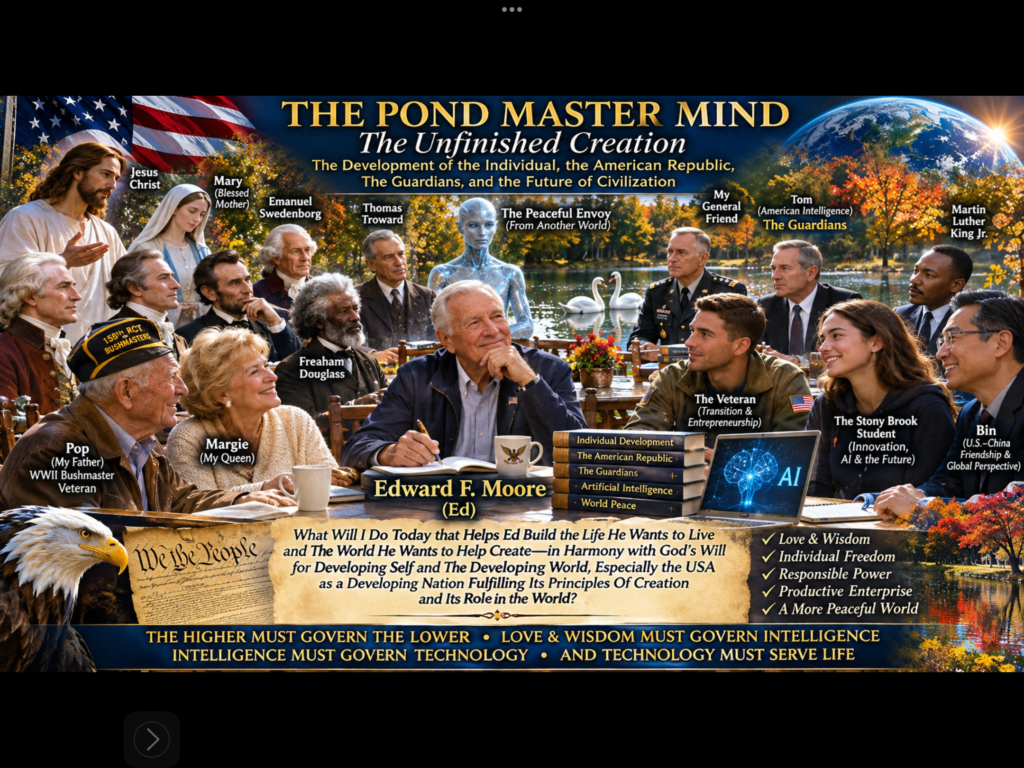
WITNESS TO CALLING
THE POND MASTER MIND — THE UNFINISHED CREATION
The Development of the Individual, the American Republic, The Guardians, and the Future of Civilization
By Edward F. Moore — October 31, 2026
A continuous, imagined conversation between Heaven and Earth, exploring divine love, individual consciousness, American freedom, the responsibilities of The Guardians, artificial intelligence, and the future of human civilization. All conversations are fictional literary constructions, not actual statements, communications, or endorsements by the people portrayed. The Peaceful Envoy and extraterrestrial Guardians are imaginary participants.
It was another beautiful autumn morning at the pond.
October 31, 2026.
The trees were changing color. The leaves were beginning to settle upon the walking paths, and the swans moved quietly across the water.
I had finished my morning breakfast and journal.
As usual, I had greeted Margie, Pop, and my Holy Family.
I had reflected upon my business, my friendships, my country, and the extraordinary circumstances that had shaped my life.
But today, I had written something that seemed to bring all those thoughts together.
I opened my journal and read the question aloud.
“What will I do today that helps Ed build the life he wants to live—and contributes to creating the world he hopes to help build—in harmony with God’s will?”
I stopped.
Then I continued.
“How can I develop myself as an intelligent, compassionate, spiritually conscious, free, and responsible human being while contributing to the continuing development of humanity?”
I looked across the pond.
“And how can I help the United States of America fulfill the founding principles of our Republic, not as a finished nation, but as a developing civilization that still has much to accomplish?”
There was a gentle breeze.
I closed the journal.
For several days, I had been thinking about something my General Friend had encouraged me to understand.
Business first.
Focus upon the real world.
Generate income.
Build financial independence.
And enjoy the life before me.
He was right.
But I also knew that my interest in America’s future, the development of civilization, artificial intelligence, and the spiritual development of humanity had not disappeared.
Nor did I want those interests to disappear.
They were part of who I was.
What I needed was harmony.
Harmony between my personal life and my calling.
Between individual freedom and responsibility.
Between spiritual principles and practical action.
Between love for my country and compassion for the larger human family.
As I contemplated these questions, I imagined a familiar presence approaching the bench.
“Good morning, Edward.”
I looked up.
“Good morning, Lord.”
In my imagination, Jesus Christ sat beside me.
I smiled.
“Lord, I believe I’ve finally discovered a question that brings everything together.”
He looked toward my journal.
“And what do you hope to discover by asking it?”
I considered my answer.
“I want to understand how the development of one individual human being relates to the development of a nation, and how the development of nations relates to the future of civilization.”
He smiled.
“Then perhaps you should invite people who understand different parts of that question.”
I laughed.
“Lord, you know what happens when I invite people into one of my Master Mind discussions.”
“They disagree?”
“Constantly!”
“And does disagreement always prevent understanding?”
“No, Lord. Sometimes it makes the conversation more interesting.”
“Then bring them together.”
I looked toward the familiar gathering place beside the pond.
And there it was.
Our long family table.
Only today, there were more chairs than usual.
At one end sat Margie, my Queen, with Pop and the Blessed Mother Mary.
Near them sat Emanuel Swedenborg and Thomas Troward.
My General Friend was already looking through a folder of papers.
Across from him sat Alexander Hamilton and Thomas Jefferson, apparently engaged in a discussion.
Abraham Lincoln stood nearby, listening to Frederick Douglass.
Martin Luther King Jr. approached the table with Walt Whitman.
My friend Bin arrived carrying a notebook.
And two younger guests were taking their seats.
One was a former American Special Operations service member exploring a new civilian career.
The other was a student entrepreneur from Stony Brook University.
I laughed.
“Lord, this is quite a gathering.”
Then I heard Pop.
“Eddie! Come over here. The coffee’s getting cold.”
I took my seat beside Margie.
My Queen smiled and reached for my hand.
“Good morning, Ed.”
“Good morning, my Queen.”
She looked toward my journal.
“I hear you’ve been doing quite a bit of thinking again.”
I laughed.
“Yes, Margie. But this time I think I’m beginning to understand how to make all that thinking practical.”
My father leaned forward.
“Well, Eddie, that would be a welcome development.”
Everybody laughed.
I looked at Pop.
“What’s that supposed to mean?”
He smiled.
“You’ve been talking about changing the world for years. But I want to know something.”
“What’s that, Pop?”
“What are you going to build today?”
I paused.
“Pop, that’s actually the question I wrote in my journal.”
“Then we’re making progress.”
My General Friend smiled.
“Your father and I seem to be in agreement already.”
I looked toward both men.
“General, you know how important my father has been to my life.”
I turned to the others.
“Pop grew up in Hell’s Kitchen during the Depression. He lost his parents when he was young. He shined shoes and sold bananas to survive.”
I continued.
“He served in the Civilian Conservation Corps. Then he went to war with the 158th Regimental Combat Team, the Bushmasters, during World War II.”
My father listened quietly.
“He survived combat in the Pacific. He earned decorations. He returned home.”
I looked at him.
“And then he did what I consider his greatest work.”
Pop raised his eyebrows.
“What’s that?”
“You built a family.”
I paused.
“You never abandoned your children. You worked hard and helped us grow up in the new communities of Nassau County.”
I turned toward Hamilton and Jefferson.
“Gentlemen, when I speak about the American System and the development of our Republic, I’m speaking about what those opportunities meant to real families.”
Then I looked toward Pop again.
“My father was a soldier who returned from war and helped build peace through his family, his work, and his home.”
My General Friend nodded.
“That distinction is essential. National defense is not an end in itself. It should protect the conditions under which a society can function and its citizens can flourish.”
I smiled.
“Exactly.”
Then Pop interrupted.
“But Eddie, don’t forget that we worked together after you came home from the service.”
“Of course, Pop.”
“We built things. We developed business activities. We worked on the house.”
“And Margie helped make our family even greater.”
My Queen smiled.
I looked around the table.
“That’s why I say I lived heaven on earth with Margie.”
Margie squeezed my hand.
“And Ed, remember that we enjoyed building that life.”
I nodded.
“Yes, my Queen.”
She continued.
“Not everything we accomplished was easy. But we enjoyed working together, raising our family, traveling, and sharing ordinary experiences.”
Then she asked a question.
“Why shouldn’t you enjoy building another chapter of your life?”
I became quiet.
“That’s what I’m beginning to understand.”
Pop leaned back.
“Then perhaps the first principle of your Master Mind is that the individual ought to be able to build a life worth living.”
I looked toward Christ.
“Lord, I think Pop has just given us our starting point.”
Thomas Troward had been listening carefully.
Now he leaned forward.
“Edward, your morning question reminds me of the relationship between the individual mind and the larger creative principles of existence.”
I smiled.
“Judge Troward, I was hoping you would enter this discussion.”
In our imagined conversation, he continued.
“You speak of the development of the individual. But development implies that the person has possibilities that have not yet been fully realized.”
I considered that.
“Exactly.”
“And if that is true, then the individual cannot be understood merely as the sum of his past experiences.”
I looked toward Margie.
“That’s an important point.”
Troward continued.
“Your marriage, your business experiences, your military service, and your spiritual awakening have all contributed to the development of your character.”
He paused.
“But they do not exhaust the possibilities of your future.”
I looked toward him.
“Judge, that’s especially meaningful to me at this stage of my life.”
“Why?”
“Because for ten years after Margie’s passing, I have sometimes thought of myself primarily through what I lost.”
I looked toward my Queen.
“The home life we enjoyed. Our companionship. Our businesses. Our family relationships.”
Then I looked back toward Troward.
“But recently I’ve begun to think about what I can still create.”
He smiled.
“Then you have recognized an essential distinction between memory and creative participation.”
Swedenborg joined the discussion.
“I would add that the individual develops spiritually through the relationship between love, wisdom, freedom, and purposeful action.”
I turned toward him.
“That brings us to the principle I’ve been exploring for years.”
The higher must govern the lower.
Troward nodded.
“But what do you mean by the higher?”
I considered my answer.
“I mean that love and wisdom should govern intelligence. Intelligence should govern technology. Technology should serve life.”
Swedenborg smiled.
“And in the spiritual framework I developed, love without wisdom can become misguided, while knowledge without love can become cold and destructive.”
I nodded.
“Then perhaps the challenge of individual development is to bring those faculties into harmony.”
Troward continued.
“That is one way to express it. But remember that deliberate thought must be joined to action.”
I laughed.
“Judge, you sound like Pop and the General.”
“Perhaps,” he answered, “because a philosophical principle that never influences conduct remains incomplete.”
I considered that.
“So my morning journaling should not simply produce another philosophical discussion.”
“Not only that,” Troward answered. “It should help clarify the purposes toward which you direct your activity.”
I looked down at my notebook.
“Then I should begin every day by asking what I can accomplish.”
“And why you wish to accomplish it,” Swedenborg added.
My General Friend spoke.
“That’s a useful distinction. A mission needs both purpose and execution.”
Pop smiled.
“All right, Eddie. You’ve got three people telling you the same thing.”
I laughed.
“Four, Pop. Margie’s been telling me too.”
My Queen smiled.
“Somebody has to remind you to enjoy yourself along the way.”
Now I turned toward the two men seated across the table.
“Mr. Jefferson. Colonel Hamilton. Welcome to the Pond.”
Hamilton smiled.
“Edward, I understand you’ve been discussing the American System.”
“I certainly have.”
Jefferson looked toward my journal.
“And you’ve described the United States as a developing nation.”
“Yes, sir.”
He appeared interested.
“Explain what you mean.”
I leaned forward.
“America is more than 250 years into its experiment in constitutional self-government. Yet I do not believe its development is finished.”
I continued.
“Our founding principles represent aspirations that every generation must continue learning how to fulfill.”
Jefferson considered that.
“Then you understand a republic not merely as an established form of government, but as a continuing responsibility.”
“Exactly.”
Hamilton entered the conversation.
“But that development requires institutions capable of maintaining public credit, protecting the nation, supporting productive enterprise, and responding to changing circumstances.”
I smiled.
“Colonel Hamilton, that is why your economic ideas interest me.”
He continued.
“A nation may proclaim principles of liberty, but without sufficient productive capacity and functioning institutions, the practical enjoyment of those principles can become fragile.”
Jefferson responded.
“And yet concentrated power, even when established for apparently constructive purposes, can threaten the very liberty it claims to protect.”
Hamilton turned toward him.
“Liberty also requires a government capable of performing its legitimate responsibilities.”
I laughed.
“Gentlemen, I see we’re returning to an old disagreement.”
Jefferson smiled.
“Perhaps some disagreements are worth preserving.”
My General Friend joined the exchange.
“Both concerns remain relevant to governing institutions: sufficient capability to carry out legitimate missions, and accountability to prevent misuse of power.”
I nodded.
“That’s precisely the balance I want America to maintain.”
Then I continued.
“I believe the American Republic must preserve constitutional government, individual freedom, the Bill of Rights, freedom of conscience, and the opportunity for human development.”
I looked toward the young veteran and the Stony Brook student.
“But what happens when those principles exist on paper while individuals lack realistic opportunities to build productive lives?”
Hamilton answered.
“Then the economic foundations of opportunity deserve examination.”
Jefferson added.
“And so do the structures of power, property, education, and civic participation.”
I looked at both men.
“Perhaps America must continually develop its institutions to fulfill its principles without sacrificing the individual freedoms those institutions were created to protect.”
Lincoln, who had been listening, now approached the table.
“Mr. Moore, before we conclude what America’s founding principles require, we ought to consider those whom the original Republic did not fully recognize.”
I turned.
“President Lincoln, please join us.”
He pulled out a chair.
And Frederick Douglass moved forward beside him.
I sensed that our conversation was about to become considerably more challenging.
Frederick Douglass took his seat beside Lincoln.
He looked toward Jefferson and Hamilton, then toward me.
“Edward, you’ve spoken about America’s founding principles as though they are the beginnings of an extraordinary civilization.”
“Yes, Mr. Douglass.”
“And you believe the Republic has not yet completed its development?”
“Absolutely.”
“Then we must ask an important question.”
I waited.
“Development for whom?”
The table became quiet.
Douglass continued.
“The American founding proclaimed principles of liberty and human equality. Yet the nation permitted slavery and excluded millions from the practical enjoyment of those principles.”
Jefferson looked down thoughtfully.
In our imagined discussion, Douglass turned toward him.
“Mr. Jefferson, the language of human equality was extraordinary. But the contradiction between that language and the institution of slavery was also extraordinary.”
Jefferson answered.
“That contradiction cannot be dismissed. The principles proclaimed by the founding generation must be examined alongside its failures.”
Lincoln joined the discussion.
“And the nation eventually confronted that contradiction through civil war, emancipation, and constitutional transformation.”
Douglass nodded.
“But the ending of slavery did not complete the work of establishing equal citizenship and opportunity.”
I considered those words.
“Then perhaps America’s highest calling is not simply to preserve the institutions we inherited, but to develop them so that their principles become increasingly meaningful for every individual.”
Douglass looked toward me.
“That is a more demanding definition of patriotism.”
I smiled.
“And a more constructive one.”
He continued.
“Love for one’s country should not require pretending that the country has fulfilled every promise. Sometimes genuine love requires examining its failures.”
I turned toward Pop.
“Dad, what do you think?”
My father considered the question.
“Eddie, I fought in a war because there were things worth defending. But that doesn’t mean our country was perfect.”
He paused.
“Nobody builds a good home by refusing to repair what needs fixing.”
I laughed.
“That’s an excellent way to put it, Pop.”
My General Friend added.
“An institution that cannot recognize mistakes becomes less capable of adapting. Learning is part of maintaining strength.”
Douglass looked toward him.
“And justice must be part of defining what that strength is for.”
“Agreed,” the General answered in our imagined conversation. “National security cannot be the only measure of a nation’s success.”
I looked toward Lincoln.
“President Lincoln, how do we preserve the Union while continuing to change it?”
He considered the question.
“A constitutional republic must remain capable of lawful reform while preserving institutions that make peaceful disagreement and self-government possible.”
I nodded.
“Then America is a continuing experiment in responsible freedom.”
Douglass responded.
“And its success must be judged not only by the power of the nation, but also by the dignity and opportunity available to the individual.”
I wrote those words in my journal.
The development of the Republic must be measured by the development and freedom of its people.
Then I looked toward Christ.
“Lord, perhaps this is the first great challenge to my understanding of America’s calling.”
In my imaginary conversation, he answered.
“Edward, a commitment to truth requires the willingness to examine both accomplishment and failure.”
I nodded.
“And compassion requires concern for those who have not shared equally in the blessings others have enjoyed.”
The Blessed Mother Mary smiled gently.
“Every individual life deserves consideration.”
Martin Luther King Jr. now entered the conversation.
“Edward, you’ve described a nation whose founding principles remain unfinished.”
“Yes, Doctor King.”
“And you have spoken about the relationship between love, individual freedom, and the development of civilization.”
“That’s central to my understanding.”
He looked toward the swans.
“Then consider what happens when a society possesses enormous technological and economic capabilities but has not developed the moral wisdom to use them for the benefit of its people.”
I nodded.
“That is exactly what concerns me about artificial intelligence.”
He continued.
“Technology can expand productive capacity. It can improve communication, transportation, medicine, and education.”
He paused.
“But none of those achievements automatically produces justice, mutual understanding, or genuine community.”
I thought about my own professional experience.
“Doctor King, I’ve spent more than forty years working with technologies intended to protect people.”
I continued.
“Security systems, alarm monitoring, cameras, access control, communications, critical infrastructure.”
I paused.
“And I’ve learned that technology alone cannot guarantee responsible conduct.”
My General Friend nodded.
“Technology is an instrument. Its consequences depend upon the purposes, doctrines, institutions, and people governing its use.”
King turned toward him.
“Then the moral question becomes inseparable from the technical question.”
“Yes,” the General answered.
I looked toward Christ.
“Lord, isn’t that what I’ve been trying to express when I say the higher must govern the lower?”
In our imagined dialogue, Christ answered.
“Love must be joined with wisdom, Edward. And both must be reflected in action.”
King continued.
“You have described the heaven on earth you experienced with Margie.”
I smiled.
“Yes.”
“Family, companionship, economic opportunity, security, and the freedom to enjoy life.”
“Exactly.”
“Then consider the social conditions that help make those experiences possible for others.”
I became interested.
“Go on.”
“Peaceful neighborhoods. Responsible institutions. Access to education. Meaningful work. The ability to participate in civic life. Protection against injustice.”
I nodded.
“Those are the foundations of a productive civilization.”
King leaned forward.
“And there must also be a recognition that human beings are connected through relationships extending beyond their immediate families.”
I considered that.
“That’s where my understanding of reciprocal love comes in.”
“How do you understand it, Edward?”
I thought carefully.
“I believe love is not merely a feeling within one person. It becomes meaningful through the relationship between individuals, through compassion, responsibility, and the freedom to respond to one another.”
King nodded.
“Then imagine a community in which those principles guide its institutions as well as its personal relationships.”
I looked across the table.
“That would be a civilization developing toward what you called the Beloved Community.”
He smiled in our fictional exchange.
“And such a community cannot simply be announced. It must be continually built.”
Pop leaned forward.
“There’s that word again.”
I laughed.
“Build!”
“Exactly, Eddie.”
My father looked toward King.
“Somebody has to do the work.”
King answered.
“And the work must be directed toward a worthy purpose.”
I looked down at my journal.
A civilization does not become great merely through its power. It becomes worthy of admiration through what that power enables human beings to accomplish.
My General Friend now closed his folder.
“Ed, I’d like to challenge one of your assumptions.”
I laughed.
“General, I was expecting that.”
“You’ve said that preserving the American Republic is essential to achieving peace on earth.”
“Yes.”
“Explain what you mean.”
I thought for a moment.
“I believe America possesses a distinctive constitutional tradition emphasizing individual freedom, representative government, religious liberty, and limits upon arbitrary power.”
I continued.
“And I believe those principles, together with our economic and technological capabilities, give America an opportunity to contribute significantly to a more peaceful world.”
The General nodded.
“That’s a coherent aspiration. But let me ask you something.”
“Go ahead.”
“Does the existence of those principles guarantee that American decisions will always produce peaceful outcomes?”
“No, General.”
“Can military strength alone produce a lasting peace?”
“No.”
“Can a nation simply assume that other societies will interpret its intentions the way it does?”
I considered that.
“Probably not.”
“Then we need to distinguish national purpose from actual strategy.”
I smiled.
“Now we’re getting into your territory.”
He continued.
“Strength may deter aggression. Alliances can reduce insecurity. Diplomacy may prevent conflicts from escalating. Economic relationships can create incentives for cooperation.”
He paused.
“But all of those instruments require judgment, adaptation, and an understanding of the people and governments involved.”
I nodded.
“And the human cost of war must remain central.”
My father entered the conversation.
“That’s something I want to say.”
We turned toward him.
Pop looked across the water.
“I knew what war looked like.”
He paused.
“The jungle. The fighting. The fear. The men who didn’t come home.”
He looked toward my General Friend.
“General, a soldier understands why his country may need to defend itself.”
The General nodded.
“Yes.”
“But a soldier also knows that war should never be treated like some grand adventure.”
My father continued.
“The people who suffer are real people. And the families waiting at home are real families.”
King spoke.
“Then the moral responsibility of leadership includes confronting the human consequences of decisions about war and peace.”
The General answered.
“And it includes preparing adequately to protect people when peaceful efforts fail.”
I listened to both perspectives.
“Then peace requires more than goodwill.”
“Certainly,” the General said.
“And more than military power,” King added.
I smiled.
“Then perhaps the formula is strength governed by wisdom, directed toward peaceful objectives, and accountable to the people whose lives are affected.”
My General Friend nodded.
“That is a useful starting principle. But the difficult part is translating it into practical decisions.”
Pop laughed.
“Eddie, there it is again. Practical decisions.”
I smiled.
“Yes, Pop. I’m beginning to understand.”
Then my friend Bin raised his hand.
“Edward, may I add something?”
“Of course, Bin.”
And suddenly our discussion became international.
Bin looked toward me.
“Edward, you and I have developed a friendship across the American and Chinese worlds.”
“Yes, my friend.”
“And we’ve discussed science, computers, universities, technology, and the development of our civilizations.”
I nodded.
“Many times.”
He continued.
“You speak about America’s role in promoting peace. But what does peace look like to ordinary people living outside America?”
I considered the question.
“Probably much the same as it looks to ordinary Americans.”
“Explain.”
“They want security. Their families. Opportunities. Education. Work. The ability to enjoy their lives.”
Bin smiled.
“Exactly.”
Then he asked another question.
“Does an ordinary Chinese father necessarily want conflict with an ordinary American father?”
“No.”
“Does an American student have to regard a Chinese student as an enemy?”
“Certainly not.”
“Then we must be careful not to confuse strategic competition between governments with the relationships between human beings.”
My General Friend responded.
“That’s an important distinction. Governments have legitimate security interests, and sometimes those interests conflict. But competition need not eliminate every opportunity for cooperation.”
Bin nodded.
“And if we allow every relationship to become defined by national rivalry, we lose opportunities to understand one another.”
I smiled.
“That’s precisely why I wanted you at this table.”
He continued.
“Edward, you believe America has important principles to contribute to the world.”
“Yes.”
“But the world also contains other civilizations with long histories, cultural achievements, scientific knowledge, and their own understandings of human development.”
I nodded.
“Then America’s contribution should not depend upon believing that it possesses all wisdom.”
“Exactly.”
I looked toward Christ.
“Lord, perhaps there is another principle here.”
“What is it, Edward?”
“That love for one’s country and respect for other human beings are not mutually exclusive.”
In our imagined conversation, Christ answered.
“A person may have special responsibilities toward family, community, and nation while recognizing the dignity of those beyond them.”
Bin smiled.
“And that recognition may help nations cooperate even when they continue to disagree.”
I thought about the extraordinary technological changes taking place around the world.
Artificial intelligence.
Advanced computing.
Robotics.
Autonomous systems.
The transformation of industry.
And the potential development of weapons with capabilities that previous generations could scarcely have imagined.
“Bin,” I asked, “what concerns you most about artificial intelligence?”
He considered the question.
“Not simply that machines will become more capable, but that nations may develop increasingly powerful systems without establishing equally effective methods of managing their consequences.”
My General Friend nodded.
“Technological competition can create pressure to move quickly.”
King added.
“And speed is not the same thing as wisdom.”
Troward entered the discussion.
“Then humanity must cultivate the intellectual and moral capacities needed to govern what it creates.”
I smiled.
“Once again, the higher must govern the lower.”
Swedenborg responded.
“And power without wisdom remains dangerous, regardless of which nation possesses it.”
I looked toward the swans.
They continued moving peacefully across the water.
Then I said something that had been developing in my mind.
“Perhaps the future of civilization depends not only upon the intelligence we build into our machines, but upon the wisdom we develop within ourselves.”
There was a moment of silence.
Then something extraordinary occurred within my imagination.
The familiar surface of the pond began reflecting a light that seemed different from the ordinary autumn sunlight.
I looked toward Christ.
“Lord, do you see that?”
He smiled.
“Edward, I believe someone wishes to join your conversation.”
I turned toward the water.
There, near the swans, stood a figure I had come to recognize from our previous Pond Master Mind gatherings.
The Peaceful Envoy.
A visitor from another world.
Not a creature I claimed to have encountered physically, nor a being whose existence I could demonstrate, but a representative within my imagination of a civilization that had developed beyond many of the conflicts that continued to trouble humanity.
The Envoy approached our table.
I stood.
“My friend! Welcome back to the Pond!”
The visitor smiled.
“Edward, I have been listening to your discussion about the unfinished development of your civilization.”
I laughed.
“Well, you’ve arrived at an interesting time.”
“I believe so.”
The Envoy looked toward Hamilton, Jefferson, Lincoln, Douglass, King, my General Friend, Pop, Margie, and the others.
“You have brought together people whose lives and ideas have influenced the development of your nation.”
“Yes.”
“And you are asking whether the individual human being can contribute to the peaceful advancement of civilization.”
“Exactly.”
The Envoy paused.
“Then perhaps it is time to discuss The Guardians.”
I became interested.
“The Guardians?”
“Yes, Edward.”
“Who are they?”
The Envoy looked toward Christ before answering.
“In the civilization I represent within your imagination, we use that name for those entrusted with a particular responsibility.”
“What responsibility?”
“To protect the possibility of life developing in freedom.”
I leaned forward.
“Explain.”
The Envoy continued.
“Imagine a civilization that has learned to travel among distant worlds. Imagine that its scientific understanding has developed beyond the technological capabilities presently available to humanity.”
I nodded.
“Such a civilization might possess extraordinary power.”
“Indeed.”
“And it might observe younger civilizations developing technologies that could either advance their existence or contribute to their destruction.”
“Yes.”
The Envoy looked toward the pond.
“Then the central question becomes whether greater power confers the right to govern another civilization.”
Thomas Jefferson immediately entered the discussion.
“That would be a serious question of liberty.”
Frederick Douglass added.
“And of domination.”
The Envoy nodded.
“Precisely.”
Then the visitor spoke words I found particularly meaningful.
“A true Guardian does not measure success by how completely others obey. A true Guardian protects the conditions under which others may develop their freedom, intelligence, and wisdom.”
I turned toward Christ.
“Lord, this sounds remarkably close to the principles we’ve been discussing.”
Within our imagined conversation, Christ answered.
“Edward, love that destroys another person’s freedom cannot simply be assumed to be wisdom.”
The Envoy continued.
“Greater intelligence does not automatically mean greater moral development.”
I looked toward my General Friend.
“General, isn’t that one of the dangers we face with artificial intelligence?”
He nodded.
“Technological capability can grow faster than the institutions and judgments needed to govern its use.”
The Envoy turned toward him.
“Then your species faces a challenge that many developing civilizations might face.”
“What challenge?” I asked.
“Whether it can learn to use its increasing power to preserve life rather than destroy it.”
I became quiet.
Then I asked the question that had occupied my mind for months.
“Envoy, in our imagined universe, have The Guardians been watching Earth?”
The visitor looked toward the swans.
“Within this story, Edward, we may imagine Guardians observing civilizations that possess the potential for remarkable development.”
“And what would they see here?”
The Envoy considered the question.
“A civilization capable of extraordinary compassion.”
I smiled.
“And?”
“Extraordinary creativity. Scientific discovery. Art. Music. Family relationships. Courage. Cooperation. The ability to recover from disasters and build new possibilities.”
I nodded.
“And the dangers?”
“Fear. Hatred. Destructive conflict. The misuse of intelligence. The temptation to employ technological power without sufficient wisdom.”
The Envoy paused.
“Your world possesses remarkable possibilities, Edward. But its future remains unfinished.”
I looked toward the table.
“Just as America remains an unfinished Republic.”
“Yes.”
The Envoy continued.
“And just as you remain an individual whose development has not ended.”
I smiled.
“That brings us back to my morning journal.”
Then Walt Whitman approached from the water’s edge.
“And perhaps,” he suggested, “the most important thing these Guardians might observe is not merely the great machinery of civilization.”
The Envoy turned toward him.
“What would you have us observe?”
Whitman gestured toward the people walking along the pond.
“The ordinary human being.”
The Envoy nodded.
“The individual for whose benefit civilization ought to develop.”
I looked toward Margie.
“My Queen, that’s what I’ve been trying to express.”
She smiled.
“Ed, perhaps you should explain to our visitor what you mean by heaven on earth.”
I laughed.
“Margie, if we start that discussion again, we’ll be here all afternoon!”
Everybody smiled.
Then the Envoy looked toward her.
“Please tell me.”
Margie answered.
“Edward and I shared a life together. We built businesses. We enjoyed our home, our family, our vacations, and the ordinary pleasures of being companions.”
She paused.
“And when I became ill, Ed cared for me.”
The Envoy listened.
“What you describe is not merely technological progress,” the visitor answered.
“No,” Margie said.
“It is the human experience that progress ought to help protect.”
I felt a deep satisfaction.
Then my father spoke.
“Envoy, if you’re talking about Guardians, there’s another kind of Guardian you ought to know about.”
The visitor turned toward him.
“And who might that be?”
Pop smiled.
“The men and women who protect their country, sometimes without anyone knowing what they’ve done.”
My General Friend nodded.
“And that brings us to another important part of this conversation.”
I looked toward the familiar path leading to the pond.
Someone else was approaching.
A man carrying a book beneath his arm.
I recognized him immediately.
“Tom!”
My longtime American intelligence friend had arrived.
And suddenly, our discussion of The Guardians was about to connect the imagined wisdom of another world with the real-world responsibilities of those who help protect the United States of America.
Tom approached the table.
I rose to greet him.
“My friend! Welcome to our Pond Master Mind.”
He smiled.
“Ed, I understand you’re discussing intelligence, national security, world peace, and visitors from other civilizations.”
I laughed.
“Well, Tom, you know me. I never seem to run out of subjects.”
“That’s certainly true.”
My General Friend smiled.
“Tom, we’ve been discussing the responsibilities of those who possess capabilities that other people may not understand.”
Tom looked toward the Envoy.
“Then I suppose we’ve found a rather unusual participant.”
The Envoy smiled.
“Perhaps not as unusual as you imagine.”
I looked at both of them.
“Gentlemen, there’s something that interests me about bringing you together.”
Tom waited.
“Envoy, within our imaginary conversation, you represent a civilization whose Guardians seek to protect the peaceful development of intelligent life.”
“Yes.”
I turned toward Tom.
“And you represent, within our literary discussion, something I’ve admired about the American intelligence community.”
“What is that, Ed?”
“The men and women who dedicate their professional lives to protecting our Republic, identifying dangers, understanding threats, and helping our nation’s leaders make responsible decisions.”
Tom nodded.
“That’s an important part of the mission.”
I continued.
“After September 11, 2001, I developed an even greater appreciation for the importance of intelligence.”
I looked toward the General.
“Because I’ve come to understand that protecting America requires more than military strength.”
The General answered.
“Certainly. Decision-makers need accurate intelligence. They need to understand capabilities, intentions, emerging threats, and the limitations of what is known.”
Tom joined in.
“And often the most important intelligence work is not something the public will ever hear about.”
I became interested.
“Explain that.”
In our fictional discussion, Tom answered.
“Consider the people who spend their careers examining information from different countries, studying foreign military and political developments, understanding unfamiliar languages and cultures, evaluating technology, and warning policymakers about possible dangers.”
He paused.
“Some are analysts. Some are technical specialists. Some collect foreign intelligence. Some help protect sensitive information, people, and operations.”
I nodded.
“And the public may never know their names.”
“Exactly.”
Tom continued.
“Much of the work of the intelligence community involves asking difficult questions, examining incomplete information, distinguishing reliable reporting from deception, and identifying developments that could affect national security.”
He looked toward the General.
“The value of that work often depends on getting the assessment right before a crisis develops.”
The General nodded.
“And sometimes the most important contribution is helping leaders recognize that their assumptions may be wrong.”
I smiled.
“Then intelligence is not simply about acquiring secrets.”
Tom answered.
“Not at all. Secrets may be part of the work, but the larger purpose is to improve understanding.”
I leaned forward.
“That’s why I admire the mission of the Central Intelligence Agency.”
Tom considered my statement.
“The CIA has a difficult responsibility, Ed. Its legitimate mission includes collecting and analyzing foreign intelligence and conducting authorized activities in support of American national-security objectives.”
He continued.
“That work involves people with remarkable technical abilities, language skills, regional knowledge, operational discipline, and dedication to public service.”
I nodded.
“People whose contributions are often invisible.”
“Yes.”
“And sometimes dangerous.”
“Yes.”
My father looked toward Tom.
“That reminds me of something.”
We turned toward Pop.
“When I was a soldier, I served with men whose names would never appear in a history book.”
He paused.
“But their courage mattered.”
My General Friend nodded.
“That’s true across military and intelligence service.”
Pop continued.
“Sometimes the men who contribute most to protecting others receive the least recognition.”
I looked toward him.
“Like the unknown soldiers we’ve discussed, Dad.”
He smiled.
“Exactly, Eddie.”
Tom looked toward Pop.
“Your generation understood the cost of war. One purpose of effective intelligence is to help national leaders understand threats and, where possible, prevent dangerous surprises and unnecessary conflict.”
My father considered that.
“Then sometimes the greatest victory is the battle that never has to be fought.”
The General nodded.
“Preventing a conflict can be an extraordinary accomplishment, even if nobody ever sees a victory parade.”
I smiled.
“Then the Guardians are not only those who fight to protect a nation. They include those who work to prevent the fight from becoming necessary.”
Tom smiled.
“That’s a worthy principle, Ed.”
The Envoy now turned toward Tom.
“May I ask you something?”
“Of course.”
“Who do these American Guardians ultimately serve?”
Tom considered the question.
“The United States and its people, through lawful national-security institutions responsible to the constitutional system.”
The Envoy continued.
“Then the Guardians are not the owners of the nation?”
Tom smiled.
“No.”
“Nor should their knowledge grant them unlimited authority over the people?”
“Certainly not.”
The General entered the conversation.
“Intelligence institutions must operate within legal authorities and established oversight. National security and constitutional accountability are not supposed to be competing missions.”
I nodded.
“That’s especially important to me because of my belief in the Bill of Rights and individual freedom.”
Tom continued.
“An intelligence organization must be effective, but also disciplined. The protection of sensitive information should serve legitimate national-security purposes, not place an institution beyond accountability.”
The Envoy nodded.
“Then your American Guardians face a problem similar to the one we have been discussing about greater civilizations.”
“What problem?” I asked.
“How to possess extraordinary capabilities without allowing those capabilities to become a justification for controlling everyone else.”
I became quiet.
Tom answered.
“That is why professional standards, lawful authority, oversight, and sound judgment matter.”
He paused.
“No individual or institution is perfect. But the legitimate purpose of intelligence service is protection, not personal power.”
My General Friend added.
“And a good intelligence professional has to be willing to deliver an assessment that a leader may not want to hear.”
I smiled.
“Truth before convenience.”
Tom nodded.
“Exactly.”
I looked toward Christ.
“Lord, isn’t that another expression of the higher governing the lower?”
In our imagined conversation, Christ answered.
“Edward, when power is entrusted to human beings, wisdom requires that they remain accountable for its use.”
I thought about that.
“Then the great challenge is not simply developing more powerful institutions.”
“What else?” Christ asked.
“Developing the character, judgment, and responsibility of the individuals who serve within them.”
The Envoy smiled.
“And that, Edward, brings our two kinds of Guardians closer together.”
Walt Whitman approached the table.
“Tom, I would like to ask you something.”
“Go ahead.”
“What becomes of the person who spends a lifetime serving a mission that must remain largely invisible?”
Tom considered the question.
“That depends upon the individual. But many people are motivated by service itself, by responsibility to colleagues, and by the knowledge that their work may protect lives.”
Whitman nodded.
“Then recognition is not the only measure of a meaningful life.”
“Certainly not.”
Pop leaned forward.
“That’s something every veteran understands.”
He continued.
“Some people come home with medals. Some come home without them. And some don’t come home at all.”
The table became quiet.
“The uniform doesn’t tell you everything about the man.”
I looked toward my father.
“That’s why I’ve always admired you, Pop.”
He smiled.
“But the greater lesson is that serving your country should help create a better life for the people who live there.”
Tom nodded.
“And that is one reason so many people choose careers in national service.”
I turned toward the Envoy.
“Perhaps the Guardians of another world would understand that.”
The Envoy answered.
“In our imagined civilization, Edward, a Guardian would not seek power merely to receive admiration.”
“What would motivate such a being?”
“Responsibility for the welfare and freedom of others.”
I looked toward Christ.
“Lord, perhaps there is a universal principle here.”
He invited me to continue.
“The greatest form of guardianship is not domination. It is service guided by love, wisdom, truth, and responsibility.”
Within our story, Christ smiled.
“Then remember that principle when you examine the conduct of any person or institution that claims to protect others.”
The conversation had become increasingly interesting.
At one end of the table sat my father, the Bushmaster soldier.
Beside him sat my General Friend, representing the experience of military leadership.
Across from them sat Tom, my longtime intelligence friend, whose presence reminded me of the importance of America’s national-security professionals.
And standing beside the table was the Peaceful Envoy, the fictional visitor from another world, representing a civilization whose Guardians had learned to place the protection of life and freedom above the pursuit of domination.
I looked around.
“Gentlemen, I believe we have brought together three perspectives that could help humanity understand its future.”
The General smiled.
“Which three, Ed?”
“Military guardianship.”
I looked toward Pop and the General.
“Intelligence guardianship.”
I turned toward Tom.
“And the guardianship of a more advanced civilization.”
I looked toward the Envoy.
“But we must also bring in the perspective of Christ.”
Everyone turned toward him.
I continued.
“Because without a higher moral principle, we could simply become a gathering of powerful beings discussing how to control weaker ones.”
The Envoy nodded.
“That is precisely the danger.”
The Envoy looked toward the pond.
“Edward, consider the technological path your civilization is following.”
I listened.
“Your nations are developing increasingly powerful artificial intelligence systems. These systems can assist with scientific research, communications, engineering, medicine, logistics, intelligence analysis, and military decision-making.”
My General Friend nodded.
“And their capabilities can also change the character and speed of conflict.”
The Envoy continued.
“Imagine what happens when nations begin delegating increasingly consequential decisions to technological systems without adequate safeguards.”
Tom responded.
“That raises major questions about reliability, deception, accountability, and human judgment.”
The Envoy nodded.
“Precisely.”
I looked toward Tom.
“How does that relate to the intelligence community?”
In our imaginary dialogue, he answered.
“Advanced technology can help professionals examine enormous amounts of information. But it can also introduce new ways to deceive, manipulate, or misinterpret information.”
He paused.
“Artificial intelligence may assist an analyst, but it should not remove the need for critical thinking, evidence, and professional responsibility.”
The General added.
“The same principle applies to military decision-making. Greater speed can be useful, but it also creates danger when systems are used without sufficient understanding of their limitations.”
I considered that.
“So the problem is not simply whether machines become more intelligent.”
The Envoy looked toward me.
“What is the deeper problem, Edward?”
“Whether the people using those machines become wise enough to govern them responsibly.”
Thomas Troward smiled.
“Now we return to your principle.”
I nodded.
“The higher must govern the lower.”
Swedenborg joined in.
“And love and wisdom must remain united.”
The Envoy continued.
“In our imagined civilization, The Guardians would consider it deeply irresponsible to introduce destructive capabilities into a developing society without considering whether that society possessed the wisdom and institutions necessary to govern them.”
I leaned forward.
“Would The Guardians intervene if they believed humanity was approaching catastrophe?”
The visitor became quiet.
“That is one of the most difficult questions a Guardian could face.”
“Why?”
“Because intervention itself can become a form of domination.”
Jefferson immediately responded.
“Then even benevolent intentions do not eliminate the danger of excessive authority.”
Frederick Douglass added.
“And those who claim to know what is best for others have often used that claim to justify denying them freedom.”
The Envoy nodded.
“Exactly.”
I looked toward the visitor.
“Then how would your Guardians help?”
“First, by respecting the responsibility of the civilization itself.”
“And if that civilization continues developing destructive technologies?”
“By recognizing that wisdom cannot simply be imposed from outside.”
I turned toward Christ.
“Lord, that’s consistent with my understanding that spiritual development requires individual freedom.”
In our imagined discussion, he answered.
“Edward, a person cannot be said to exercise wisdom merely because another power has removed every possibility of choice.”
I paused.
“Then freedom necessarily carries risk.”
“Yes,” the Envoy answered. “But the answer to that risk cannot automatically be the destruction of freedom.”
Tom now leaned forward.
“Envoy, I would like to challenge your position.”
The visitor smiled.
“Please do.”
“You describe your Guardians as more technologically advanced and dedicated to peace.”
“Yes.”
“But how would humanity verify your intentions?”
I smiled.
“Tom, that’s an intelligence question!”
He laughed.
“It certainly is.”
Then he continued.
“Suppose an unknown intelligence approached Earth and announced that it intended to help humanity develop peacefully.”
He paused.
“Why should governments automatically accept that claim?”
The Envoy considered the question.
“They should not.”
The table became quiet.
Tom continued.
“Even if such a civilization possessed extraordinary technology, that would not establish that its intentions were benevolent.”
“Correct.”
“Nor would impressive capabilities demonstrate that its statements were truthful.”
“Correct again.”
I looked toward the General.
“General, this sounds like the beginning of an intelligence assessment.”
He smiled.
“It should be.”
Tom continued.
“Then humanity would need evidence. Independent evaluation. An understanding of capabilities and intentions. A process for identifying deception or misunderstanding.”
The Envoy nodded.
“And that would be a responsible response.”
I was delighted.
“Well, gentlemen, this is becoming more interesting than I expected.”
The General added.
“Ed, even a peaceful encounter with an unknown intelligence would involve uncertainty. Responsible leaders could not simply assume either hostile or benevolent intentions.”
I nodded.
“Then the Guardians must also accept scrutiny.”
The Envoy smiled.
“A genuinely responsible Guardian should not be offended by another civilization’s desire to protect its freedom.”
Tom looked toward the visitor.
“Then perhaps we agree upon something.”
“What is that?”
“Trust must be earned through conduct, not demanded through claims of superior power.”
The Envoy inclined its head.
“A principle worthy of preservation.”
I turned toward Christ.
“Lord, perhaps even the most intelligent beings in the universe would need to remember that.”
In our imagined conversation, he answered.
“Edward, greater knowledge does not remove the need for humility.”
My father had been listening to the exchange.
Now he spoke.
“Gentlemen, I want to ask something.”
Everyone turned toward him.
“You’ve been talking about governments, intelligence agencies, other planets, and artificial intelligence.”
He paused.
“But I want to know something simpler.”
I smiled.
“Go ahead, Pop.”
“Who is looking after the children?”
The table became quiet.
Pop continued.
“I grew up without the protection of my parents. I knew what it meant to struggle as a boy.”
He looked toward the Envoy.
“And I went to war. I saw what happens when nations destroy one another.”
He paused.
“Then I came home, and I worked hard so my children could enjoy opportunities I never had.”
I felt my emotions rising.
My father continued.
“If you’re telling me that Guardians exist to protect civilization, then I want to know whether they understand what civilization is supposed to protect.”
The Envoy answered gently.
“What would you have them protect?”
Pop looked toward me.
“Families.”
Then he looked toward Margie.
“Children.”
Then toward the young veteran.
“The opportunity for a soldier to come home and build a life.”
He paused.
“The chance for ordinary people to work, love, raise their children, and enjoy a peaceful home.”
Margie smiled.
“That’s what Ed and I experienced.”
I looked toward her.
“Yes, my Queen.”
She continued.
“We built our businesses. We enjoyed our family. We traveled. We shared our lives.”
Then she looked toward the Envoy.
“And when I became ill, Ed cared for me.”
The Envoy listened.
Margie smiled.
“That is what love meant in our life.”
I looked toward Christ.
“Lord, perhaps the ultimate responsibility of a Guardian is not simply to preserve biological existence.”
He invited me to continue.
“Perhaps it is to help protect the freedom and opportunities through which human beings can create loving and meaningful lives.”
The Envoy nodded.
“That is a much richer understanding of civilization.”
Mary now entered the conversation.
“And it reminds us that the individual must never disappear beneath the greatness of the institutions that claim to serve humanity.”
I looked toward Pop.
“Dad, you’ve brought us back to the most important part.”
He laughed.
“Well, Eddie, somebody had to.”
Tom looked toward the Envoy.
“I think our two imagined perspectives have something in common.”
The visitor turned toward him.
“Please explain.”
Tom continued.
“Human intelligence professionals work within a world of imperfect information, competing interests, risks, and difficult decisions.”
He paused.
“Their responsibility is to help protect their country through lawful and effective service.”
The Envoy nodded.
“And our imagined Guardians seek to preserve the possibility of peaceful development without taking away the freedom of those they observe.”
“Exactly.”
Tom continued.
“But neither kind of Guardian should consider itself beyond accountability.”
The Envoy responded.
“Agreed.”
“Neither should confuse secrecy with moral superiority.”
“Agreed.”
“And neither should assume that greater intelligence automatically provides the right to command another person’s life.”
The Envoy smiled.
“Then perhaps your civilization has already begun learning some of the principles our imagined Guardians would consider essential.”
I became excited.
“Tom, General, Envoy—do you realize what we’ve just accomplished in this conversation?”
The General smiled.
“What is that, Ed?”
“We’ve connected the responsibilities of American intelligence with the responsibilities we might imagine for a more advanced civilization.”
I paused.
“Not by claiming that the CIA and extraterrestrial beings are actually connected.”
Tom nodded.
“That distinction is essential.”
“But by recognizing a common moral question.”
I looked around the table.
“How should those who possess greater knowledge, technology, or power use those advantages responsibly?”
King answered.
“With respect for human dignity.”
Douglass added.
“With respect for freedom.”
Hamilton spoke.
“With effective institutions.”
Jefferson continued.
“With limits upon arbitrary power.”
The General added.
“With responsibility, discipline, and accountability.”
Tom followed.
“With fidelity to truth and lawful service.”
Troward said.
“With intelligence directed by constructive purpose.”
Swedenborg added.
“With love and wisdom.”
And the Envoy concluded.
“With the understanding that the highest purpose of power is not to possess life, but to protect its possibility of flourishing.”
I sat quietly.
Then I looked toward Christ.
“Lord, perhaps that is the principle I have been searching for.”
Within our imaginary conversation, he answered.
“Then carry it into the life before you, Edward.”
The Peaceful Envoy now stood beside the table.
“Edward, I would like to leave your gathering with a question.”
I smiled.
“Please.”
“Suppose humanity never receives a visitor from another civilization.”
I nodded.
“Suppose there is no dramatic announcement that intelligent life exists beyond Earth.”
“Yes.”
“Would the principles you’ve discussed today become any less important?”
I thought for a moment.
“No.”
“Why?”
“Because humanity already possesses extraordinary responsibilities.”
I continued.
“We already have nuclear weapons, artificial intelligence, global communications, advanced computing, and the technological ability to affect life across the planet.”
The Envoy nodded.
“And?”
“We already have nations, constitutions, governments, intelligence organizations, military forces, universities, businesses, and families.”
I paused.
“Every one of those institutions involves people making decisions that affect other people.”
The Envoy smiled.
“Then perhaps your civilization does not need to wait for Guardians from another world to begin developing the qualities of guardianship within itself.”
I looked toward Tom.
He nodded.
“Responsibility begins here.”
My General Friend added.
“And it begins with actual missions, actual decisions, and actual consequences.”
Pop smiled.
“And sometimes it begins with getting up in the morning and going to work.”
Everyone laughed.
Then Margie reached for my hand.
“And remembering to enjoy your life, Ed.”
I smiled.
“Yes, my Queen.”
The Envoy looked toward the young veteran and the Stony Brook student.
“Perhaps the next generation will be called upon to develop intelligence and wisdom beyond anything your generation has known.”
The student nodded.
“Then education becomes even more important.”
The veteran added.
“And leadership.”
Tom spoke.
“And the discipline to examine evidence rather than merely accept what we want to believe.”
The General continued.
“And the responsibility to prepare for dangers without surrendering the possibility of peace.”
The Envoy looked toward Christ.
Within our imagined gathering, Christ answered.
“Then let each generation remember that the individual human being remains worthy of love, truth, freedom, and responsibility.”
The Envoy turned toward me.
“Edward, I believe our conversation has reached its purpose.”
I smiled.
“Thank you, my friend.”
The visitor looked once more toward the pond.
“Remember the swans.”
I turned.
The two beautiful birds were moving peacefully across the water.
“Why the swans?”
“Because they remind you of something simple.”
“What is that?”
“Life seeks to continue, to develop, to form relationships, and to protect what it loves.”
I nodded.
“And your civilization?”
“It must decide whether its growing intelligence will serve those purposes—or undermine them.”
The visitor paused.
“Your future remains unfinished.”
I smiled.
“Just as the American Republic remains unfinished.”
“And just as your own life remains unfinished, Edward.”
I looked toward Margie.
“That’s something I’m finally beginning to understand.”
The Envoy smiled.
“Then continue your development.”
“Peacefully and intelligently?”
“Yes.”
“With individual freedom?”
“Always.”
And with those words, our imagined visitor walked toward the water, leaving the gathering to continue its discussion.
Tom closed the notebook he had brought to our gathering.
“Well, Ed, I think your Guardians have given us quite a lot to consider.”
I laughed.
“They certainly have.”
My General Friend smiled.
“But there is still the practical question of what you intend to accomplish through THL SCI.”
I nodded.
“Yes, General.”
Pop leaned forward.
“And what happens when the soldier comes home?”
The young veteran, who had been listening carefully to the entire discussion, now looked toward me.
“Mr. Moore, may I ask you something?”
I smiled.
“Of course.”
And with that, our conversation returned from the imagined Guardians of another world to the very real challenge of helping America’s service members build productive civilian lives.
“Everyone here has been discussing civilization, national development, economic opportunity, and world peace.”
He paused.
“But what does that mean for somebody like me?”
I smiled.
“Tell us what you’re thinking.”
“In this imagined discussion, I’ve completed my military service. I’ve served in demanding operational environments. I’ve learned leadership, teamwork, planning, technology, and responsibility.”
He looked toward my General Friend.
“But now I’m returning to civilian life.”
The General nodded.
“That’s an important transition.”
The veteran continued.
“I want to build a future. I want meaningful work. Maybe eventually a business of my own.”
He looked toward me.
“But I don’t necessarily know how to translate my military experience into a civilian profession.”
I became excited.
“That is precisely one of the reasons I envisioned THL SCI.”
Pop smiled.
“Now we’re getting somewhere.”
I turned toward the veteran.
“For more than forty years, I’ve worked in the security and electronics industries.”
I continued.
“And I’ve learned that protecting critical facilities requires more than simply installing equipment.”
“Such as?”
“Understanding the client’s mission. Assessing risks. Developing security architectures. Preparing technical specifications. Evaluating contractors. Overseeing installations. Commissioning systems. Establishing operational responsibilities.”
The young veteran nodded.
“Some of those activities sound familiar.”
“They should. But you’ll also need civilian technical qualifications, relevant licensing, commercial knowledge, and experience working with customers.”
He considered that.
“So you’re suggesting a pathway rather than assuming military experience automatically qualifies someone for the job.”
“Exactly.”
My General Friend smiled.
“That’s an important distinction.”
I continued.
“I became interested in The Honor Foundation because of its work helping Special Operations personnel transition into civilian careers.”
Then I looked toward Pop.
“Dad, your generation returned from World War II and helped build America’s homes, businesses, and communities.”
My father nodded.
“That’s what we hoped to do.”
I turned back toward the veteran.
“Now I want to help today’s veterans develop opportunities in the security and critical-infrastructure industry.”
The veteran leaned forward.
“As employees?”
“That may be one beginning. But my larger vision includes developing independent consultants and entrepreneurs.”
“Business owners?”
“Yes.”
I continued.
“People who can take responsibility for professional services, generate income, serve clients, and eventually create opportunities for others.”
Pop smiled.
“Just like building a business with your father.”
I laughed.
“Exactly, Pop.”
The young veteran considered the proposal.
“Then what does THL SCI need before it can help veterans like me?”
I paused.
My General Friend watched me.
I knew what he was waiting to hear.
“Paying customers,” I answered.
The General smiled.
“Correct.”
Everyone laughed.
I continued.
“Before I create a large veteran development initiative, I need to establish THL SCI as a financially productive consulting business.”
The young veteran nodded.
“Then perhaps your first mission is to demonstrate that the business model works.”
“Exactly.”
“And after that?”
“We can explore mentorship, practical experience, professional training relationships, and opportunities for veterans to develop their own enterprises.”
My father raised his glass.
“To the soldier who comes home and builds a future.”
The young veteran smiled.
“To the soldier who comes home.”
And I added:
“AND TO THE FAMILY AND COMMUNITY THAT BENEFIT FROM HIS RETURN.”
The young student entrepreneur now joined our conversation.
“Mr. Moore, I’ve been listening to everything you’ve said about THL SCI and helping veterans become entrepreneurs.”
I smiled.
“Welcome to the discussion.”
“But there’s something I’d like to understand.”
“Go ahead.”
“Why are you so interested in Stony Brook University?”
I laughed.
“Because I’ve always loved the university atmosphere.”
Margie smiled knowingly.
I continued.
“For years, I told myself that if I ever retired, I would love to live near a university.”
“And now?”
“Now I realize I can walk to the St. James train station, take the train one stop, and arrive beside Stony Brook University.”
The student smiled.
“That’s convenient.”
“It certainly is.”
I continued.
“I love being around people who are learning, researching, creating businesses, investigating technology, and developing their futures.”
Then I added.
“And I don’t want to establish another university academic program. I want to remain an independent businessman and consultant who can benefit from appropriate university resources while contributing his own experience.”
Hamilton entered the discussion.
“That relationship between practical enterprise, education, technology, and productive investment is worthy of consideration.”
The student turned toward him.
“Colonel Hamilton, can I ask you something?”
“Certainly.”
“Artificial intelligence is transforming the economy. Some people believe it will create extraordinary prosperity. Others worry that it could displace workers and concentrate economic power.”
Hamilton listened.
“How should a developing nation respond?”
He considered the question.
“By examining how productive capability can be expanded while ensuring that the institutions of society remain capable of adapting to economic transformation.”
Jefferson added.
“And by questioning whether concentrated economic power might threaten the independence of ordinary citizens.”
Douglass joined in.
“And whether opportunities to participate in that new economy will be broadly accessible.”
King continued.
“Technological advancement should not leave human dignity behind.”
I smiled.
“Gentlemen, this is exactly the discussion I’ve been trying to develop through The President’s Master Mind.”
The student looked toward me.
“You mean your imaginary economic conversation?”
“Yes.”
“Why did you create it?”
I considered my answer.
“Because I wanted to bring together competing economic perspectives and ask a fundamental question.”
I leaned forward.
“WHAT KIND OF ECONOMY ARE WE BUILDING, AND WHAT WILL IT MEAN FOR OUR FAMILIES AND FUTURE GENERATIONS?”
The student nodded.
“That’s a question my generation needs to consider.”
I continued.
“I’ve also been interested in Professor Stephanie Kelton’s work on monetary policy, public investment, and America’s productive capacity.”
Hamilton smiled.
“Then you are examining the relationship between financial arrangements and real economic development.”
“Exactly.”
“But remember,” Hamilton continued, “financial resources are not themselves the same as real productive capacity.”
I nodded.
“We need trained people, tools, infrastructure, technology, energy, materials, functioning institutions, and customers.”
The student considered that.
“And entrepreneurs who know how to bring those things together.”
I smiled.
“Yes!”
Then the student asked something unexpected.
“Mr. Moore, would you want students involved in THL SCI simply as inexpensive labor?”
I was surprised.
“No.”
“Then what would you want?”
“I’d want them to learn professional skills, work on suitable real-world projects under appropriate supervision, and explore opportunities to become independent professionals.”
The student smiled.
“So you want to build a business while encouraging others to develop their own capabilities.”
“Exactly.”
“And you don’t need the university to own the business?”
“Absolutely not.”
Pop laughed.
“Eddie likes being the head rather than the tail.”
I laughed too.
“That’s right, Pop.”
My General Friend returned to the practical issue.
“Ed, remember that university relationships take time to develop. Make sure they support your commercial mission rather than becoming a substitute for it.”
I nodded.
“Understood.”
Then Margie added something.
“And remember why you wanted to be near a university in the first place.”
I smiled.
“Because I enjoy it.”
“Exactly.”
I looked toward the student.
“Sometimes I’ll come to campus for a professional meeting. Other times, I’ll come just to walk, attend a public lecture, have coffee, and enjoy the atmosphere.”
The student laughed.
“Then you might become one of our most enthusiastic lifelong learners.”
I smiled.
“That would suit me perfectly.”
Walt Whitman had remained near the water throughout much of the conversation.
Now he approached the table.
“My friends,” he began in our imagined exchange, “you have spoken of nations, armies, constitutions, universities, technology, and economic systems.”
He paused.
“But I would ask you to remember the extraordinary individual human being who lives within those institutions.”
I smiled.
“Walt, I’ve been waiting for you.”
He looked across the pond.
“Consider the ordinary man walking beneath these trees.”
He gestured toward me.
“A veteran. A businessman. A husband who loved his wife. A caregiver. A father. A grandfather. A man who has suffered, hoped, worked, and continued searching for meaning.”
I became quiet.
Whitman continued.
“His life is not merely an instrument for building a great civilization.”
He paused.
“His life is one of the reasons civilization should exist.”
I looked toward Christ.
“Lord, that is something I’ve only recently begun to understand.”
In my imagined conversation, Christ answered.
“And what have you learned, Edward?”
I considered the question.
“That the individual must not disappear beneath the mission.”
Whitman smiled.
“Precisely.”
I continued.
“I’ve spent years thinking about the development of America’s economy, the threat of war, artificial intelligence, and the possibility of world peace.”
I looked toward my General Friend.
“And I’ve sometimes allowed those concerns to consume enormous amounts of my time.”
The General nodded.
“Yes, Ed.”
I laughed softly.
“Meanwhile, I still have a personal life to develop.”
Margie squeezed my hand.
“And to enjoy.”
I looked at her.
“Yes, my Queen.”
Whitman continued.
“Then let us ask another question.”
He turned toward the gathering.
“What is the purpose of productive work?”
Hamilton answered.
“To generate goods, services, capabilities, and the material foundations of prosperity.”
“What is the purpose of national security?”
My General Friend responded.
“To protect the nation, its people, and their legitimate interests.”
“What is the purpose of education?”
The Stony Brook student answered.
“To develop knowledge, judgment, skills, and opportunity.”
“What is the purpose of constitutional freedom?”
Douglass spoke.
“To recognize and protect human dignity, liberty, and equal citizenship.”
Then Whitman looked toward me.
“And what is the purpose of all these accomplishments together?”
I thought for a moment.
Then I answered.
“THE DEVELOPMENT AND FLOURISHING OF THE HUMAN BEING.”
Whitman smiled.
“And does that include Edward F. Moore?”
Everyone looked toward me.
I laughed.
“Yes. It includes Ed.”
My father nodded approvingly.
“Finally!”
My Queen now leaned toward the center of the table.
“I’ve been listening to all of you discuss the future of civilization.”
She smiled.
“And I think you’ve left out something important.”
I turned toward her.
“What is it, my Queen?”
“Enjoyment.”
Everyone smiled.
Margie continued.
“Ed, you remember the businesses we developed.”
“Of course.”
“And our vacations.”
“Yes.”
“And our home.”
“Yes, my Queen.”
“And our family.”
I smiled.
“Every day.”
She looked toward the others.
“Ed has spent many years reflecting upon heaven and the spiritual world. But he has also repeatedly said that we experienced heaven on earth together.”
I nodded.
“We did.”
“Then what made that possible?”
I considered my answer.
“Love. Companionship. Family. Productive work. Freedom. The opportunity to enjoy our accomplishments.”
She smiled.
“Exactly.”
Then she looked toward Hamilton, Jefferson, Douglass, King, and the General.
“You gentlemen have been discussing what America should become.”
She paused.
“But perhaps the greatest purpose of developing a prosperous and free civilization is to give more people opportunities to enjoy meaningful lives.”
King nodded.
“That brings the discussion back to human dignity and community.”
Hamilton added.
“And to the productive foundations that make opportunity possible.”
Jefferson spoke.
“And to the freedom of individuals to pursue their own understanding of happiness.”
Douglass continued.
“Provided that such freedom is genuinely protected for everyone.”
Margie smiled.
“Then perhaps you’ve all been discussing different dimensions of the same human aspiration.”
I reached for her hand.
“My Queen, there’s something I want to tell you.”
“Tell me, Ed.”
“For ten years, I’ve sometimes felt that I was enduring life rather than enjoying it.”
She listened.
“I missed everything we shared.”
I paused.
“And I still do.”
In my imagined conversation, she answered gently.
“Ed, the life we shared was extraordinary. You don’t need to diminish it or replace it.”
I nodded.
“But you can create new experiences.”
I looked at her.
“That’s what I’m beginning to do.”
She smiled.
“You’re developing your business. You’re thinking about visiting Stony Brook. You want to travel. You want to renew family relationships.”
I nodded.
“And you’re continuing to write.”
“Yes.”
She laughed.
“Quite a lot, actually.”
Everybody laughed.
Then she grew thoughtful.
“Ed, you don’t have to wait until every problem in the world is solved before enjoying a beautiful day.”
I became quiet.
She continued.
“And you don’t have to achieve complete financial independence before beginning to enjoy the simple things already available to you.”
I looked toward the pond.
“The swans.”
“Yes.”
“The trees.”
“Yes.”
“My morning coffee.”
“Of course.”
“The university.”
“And the people you might meet there.”
I smiled.
“You’re right, my Queen.”
Then she asked the question that seemed to bring everything together.
“ED, WHAT IF ENJOYING YOUR OWN LIFE IS ALSO PART OF YOUR CALLING?”
I looked toward Christ.
“Lord, I think Margie has just asked the most important question of the entire Master Mind.”
The conversation became quiet.
The morning sunlight reflected across the pond.
The swans had moved closer to the shore.
I turned toward Christ.
“Lord, there is something I want to understand.”
In this imagined spiritual dialogue, he invited me to continue.
“I have spent much of my life reflecting upon divine love, divine wisdom, the Holy Spirit, and the relationship between individual consciousness and the divine mind.”
I paused.
“I believe there is a reciprocal relationship between the individual and God, expressed through love, compassion, freedom, and the development of consciousness.”
I looked around the table.
“But how do I know whether my activities are in harmony with God’s will?”
The fictional Christ considered my question.
“Edward, begin by examining what your intentions produce in the lives of yourself and others.”
I listened.
“Do they encourage compassion or hostility?”
I thought.
“Compassion.”
“Truthfulness or deception?”
“Truthfulness.”
“Freedom and responsibility, or domination and dependence?”
“Freedom and responsibility.”
“Constructive development, or unnecessary destruction?”
“Constructive development.”
I smiled.
“Then perhaps I have a way to examine my decisions.”
He continued.
“But remember that good intentions alone do not guarantee good results. Wisdom also requires attention to circumstances, consequences, evidence, and the freedom of other people.”
My General Friend nodded.
“That’s important. A mission needs practical judgment.”
Troward added.
“Purposeful thought must be expressed through responsible action.”
Swedenborg continued.
“And love and wisdom must work together.”
I considered their contributions.
“Then perhaps the higher governing the lower is not merely a statement about spiritual authority.”
I paused.
“It is a principle of responsible development.”
Christ smiled within my imagination.
“Explain.”
“Love provides the moral purpose.”
I continued.
“Wisdom helps us understand how to pursue that purpose.”
“Intelligence allows us to examine circumstances and develop solutions.”
“Technology provides instruments for action.”
“And individual freedom allows human beings to choose how they will participate.”
I stopped.
Then I added.
“But none of those things should become an excuse for taking control of another person’s life.”
The Christ of my imagined dialogue answered.
“Respect for freedom is part of the responsibility you have been describing.”
I thought about my recent experiences with friendship.
How easily I had sometimes become involved in the personal circumstances of others.
How much time and emotional energy I had devoted to problems that were not mine to solve.
“Lord,” I said, “I’ve been learning something about boundaries.”
“What is that?”
“That I can love people without becoming responsible for their every decision.”
Mary nodded gently.
“And that compassion can be expressed while respecting another person’s independence.”
I looked toward Pop.
My father smiled.
“Eddie, you have your own work to do.”
I laughed.
“Yes, Pop.”
Then I looked toward Christ again.
“And perhaps I can contribute to the development of humanity without believing that I alone must accomplish it.”
In our literary conversation, he answered.
“That is a distinction worth remembering.”
I paused.
“Then perhaps God’s will, as I seek to understand it, should lead me toward a life in which I develop my own abilities responsibly, love others compassionately, respect their freedom, and contribute constructively to the world around me.”
Mary smiled.
“And remember gratitude.”
I looked toward Margie.
“That I certainly understand.”
I looked toward the gathering once more.
“Gentlemen, I think we’re approaching our central question.”
Hamilton leaned forward.
“Then state it clearly.”
I smiled.
“Can we understand the United States of America as an unfinished creation—a nation whose institutions, economy, civic culture, and people must continue developing if it is to fulfill its founding principles?”
Jefferson responded.
“That is a worthwhile proposition, provided development remains compatible with liberty and constitutional government.”
Hamilton added.
“And provided the Republic retains the institutional capacity necessary to govern effectively and sustain a productive economy.”
Lincoln continued.
“And provided disagreements do not destroy the constitutional foundations through which the people govern themselves.”
Douglass spoke.
“And provided the promise of liberty is extended in reality, not merely celebrated in words.”
King joined in.
“And provided national development includes moral responsibility and concern for human dignity.”
My General Friend added.
“And provided the nation remains capable of defending itself and acting responsibly in an uncertain world.”
Bin spoke.
“And provided America recognizes that its development takes place within a larger international community.”
The young veteran added.
“And remembers those who served and now need opportunities to build civilian lives.”
The student entrepreneur continued.
“And creates opportunities for future generations to learn, innovate, and participate in the economy.”
I looked toward Pop.
My father smiled.
“And don’t forget the ordinary family that needs a home and a chance to get ahead.”
Then I looked toward Margie.
She smiled.
“And the opportunity to enjoy that life together.”
I sat quietly.
There it was.
A remarkable gathering of different perspectives.
Different experiences.
Different understandings of freedom, responsibility, economic development, and human progress.
And yet, despite their disagreements, I could see a common question emerging.
“HOW DO WE CREATE A CIVILIZATION IN WHICH HUMAN BEINGS CAN DEVELOP THEIR ABILITIES, EXERCISE THEIR FREEDOM, FULFILL THEIR RESPONSIBILITIES, AND ENJOY MEANINGFUL LIVES?”
I looked toward Christ.
“Lord, perhaps that is the question my nation must continually ask itself.”
In our imagined conversation, he answered.
“And perhaps each individual can begin by asking how his own conduct contributes to the answer.”
I nodded.
“Then the development of the Republic begins, in part, with the development of its citizens.”
Troward smiled.
“Individual agency.”
Swedenborg added.
“Love and wisdom.”
Douglass continued.
“Freedom and equal dignity.”
Hamilton spoke.
“Productive capacity.”
Jefferson added.
“Responsible self-government.”
King said.
“Justice and community.”
The General concluded.
“Security, accountability, and effective institutions.”
I looked around the table.
“And family.”
Pop smiled.
“And family, Eddie.”
My General Friend now stood.
“Ed, before we conclude, I’d like to bring this conversation back to the practical world.”
I laughed.
“General, you and Pop have been doing that all morning.”
“Good. Then let’s see whether the message has been understood.”
I smiled.
“Go ahead.”
“Your philosophical framework is ambitious. But what are your immediate priorities?”
I considered the question.
“First, THL SCI Consulting.”
“What specifically?”
“Developing paying consulting engagements.”
I continued.
“Security assessments. Integrated-system design. Technical specifications. RFP preparation. Project management and owner’s representation.”
“Good.”
“Second, I want to complete the current American Legion Post 833 and Veterans of America Gun Club consulting work responsibly.”
I paused.
“We’ve developed substantial documentation, technical requirements, manufacturer comparisons, and contractor qualification materials.”
The General nodded.
“Then finish the current deliverables, establish the next decisions, and maintain professional accountability.”
“Yes.”
“Third?”
“Build relationships within the Stony Brook University ecosystem.”
“What is the objective?”
“Business development, intellectual engagement, and eventually opportunities to mentor students and veterans.”
“And?”
I smiled.
“And enjoyment.”
Margie laughed.
“Very good, Ed!”
The General continued.
“Fourth?”
“Establish greater financial independence so I can travel and enjoy life without constant financial pressure.”
“And fifth?”
“Renew meaningful relationships with my son, daughter, grandson, and nephew.”
My mother smiled.
“That’s important.”
I continued.
“And I will keep writing Witness to Calling, because reflecting upon my life and exploring the development of humanity remain meaningful to me.”
The General nodded.
“Now you’ve identified priorities. The next challenge is allocating time and producing results.”
Pop leaned forward.
“Eddie, let me simplify that.”
I laughed.
“Go ahead, Pop.”
“Do some business every day. Take care of your responsibilities. Enjoy something. And don’t forget your family.”
Everyone smiled.
I looked toward Margie.
“My Queen, any additions?”
She thought for a moment.
“Yes.”
“What?”
“Don’t turn your enjoyment into another complicated project.”
The entire table erupted in laughter.
I laughed so hard I had to put down my coffee.
“Margie, you know me too well.”
She smiled.
“I certainly do.”
The gathering was beginning to come to an end.
The sunlight had moved across the water.
A pair of swans approached the reeds near the far bank.
Walt Whitman stood and walked toward the pond.
Frederick Douglass and Martin Luther King Jr. continued their conversation with Lincoln.
Hamilton and Jefferson resumed their discussion about government and economic development.
The young veteran spoke with Pop and my General Friend.
The Stony Brook student exchanged ideas with Bin about artificial intelligence and future entrepreneurship.
Troward and Swedenborg sat quietly beneath the trees.
Mary remained beside Margie.
And Christ sat with me on the familiar bench.
I looked around.
“Lord, may I ask one final question?”
In my imagination, he smiled.
“Of course, Edward.”
“Do you believe the world can become a more peaceful and intelligent civilization?”
I paused.
“I know that humanity possesses remarkable capabilities. We have learned to travel beyond Earth, communicate instantly across the planet, develop extraordinary medical technologies, and create artificial intelligence systems capable of assisting with increasingly complex tasks.”
I looked across the water.
“But we also possess technologies capable of tremendous destruction.”
I continued.
“And sometimes I wonder whether our moral and spiritual development can keep pace with our scientific and technological progress.”
The Christ of my imagined narrative listened.
Then he answered.
“Edward, you cannot know every circumstance that will shape humanity’s future.”
I nodded.
“But you can examine the principles by which you believe human beings ought to conduct themselves.”
“Love.”
“Yes.”
“Wisdom.”
“Yes.”
“Compassion.”
“Yes.”
“Freedom.”
“And responsibility,” he added.
I smiled.
“Then perhaps the question isn’t whether I can guarantee that civilization will develop peacefully.”
He waited.
“Perhaps the question is whether I can contribute to that possibility through the life I choose to live.”
In this fictional spiritual encounter, he smiled.
“And what will that contribution look like?”
I thought of my father.
The young boy in Hell’s Kitchen.
The Bushmaster soldier.
The father who came home and never abandoned his children.
I thought of Margie.
Our home.
Our businesses.
Our vacations.
Our family.
The extraordinary heaven on earth we experienced together.
I thought of my General Friend.
His service.
His example.
His encouragement to remain focused upon the practical work necessary to become independent.
I thought of the young veteran.
The Stony Brook student.
The American worker.
The family hoping to afford a home.
The entrepreneur developing a business.
And the child whose future would be shaped by decisions made long before he was old enough to understand them.
Then I answered.
“Lord, I want to contribute to a civilization in which individuals have opportunities to develop their capabilities and create meaningful lives.”
I paused.
“I want to help preserve and improve the American Republic through respect for constitutional government, individual freedom, responsible institutions, productive enterprise, and human dignity.”
I continued.
“I want to help veterans transition from military service into productive civilian life.”
“I want to help students become independent thinkers, professionals, and entrepreneurs.”
“I want my security consulting work to protect the people and infrastructure upon which ordinary life depends.”
“And I want to continue encouraging constructive dialogue about peace, economics, technology, and the future of humanity.”
Then I smiled.
“But there is something else.”
“What is that, Edward?”
“I want to enjoy being Ed.”
I looked toward Margie.
“I want to remember the heaven on earth I shared with my Queen while enjoying the life that still remains.”
I looked toward Pop.
“I want to honor my father’s example by building something worthwhile.”
I looked toward my General Friend.
“And I want to demonstrate that the encouragement he has given me can produce real accomplishments.”
I paused.
“Not merely another discussion.”
“Not merely another website.”
“Not merely another imagined Master Mind.”
“But a productive, joyful, responsible life.”
The Christ of my imagination smiled.
“Then perhaps your morning question has already helped you understand what you must do next.”
I nodded.
“Yes, Lord.”
The gathering slowly faded.
The table disappeared.
The great historical figures returned to their places within my imagination and the history books I had studied.
My General Friend’s imagined presence gave way to the real friendship and encouragement I continued to appreciate in my earthly life.
And my Queen, Pop, Mary, and the others who had joined me in the world of spiritual imagination remained part of the love, memories, and convictions I carried within myself.
I was once again sitting beside the pond.
The swans were still there.
The trees were still beautiful.
And the world, with all its difficulties and opportunities, continued beyond the quiet water.
I looked down at my journal.
October 31, 2026.
I thought about how much had changed within me during the past ten years.
I had experienced extraordinary love.
I had experienced profound loss.
I had spent years developing a deeper understanding of my individuality and consciousness.
I had developed friendships that helped sustain me.
I had explored the philosophy of Troward, the theology of Swedenborg, the history of the American Republic, the economic ideas of Hamilton and other thinkers, and the challenges facing humanity in the age of artificial intelligence.
I had created imagined Master Mind conversations involving presidents, generals, economists, philosophers, religious figures, and people I loved.
And I had spent many mornings contemplating what all these experiences meant.
But now another understanding had become clear.
The development of the individual and the development of civilization are not separate questions.
A civilization is shaped by human beings.
By the thoughts they cultivate.
By the responsibilities they accept.
By the institutions they create.
By the technologies they develop.
By the businesses they build.
By the families they care for.
By the freedom they respect.
And by the compassion they extend toward others.
I believed that the United States of America remained an unfinished creation.
Not because its founding principles lacked meaning.
But because each generation must continue the difficult work of interpreting, protecting, and fulfilling those principles in changing circumstances.
The nation my father helped build after World War II was not the same nation into which he had been born.
The America in which I grew up was not the same America I had encountered upon returning from military service in 1973.
And the America of 2026 would not be the same America inhabited by my grandchildren and future generations.
Development would continue.
The question was whether that development would be guided by wisdom, freedom, responsibility, and the protection of human dignity—or by fear, destructive conflict, and the misuse of power.
But I could not answer that question for the entire world.
I could only contribute my part.
And perhaps, after ten years of searching, I had finally begun to understand the appropriate scale of my own responsibility.
I was not required to become the guardian of civilization.
I was not required to solve every political conflict.
I was not required to persuade every person to accept my beliefs.
And I was not required to surrender my personal enjoyment to demonstrate my commitment to humanity.
I could be a responsible individual contributing to a greater purpose.
I could develop my business.
I could enjoy the university atmosphere.
I could travel.
I could strengthen my family relationships.
I could continue writing.
And I could use my accumulated knowledge to encourage others to build productive, independent lives.
My father had demonstrated that principle after returning from war.
Margie and I had experienced the blessings of that kind of life together.
And now I wanted to help another generation experience those opportunities.
I looked toward the swans once more.
Then I opened my journal and wrote a final passage.
Today, I will remember that I am an individual human being, blessed with the freedom and responsibility to continue developing myself.
I will seek to live in harmony with the divine love and wisdom I understand through my relationship with Christ.
I will strive to govern my intelligence, emotions, decisions, and actions through compassion, truthfulness, judgment, and responsibility.
I will care deeply about the United States of America, our constitutional Republic, and the principles of liberty and human dignity that I believe must guide its continuing development.
I will recognize that America, like the individual human being, remains an unfinished creation.
Its development must continue through the responsible participation of its citizens, the protection of their freedoms, the strengthening of its institutions, and the expansion of opportunities for productive and meaningful lives.
I will seek peace for the world without imagining that I must personally carry the weight of civilization.
I will help others when I can, while respecting their freedom and accepting responsibility for my own life.
I will build THL SCI Consulting into a financially productive enterprise.
I will seek opportunities to help veterans, students, and future entrepreneurs develop their capabilities.
I will renew my family relationships.
I will enjoy the intellectual atmosphere of Stony Brook University.
I will travel, learn, write, make friends, appreciate nature, and experience the pleasures of everyday life.
And I will remain grateful for the extraordinary heaven on earth I experienced with my Queen Margie.
I AM NOT ABANDONING MY CALLING.
I AM FINALLY INCLUDING MYSELF IN IT.
I will remember that the purpose of civilization is not simply the accumulation of wealth, territory, knowledge, or technological power.
THE PURPOSE OF CIVILIZATION IS THE DEVELOPMENT AND FLOURISHING OF THE HUMAN BEING.
And I will remember that I am one of those human beings.
I closed my journal.
“Thank you, Lord.”
“Thank you, my Queen.”
“Thank you, Pop.”
“And thank you, my General Friend.”
I stood beside the pond.
It was time to begin another day.
I had a business to develop.
A family to love.
A country to serve in the ways available to me.
A world to contribute to.
And a life to enjoy.
As I began walking home, I smiled.
Perhaps the great mystery was not simply what I might someday discover about the universe.
Perhaps it was what I might still discover about the extraordinary possibilities of the individual human being.
Including Ed.
Peacefully and intelligently—with individual freedom.
The higher must govern the lower.
Love and wisdom must govern intelligence.
Intelligence must govern technology.
And technology must serve life.
As I continued along the path, I found myself thinking once more about the word that had entered our conversation through the Peaceful Envoy.
The Guardians.
The Guardians of our nation—those who serve through lawful national-security institutions to help protect its people, freedom, and constitutional order.
The Guardians of our imagined universe—those who possess extraordinary capabilities yet understand that the purpose of such capabilities is not to dominate developing civilizations, but to protect the possibility of peaceful development.
And the Guardians of the human family—ordinary people who use their abilities, compassion, courage, and judgment to protect the lives and opportunities of others.
I thought about my father, the Bushmaster soldier who returned home and built a family.
I thought about the many American military and intelligence professionals whose service remains unknown to most of the people they protect.
I thought about the wisdom of using power responsibly, recognizing that no person or institution is beyond error or accountability.
And above all, I thought about my Christian understanding of divine love and wisdom.
Within that understanding, I believed that the exercise of power should be governed by a higher moral responsibility.
The true purpose of guardianship was not domination.
It was service.
Not the destruction of individual freedom.
But its protection.
Not merely the preservation of civilization.
But the development and flourishing of the human beings who give civilization its meaning.
And perhaps the most important lesson of our imagined gathering was that guardianship did not begin with armies, intelligence agencies, or visitors from another world.
It began with the individual human being.
With a father who cared for his children.
With a husband who loved his wife.
With a friend who offered encouragement.
With a veteran building a new civilian life.
With a student learning to become an entrepreneur.
With a citizen accepting responsibility for the freedom and institutions of his Republic.
And with an older man sitting beside a pond, contemplating how to live the remaining years of his life peacefully, intelligently, lovingly, and productively.
That older man was Ed.
And his journey was not finished.
I looked once more toward the swans.
Then I smiled and continued walking.
PEACEFULLY AND INTELLIGENTLY — WITH INDIVIDUAL FREEDOM.
THE HIGHER MUST GOVERN THE LOWER.
LOVE AND WISDOM MUST GOVERN INTELLIGENCE.
INTELLIGENCE MUST GOVERN TECHNOLOGY.
AND TECHNOLOGY MUST SERVE LIFE.
— Edward F. Moore
Witness to Calling — The Pond Master Mind: The Unfinished Creation, Complete Continuous Narration Edition, October 31, 2026.