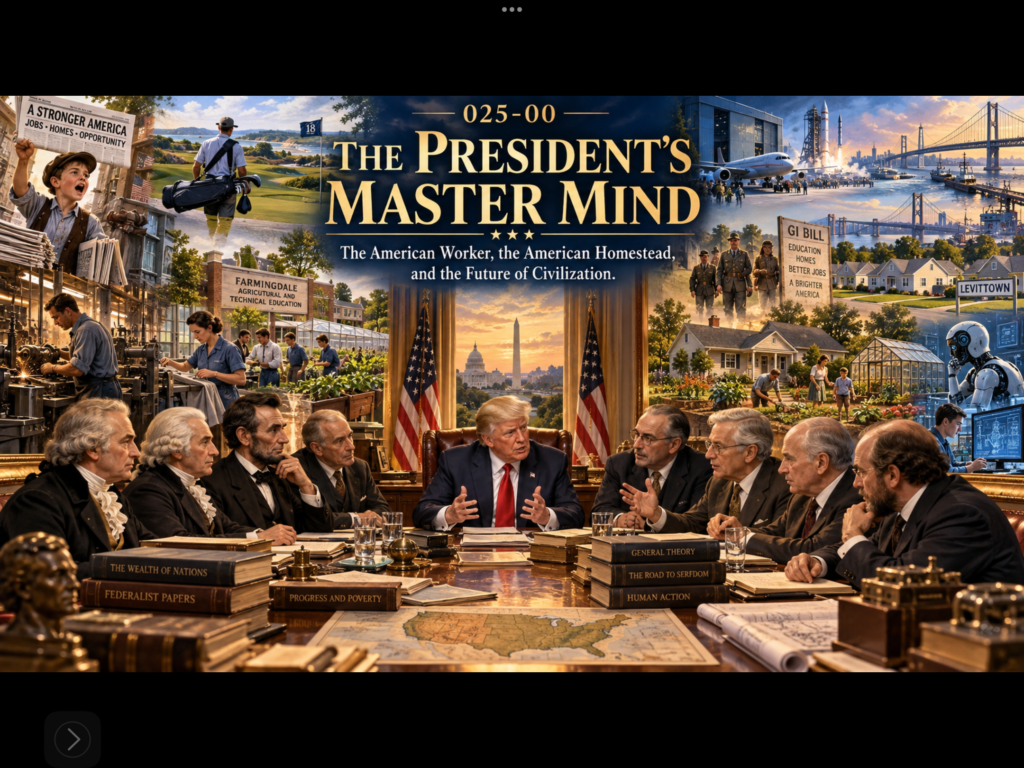
Here is the complete, consolidated President’s Master Mind discussion, recreated as one continuous narrative for your review and listening. It preserves the full economic group, their competing theories, your personal Long Island working history, Farmingdale, Airborne Instruments Laboratory, the GI Bill, Levittown, small farms, displaced workers, infrastructure investment, and the future of American civilization.
The discussion is written for spoken narration, with the President introducing the group and leading the conversation. All dialogue is fictional and does not represent actual statements or endorsements by the participants.
THE PRESIDENT’S MASTER MIND
THE AMERICAN WORKER, THE AMERICAN HOMESTEAD, AND THE FUTURE OF CIVILIZATION
From Hamilton’s American System and the GI Bill to Farmingdale, Levittown, Long Island’s Industrial Economy, and the Age of Artificial Intelligence
A Complete Imagined Presidential Master Mind Discussion
By Edward F. Moore
Witness to Calling — October 2026
CHAPTER I
THE PRESIDENT CONVENES THE MASTER MIND
The President’s Master Mind had assembled once again.
It was an extraordinary gathering, one that could exist only within the imagination, where the great economic thinkers of the past could sit alongside contemporary leaders and discuss the future of American civilization.
The subject before them was not simply America’s gross domestic product, the balance of international trade, interest rates, tariffs, or financial markets. Those matters remained important, but the President had convened this special gathering to examine something even more fundamental.
What happens to the American people when artificial intelligence, robotics, and advanced machinery become capable of performing an increasing share of the work upon which families have traditionally depended?
And if this transformation changes the economic relationship between human labor and production, how can the United States preserve opportunities for individual independence, productive employment, homeownership, family security, and retirement?
President Donald Trump entered the room and took his place at the head of the long conference table.
Around him sat contemporary economic advisers, historical economists, industrial thinkers, and individuals whose experiences would bring a distinctly human perspective to the discussion.
The President looked around the room.
“Ladies and gentlemen, welcome to another meeting of the President’s Master Mind. We have brought together some of the greatest minds in economic history, and I want a serious discussion. I want disagreements. I want everybody to explain their ideas. We are not here simply to congratulate one another.”
“We have been talking about the American economy, manufacturing, international trade, economic independence, and artificial intelligence. We want to create wealth, develop our industries, modernize our infrastructure, and provide opportunities for the American people.”
“But today I want to discuss something that concerns every family in this country.”
“What happens to the American worker?”
The President paused.
“We hear extraordinary things about artificial intelligence. We hear that machines will be able to design products, manage businesses, analyze financial information, operate equipment, and perform work that previously required years of education.”
“We are also developing more sophisticated robotics. Some factories can produce enormous quantities of goods with far fewer employees than older factories required.”
“Now, perhaps that makes our economy more productive. But what happens to the men and women who once performed those jobs?”
“Where do they go?”
“How do they support their families?”
“And what happens to their children?”
The President turned toward the historical participants.
“Before we begin, I want everyone to understand who has joined this Master Mind and what each person brings to the discussion.”
He first introduced Alexander Hamilton, the first Secretary of the Treasury of the United States, whose economic vision emphasized public credit, manufacturing, commerce, and the development of American productive capabilities.
“Alexander Hamilton understood that a nation needed more than political independence. It needed the ability to finance its development, manufacture important products, and establish the infrastructure of a productive economy.”
Beside Hamilton sat Adam Smith, the Scottish moral philosopher and economist whose The Wealth of Nations examined specialization, competition, markets, and the division of labor.
“Adam Smith gave us a powerful explanation of how individuals pursuing productive opportunities through trade and specialization could contribute to national prosperity.”
Next came David Ricardo, whose work on comparative advantage helped shape international trade theory, and who also recognized that the introduction of machinery could impose serious hardships upon workers.
Then came Friedrich List, the German economist whose National System of Political Economy emphasized the development of national productive powers, including manufacturing, transportation, education, and technological capability.
Henry Charles Carey, one of the leading advocates of the nineteenth-century American School of Economics, joined Hamilton and List in examining the relationship between domestic production, economic development, and national independence.
President Abraham Lincoln was also present within this imagined gathering, bringing his historical connection to labor, education, internal improvements, economic opportunity, and the Homestead Act of 1862.
The President then turned toward John Maynard Keynes.
“Mr. Keynes, you warned long ago that technology might eliminate jobs faster than new occupations could develop. I think we need to revisit that warning.”
Joseph Schumpeter sat nearby, prepared to explain his theory of entrepreneurial innovation and creative destruction.
Hyman Minsky would examine the dangers of unstable finance, excessive borrowing, and the collapse of seemingly prosperous economic arrangements.
Elinor Ostrom would contribute her understanding of community institutions, cooperation, and the governance of shared resources.
The Austrian economists occupied another section of the table.
Carl Menger, founder of the Austrian School, would explain how economic value arises through individual needs and choices.
Eugen von Böhm-Bawerk would examine the accumulation of capital, investment, interest, and the time required for productive development.
Friedrich von Wieser would explain opportunity cost and the choices societies must make when resources are limited.
Ludwig von Mises would defend the importance of economic calculation, private ownership, markets, and entrepreneurial decision-making.
Friedrich Hayek would examine the limitations of centralized planning and the knowledge dispersed throughout society.
Murray Rothbard would challenge proposals that unnecessarily concentrated power over property, finance, and individual economic choices.
Henry George, author of Progress and Poverty, had also joined the discussion. His work examined why remarkable economic progress could coexist with poverty and the increasing cost of access to land.
The President then introduced the specialists in technological transformation and employment.
Wassily Leontief, the Nobel laureate known for input-output economics, would help the group understand the interconnected relationships among industries, technology, production, and labor.
David Autor would contribute contemporary research examining how automation changes occupations and the tasks people perform.
Daron Acemoglu and Simon Johnson would explore the relationship between technological progress, institutional power, employment, and the distribution of economic benefits.
James O’Toole, associated with the influential study Work in America, would remind everyone that employment carries psychological, social, and personal significance beyond monetary compensation.
Jeremy Rifkin, author of The End of Work, would present the possibility that continuing technological advancement could fundamentally alter the demand for human labor.
Professor Stephanie Kelton would contribute her perspective on public finance, employment, monetary sovereignty, inflation, and the relationship between government spending and productive resources.
The President also welcomed his contemporary economic-policy circle, represented in this imagined conversation by Scott Bessent, Howard Lutnick, Jamieson Greer, Kevin Hassett, and Peter Navarro. They would examine how economic proposals might interact with financial markets, domestic manufacturing, international trade, employment, and the practical administration of national policy.
Finally, the President turned toward Edward F. Moore.
“And Ed, you’ve been asking us to consider what kind of economy we are actually building.”
“Yes, Mr. President.”
“You’ve also spent much of your life working in the American economy, haven’t you?”
“Yes, sir. And that is part of what I want to bring into this discussion.”
“Then let’s begin.”
The President looked around the room.
“Ladies and gentlemen, we have a country to think about.”
CHAPTER II
WHEN THE MACHINE BECOMES THE WORKER
John Maynard Keynes opened the economic discussion.
“Mr. President, in 1930 I wrote about what I called technological unemployment. I anticipated that advances in production might enable humanity to satisfy more of its economic needs with less human labor.”
“The difficulty was the transition. The development of labor-saving technology could proceed more rapidly than society’s ability to discover new occupations for displaced workers.”
The President leaned forward.
“So you’re saying this problem existed long before artificial intelligence.”
“Certainly,” Keynes replied. “Mechanization has transformed employment for generations. But increasingly sophisticated technology presents the possibility that tasks once considered exclusively intellectual may also become subject to automation.”
David Ricardo entered the conversation.
“There is an important distinction between increasing total production and improving the circumstances of every worker. I came to recognize that machinery might benefit production and capital while reducing employment opportunities for particular groups of laborers.”
Adam Smith offered another consideration.
“Nevertheless, the division of labor and the improvement of machinery have historically increased the productive capabilities of society. We must not confuse the hardship of transition with proof that technological advancement is inherently undesirable.”
Joseph Schumpeter agreed in part.
“Technological change continually transforms the economy. Entrepreneurs create new products, new production methods, new markets, and new organizations. Older activities disappear while new activities emerge.”
“But,” David Autor interrupted, “the speed of this process matters, as does the nature of the tasks being automated.”
“An occupation consists of many tasks. Technology may replace some tasks while complementing others. The final employment outcome depends upon what businesses choose to automate, what new tasks become possible, and whether workers can acquire the capabilities required.”
Daron Acemoglu added:
“We should not assume that every available application of artificial intelligence necessarily improves the economic position of workers. Some applications primarily replace labor. Others can increase human productivity and create new opportunities.”
Simon Johnson continued.
“And the direction of technological development is influenced by institutional incentives, ownership structures, and the decisions of those who control investment. Who benefits from technological progress is not predetermined.”
The President turned toward Howard Lutnick.
“If American factories become more productive, that should be good for the economy. But how do we make sure the country also provides opportunities for workers?”
In this imagined exchange, Lutnick responded.
“Manufacturing investment can create employment in engineering, logistics, construction, equipment production, maintenance, and related industries. But we have to distinguish between building new productive capacity and assuming that every new factory will employ the same number of people as one built decades earlier.”
Wassily Leontief nodded.
“Precisely. An industry must be understood within a network of other industries. A highly automated factory may employ relatively few production workers while creating additional demand for electricity, transportation, machinery, components, construction, and technical services.”
“Yet those indirect jobs may require different skills, may be located in different places, and may not appear at the same time as the displaced employment.”
The President looked toward Ed.
“Now, Ed, you’ve been thinking about this from a different perspective.”
“Yes, Mr. President.”
“I’ve been thinking about the American worker, but also about the American family.”
“And I’ve been thinking about the economic world in which I grew up on Long Island.”
“Because in that world, there were opportunities to begin with simple work and gradually move into more sophisticated occupations.”
“I experienced that progression myself.”
CHAPTER III
LONG ISLAND: MY ECONOMIC EDUCATION BEGINS
Ed Moore leaned forward.
“Mr. President, I want to take everyone back to Long Island, New York, because that is where I experienced much of what we are discussing.”
“Before I knew anything about Alexander Hamilton, Adam Smith, or national economic development, I was already participating in the American economy.”
“I began as a newspaper boy.”
The President smiled.
“A newspaper boy?”
“That’s right, Mr. President. I was still in elementary school.”
“I had newspapers to deliver, and I wanted to earn some money. But I also wanted to play with my friends after school.”
“So I figured out a way to do both.”
“I delivered my newspapers during my lunch hour.”
The President laughed.
“That’s pretty good. You got the work done so you could have the afternoon.”
“Exactly.”
“I had a responsibility. People expected their newspapers, and I had to deliver them. But once I completed my work, I could enjoy time with my friends.”
Adam Smith considered the story.
“Here we have a young person learning several fundamental economic principles without formal instruction. There is a service to be provided, a customer who values that service, compensation for performing it, and an individual deciding how to allocate his time.”
Carl Menger added:
“The young person is making choices based upon the value he assigns to different outcomes. He values income, responsibility, and the opportunity to spend time with friends.”
Friedrich von Wieser continued.
“And he discovers opportunity cost. Time devoted to work cannot simultaneously be devoted to recreation. By organizing his schedule, he makes room for both.”
Ed smiled.
“That’s right. But at the time I wasn’t thinking about economic theory. I just wanted to get the papers delivered and play with my friends.”
James O’Toole joined the discussion.
“This is important because an early working experience can contribute to developing responsibility, confidence, and a sense of usefulness.”
“A young person learns that his actions matter to other people.”
Ed agreed.
“And that is one of the things that worries me about the future.”
“What happens when the simple jobs that once introduced young people to the economy become automated or disappear?”
“How does the next generation develop an understanding of responsibility, work, customers, money, and the satisfaction of completing something useful?”
The President looked toward David Autor.
“That’s a good question.”
Autor responded.
“One consequence of automation may be that some traditional entry-level tasks become less available. That makes it important to examine how young people obtain supervised experience and learn the skills that traditionally developed through early employment.”
Ed continued.
“After delivering newspapers, I became a caddie.”
“And I had the opportunity to caddie at Bethpage Golf Course.”
The President recognized the location.
“Bethpage, Long Island. A great public golf facility.”
“Yes, Mr. President.”
“Bethpage taught me another kind of work. I was now providing a personal service.”
“I had to show up, pay attention, carry the golf bag, understand what was expected of me, and conduct myself properly.”
“The work was simple in one sense, but it required responsibility and dealing with people.”
Adam Smith responded.
“An economy needs services as well as manufactured products. A service worker creates value by assisting another person.”
Schumpeter added:
“And these early experiences often provide the practical foundation for later entrepreneurship. The ability to understand customers and organize productive activity is learned through experience.”
Ed considered the memory.
“Bethpage was more than a place where I could earn money. It was also part of the community, a public recreational facility where people from different backgrounds could enjoy the game.”
“During the Great Depression, the development of Bethpage State Park had itself been connected with public investment in recreation and infrastructure.”
“Think about that. The construction of the golf courses created work, the completed facilities provided recreation, and the continuing operations created opportunities for people like me to earn money.”
Alexander Hamilton observed:
“Public infrastructure can generate continuing economic activity long after the original construction has been completed.”
Friedrich Hayek answered:
“That does not mean every public project is worthwhile. But the continuing benefits of an investment can certainly extend beyond the immediate employment required to build it.”
The President returned to Ed.
“Then what happened?”
“I went to work in a small factory making coats.”
CHAPTER IV
THE COAT FACTORY, THE MACHINE SHOP, AND THE LADDER OF OPPORTUNITY
Ed continued.
“The coat factory introduced me to manufacturing.”
“It was a relatively simple operation. People worked with materials and equipment. Different activities had to be coordinated, and the result was a finished product.”
“I could see that the goods people purchased did not simply appear in stores. Human beings had to organize the work, operate equipment, handle materials, and complete the manufacturing process.”
Henry Charles Carey responded.
“That experience illustrates the interdependence of labor, capital, materials, and consumption. Manufacturing creates a network of relationships between suppliers, workers, businesses, and customers.”
Friedrich List added:
“Manufacturing also contributes to the development of knowledge. Workers acquire practical capabilities, managers learn organization, and industries improve the use of machinery.”
The President looked toward Ed.
“And after the coat factory?”
“I worked in a small machine shop.”
“Now I was exposed to another level of manufacturing. Machine tools, precision, measurement, materials, and the processes required to produce components.”
“I began to understand that machinery itself was the product of considerable human knowledge.”
David Ricardo entered the discussion.
“There is a distinction between using a machine and understanding how machines change the relationship between capital and labor.”
Ed agreed.
“That’s what I was learning through experience. The machine shop connected practical work with technology.”
“Those jobs were not the end of my economic development. They were steps along the way.”
“I then went to college.”
The President looked around the room.
“So we have a young man who started delivering newspapers, became a caddie, worked in a coat factory, then in a machine shop, and went to college.”
“That’s right.”
“What I want everyone to understand is that I was able to move through different parts of the economy.”
“Each opportunity introduced me to something new. Each experience helped prepare me for what came next.”
David Autor spoke.
“That is the employment ladder we need to understand. Economic mobility depends not only upon formal education but also upon the existence of accessible jobs, opportunities to acquire experience, and pathways to more demanding occupations.”
James O’Toole added:
“Work can be developmental. When jobs provide opportunities for learning and responsibility, they may contribute to personal growth as well as income.”
Ed looked toward the President.
“Mr. President, this is the question I want us to ask about the age of artificial intelligence.”
“What happens when the lower rungs of that ladder disappear?”
“If a machine does the first job, and another machine does the second job, where does the young person begin?”
“If artificial intelligence performs much of the routine professional work that graduates once performed, where do they acquire the experience needed to become accomplished professionals?”
The President turned toward Schumpeter.
“You’ve argued that innovation destroys some businesses and creates others. But what happens to the people in the middle?”
Schumpeter responded.
“Creative destruction describes a process, not a guarantee that every individual will experience it favorably. New enterprises may emerge, but displaced workers face immediate costs and uncertainty. The transition matters.”
Keynes added:
“And the economy may experience periods during which workers are willing and capable of employment but cannot find sufficient demand for their labor.”
Ed nodded.
“Then we must begin thinking beyond simply retraining someone for another job that may itself be automated.”
“We have to examine how people acquire lasting capabilities, productive assets, and independence.”
CHAPTER V
FARMINGDALE: AN AGRICULTURAL SCHOOL BECOMES A TECHNOLOGICAL INSTITUTION
The President directed attention toward the large screen.
A photograph of the original New York State School of Agriculture on Long Island appeared.
Ed continued.
“Now I want to introduce an important part of Long Island history.”
“In 1912, New York State chartered an agricultural school at Farmingdale. The school opened to students in 1916.”
“At that time, much of Long Island remained agricultural, with farms producing food for local communities and the enormous market of nearby New York City.”
“The idea behind the school was practical. Teach people agricultural science. Teach them how to cultivate land, understand machinery, improve production, and apply knowledge to the real economy.”
Friedrich List leaned forward.
“This is an important example of a nation developing its productive powers through education.”
“An educational institution should not simply distribute abstract information. It can help people acquire knowledge that improves agriculture, industry, infrastructure, and enterprise.”
Alexander Hamilton agreed.
“The improvement of productive capability is one of the foundations of national economic development.”
Ed continued.
“The school did not remain unchanged.”
“As Long Island developed, agriculture became connected with aviation, electronics, manufacturing, and increasingly sophisticated technology.”
“During World War II, Long Island became an important industrial center. Aircraft manufacturers needed people who understood tools, sheet metal, mechanical processes, and production.”
“Farmingdale responded.”
“During the war, the institution offered industrial training, including courses involving sheet-metal work, tools, forming, drilling, riveting, and assembly.”
“It even offered a special course for Republic Aircraft employees in 1944.”
The President looked toward Kevin Hassett.
“That’s an interesting model, isn’t it? The school adapting to the jobs that industry needed.”
Within the imagined discussion, Hassett replied.
“Technical education can be especially valuable when institutions understand actual employer demand. But programs must adapt as technologies and regional economies change.”
Ed continued.
“In 1946, the school became the Long Island Agricultural and Technical Institute.”
“Think about the significance of that name.”
“An institution that began by educating people in agriculture had evolved to educate people for a more industrial and technological economy.”
“New programs included building construction, aircraft maintenance, industrial chemistry, and other technical fields.”
“Eventually it became the Agricultural and Technical College at Farmingdale, and later Farmingdale State College.”
“It adapted as the economic needs of Long Island changed.”
David Autor considered the example.
“That is an important precedent. Educational institutions that connect learning with real productive activity may be better positioned to respond to changing occupational requirements.”
Daron Acemoglu added:
“But the new training must correspond to technologies that make human workers more productive, rather than simply teaching people tasks that businesses are preparing to automate.”
Ed agreed.
“Exactly.”
“Mr. President, this is one of the lessons I want to carry into our discussion.”
“We do not necessarily need to invent entirely new educational institutions. We need to examine how institutions with practical and technical capabilities can evolve to serve the next economic transformation.”
“Perhaps agricultural and technical colleges can once again combine land, buildings, laboratories, machinery, workshops, and modern technology.”
“Only now the subjects would include robotics, artificial intelligence, construction, housing, energy technologies, building automation, small-enterprise management, and the protection of critical infrastructure.”
The President considered the proposal.
“So the school that taught people to farm becomes a place that teaches people to build and operate the economy of tomorrow.”
“Yes, Mr. President.”
“And the education should be connected with opportunities that actually exist.”
CHAPTER VI
AIRBORNE INSTRUMENTS LABORATORY AND LONG ISLAND’S INDUSTRIAL CIVILIZATION
Ed asked that another image be placed upon the screen.
The words AIRBORNE INSTRUMENTS LABORATORY appeared.
“After college, I worked for Airborne Instruments Laboratory.”
“AIL was part of Long Island’s remarkable technological and manufacturing economy.”
The President listened as Ed continued.
“During World War II, research associated with Columbia University helped develop technologies for military aviation and the detection of submarines. Airborne Instruments Laboratory emerged from that technological environment.”
“AIL operated on Long Island, including Mineola and later Deer Park, and became involved in radar, electronics, aviation, defense systems, and other advanced technological work.”
“It was an example of the relationship between scientific research, industrial engineering, manufacturing, and national requirements.”
Alexander Hamilton responded.
“Here again we see the relationship between national development and productive capability.”
“Scientific knowledge alone does not necessarily produce useful goods. It must be translated into equipment, manufacturing methods, skilled employment, and practical systems.”
Wassily Leontief added:
“Such an enterprise is part of a larger industrial system. Universities develop knowledge, suppliers manufacture components, engineers design equipment, workers assemble products, and customers create demand.”
Ed continued.
“Long Island had companies like Grumman, Republic Aviation, Sperry, Airborne Instruments Laboratory, and many smaller businesses that supported them.”
“There were machine shops, electronics manufacturers, suppliers, engineering firms, and service businesses.”
“These companies formed an economic environment in which people with different levels of education and technical experience could find opportunities.”
Joseph Schumpeter considered the industrial history.
“Large technological enterprises also create opportunities beyond their own employment. Engineers, technicians, and managers may eventually establish new businesses, carrying knowledge and innovation into other parts of the economy.”
Ed agreed.
“And we must remember the people.”
“The workers in these companies were not simply statistics in national industrial production reports.”
“They were people with families.”
“They bought homes. They raised children. They paid their bills. They participated in their communities.”
“And, in many cases, they expected that years of productive employment would eventually lead toward retirement.”
The President looked toward Ed.
“Now that’s an important point.”
CHAPTER VII
WHEN EMPLOYERS TOOK CARE OF THEIR PEOPLE
Ed continued.
“Mr. President, one of the things I remember about the working world of that period was the relationship between employers and their people.”
“At Airborne Instruments Laboratory, I remember an environment in which people could develop careers and eventually retire.”
“And I remember the expectation that employers had responsibilities to the people whose work made their businesses successful.”
The President asked:
“What kind of responsibilities?”
“Fair compensation. Opportunities for advancement. Employee benefits where available. Retirement arrangements. And a recognition that the company depended upon the knowledge, experience, and loyalty of its workers.”
“People were not simply interchangeable expenses on a financial statement.”
“They were human beings contributing to a productive enterprise.”
The Master Mind turned toward another Long Island example.
Grumman Aircraft had developed a reputation for paying attention to employee welfare. Historical accounts described recreational facilities, profit-sharing arrangements, and opportunities for communication between employees and management.
Ed continued.
“Those industrial enterprises understood something that should remain part of our economic discussion.”
“A business is not productive merely because it owns machines.”
“It depends upon people who understand its operations, its equipment, its customers, and its mission.”
“That knowledge develops over time.”
Hyman Minsky entered the discussion.
“Retirement arrangements create long-term financial commitments. If a company promises pension benefits, those commitments must be adequately funded.”
“An economic system cannot promise security through arrangements that collapse when business conditions deteriorate.”
Stephanie Kelton added:
“The financial security of households affects the entire economy. Workers who have reliable incomes and retirement provisions face different economic circumstances from workers living with uncertainty about their future.”
Ludwig von Mises responded.
“Yet a firm must remain economically productive to sustain compensation and retirement commitments. The value of employer-sponsored benefits cannot be separated from the financial health of the enterprise.”
Ed nodded.
“Of course. And not every company treated its employees well. Not every worker had a pension, and even great manufacturers experienced layoffs and economic difficulties.”
“But I remember that retirement was something working people could reasonably aspire to in many established enterprises.”
“That expectation is important.”
The President turned toward Scott Bessent.
“How does the financial system fit into this?”
In the imagined exchange, Bessent replied:
“Long-term household security depends upon a combination of wages, savings, retirement assets, sustainable businesses, and a financial system capable of channeling investment into productive uses.”
Ed continued.
“And that is why our discussion cannot stop at the question of whether artificial intelligence increases corporate profits.”
“What happens to the relationship between the enterprise and the individual when a company can produce more with fewer employees?”
“If the financial benefits of technological progress increasingly accrue to the owners of capital, what opportunities remain for the workers whose labor is no longer required?”
Henry George entered the discussion.
“This is a variation of a question I examined in Progress and Poverty.”
“Why can economic progress and increasing wealth coexist with hardship among people who lack access to productive assets?”
The President considered the question.
“Then perhaps we need to look at ownership as well as employment.”
Ed answered.
“Exactly.”
“And that takes us back to the GI Bill.”
CHAPTER VIII
THE GI BILL: WHEN AMERICA INVESTED IN THE FUTURE OF ITS VETERANS
The large screen displayed a photograph from 1944.
President Franklin D. Roosevelt was signing the Servicemen’s Readjustment Act.
Ed continued.
“Mr. President, one of the most remarkable economic transformations in American history began while World War II was still being fought.”
“American leaders understood that millions of service members would return home.”
“Those men and women would need education, employment, housing, and opportunities to establish civilian lives.”
“The American Legion understood the problem.”
“In late 1943, former American Legion National Commander Harry W. Colmery helped draft the legislation that became the GI Bill.”
“On June 22, 1944, President Roosevelt signed it into law.”
The President looked across the gathering.
“And that helped millions of veterans go to school and buy homes.”
“Yes, Mr. President.”
“The original GI Bill supported education, vocational training, access to home, farm, and business financing, and temporary assistance during the transition to civilian life.”
“But here is what makes it so important to our discussion.”
“The government did not simply decide what job every returning veteran would perform.”
“It helped create opportunities for veterans to develop their own capabilities and pursue independent lives.”
Alexander Hamilton responded.
“That is consistent with an important principle of economic development. Public credit and public institutions can, under appropriate arrangements, help mobilize productive activity.”
Friedrich List continued.
“The education of millions of returning service members could strengthen the nation’s productive powers over an extended period.”
Henry Charles Carey added:
“And the construction of homes, the growth of manufacturing, the expansion of transportation, and the development of communities could reinforce one another.”
The President turned toward Ed.
“Now you are also involved with the American Legion.”
“Yes, Mr. President.”
“And this history matters to me because it demonstrates how veterans helped create opportunities extending far beyond their own generation.”
“The GI Bill was a practical approach to one of the greatest labor transitions in American history.”
“Millions of people who had been serving in the military needed to enter a peacetime economy.”
“And the nation developed institutions that helped make the transition possible.”
Keynes reflected upon the example.
“The return of millions of service members could have created considerable economic disruption. Investment in education, housing, and civilian productive activity helped support a new period of economic development.”
Ed continued.
“But we must also acknowledge that access was not equal.”
“Discrimination in housing, lending, and education prevented many Black veterans from receiving the same practical benefits available to other Americans.”
“The lesson is not simply that a program can create opportunities. It is that those opportunities must be administered fairly.”
Elinor Ostrom agreed.
“Institutions must be evaluated by their actual operation, not merely by their stated purpose.”
The President then asked:
“Could we develop something that serves workers displaced by artificial intelligence?”
Ed answered.
“That is precisely the question.”
“But first we need to examine another part of Long Island history.”
“Levittown.”
CHAPTER IX
LEVITTOWN: HOW AMERICA LEARNED TO BUILD HOMES AT SCALE
The screen now displayed aerial photographs of Levittown, Long Island, during the years following World War II.
Rows of modest houses appeared along newly constructed streets.
Ed addressed the Master Mind.
“In 1947, Levitt & Sons began transforming former agricultural land into one of America’s most influential suburban housing developments.”
“The company applied industrial production methods to residential construction.”
“Standardized designs, specialized crews, coordinated material deliveries, and repeated construction processes enabled homes to be built rapidly.”
Joseph Schumpeter spoke.
“This is a classic example of innovation through the reorganization of production.”
“The house itself was not a new invention. The innovation was the process by which large numbers of houses could be constructed and delivered to consumers.”
The President responded.
“So this was mass production applied to housing.”
“Exactly,” Ed replied.
“And the construction of those homes generated demand far beyond the building site.”
“Workers were needed. Lumber and other materials were required. Roads, water, drainage, electrical service, transportation, stores, schools, and community institutions developed.”
Wassily Leontief entered the discussion.
“Construction creates demands across a large network of industries. A residential development involves not merely the direct employment of construction workers but also the production and transportation of materials, infrastructure, equipment, and services.”
Henry Charles Carey added:
“The development of housing can contribute to the growth of productive communities, especially when connected with employment and transportation.”
Ed continued.
“But there is an important distinction between what Levittown accomplished and what I am proposing.”
“Levittown’s residents generally moved into homes built by professional construction crews.”
“What if we took the next step?”
“What if some of the workers displaced by artificial intelligence could participate in the construction of the homes they would eventually own?”
“What if we connected home construction with technical education, workforce development, and practical opportunities to acquire equity?”
The President considered the possibility.
“People helping to build their own homes.”
“Yes, Mr. President.”
“Not everyone, and not without professional supervision.”
“But why shouldn’t we examine the possibility?”
Henry George interrupted.
“Before proceeding, we must address the land.”
“Making construction more efficient does not necessarily make housing affordable if the price of land continues to rise.”
Ed agreed.
“And that is why land acquisition, financing, zoning, infrastructure, and the legal structure of ownership must be central to the concept.”
Friedrich Hayek added:
“A voluntary arrangement among developers, households, financial institutions, and local organizations may discover opportunities that a centralized national plan would overlook.”
Murray Rothbard spoke next.
“Residents must retain meaningful rights over their property. A program described as creating ownership should not leave families permanently subject to an institution that controls every economic decision they make.”
Elinor Ostrom responded.
“Shared resources can be governed cooperatively without eliminating individual ownership. The appropriate rules depend upon the community and the resources involved.”
Ed continued.
“And this modern concept must learn from Levittown’s failures, including the racial discrimination that excluded many families from the opportunity to purchase homes.”
“The new community must be an opportunity for qualified participating families without the discriminatory barriers of the past.”
The President looked around the table.
“So we can learn from the efficiency of Levittown without repeating its mistakes.”
“Exactly,” Ed replied.
CHAPTER X
THE SMALL FARM AND THE AMERICAN HOMESTEAD
Ed requested another historical image.
On the screen appeared a modest house surrounded by a vegetable garden, fruit trees, and small agricultural plots.
“Mr. President, this brings me to the other part of the idea.”
“What if Americans could grow some of what they eat?”
The President responded.
“You mean small farms?”
“Small farms, gardens, greenhouses, and shared agricultural facilities.”
“But I do not mean that every family should abandon modern employment and become a commercial farmer.”
“I mean restoring an opportunity for households to participate directly in producing a portion of the necessities they consume.”
Henry George immediately recognized the importance of the question.
“Land can provide more than a place to construct a building. It can support productive activities and create opportunities for households to develop independent economic capabilities.”
Ed continued.
“During the Great Depression, the United States experimented with this idea.”
“In 1933, the federal government established the Subsistence Homesteads Program.”
“The concept was to provide qualifying families with opportunities to combine housing, wage employment, and small-scale agriculture.”
“Some communities allowed people to work outside the home while cultivating gardens and maintaining modest homesteads.”
“The program did not become a permanent nationwide solution, but it demonstrated that residential development and small-scale agriculture could be considered together.”
Adam Smith considered the idea carefully.
“Household production can be useful, but we should not forget the benefits of specialization and exchange.”
“A modern household may obtain many goods more efficiently through purchasing them from specialized producers.”
Ed agreed.
“Of course. I’m not suggesting we return to an economy in which each family must produce everything it needs.”
“But suppose a family could grow vegetables, maintain fruit trees, or participate in a community greenhouse.”
“Perhaps the household could reduce some food expenses, teach children practical skills, and build relationships with neighbors.”
Carl Menger responded.
“The benefits would differ according to individual preferences. One family might enjoy cultivating a garden. Another might prefer using the same time to earn income or pursue other activities.”
Friedrich von Wieser added:
“And the time, land, water, and equipment committed to small-scale agriculture have alternative uses.”
Ed nodded.
“Then we should examine the economics.”
“Some gardens may be worthwhile for the quantity of food produced. Others may provide educational, recreational, or social benefits.”
“The objective is not to pretend that a small garden replaces modern commercial agriculture.”
“It is to explore whether households can become somewhat more resilient while enjoying a productive relationship with the land.”
The President looked toward the Austrian economists.
“Would this be something people choose for themselves?”
Mises answered.
“Under voluntary ownership and exchange, individuals should determine whether such activity benefits them. The economic costs must be recognized.”
Ed agreed.
“That is precisely the idea.”
“Give people more choices, more capabilities, and more opportunities.”
“Not compulsory farming.”
“Not compulsory housing.”
“Not a government deciding how every family must live.”
“But the opportunity to participate in creating and maintaining some of the productive assets upon which life depends.”
CHAPTER XI
WORK IN AMERICA: THE HUMAN BEING BEHIND THE EMPLOYMENT STATISTICS
James O’Toole now entered the center of the conversation.
“Mr. President, Ed’s discussion reminds me of the issues examined in the 1973 report Work in America.”
“The study considered the role of work in the lives of American people, including the dissatisfaction created by repetitive jobs, limited autonomy, and inadequate opportunities for personal development.”
“It challenged the assumption that employment should be understood only through wages and productivity.”
The President looked toward Ed.
“You mentioned reading Work in America.”
“Yes, Mr. President. And one of the questions that has stayed with me concerns where displaced workers go.”
“Because we tend to discuss technology from the perspective of businesses, investors, and economists.”
“We talk about productivity, operating costs, financial returns, and national income.”
“But what about the individual who has spent twenty years doing a job that is no longer required?”
“What happens to that person?”
O’Toole continued.
“Work often contributes to identity, social relationships, competence, and personal dignity.”
“A person may derive satisfaction from being needed, accomplishing a task, helping others, and participating in a larger enterprise.”
Jeremy Rifkin responded.
“Technological advancement raises the possibility that entire categories of labor may require fewer people. We must consider how society preserves income and meaningful activity under those circumstances.”
John Maynard Keynes spoke.
“Greater productivity can potentially reduce the amount of labor required to produce society’s necessities.”
“But that possibility does not automatically ensure that displaced workers possess adequate incomes or economic security.”
Stephanie Kelton added:
“The question of income security must be considered in relation to employment, public policy, the financial system, and the actual productive resources available.”
Hyman Minsky interrupted.
“And one should not overlook household debt.”
“A worker may lose employment while still owing mortgage payments, automobile loans, insurance premiums, and other financial obligations.”
“An economy may be productive in the aggregate while individual families experience severe financial distress.”
The President turned toward Ed.
“Then the worker needs more than another training certificate.”
“Yes, Mr. President.”
“The person needs a real opportunity.”
“And perhaps that opportunity should include more than exchanging labor for the next paycheck.”
“Perhaps it should include ownership, useful skills, participation in productive enterprise, and a foundation for family security.”
CHAPTER XII
THE GREAT AUSTRIAN DEBATE: ECONOMIC FREEDOM AND PRODUCTIVE INDEPENDENCE
Ludwig von Mises leaned forward.
“I must raise an objection.”
The President smiled.
“Good. That’s why you’re here.”
Mises continued.
“The desire to improve the economic circumstances of displaced workers is understandable. But a program does not become productive merely because its intentions are admirable.”
“Land, construction materials, skilled labor, machinery, equipment, and financial capital remain scarce.”
“Investments must be evaluated through economic calculation.”
The President turned toward Hamilton.
“Alexander, how do you answer?”
Hamilton responded.
“Properly structured public credit can contribute to productive development. The question is not simply whether government or private capital is involved, but whether the arrangements help develop useful economic capabilities and are financially responsible.”
Friedrich List added:
“A nation’s productive powers extend beyond individual transactions. Infrastructure, education, industry, and technological knowledge may influence the country’s development over generations.”
Friedrich Hayek replied.
“But no centralized authority possesses all the information required to decide which investments are most appropriate for every household and community.”
“Knowledge is dispersed among individuals, builders, lenders, employers, and local institutions.”
“Prices and decentralized choices coordinate information that cannot be fully assembled in a national planning office.”
Stephanie Kelton entered the debate.
“And yet private financing markets do not always provide adequate access to affordable housing, education, or employment transitions.”
“The financial capabilities of a currency-issuing federal government differ from those of a household or business. But any public program still confronts real productive constraints.”
Eugen von Böhm-Bawerk responded.
“Capital must be accumulated and committed over time. A house does not emerge immediately from a financing decision.”
“Resources must be devoted to land, equipment, infrastructure, materials, and construction before the completed asset becomes available.”
Friedrich von Wieser added:
“And choosing one development means foregoing other possible uses of those resources.”
“Should the capital finance housing, energy systems, transportation, hospitals, industrial equipment, or some alternative?”
The President turned toward Rothbard.
“And your concern?”
“Ownership and individual liberty,” Rothbard responded.
“If a program promises economic independence, the participants must understand their property rights.”
“They should know who owns the land, who owns the house, whether they may sell, whether they may leave, and what obligations they have accepted.”
Elinor Ostrom spoke.
“That is why the institutional design matters.”
“A neighborhood may require shared roads, drainage systems, gardens, equipment, and community facilities.”
“Participants need clearly defined rules and effective procedures for governing those resources.”
Ed listened to the competing arguments.
“Mr. President, I see value in what all of them are saying.”
“The Austrian economists remind us that people must remain free to decide how to live and what to produce.”
“Hamilton and List remind us that productive development may require long-term institutional support.”
“Keynes and Kelton remind us that unemployment and inadequate demand can constrain people’s opportunities.”
“Henry George reminds us that access to land matters.”
“And Minsky reminds us that debt can destroy the security that ownership is supposed to create.”
The President considered the debate.
“Then we should investigate arrangements that combine voluntary participation, private enterprise, responsible financing, technical education, and community development.”
“Not assume that one institution can do everything.”
“Exactly,” Ed replied.
CHAPTER XIII
THE NEW AMERICAN HOMESTEAD: BUILD WHAT YOU LIVE IN AND GROW SOME OF WHAT YOU EAT
Ed rose from his chair.
“Mr. President, I would like to put the concept together.”
The screen displayed an illustration of a modern residential community.
There were modest homes, neighborhood roads, gardens, greenhouses, shared open spaces, and buildings designed to accommodate educational and small-business activities.
“Imagine a community designed to provide opportunities for qualified families, including some workers displaced by technological change.”
“Land would first have to be acquired lawfully and evaluated for suitable residential development.”
“Architects and engineers would examine the site. Roads, utilities, water, wastewater, drainage, communications, and emergency services would have to be planned.”
“Builders could use standardized and potentially modular construction techniques to reduce unnecessary costs.”
“Professional contractors would perform the work requiring specialized training, licensing, or regulated inspections.”
“But participating residents could have opportunities to perform appropriate supervised construction tasks and develop useful skills.”
The President interrupted.
“So the people are helping to build the homes they will live in.”
“Yes.”
“And in the process, they may gain practical experience that has value beyond the construction of their own homes.”
Joseph Schumpeter responded.
“The educational benefit could become an entrepreneurial benefit if people acquire capabilities that allow them to establish enterprises or work in new industries.”
Ed continued.
“The community could also include small gardens, shared agricultural areas, greenhouses, and perhaps facilities for food preservation.”
“Some families might grow a portion of their vegetables. Others might participate in a cooperative garden.”
“Some might establish small agricultural enterprises, but only where there is a genuine market and a viable business plan.”
Adam Smith considered the arrangement.
“So families remain participants in a specialized market economy while acquiring additional productive capabilities.”
“Exactly.”
“We are not trying to make every household economically isolated.”
“We are trying to give people additional foundations of independence.”
The President looked at the illustration again.
“And what about artificial intelligence?”
Ed smiled.
“Now we bring the future into it.”
“AI can assist with building design, engineering analysis, project scheduling, materials management, and construction planning.”
“Intelligent building systems can help manage energy consumption, identify maintenance needs, and improve the operation of residential infrastructure.”
“Digital tools can assist with agricultural planning, soil monitoring, and efficient irrigation.”
“Technology can help people become more productive.”
“But technology should remain a tool serving human purposes.”
Daron Acemoglu responded.
“That distinction is essential. The goal should be to develop applications that expand human capabilities where possible, not merely automate every available task without regard to employment consequences.”
David Autor added:
“Technology may create productive opportunities when it makes workers capable of performing tasks that previously required more specialized expertise.”
The President turned toward Ed.
“And how do people pay for their homes?”
“Now that,” Ed replied, “takes us directly into the question of financing.”
CHAPTER XIV
FINANCING THE FUTURE: THE GI BILL, PRIVATE CAPITAL, AND AMERICAN INFRASTRUCTURE BONDS
Alexander Hamilton returned to the center of the discussion.
“Mr. President, productive development requires organized access to capital.”
“Financial institutions can channel savings into investment, while public institutions may influence the availability and cost of financing.”
Ed continued.
“We should examine existing housing finance arrangements before proposing entirely new institutions.”
“One important example is the United States Department of Agriculture’s Mutual Self-Help Housing Program.”
“Under that program, qualifying rural households can participate in supervised construction, working together to build their own homes.”
“Eligible organizations may receive technical-assistance grants to organize and supervise the work.”
“Separate arrangements are required to finance the land and construction itself.”
The President looked toward the group.
“So there is already a working example.”
“Yes, Mr. President.”
“That means we can examine real operating experience instead of relying entirely upon theory.”
Ed continued.
“We should study whether such concepts could be adapted or complemented through other programs, private financing, nonprofit organizations, employers, credit unions, community development institutions, and professional homebuilders.”
“Not every family will qualify for the same financing.”
“And not every location will be suitable.”
Henry George responded.
“Land acquisition must be treated as a central financial consideration. If rising land costs absorb the benefits of efficient construction, the objectives may be frustrated.”
Hyman Minsky added:
“A development should be evaluated according to the financial resilience of its participating households.”
“Can they afford the mortgage, taxes, insurance, utilities, and maintenance?”
“What happens if one household experiences unemployment?”
“Are the loans sustainable?”
Stephanie Kelton asked:
“And what are the real resources required? Financing cannot eliminate shortages of qualified labor, available land, electricity, construction materials, or adequate transportation.”
Ed nodded.
“Exactly.”
“But I also want to introduce another concept we have explored in our economic discussions.”
“American Infrastructure Bonds.”
The President turned toward Hamilton.
“Now that sounds like something you would enjoy discussing.”
Hamilton smiled.
“Public credit and long-term development are certainly subjects worthy of examination.”
Ed continued.
“During World War II, American citizens purchased war bonds to help finance the national war effort.”
“The bonds provided an opportunity for individuals to participate financially in a national undertaking.”
“What if we examined a modern, carefully structured infrastructure investment instrument?”
“Something that could provide eligible investors with opportunities to finance productive American infrastructure, housing-related improvements, and community development.”
“Such an arrangement would have to establish its own legal authority, credit protections, investor disclosures, repayment sources, and financial oversight.”
Scott Bessent entered the imagined discussion.
“Any proposed bond should be judged through its financial structure.”
“What supports repayment? What risks do investors assume? How are proceeds allocated? Are projects evaluated independently?”
“A bond should not be treated as sound merely because the project it finances carries an appealing name.”
Mises agreed.
“That is an important distinction.”
Minsky added:
“And we must not replace unsustainable household borrowing with unsustainable institutional borrowing.”
Ed responded.
“I agree.”
“The point is not to manufacture financial promises.”
“It is to examine whether American capital can be organized in ways that support productive development and provide transparent opportunities for investment.”
“Families need homes.”
“Communities need infrastructure.”
“Workers need opportunities.”
“And investors need credible financial arrangements.”
The President considered the proposal.
“Then the first requirement is a financially credible project.”
“Yes, Mr. President.”
“And if the project cannot demonstrate that credibility, it should not proceed.”
CHAPTER XV
FARMINGDALE REIMAGINED: THE EDUCATION OF THE NEXT AMERICAN WORKER
The screen once again displayed Farmingdale’s agricultural and technical history.
Ed addressed the President.
“Now I want to connect the housing concept to the education of displaced workers.”
“The original Farmingdale school did not teach agriculture merely as an intellectual subject.”
“People learned through contact with land, machinery, production, and practical problems.”
“When Long Island needed industrial workers, the institution expanded into technical education.”
“Why shouldn’t we explore similar connections between education and productive community development today?”
The President asked:
“What would the training look like?”
Ed responded.
“Imagine a voluntary training partnership involving an agricultural and technical college, qualified contractors, manufacturers, experienced tradespeople, technology companies, and community organizations.”
“One training program might focus on construction technologies.”
“Another might focus on building automation, low-voltage electronics, communications, and the integration of intelligent security systems.”
“Another might address energy management, water systems, maintenance, and agricultural technologies.”
“Another might teach small-enterprise accounting, business development, project management, and professional consulting.”
“Participants could learn through supervised real-world projects.”
David Autor replied.
“That kind of training should be structured around actual demand.”
“We must measure whether participants obtain qualifications that employers recognize or capabilities that support viable independent businesses.”
Daron Acemoglu added:
“The technology should complement the participants’ work whenever possible. Training someone to perform tasks that are likely to disappear immediately would not be a durable solution.”
Ed agreed.
“And I would especially like to examine the role of veterans.”
“Veterans have experience with discipline, operations, teamwork, equipment, responsibility, and mission-oriented performance.”
“Some possess advanced technical capabilities.”
“Others may benefit from additional education and a pathway into civilian professions.”
“The GI Bill provides an important historical precedent.”
The President responded.
“So you want to help veterans become productive businesspeople.”
“Yes, Mr. President.”
“Not only employees.”
“Independent consultants, technology specialists, project managers, and business owners.”
“And some of those enterprises could eventually employ other people.”
Ed continued.
“That connects directly with the mission I have been developing through THL Security & Infrastructure Consulting.”
“An independent security and critical-infrastructure consultant helps owners understand what systems they require, develops specifications, assists with contractor selection, and evaluates how different technologies should work together.”
“Those are professional services that depend upon judgment, responsibility, practical knowledge, and effective use of technology.”
“Qualified veterans could develop the capabilities needed to enter such professions.”
“And similar educational models could be considered for other people seeking new careers.”
Schumpeter responded.
“That brings the entrepreneur into the center of the employment discussion.”
“A new business is not simply another job. Under favorable conditions, it may create new products, services, and additional employment.”
Hayek added:
“Such ventures should remain free to respond to customers and market conditions. Their success cannot be guaranteed by an educational institution or planning authority.”
Ed agreed.
“Exactly.”
“The objective is to help people acquire the knowledge and opportunities necessary to compete.”
“Not to promise success where no market exists.”
CHAPTER XVI
WHO PROTECTS THE COMMUNITY AND ITS CRITICAL INFRASTRUCTURE?
Ed requested that the illustration of the proposed community be expanded.
The display now showed the water system, electrical distribution, roads, communications, common areas, commercial facilities, and emergency access routes.
“Mr. President, there is another part of community development that we must consider.”
“Security and infrastructure.”
“Every functioning community depends upon systems that must operate reliably.”
“Water must be available. Electricity must be delivered safely. Communications must function. Buildings must be maintained. Emergency responders must have access.”
“And the protection of people must remain a fundamental objective.”
The President asked:
“How does that connect with our discussion about displaced workers?”
Ed answered.
“These systems require professional design, engineering, installation, operation, and maintenance.”
“They create opportunities for engineers, licensed tradespeople, technicians, consultants, and service businesses.”
“But they also require proper responsibility and accountability.”
“Security technology is not a substitute for professional judgment.”
“A camera does not create safety merely because it is installed.”
“An access-control system does not become appropriate merely because it can be operated remotely.”
“A community needs carefully designed systems, clear ownership of equipment and information, privacy protections, dependable maintenance, and safe emergency egress.”
Elinor Ostrom considered the governance implications.
“Shared infrastructure requires institutions capable of establishing responsibilities, managing costs, and resolving disputes.”
Hayek added:
“Local knowledge and individual rights remain important. A community should not become an excuse for excessive monitoring or centralized control over residents.”
Ed agreed.
“That is especially important.”
“The technology should protect the individuals and institutions it serves, not become an instrument for unnecessary control over their lives.”
“Professional consultants can help developers and owners design systems around those principles.”
“Some displaced workers and veterans may find meaningful careers in these technical professions.”
“But proper qualifications, licensing, and supervision remain essential.”
The President considered the complete picture.
“So we’re not just building houses.”
“No, Mr. President.”
“We are examining how to build economically sustainable communities and how the work involved might create genuine professional opportunities.”
CHAPTER XVII
THE WORKER WHO HAS BEEN REPLACED
The President asked the Master Mind to imagine a particular American family.
The father had worked for years in an occupation increasingly transformed by automation.
The mother worked in an administrative position where artificial intelligence was changing the number and nature of available jobs.
They were raising children.
They paid rent, utilities, transportation expenses, insurance, and the ordinary costs of maintaining a household.
They had limited savings.
Now their employment prospects had become uncertain.
The President asked:
“What do we tell this family?”
Keynes responded.
“First, we must acknowledge their immediate economic needs.”
“A household cannot postpone its expenses indefinitely while waiting for the economy to create new occupations.”
Stephanie Kelton added:
“Income security during the transition is an important consideration, but financing must ultimately be supported by the economy’s capacity to provide goods and services.”
Minsky continued.
“And we must examine whether the household is burdened by obligations that become impossible to service after a loss of income.”
David Autor turned to education.
“The family also needs an accurate understanding of actual employment opportunities.”
“If suitable work exists in a growing industry, a credible training pathway may be valuable.”
“But training alone does not create employment demand.”
Daron Acemoglu added:
“We should examine whether businesses can use technology to expand workers’ capabilities rather than simply replacing them.”
Rifkin offered a more difficult question.
“And if the demand for labor declines across many sectors, how will society organize access to income and productive resources?”
The President looked toward Ed.
“Where does your homestead idea fit into this?”
Ed answered.
“It could be one option.”
“Suppose the family qualifies for an affordable housing development based upon sustainable financial arrangements.”
“Suppose one or both parents can acquire practical skills through supervised educational and construction projects.”
“Suppose the family has the opportunity to develop equity in a home and participate in small-scale productive activities.”
“Suppose one parent eventually qualifies for work in building technology or project management while the other establishes a viable service enterprise or pursues another profession.”
“Perhaps that creates a stronger economic foundation.”
Mises raised his hand.
“But none of those outcomes can be assumed. The business must have customers. The workers must acquire useful skills. The house must be affordable. And the financing must be sustainable.”
“Agreed,” Ed responded.
“That is why we must measure actual results.”
“We cannot simply promise that everyone who becomes displaced will become a successful entrepreneur.”
“Nor should we assume that a vegetable garden can replace a household paycheck.”
“What we can do is examine practical ways to provide families with additional choices, productive capabilities, and assets.”
The President turned toward Leontief.
“Can we measure whether such a program actually produces new economic activity?”
Leontief answered.
“We can analyze the direct and indirect employment effects, capital requirements, construction inputs, and relationships with other industries.”
“But we should distinguish temporary construction employment from the continuing employment and business activity that remain after the homes are occupied.”
Ed nodded.
“Exactly.”
“An affordable house is a valuable achievement.”
“But a family also needs a sustainable livelihood.”
CHAPTER XVIII
THE AMERICAN HOMESTEAD PILOT: FROM VISION TO PRACTICAL EXPERIMENT
The President returned to his chair.
“All right. We’ve discussed history, economics, education, housing, and technology.”
“What would a practical experiment look like?”
Ed requested a new display.
“Mr. President, I would begin modestly.”
“Instead of immediately proposing a national program, we could examine the feasibility of a small pilot development.”
“Perhaps twenty to thirty homes, depending upon the land, local regulations, financing, and market demand.”
“The purpose would be to test the actual costs, technical requirements, education opportunities, and long-term outcomes.”
The President asked:
“What happens first?”
“First, a feasibility study.”
“We identify a suitable location and examine land costs, zoning, environmental conditions, transportation, water, wastewater, electrical service, communications, and access to schools and healthcare.”
“Second, we examine the housing market.”
“Can standardized, professionally designed homes be built at costs that make them genuinely affordable to qualifying households?”
“Third, we develop financing structures.”
“That may involve existing housing programs, private lenders, community development organizations, and other lawful arrangements.”
“Fourth, we examine whether a local agricultural or technical institution is interested in participating through an appropriate educational partnership.”
“Fifth, we identify qualified contractors, engineers, architects, licensed tradespeople, and technical specialists.”
“Sixth, we evaluate whether interested residents could participate in supervised construction tasks without compromising safety, legal requirements, or construction quality.”
“Finally, we examine whether gardens, shared agricultural facilities, training spaces, and small-business opportunities make economic sense for the selected location.”
The President considered the approach.
“How would we determine whether it works?”
Hyman Minsky answered first.
“Household affordability and financial resilience.”
Henry George followed.
“Land acquisition costs and the long-term ownership structure.”
Böhm-Bawerk added:
“The capital committed and the period required to complete the development.”
Wieser responded:
“The opportunity cost of the resources employed.”
Leontief continued.
“Direct and indirect employment effects.”
David Autor added:
“Recognized skills acquired, job placement, earnings, and career progression.”
Acemoglu spoke.
“Whether technology expands the productive capabilities of participants.”
Ostrom continued.
“The effectiveness and accountability of arrangements governing shared resources.”
Adam Smith added:
“The cost, quality, and usefulness of the completed homes compared with realistic alternatives.”
Stephanie Kelton concluded.
“And whether the program makes efficient use of available labor, materials, infrastructure, and finance without creating unintended inflationary pressures.”
Ed looked toward the President.
“Then we have a framework.”
“Not just a vision.”
“A testable economic proposition.”
The President responded.
“That’s what I wanted.”
CHAPTER XIX
THE CHILDREN OF THE NEXT AMERICAN ECONOMY
The screen now showed a small residential community.
Children were helping adults tend a vegetable garden.
Nearby, an instructor was demonstrating a building system to a group of students.
A workshop contained tools, electronics equipment, and educational displays.
Abraham Lincoln looked toward the image.
“In my time, the ability of individuals to improve their circumstances through education, useful labor, and access to productive opportunity was a fundamental question for the republic.”
Ed turned toward Lincoln.
“And that is the question before us once again.”
“What do we want our children to understand about the world in which they live?”
“Will they understand how food is produced?”
“Will they understand where electricity comes from?”
“Will they understand how a home is constructed?”
“Will they know how to use modern technology rather than merely depend upon it?”
“And will they have opportunities to learn how to provide services, establish enterprises, and participate in the economy?”
Adam Smith responded.
“Education should develop the capabilities required for participation in a specialized society. Practical experience and intellectual development can complement one another.”
Carl Menger added:
“Children should learn that resources have value because they satisfy human needs, and that choices involve tradeoffs.”
Schumpeter continued.
“They should also learn that today’s industries are not necessarily tomorrow’s industries.”
“Some of those children may eventually establish enterprises that none of us can presently imagine.”
Ed smiled.
“I remember being that child delivering newspapers during my lunch hour.”
“I wanted to earn some money and still be able to play with my friends.”
“I did not know that I was beginning a journey through different parts of the American economy.”
“I did not know I would eventually work in factories, machine shops, attend college, or participate in sophisticated technological enterprises.”
“But those opportunities existed.”
The President looked toward Ed.
“And that’s what you want for the next generation.”
“Yes, Mr. President.”
“Not necessarily the same jobs.”
“Not the same machines.”
“Not even the same industries.”
“But the same fundamental opportunity to begin, learn, work, advance, and build an independent life.”
CHAPTER XX
THE NEW RELATIONSHIP BETWEEN THE HUMAN BEING AND THE MACHINE
The room became quiet as the Master Mind returned to its original subject.
Artificial intelligence.
Keynes spoke.
“Technological advancement could eventually enable society to produce more goods and services with less human labor.”
“That would create possibilities earlier generations could scarcely imagine.”
“But the benefits depend upon how society manages the transition and distributes the gains.”
Hayek responded.
“And how much freedom individuals retain to discover new opportunities.”
Mises added:
“And whether the economic institutions preserve rational calculation, private initiative, and the allocation of scarce resources.”
Hamilton continued.
“And whether the nation develops the infrastructure, capital formation, and productive capabilities required to sustain its economic independence.”
Friedrich List added:
“A nation that neglects the development of its productive powers may become dependent upon the decisions and capabilities of others.”
Henry Carey responded.
“Prosperity requires more than the movement of financial claims. It requires productive relationships among workers, businesses, agriculture, industry, and communities.”
Henry George offered another perspective.
“And technological prosperity should not be separated from access to land and the ownership of productive assets.”
Schumpeter considered the opportunities.
“Entrepreneurs will continue to discover new uses for technology, creating industries and services that we cannot fully anticipate.”
Minsky cautioned.
“Yet financial enthusiasm for a new technology can produce excessive speculation and debt. A productive transformation must not become a foundation for financial instability.”
Autor continued.
“We must examine the difference between technologies that replace human tasks and those that expand what people can accomplish.”
Acemoglu added.
“And we should recognize that the direction of technological development reflects human choices.”
Simon Johnson concluded.
“The institutions governing investment, employment, and economic participation help determine who benefits.”
Ed listened carefully.
Then he addressed the President.
“Mr. President, perhaps this is the real purpose of our Master Mind.”
“We are not simply trying to determine whether artificial intelligence will be good or bad for the economy.”
“We are asking what kind of civilization human beings will create with the technologies now becoming available.”
“Will artificial intelligence enable more people to become productive and independent?”
“Will it help families acquire homes?”
“Will it make construction more affordable?”
“Will it support education, agriculture, and small enterprise?”
“Will it improve critical infrastructure and strengthen the communities in which people live?”
“Or will it gradually concentrate productive ownership and economic opportunity while leaving many people uncertain about their place in society?”
The President answered.
“That’s a very important question.”
Ed continued.
“Machines can produce goods.”
“They can process information.”
“They can assist with engineering, manufacturing, and administration.”
“But they do not determine for us what a good human life should be.”
“They do not decide what responsibilities we have to our families.”
“They do not determine whether communities are places of freedom, trust, and cooperation.”
“And they do not relieve us of our responsibility to create institutions that serve the human being.”
CHAPTER XXI
THE PRESIDENT’S FINAL DISCUSSION: WHAT KIND OF AMERICA ARE WE BUILDING?
The President stood and walked toward the window.
Beyond it lay the imagined landscape of a productive American civilization.
Communities, homes, farms, factories, schools, transportation systems, power facilities, and the businesses that connected them.
He turned toward the Master Mind.
“We began this meeting by asking what happens to the American worker.”
“We have heard about the Industrial Revolution, economic development, free markets, government finance, manufacturing, education, landownership, technological innovation, and artificial intelligence.”
“We have heard about the GI Bill and how America helped millions of veterans return to civilian life.”
“We have heard about Levittown and how industrial production methods helped transform American homebuilding.”
“We have heard about small farms and the importance of access to productive land.”
“And we have heard about Farmingdale, where agricultural education evolved into technical and industrial education as the Long Island economy changed.”
The President looked toward Ed.
“But I think the most important part of today’s discussion may have been your own experience.”
“You began by delivering newspapers during your lunch hour because you wanted to play with your friends after school.”
“You became a caddie at Bethpage.”
“You worked in a coat factory.”
“You worked in a machine shop.”
“You went to college.”
“And you worked at Airborne Instruments Laboratory, in an economy where many people could build careers and eventually retire.”
Ed nodded.
“Yes, Mr. President.”
“And what I remember most is not simply the money I earned.”
“It is that opportunities existed.”
“I could learn.”
“I could move forward.”
“I could experience different kinds of work.”
“And I could become more capable as I progressed.”
The President considered the meaning.
“Then perhaps the question we should be asking is how future Americans will move forward.”
“Where will their first opportunity come from?”
“How will they learn?”
“How will they acquire the skills required for productive independence?”
“And how will they establish a family, obtain a home, and prepare for retirement?”
Ed responded.
“Mr. President, that is exactly what this Master Mind should examine.”
“The economic institutions that supported my working life were not perfect.”
“There were inequalities, difficult working conditions, businesses that failed, and people who were excluded from opportunities.”
“We should not pretend that the past was without serious problems.”
“But we should learn from what worked.”
“The GI Bill demonstrated how education and financing could help millions establish productive civilian lives.”
“Levittown demonstrated how improved construction methods could increase housing production.”
“Farmingdale demonstrated how an educational institution could evolve alongside the productive economy.”
“Long Island’s industrial enterprises demonstrated the connections among scientific research, manufacturing, engineering, skilled employment, and technological innovation.”
“And the American small-farm tradition reminds us that productive participation can begin with the land and the household.”
The President returned to the conference table.
“Then let’s bring it together.”
“What is the principle?”
Ed looked around the room.
“The principle is that Americans should have meaningful opportunities to participate in building the civilization in which they live.”
“That means opportunities for education, employment, enterprise, property ownership, and productive activity.”
“It means examining whether displaced workers can be given pathways into affordable homeownership and practical skill development.”
“It means investigating whether families can participate in building their homes and producing a portion of their food.”
“It means connecting technical education with real economic demand.”
“It means preserving responsible relationships between employers and employees.”
“And it means using artificial intelligence to expand human capabilities wherever possible.”
The President nodded.
“Continue.”
Ed answered.
“It also means recognizing that not everyone will choose the same life.”
“Some people will live in cities.”
“Some will live in suburbs.”
“Some will farm.”
“Some will work in advanced manufacturing.”
“Some will become engineers, doctors, teachers, technicians, consultants, entrepreneurs, or business owners.”
“Others will require assistance through periods when employment is unavailable.”
“The objective is not to design one way of life for everyone.”
“It is to preserve the freedom and practical opportunity for individuals to pursue meaningful lives.”
Friedrich Hayek responded.
“That distinction is essential. A free society must preserve the ability of individuals to make their own economic choices.”
Hamilton added.
“And it must possess the productive foundations necessary to sustain those opportunities.”
Keynes continued.
“And it must recognize the possibility of economic disruption that individuals cannot always overcome through their efforts alone.”
Schumpeter concluded.
“And it must remain open to innovation, enterprise, and the creation of new forms of productive activity.”
The President looked once more toward Ed.
“One final question.”
“What do you believe the purpose of all this economic development should be?”
Ed paused.
Then he answered.
“Mr. President, I believe we have to remember that an economy is something human beings create.”
“Financial markets are human institutions.”
“Businesses are human institutions.”
“Governments are human institutions.”
“Machines and artificial intelligence are technologies developed and used by human beings.”
“They are all means to an end.”
“And that end must ultimately concern the life of the individual and the civilization we create together.”
“When I was a boy delivering newspapers, I wanted to earn some money, fulfill my responsibility, and have time to enjoy life with my friends.”
“Later, when I worked as a caddie, in factories, in a machine shop, and eventually in advanced technology, I was participating in a larger economic system.”
“I was learning how people provide for themselves and contribute to the world around them.”
“Now, as we face the extraordinary capabilities of artificial intelligence, we should not forget the importance of that personal journey.”
“Every generation should have opportunities to begin.”
“Every generation should have opportunities to learn.”
“Every generation should have opportunities to develop useful capabilities.”
“And every generation should have opportunities to establish homes, families, enterprises, and productive communities.”
He continued.
“Perhaps one part of the answer lies in allowing more Americans to become builders and owners of their own future.”
“Let them participate in building the homes they live in.”
“Let them grow some of the food they eat.”
“Let them acquire skills they can use throughout their lives.”
“Let them become entrepreneurs where genuine opportunities exist.”
“Let them participate in building and protecting the infrastructure upon which their communities depend.”
“And let them benefit from technologies that expand what human beings are capable of accomplishing.”
The President returned to his chair.
“That sounds like a serious agenda for the future.”
Ed smiled.
“It is, Mr. President.”
“But it is not something we must invent from nothing.”
“We can begin by studying our own history.”
CHAPTER XXII
THE AMERICAN ECONOMIC LADDER: FROM THE FIRST JOB TO AN INDEPENDENT LIFE
Before adjourning, President Trump invited each of the great economic traditions to offer one concluding observation.
Adam Smith spoke first.
“Human prosperity depends substantially upon productive specialization, exchange, competition, and the opportunities people possess to improve their circumstances.”
Alexander Hamilton followed.
“National prosperity also requires productive capabilities, financial institutions, manufacturing, infrastructure, and a system capable of mobilizing capital toward useful development.”
Friedrich List continued.
“The development of the individual and the development of the nation’s productive powers should be understood together.”
Henry Charles Carey added.
“A productive economy is sustained by the relationships among agriculture, industry, transportation, communities, labor, and enterprise.”
David Ricardo reminded everyone:
“Improvements in machinery may increase production while harming particular workers. Their circumstances must not disappear from economic analysis.”
John Maynard Keynes spoke next.
“Technology creates the possibility of greater prosperity and reduced necessary labor, but economic institutions must address the difficulties of transition.”
Joseph Schumpeter continued.
“Innovation transforms the economy. The creation of new enterprises and opportunities is central to its development.”
Carl Menger added.
“Individuals themselves determine the relative value of the opportunities available to them.”
Böhm-Bawerk spoke.
“Future production requires capital formation, patience, and investment.”
Von Wieser continued.
“Every economic choice involves alternatives that must be considered.”
Mises added.
“Productive arrangements require economic calculation and clear ownership.”
Hayek responded.
“The knowledge necessary for economic cooperation is dispersed throughout society. Freedom and decentralized initiative remain essential.”
Rothbard emphasized individual property rights and voluntary association.
Henry George reminded the gathering that access to land and the distribution of its economic value remained central to the problem of prosperity alongside poverty.
Hyman Minsky warned that financial security could not be built upon unsustainable debt.
Elinor Ostrom emphasized the capacity of communities to develop accountable institutions for shared resources.
Wassily Leontief urged the group to examine the entire system of production rather than individual industries in isolation.
David Autor emphasized the necessity of understanding how technology changes tasks, occupations, and employment pathways.
Daron Acemoglu and Simon Johnson reminded the group that technological progress and economic institutions influence the distribution of productive opportunity.
James O’Toole returned to the quality and human significance of working life.
Jeremy Rifkin asked everyone to consider the possibility that conventional employment might occupy a different place in the economy of the future.
Stephanie Kelton emphasized the relationship between employment, public finance, inflation, and the real productive resources upon which economic development depends.
Finally, Abraham Lincoln addressed the gathering.
“A republic must be concerned with the opportunities available to its people. Education, productive enterprise, useful labor, and the ability to improve one’s circumstances are among the foundations of a free society.”
The President looked toward Ed.
“And what would you add?”
Ed answered.
“I would add the story of the ordinary American.”
“The boy delivering newspapers.”
“The young caddie.”
“The factory worker.”
“The machinist.”
“The college student.”
“The engineer.”
“The technician.”
“The returning veteran.”
“The small-business owner.”
“The family trying to purchase its first home.”
“And the older worker who hopes that a lifetime of productive effort will provide some measure of security in retirement.”
“Those are the people whose lives make up the American economy.”
“They are not simply labor inputs.”
“They are not simply consumers.”
“They are not simply statistics.”
“They are human beings.”
“And our economic system should be examined by whether it provides them with meaningful opportunities to develop their potential.”
The President nodded.
“Then that is the challenge before us.”
“How do we build an economy that remains productive, technologically advanced, internationally competitive, and capable of creating opportunities for ordinary Americans?”
“How do we preserve the freedom of the individual while developing the institutions necessary for national prosperity?”
“And how do we make sure that technological advancement expands the possibilities available to future generations?”
The Master Mind understood that there would be no single answer.
Economic history offered competing theories, successful institutions, failed experiments, and important warnings.
But the conversation had established a question worthy of continued investigation.
Not merely how America could produce more goods with fewer workers.
Not merely how investors and businesses could obtain greater financial returns.
And not merely how government might respond to technological unemployment.
The deeper question concerned the future relationship between productive technology and human freedom.
Would economic progress provide individuals with greater capabilities, ownership opportunities, and independence?
Or would increasing productive power coexist with declining opportunities for ordinary people to participate in creating and owning the wealth of their civilization?
The question remained open.
And that was precisely why the Master Mind would continue.
EPILOGUE
WHAT KIND OF CIVILIZATION SHALL WE CREATE?
The conference room gradually became quiet.
Ed looked once more at the image of a modest American home.
It was not an enormous house.
It was not a symbol of luxury.
It was a place where a family could live, where children could grow, where people could enjoy friendships, where productive skills could be developed, and where the future could begin.
Beyond the house was a small garden.
Beyond the garden stood a workshop.
Beyond the workshop lay a road connecting the community with schools, industries, farms, businesses, hospitals, and the rest of American society.
And beyond all of them was a nation facing one of the greatest technological transformations in human history.
Ed considered his own journey.
From delivering newspapers during his elementary-school lunch hour so he could play with his friends afterward, to caddying at Bethpage Golf Course, working in a coat factory, learning in a machine shop, attending college, and entering the technological world of Airborne Instruments Laboratory.
It was a journey through the productive economy of Long Island.
An economy built upon agriculture, education, manufacturing, engineering, enterprise, and the work of ordinary people.
It was not a perfect economy.
No human economic system has ever been perfect.
But it was an economy in which a person could begin with simple work and discover opportunities to advance.
Now artificial intelligence was changing the world again.
And humanity faced a choice about how to use this extraordinary technology.
The answer could not be found exclusively in the doctrines of Hamilton, Smith, Keynes, Hayek, Mises, Schumpeter, or any one economist.
Their ideas remained important precisely because they challenged one another.
The task was to learn from them, examine history, test new arrangements, and preserve the human purposes that economic activity was meant to serve.
Ed returned to the thought that had begun the discussion.
Perhaps one way to help displaced workers was to create additional pathways into productive ownership.
Perhaps families could participate in building the homes they would occupy.
Perhaps small gardens and shared agricultural facilities could strengthen household resilience.
Perhaps agricultural and technical institutions could again become centers of practical economic transformation.
Perhaps veterans and experienced professionals could help others develop useful capabilities and establish independent enterprises.
Perhaps employers and investors could recognize that long-term prosperity depended not simply upon the efficiency of machinery, but upon the well-being and productive capacities of the people who made their enterprises and communities possible.
And perhaps the greatest measure of economic progress would not be found exclusively in the number of goods produced, the growth of financial assets, or the sophistication of artificial intelligence.
Perhaps it would also be found in the lives of the people.
In their opportunities.
In their freedom.
In their ability to contribute.
In the homes they establish.
In the families they raise.
In the communities they create.
And in the civilization they leave to future generations.
LET THE AMERICAN PEOPLE PARTICIPATE IN BUILDING WHAT THEY LIVE IN, PRODUCING SOME OF WHAT THEY NEED, AND OWNING A GREATER SHARE OF THE FUTURE THEY CREATE.
THE ULTIMATE PURPOSE OF ECONOMIC DEVELOPMENT IS NOT MERELY THE ADVANCEMENT OF MACHINERY, FINANCE, OR GOVERNMENT INSTITUTIONS.
IT IS THE ADVANCEMENT OF THE HUMAN BEING.
And with those words, the President’s Master Mind concluded its discussion.
Not with a final economic doctrine.
But with a question for every generation of Americans.
WHAT KIND OF ECONOMY ARE WE BUILDING—AND WHAT KIND OF CIVILIZATION SHALL WE CREATE?
END OF COMPLETE MASTER MIND DISCUSSION
THE PRESIDENT’S MASTER MIND — THE AMERICAN WORKER, THE AMERICAN HOMESTEAD, AND THE FUTURE OF CIVILIZATION
Edward F. Moore
Witness to Calling — October 2026
This is the complete 22-chapter discussion with its epilogue, retaining the original historical, economic, and autobiographical themes in a single continuous work. You can use ChatGPT’s Read Aloud feature to listen to it and review how the dialogue flows before recording your narration.