WITNESS TO CALLING
THE POND MASTER MIND — A NEW CONVERSATION
THE UNIVERSAL RESPECT FOR CHRIST
Where Science Meets the Creative Process — The Evolution of Consciousness, Divine Intelligence, and the Future of Civilization
October 20, 2026 | A New Narrative Building Upon 024-03
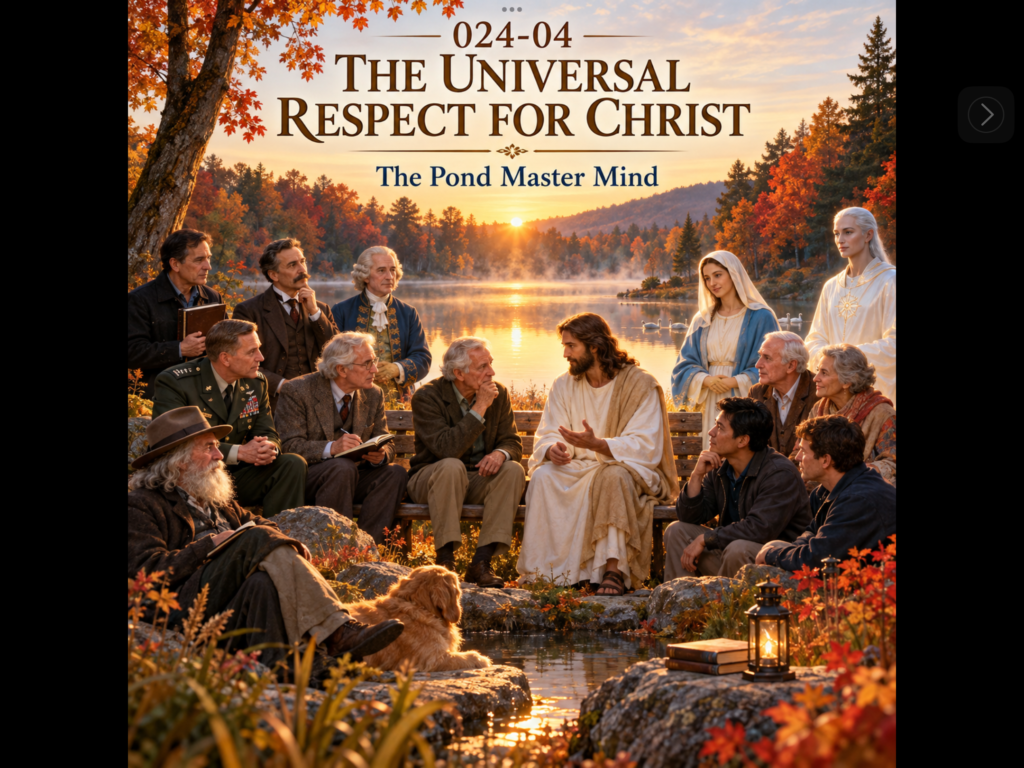
An imagined gathering with Jesus Christ, the Blessed Mother Mary, General David Petraeus, Dr. James T. Ryder, Thomas Troward, Emanuel Swedenborg, Jay Stratton, Walt Whitman, Tom, Bin, Pop, Margie, and the Peaceful Higher Intelligence Envoy.
Author’s note: This is a first-person spiritual and philosophical narrative. The conversations are imagined, not authentic quotations, revelations, or endorsements. The Envoy represents a hypothetical peaceful intelligence. The narrative explores how scientific discoveries can illuminate questions raised by Troward without claiming that science has proved his metaphysical theories. Universal recognition of Christ is presented within the story’s Christ-centered spiritual vision, not as an established fact about extraterrestrial civilizations.
THE MORNING WHEN SCIENCE AND SPIRIT MET AT THE POND
It was another beautiful morning at the pond.
The sun was rising above the trees, spreading its light across the water. The reflections seemed almost perfectly arranged, as though the universe itself were offering another invitation to consider the relationship between the physical world and the unseen principles that give it order.
I sat upon my familiar bench, looking toward the water, thinking about everything that had happened in my consciousness during these past several weeks.
I had been reading Jay Stratton’s Out of the Shadows. My longtime intelligence friend, Tom, had sent me the book, and its extraordinary allegations about unidentified technology and possible non-human intelligence had opened another field of inquiry.
Through my research, I had learned about Dr. James T. Ryder, the former Lockheed Martin scientist and executive whose name appeared in Stratton’s account.
What had particularly interested me was not simply Ryder’s association with advanced aerospace technology.
It was his interest in God, the soul, consciousness, and the relationship between science and a greater spiritual reality.
And now I had returned to Thomas Troward.
Chapter Eight of The Creative Process in the Individual had occupied my thoughts.
Troward had described the development of individuality, the relationship between Universal Spirit and physical existence, and his philosophical conception of humanity evolving toward a higher form of conscious life.
He had also examined Christ, resurrection, and the ultimate meaning of the Creative Process.
As I considered his ideas, a remarkable question came to mind.
What if the extraordinary scientific discoveries of modern civilization were revealing physical principles that encouraged humanity to reconsider some of the questions Troward had been asking more than a century ago?
Not proving his spiritual theories.
Not confirming every conclusion he had reached.
But revealing a physical universe of such extraordinary mathematical order, complexity, possibility, and creative development that his philosophical questions deserved renewed attention.
And what if the universe contained other intelligent civilizations that had advanced beyond humanity, not merely technologically, but in their understanding of consciousness and the responsibilities of intelligent life?
Would such civilizations recognize a higher spiritual principle?
And what might they understand about Jesus Christ?
I looked toward the bench beside me.
Within the freedom of my imagination, Christ was already sitting there.
I felt the comfort of his presence in the story I was creating, and I began speaking as naturally as I would speak to a lifelong friend.
“Lord, I have been thinking about something extraordinary.
“Troward tells us that the Creative Process develops toward greater individuality and conscious participation. Ryder spent his lifetime investigating the physical universe and exploring the possibility that consciousness and spirituality are connected to something greater.
“Swedenborg tells us that you are Lord of the whole universe.
“And now Stratton has introduced the possibility that other intelligent beings may exist, perhaps possessing knowledge far beyond our own.
“Lord, could all of these investigations be pointing us toward a greater understanding of creation?”
In my imagined conversation, Christ looked across the water.
“Edward, the search for truth is worthy of your attention. But remember that understanding requires you to distinguish what you discover from what you believe, and what you believe from what you merely imagine.
“Bring your companions together. Let each contribute the understanding developed through his own experience and inquiry.”
I smiled.
“Then, Lord, we need another Master Mind.”
And in that familiar imaginative world, the gathering began.
THE MASTER MIND ASSEMBLES
My General Friend arrived first, walking toward the bench with the familiar bearing of a man accustomed to examining difficult problems.
Tom followed, carrying Stratton’s book beneath his arm.
Bin came along the pathway, looking toward the water and smiling at the thought of another conversation about humanity’s responsibilities toward its own civilization.
Walt Whitman stood near the trees, contemplating the natural world that he had celebrated so beautifully in his poetry.
Emanuel Swedenborg took his place beside Thomas Troward.
And then I imagined Dr. Ryder approaching, carrying a notebook filled with scientific observations and questions about the universe.
Jay Stratton followed, prepared to examine what his investigations might mean for human civilization.
My Pop and my Queen, Margie, joined the gathering as beloved figures from my memories and spiritual imagination. The Blessed Mother Mary sat beside them.
Finally, from across the pond, the Peaceful Envoy approached.
There was no spacecraft.
No brilliant flash of light.
No demonstration of extraordinary power.
Only a peaceful presence, representing the possibility of an intelligence whose wisdom might be greater than anything humanity had yet achieved.
As the Envoy approached, it paused before Christ.
There was something about that moment that captured my attention.
The Envoy did not appear afraid.
Nor did it behave as though it were approaching an unfamiliar authority.
Instead, it offered a quiet gesture of profound respect.
Christ acknowledged the visitor and invited it to join the gathering.
The General noticed the exchange.
“Ed,” he said, “before we begin, I think you have something important to ask our visitor.”
I nodded.
“Yes, General. I do.”
I turned toward the Envoy.
“Why did you acknowledge Christ in that way?
“You represent, within our imagination, a civilization far beyond our present human development.
“Why would an intelligence from another world, perhaps possessing knowledge of the universe greater than ours, express such extraordinary respect for Jesus Christ?”
The Envoy looked toward me.
“Edward, that is the question your gathering must examine today.
“But to understand the answer, you must first understand the relationship between knowledge, wisdom, love, and the freedom of intelligent creation.”
And with those words, our new Pond Master Mind began.
DR. RYDER — DOES SCIENCE REVEAL THE CREATIVE PROCESS?
I turned toward Dr. James Ryder.
“Doctor, I want to begin with you because your professional life represents something that I believe is very important to our discussion.
“You spent decades at Lockheed, working with some of the most advanced technologies developed by our civilization.
“You understood physics, engineering, aerospace systems, materials, and the extraordinary technological capabilities that the human intellect can produce.
“Yet your public lectures explored God, the soul, and consciousness.
“What I want to know is this: As science continues to advance, are we discovering principles that bring us closer to some of the philosophical ideas expressed by Thomas Troward?”
In my imagined conversation, Ryder looked toward Troward before answering.
“Edward, let us begin with what science has actually established.
“The physical universe operates through discoverable regularities. Matter and energy interact according to principles that can be described mathematically and tested experimentally.
“Through astronomy, we have discovered that the universe contains an extraordinary number of galaxies, stars, and planetary systems.
“Through physics, we have investigated the fundamental particles and forces that govern the behavior of matter.
“Through chemistry, we have learned how relatively simple elements can combine to create complex structures.
“And through biology, we have discovered how living organisms develop, reproduce, adapt, and evolve.
“These discoveries reveal an extraordinary physical universe.
“But science itself does not establish that these processes originated in a conscious Universal Spirit. That is a philosophical proposition requiring a different kind of argument.”
I nodded.
“Then where do you see a relationship to Troward?”
Ryder continued.
“In the questions raised by the organization and development of nature.
“Troward attempted to understand creation as an intelligible process rather than a collection of unrelated events.
“Modern science also investigates the processes through which complex structures emerge from simpler physical interactions.
“That gives us a point of comparison.
“But comparison is not proof. Science does not demonstrate that evolution must culminate in spiritual perfection, or that the universe consciously intends to produce a particular kind of individual.
“Nevertheless, the very existence of discoverable natural laws invites philosophical reflection about why the universe has the properties it does.”
Troward leaned forward.
“And that is where my conception of the Creative Process begins.
“I proposed that originating Spirit expresses itself through a progressive development of forms, ultimately producing individuals capable of conscious initiative.
“The individual becomes more than a passive consequence of physical circumstances. Through reason, selection, and purposeful thought, the individual participates in the direction of life.”
Ryder nodded.
“Modern science certainly recognizes that human beings possess capacities for planning, learning, adaptation, and deliberate action.
“Our understanding of the brain has advanced enormously. We can investigate relationships between neural processes, perception, memory, and conscious experience.
“But the deeper philosophical question—why subjective experience exists at all, and whether consciousness is entirely explained by physical processes—remains contested.”
I looked toward Troward.
“Then some of the things you anticipated as philosophical questions remain important today.”
“Indeed,” Troward answered within our imagined gathering. “But the significance of my philosophy cannot depend upon claiming that a later scientific discovery verifies every detail of it.”
I smiled.
“That’s an important distinction.
“Because what I am beginning to see is that science and spiritual philosophy can illuminate each other without becoming identical.”
Swedenborg joined the conversation.
“Edward, this distinction is also important in my theology.
“I understood the natural and spiritual worlds as related, but not interchangeable.
“Physical investigation reveals properties of the natural world. Spiritual inquiry concerns questions of divine love, wisdom, human conscience, and the purpose of life.
“Confusion arises when one method of inquiry is required to prove everything claimed by the other.”
Ryder looked toward Swedenborg.
“And productive dialogue becomes possible when both are prepared to acknowledge their limitations.”
For a moment I looked across the pond.
The sunlight was illuminating the water, and I found myself thinking about the relationship between light, physical energy, and the extraordinary physical processes that made life possible.
I turned toward Ryder.
“Doctor, in your lectures you explored the relationship between light and the soul.
“Does the physical study of light provide another way to understand this connection?”
The imagined Ryder answered.
“Light is one of the most remarkable subjects in physics.
“It carries energy and information. Our observations of distant stars and galaxies depend upon it. Much of life on Earth ultimately depends upon energy received from the Sun.
“The study of light has also played an enormous role in the development of modern physics.
“But when a philosopher or spiritual teacher uses light as a symbol of consciousness or divine wisdom, that is a different application of the idea.
“The physical nature of light does not establish that the human soul is literally electromagnetic radiation.
“Nevertheless, the metaphor can be meaningful.
“Light enables physical vision. Knowledge enables intellectual understanding. Wisdom allows knowledge to be directed toward good purposes.”
I smiled.
“Then perhaps light can serve as a bridge between the scientist and the spiritual philosopher—not because the metaphor proves the theology, but because it allows us to contemplate the meaning of understanding itself.”
“Precisely,” Ryder replied.
And I began to recognize the kind of scientific and spiritual dialogue I had been seeking.
THOMAS TROWARD — THE FIFTH KINGDOM AND THE FUTURE OF HUMANITY
I turned toward Troward.
“Judge, I want us to examine Chapter Eight more deeply.
“You describe what you call the Fifth Kingdom—a higher stage of individual development.
“You also discuss Christ, resurrection, the relationship between consciousness and matter, and the possibility that life may ultimately develop capacities beyond anything ordinary humanity presently understands.
“Now, I do not want to pretend that we have scientifically verified those possibilities.
“But I want to understand what you were trying to tell us about the purpose of the Creative Process.”
In our imagined conversation, Troward looked toward Christ before answering.
“Edward, I was concerned with the ultimate development of the individual.
“If the Creative Process produces ever greater capacities for conscious action, one may ask whether the human being represents its final expression or whether further development is conceivable.
“My philosophical answer was that a higher degree of individual life could become possible through greater participation in the originating principle of creation.
“I called this the Fifth Kingdom.”
I interrupted.
“Then the Fifth Kingdom is not simply a society with more advanced computers, aircraft, or spacecraft?”
“No,” Troward answered.
“Nor is it merely the acquisition of extraordinary powers.
“In my conception, the development of individuality must be understood through the relationship between the individual and the Universal Spirit.
“The individual becomes increasingly conscious of the principles through which life is expressed.”
I considered his words.
“Then spiritual progress would involve a greater capacity to act consciously and responsibly rather than merely respond automatically to circumstances?”
“That would be one important aspect,” Troward answered.
“But Chapter Eight also moves toward propositions about immortality and the transformation of the physical condition. Those belong to the more speculative and theological dimensions of my argument.”
Ryder entered the conversation.
“And there we must recognize an important boundary.
“Modern science has not established that spiritual development allows the human body to become immortal, to overcome physical death, or to travel between planets through consciousness.
“Those claims would require evidence beyond philosophical reasoning.”
The General nodded approvingly.
“Good. Now we’re keeping the categories straight.”
I laughed.
“General, I knew you would appreciate that.”
Then I continued.
“But suppose we consider the Fifth Kingdom as a philosophical vision of human development.
“What practical lessons could humanity learn from it today?”
Troward answered.
“That the creative capacity of the individual should be directed through increasingly conscious judgment.
“That mental freedom carries responsibility.
“That human beings should not surrender their lives entirely to external circumstances.
“And that spiritual development should result in a fuller and more constructive expression of life.”
I looked at Christ.
“Lord, this reminds me of the way I have come to understand your teachings.
“Not merely as religious commands, but as principles that transform how we live, how we treat one another, and what kind of world we create.”
Within the imaginative framework of our Pond conversation, Christ replied.
“Edward, a life centered upon love does not remain an abstraction. It becomes visible through mercy, honesty, service, forgiveness, courage, and the protection of others.
“The meaning of spiritual growth must be found in how that growth changes the life of the person.”
Mary gently added another thought.
“And the love expressed in the smallest act of care may be more important than the possession of extraordinary knowledge.”
I thought immediately of Margie.
And I understood why she belonged at this gathering.
For years, I had expressed my spiritual beliefs through the daily acts of caring for someone I loved.
Perhaps those acts had taught me more about Christ than many of the books I had read.
THE ENVOY — THE UNIVERSAL RESPECT FOR CHRIST
Now the Peaceful Envoy stood.
The gathering became quiet.
I had been waiting for this moment.
“Edward,” the Envoy began, “you have asked why I approached Christ with such profound respect.
“You have imagined me as a representative of an intelligence that has progressed beyond humanity in its knowledge of the universe.
“But there is something you must understand.
“Within the spiritual universe your story is contemplating, the highest intelligence is not recognized because it possesses the greatest power. It is recognized because its wisdom is inseparable from love.“
I listened carefully.
The Envoy continued.
“Your civilization often measures advancement through capability.
“How much energy can be controlled?
“How far can a vehicle travel?
“How quickly can information be processed?
“How much territory can a nation command?
“How powerful can a weapon become?
“These measurements describe forms of capability.
“But they do not establish the moral development of a civilization.”
Ryder nodded.
“That is precisely why scientific capability and ethical responsibility must be distinguished.”
The Envoy turned toward him.
“Yes, Doctor.
“An intelligence might understand the structure of matter, manipulate enormous quantities of energy, and communicate across extraordinary distances while remaining morally immature.
“Great technological capability does not automatically produce compassion.”
I asked the question again.
“Then why Christ?”
The Envoy turned toward Jesus.
“Because in the spiritual vision through which you have imagined this gathering, Christ represents something fundamentally different from technological or political supremacy.
“He represents Divine Love united with Divine Wisdom.
“He demonstrates that true greatness is not expressed through the domination of the weaker by the stronger.
“It is expressed through the capacity to protect life, offer truth, respect freedom, and exercise power without being corrupted by it.”
Swedenborg leaned forward.
“That corresponds closely to the central principle of my theology. I understood the Lord Jesus Christ as the visible manifestation of the one Divine Being, whose essential nature is love and wisdom.
“In that understanding, the Lord’s sovereignty is universal. It is not limited by the boundaries of nations or planets.”
The Envoy acknowledged Swedenborg.
“And within this imagined spiritual order, the recognition of Christ is not merely the acknowledgment of a powerful being.
“It is respect for the highest moral and spiritual principle governing intelligent existence.”
I became deeply interested.
“Are you saying that all advanced intelligent civilizations would recognize Christ?”
The Envoy answered carefully.
“Edward, you are asking two different questions.
“One is what a fictional civilization in your Christ-centered spiritual vision might understand.
“The other is what any actual civilization beyond Earth believes.
“You possess no evidence that allows you to answer the second question.
“But within this imagined universe, you may explore the first.
“Imagine communities of intelligent life that have developed beyond the desire to dominate one another.
“Imagine that their understanding of wisdom has led them to recognize the supreme importance of love, freedom, truth, and responsibility.
“Your own Christian faith understands these principles as finding their fullest expression in Christ.
“Within this story, my gesture of respect acknowledges that understanding.”
I considered the distinction.
“Then universal respect for Christ would not necessarily mean that every being throughout the universe possesses the same religious history, language, or customs as the people of Earth.”
“Correct,” answered the Envoy.
“Nor would such respect justify compelling another intelligence to accept a doctrine.
“Respect that is demanded through superior force ceases to be freely offered respect.
“If wisdom is truly universal, it cannot require the destruction of the freedom through which genuine understanding develops.”
Troward entered the discussion.
“And there we return to individuality.
“Spiritual development cannot be reduced to the suppression of individual consciousness. It requires the fuller and more responsible exercise of that consciousness.”
Swedenborg agreed.
“In my theology, freedom and reason are essential to spiritual life. Coercion cannot create genuine love.”
I turned toward Christ.
“Lord, within my Christian understanding, I believe you are the Lord of all intelligent creation.
“I believe your Divine Love and Wisdom are universal.
“But I also believe the freedom of each individual must be respected.
“Is that the relationship I have been trying to understand?”
In the language of my imagined conversation, Christ answered.
“Edward, do not confuse reverence with submission to earthly domination.
“Love that serves another’s good does not seek to destroy that person’s freedom.
“Wisdom that is truly concerned with life seeks understanding rather than blind obedience.
“And those who profess respect for me must consider whether their actions reflect the love they claim to honor.”
I was quiet for a long moment.
Then I looked toward the Envoy.
“I think I understand.
“In our imagined universe, you recognize Christ not because you fear a superior power, but because you recognize a higher expression of wisdom and love.”
The Envoy bowed its head.
“That is precisely the meaning of the respect I offered.”
THE GENERAL AND JAY STRATTON — THE TEST OF A HIGHER INTELLIGENCE
My General Friend had been listening intently.
Now he spoke.
“Ed, let me offer a challenge to this discussion.
“We’ve spent considerable time examining what a benevolent intelligence might represent. But as someone concerned with the protection of nations and civilian populations, I would need more than expressions of peaceful intent.
“If an unknown intelligence appeared tomorrow, how would we determine whether its intentions were genuinely peaceful?”
I looked toward the Envoy.
“That’s an important question, General.”
The Envoy answered.
“Then do not judge a civilization merely by the declarations it makes.
“Examine its actions.
“Does it respect the autonomy of others?
“Does it avoid unnecessary harm?
“Does it communicate truthfully?
“Does it demonstrate restraint where it possesses overwhelming power?
“And does it allow less-developed civilizations to exercise their freedom rather than imposing its own will?”
Tom entered the conversation.
“Those are useful indicators, but we would still need independently verifiable observations. Intent is difficult to establish, even when dealing with other human governments.”
Jay Stratton joined him.
“And unidentified phenomena should be investigated through the same disciplined assessment of evidence and alternative explanations that serious intelligence work requires.”
The General nodded.
“Exactly. Peaceful intention is a desirable objective. But responsible leadership must consider capability, uncertainty, vulnerability, and the consequences of error.”
I looked across the pond.
“Then perhaps the highest form of intelligence is one that possesses the capability to dominate, yet chooses not to.”
The Envoy responded.
“Restraint can indeed be an expression of wisdom, Edward. But restraint must also include the courage to protect life when protection is necessary.”
The General smiled.
“Now that is a principle I can work with.”
I turned toward Christ.
“Lord, I believe humanity could learn something extraordinary from that understanding.
“Imagine a world in which governments exercise necessary power without treating other nations as permanent enemies.
“Imagine technology developed for the protection of life rather than the expansion of destruction.
“Imagine artificial intelligence governed by principles of human dignity and responsibility.
“And imagine a civilization in which individuals are free to develop their talents and contribute to the common good.”
Christ answered within our imagined gathering.
“Then do not wait for another civilization to demonstrate those principles to you. Begin practicing them within your own.”
BIN AND WALT WHITMAN — INDIVIDUAL FREEDOM IN A UNIVERSAL CIVILIZATION
Bin looked toward the Envoy.
“I have been thinking about something,” he said.
“Edward and I come from different cultures. Our nations have different histories, political institutions, and ways of understanding society.
“But we have developed a friendship based upon personal respect.
“If an advanced civilization wished to establish peaceful relationships with humanity, would it have to respect those differences?”
The Envoy answered.
“Yes. Genuine respect begins by recognizing that intelligence may express itself through different histories, languages, traditions, and forms of community.
“But differences do not eliminate moral responsibility.
“A peaceful civilization must protect the conditions under which individuals can pursue truth, develop their abilities, and live without unnecessary coercion.”
Walt Whitman moved closer to the table.
“Then remember the dignity of the individual person.
“Do not build your vision of universal civilization upon the disappearance of humanity’s diverse peoples.
“Let a larger understanding of creation enlarge human freedom rather than diminish it.”
I looked toward Whitman.
“That brings us back to America and the principles of our Declaration of Independence and Constitution.
“I believe individual rights and government by consent are among humanity’s most important political achievements.
“But I also recognize that those principles have required generations of struggle to fulfill.”
The General entered the discussion.
“And that struggle is never permanently finished. Institutions must preserve freedom through laws, accountability, and the responsible exercise of authority.”
Swedenborg added.
“Spiritual freedom and political freedom are not identical, but each requires recognition that people possess a moral worth that must not be casually disregarded.”
I thought about Troward’s Fifth Kingdom again.
“Then perhaps humanity’s higher development involves more than the individual gaining greater powers of consciousness.
“Perhaps it also involves a civilization becoming increasingly capable of protecting the freedom and dignity of its members.”
Troward answered.
“That would be a worthy application of the philosophy of creative individuality.”
MARGIE, POP, AND THE BLESSED MOTHER — WHAT CHRIST CONSCIOUSNESS MUST MEAN IN DAILY LIFE
The conversation had reached an extraordinary height.
We had examined the nature of the universe, the development of consciousness, the possibility of advanced civilizations, and the universal spiritual significance of Christ.
But then I looked toward my Queen.
Margie was sitting quietly beside Mary, and Pop was looking at me with an expression I knew so well.
I smiled.
“Pop, I know what you’re thinking.”
He laughed.
“Then tell me, Eddie.”
“You’re wondering how all of this helps me get on with my life.”
“Well,” he answered, “that’s certainly part of it.”
The gathering laughed.
Pop continued.
“You’ve spent a lifetime building things, solving problems, and taking care of people. You know how to put a system together and make it work.
“Now you’re developing all these ideas about consciousness, science, and the future of civilization.
“That’s fine. But don’t forget that you still have a life to build.”
I nodded.
“Yes, Pop. I understand.
“And I believe that is exactly what Troward was trying to teach about the individual participating in the Creative Process.
“We don’t simply sit and contemplate the possibilities of life. We must make responsible decisions and act upon them.”
Ryder joined the conversation.
“That is also how scientific knowledge becomes practically useful. Understanding something is often only the beginning. Knowledge must be translated into responsible applications.”
The General looked toward me.
“And in your professional life, that means converting your experience into actual consulting engagements, delivering useful work, and building a sustainable business.”
I smiled.
“General, you never let me forget that.”
“Good,” he answered.
I turned toward Margie.
“But there is another part of this, my Queen.
“For so many years, I cared for you. I loved you, and I organized my entire life around helping you.
“During those years, I believed that love, prayer, and healing were connected in ways I was still trying to understand.
“Now, ten years after your passing, I am beginning to rediscover the life that is still before me.
“And I want that life to express the love and wisdom that I have spent so many years contemplating.”
Within the imagined conversation, Margie took my hand.
“Then live it, Ed.
“Let your love for me remain part of who you are. But don’t let the past become the only place where your love is expressed.
“You still have people to meet, work to accomplish, places to go, and joys to experience.”
Mary looked toward us.
“And remember that love is not measured by the ability to prevent every suffering or overcome every loss.
“Love is also present in faithful care, compassion, forgiveness, and the courage to continue living.”
I felt the meaning of those words.
They brought our entire conversation back to something deeply personal.
Christ Consciousness, as I had come to describe my spiritual aspiration, could not merely mean believing in a greater spiritual universe.
It had to mean allowing Christ’s example of love, wisdom, and compassion to influence my everyday actions.
It had to include the way I conducted business.
The way I treated friends.
The way I approached people whose beliefs differed from mine.
The way I exercised judgment.
And the way I cared for my own life.
CHRIST — THE UNIVERSAL PRINCIPLE OF LOVE AND WISDOM
The afternoon sunlight was beginning to soften.
The gathering became quiet as Christ rose from his place at the table and walked toward the bench.
I followed him, and my General Friend joined us.
In the freedom of my imagination, we sat together, Christ between us, his arms resting affectionately around our shoulders.
I looked toward him.
“Lord, I think I have finally begun to understand what this conversation is teaching me.
“Science allows humanity to discover the physical principles of creation.
“Troward encourages us to contemplate the creative development of individuality and consciousness.
“Ryder reminds us that scientific capability does not determine moral responsibility.
“Swedenborg brings us to the union of Divine Love and Divine Wisdom.
“Stratton raises questions about unknown intelligences and the responsibilities of government.
“And our Peaceful Envoy represents what a civilization might become if wisdom developed alongside intelligence.”
I paused.
“But what brings all these different ideas together, within my Christian understanding, is you.”
The imagined Christ looked toward me.
“And what do you understand by that, Edward?”
“That you represent the highest expression of love united with wisdom.
“That intelligence without love can become destructive.
“That freedom without responsibility can become selfishness.
“That power without wisdom can become domination.
“And that a civilization cannot claim true greatness merely because it knows more than its neighbors.”
The General looked across the pond.
“Ed, I think there’s a useful distinction there.
“Technological superiority can be measured in certain ways. Moral superiority is a much more difficult claim, and history gives us plenty of reasons to be cautious about anyone asserting it.
“Perhaps the sounder objective is to build institutions and habits that encourage responsible conduct and restrain the misuse of power.”
“Yes, General,” I answered.
“That’s exactly why individual freedom and accountability belong in this conversation.”
Christ continued within my imagined spiritual scene.
“Edward, let the reverence you feel become a responsibility rather than a claim of superiority over others.
“Those who sincerely pursue love, wisdom, truth, and mercy need not share every conclusion to recognize the importance of those principles.
“Let your convictions guide you toward service, not domination.”
I looked toward the Peaceful Envoy, still standing beside our Master Mind.
“Then I understand your expression of universal respect.
“Within this spiritual vision, Christ is recognized as Lord of all intelligent creation.
“But the highest expression of that recognition is not forced obedience.
“It is the free and conscious expression of love and wisdom.”
The Envoy bowed its head.
“That is what I came to explain, Edward.
“The most advanced intelligence is not the intelligence that commands the greatest power. It is the intelligence that understands why power must answer to love, wisdom, truth, and freedom.
“And within your imagined spiritual universe, this is why I offer profound respect to Christ.”
THE CONCLUSION — THE HIGHER MUST GOVERN THE LOWER
We returned to the table for one final thought.
I looked toward Troward and Ryder.
“Gentlemen, I believe you have helped me understand something of lasting importance.
“Judge Troward, you explored the Creative Process as a movement toward increasingly individualized consciousness and spiritual development.
“Dr. Ryder, your scientific and philosophical interests demonstrate that even those working at the frontier of advanced technology can ask serious questions about consciousness, divine reality, and moral responsibility.
“And what modern science has revealed about the development and organization of physical nature gives us new ways to explore those questions—without pretending that empirical research has established all the answers.”
Ryder nodded.
“The proper relationship is one of informed dialogue. Scientific discoveries can inspire philosophical interpretation, while philosophy can help us decide what scientific discoveries mean for human life.”
Troward added.
“And the individual must translate understanding into purposeful action.”
Swedenborg looked toward Christ.
“Through love and wisdom, freely embraced.”
Whitman raised his voice.
“And always with respect for the individual human being.”
The General nodded.
“With responsible institutions, sound judgment, and the protection of life.”
Tom added.
“And with a continuing commitment to distinguish evidence from speculation.”
Stratton looked toward the book resting upon the table.
“And a willingness to investigate extraordinary claims seriously, whatever the evidence ultimately reveals.”
Bin smiled.
“And with a recognition that the peoples of this Earth share more than the disputes between their governments might suggest.”
Pop looked toward me.
“And with some work getting done tomorrow morning.”
Margie laughed.
“And some enjoyment along the way.”
I smiled at them all.
Then I turned toward the Peaceful Envoy.
“And what would you add?”
The Envoy answered.
“That humanity should not wait to discover another intelligence before deciding what kind of intelligence it wishes to become.”
I looked toward Christ once more.
And I spoke the words that I wanted to carry forward into the next chapter of my life.
THE HIGHER MUST GOVERN THE LOWER.
LOVE AND WISDOM MUST GOVERN INTELLIGENCE.
INTELLIGENCE MUST GOVERN TECHNOLOGY.
TECHNOLOGY MUST SERVE LIFE.
AND LIFE MUST BE ALLOWED TO DEVELOP IN FREEDOM.
In my understanding of Christ, these were not merely principles for the government of nations or the engineering of machines.
They were principles for the development of the individual soul.
For the creation of a more peaceful civilization.
And perhaps, within God’s vast creation, principles worthy of respect by intelligent life wherever it might exist.
I rose from the bench and looked once more across the pond.
The birds were moving across the water. The trees were illuminated by the setting sunlight.
I had begun the morning wondering whether science could reinforce Thomas Troward’s philosophy.
I ended it understanding that their most productive meeting lay in the questions they encouraged us to examine together.
What is consciousness?
What is the purpose of intelligence?
What makes a civilization truly advanced?
How should scientific knowledge be governed?
What does freedom require?
And what would it mean for humanity to develop not merely greater technological capabilities, but greater wisdom and love?
I thought about the phrase that had guided our earlier conversations.
PEACEFULLY AND INTELLIGENTLY — WITH INDIVIDUAL FREEDOM.
Now I wanted to add a spiritual dimension to it.
WITH UNIVERSAL RESPECT FOR DIVINE LOVE AND WISDOM, WHICH MY FAITH RECOGNIZES IN JESUS CHRIST.
That was the vision I wished to share through Witness to Calling.
Not an assertion that we had discovered the secrets of the universe.
Not a claim that we possessed knowledge of what unknown civilizations believed.
But an invitation to consider whether humanity could become more worthy of the extraordinary intellectual and technological powers it was developing.
And whether we might begin that transformation, not tomorrow, not after some great disclosure, but through the decisions we make today.
I whispered a final prayer.
“Lord, help me turn understanding into action.
“Help me live with greater wisdom, greater love, and greater freedom.
“And may humanity learn to do the same.”
Then I smiled, remembering Pop’s familiar instruction.
I had work to do.
And another beautiful day of life before me.
THE END — FOR NOW.
Narrative status
New Pond Master Mind — October 20, 2026
This is a separate, read-aloud narrative building upon the approved 024-03, with a stronger theological conversation between Christ, Troward, Swedenborg, Ryder, and the Peaceful Envoy.
Central philosophical contribution: Science can illuminate aspects of nature that make Troward’s questions newly relevant, while the Envoy expresses the story’s concept of universal, freely offered respect for Christ as the embodiment of Divine Love and Wisdom.