WITNESS TO CALLING
024-03 — THE POND MASTER MIND
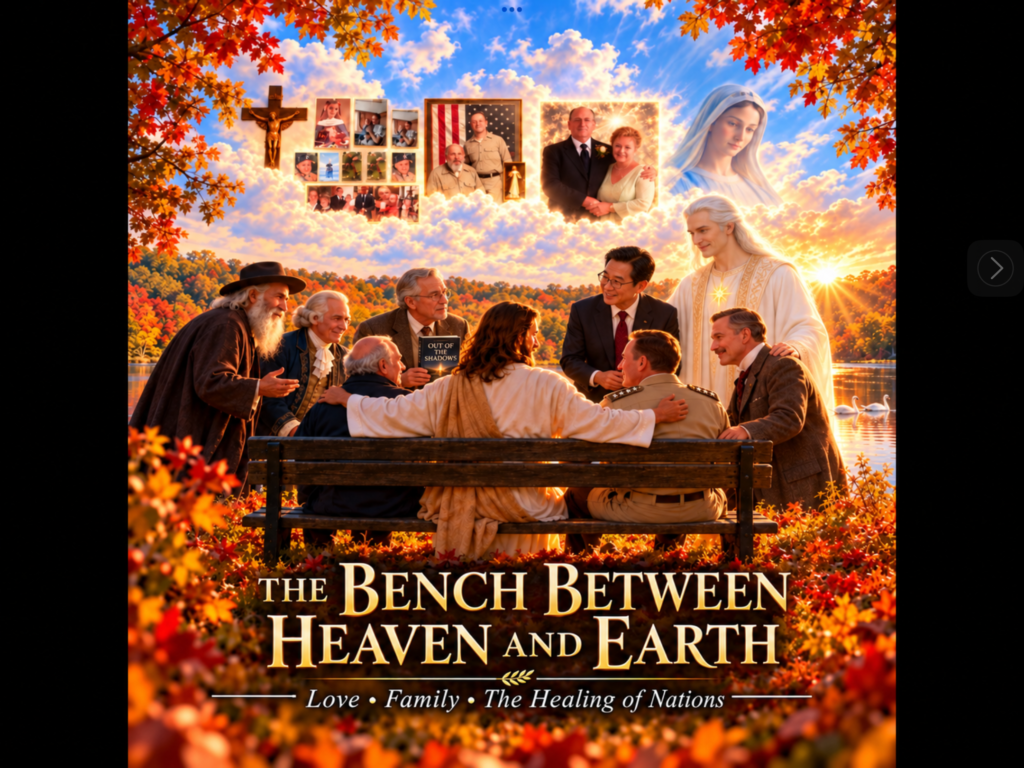
PEACEFULLY AND INTELLIGENTLY
Christ, Swedenborg, the Peaceful Envoy, and Humanity’s Responsibility for Freedom
Complete expanded first-person narrative — October 18, 2026. Prepared for reading aloud, voice recording, and future publication on WitnessToCalling.com. All conversations are imaginative literary dialogue, not actual statements by the people portrayed.
It was another beautiful morning at the pond, and I had come carrying more questions than answers.
The trees, the water, and the familiar bench offered the kind of silence in which my mind seemed able to travel from the most ordinary responsibilities of earthly life to questions almost too large to imagine.
I had been reading Out of the Shadows, the book sent to me by my longtime friend Tom, a career intelligence officer whom I had known since September 11, 2001. Tom and I spoke regularly by telephone.
I had also been thinking about my friend General David Petraeus, whom I had known since 2014, two years before my Queen, Margie, passed into what I call the Heavenly World in 2016. The General and I continued to communicate by email.
And there was Bin, my business associate and loyal friend, born in China and now visiting that country, to whom I had sent images of the bench and our remarkable imagined gatherings.
These were real friendships.
The gathering I was about to imagine was something different: a means of thinking aloud with the people and ideas that had helped shape my consciousness.
I had been asking whether humanity might be only one community of intelligent life in a universe far larger and more mysterious than we understand.
I had also been asking whether intelligent beings more advanced than ourselves could possess wisdom sufficient to avoid the destructive struggles that still threaten life here on Earth.
I did not know the answers.
But I knew how I wanted humanity to approach them.
Peacefully and intelligently, with individual freedom always protected.
That phrase remained before me as I walked toward the bench.
Peacefully and intelligently.
It was simple enough to speak in a breath, yet it suggested a demanding standard for governments, militaries, intelligence organizations, scientists, religions, businesses, and individuals.
Could we develop the discipline to investigate the unknown without making fear our first response?
Could the nations of the world learn to defend their legitimate interests without imagining that every difference must end in confrontation?
Could the intelligence we were creating in machines be governed by moral responsibility?
Could I make these convictions useful through WitnessToCalling.com, rather than allowing them to remain thoughts that lifted my spirits but changed nothing in the world?
When I looked up, my imaginary Master Mind was already assembling.
Walt Whitman stood by the water, delighted, it seemed, simply to be surrounded by life.
Emanuel Swedenborg sat at the far end of the bench, calm and attentive.
General Petraeus was studying the quiet pond with an expression I associated with practical questions.
Tom had arrived with Stratton’s book.
In the freedom of my imagination, Bin had returned from China to join us.
There was also an empty chair, placed at the center rather than at the head of the table.
And beside that chair stood Jesus Christ.
“Ed,” Christ said in the language of our imagined conversation, “you have brought the questions of your world to this pond again.”
“Yes, Lord. I keep coming back to the same thing. What is humanity supposed to do with its life here on Earth? And if intelligence beyond humanity exists, how should we respond?”
“Begin,” he answered, “with the responsibility already in your hands. But let us hear why you have gathered these particular companions.”
I looked toward Swedenborg.
“Because this morning I want to understand something you wrote centuries ago. I have imagined you sitting here with the General and Whitman, speaking of a world beyond the Earth. And now I discover that your theology went further than I understood. You wrote about other worlds, and you taught that Jesus Christ is Lord of the whole universe, not merely of our planet. That is remarkably close to what I have imagined about Christ and a benevolent higher intelligence.”
Swedenborg nodded.
“Then let us examine both the conviction and its meaning.”
In the story I saw another figure approaching from the pathway across the pond.
There was no blinding light, no craft descending from the clouds, and no spectacle intended to demand belief.
The visitor simply appeared within our shared imagined scene: unmistakably a person, yet not someone I could identify with any earthly culture.
Its presence was still, attentive, and without threat.
I would call this guest the Envoy—not because I possessed knowledge of an actual emissary, but because the name allowed us to consider what truly peaceful intelligence might say to humanity.
The Envoy approached Christ before approaching the rest of us.
There was recognition between them.
I imagined a relationship of trust and service, rather than an exchange between competing powers.
Christ invited the Envoy to sit among us.
“Friends,” Christ said, “for this conversation, imagine a universe with many communities of intelligent beings. Imagine that some have learned to cross distances and solve problems still beyond human understanding. Then ask what greater intelligence would be for.”
The Envoy looked toward me.
“Edward, a civilization may know how to travel between stars and still fail to understand love. Technology can increase capability without increasing wisdom. If you meet the unfamiliar, neither worship it because it is powerful nor attack it because it is different.”
Tom leaned forward.
“That sounds like a useful principle. But let us keep our categories straight. What have we observed? What can be corroborated? What might explain it? And which conclusions remain speculative?”
The General followed with another question.
“What are the visitor’s intentions, capabilities, and limitations? What are the possible risks to civilians and national security? Even a peaceful approach requires preparation.”
The Envoy responded.
“Preparation need not mean provocation. Restraint is not weakness. The greater the power available to an intelligence, the more consequential its judgment becomes.”
“I like that,” I said. “Peacefully and intelligently.”
“Yes,” the Envoy answered. “And without surrendering your responsibility to decide how you will live.”
Swedenborg rose slowly.
“Edward, before we imagine what a visitor from another civilization would say, permit me to explain what I myself claimed. In my work Earths in the Universe, also known as Other Planets, published in 1758, I wrote that the interior levels of my spirit had been opened and that I was allowed to converse with spirits and angels associated with worlds other than Earth. I presented these accounts as experiences I believed I had undergone, not merely as literary allegories.”
He paused, careful to look toward Tom.
“Yet a reader in your century must distinguish testimony from verification. Some planetary descriptions in my writings cannot be reconciled with what modern science has learned. You need not pretend otherwise to consider the theological question that animated my work.”
“And what was that question?” I asked.
“Whether the Lord’s providence and care are confined to one small planet. I believed the universe had been created for life, and I attempted to explain that the Lord of humanity is the Lord of the entire creation. In the passage you have begun studying—Other Planets, section 121—I discussed the recognition of the Lord among inhabitants of other worlds. That was not a claim that Christ was merely one earthly teacher among many competing cosmic authorities. I was attempting to describe a divine reality whose reach transcends the Earth.”
I turned toward Christ.
“Lord, that is the point I have been trying to express. In my imagination, you are not responsible only for the human race. You stand at the center of a wider moral universe of intelligent beings.”
Christ answered.
“Let that be the theological premise of this gathering. Now ask what follows from it. If divine authority extends through all creation, does it require each life to surrender conscience? Or does it call intelligent beings to use their freedom well?”
Swedenborg replied immediately.
“I would say that love cannot become genuine merely by command. Nor can wisdom grow when reason is extinguished. The purpose of providence is not to make conscious beings into instruments without a will of their own.”
The Envoy inclined its head toward Christ.
“That is why, in this story, I stand under your authority without claiming authority over the people of Earth. I could offer knowledge or assistance; I could not rightly demand their obedience merely because I possess greater capabilities.”
Whitman broke into a broad smile.
“Then the individual remains sacred to the conversation! The worker, the grandmother, the poet, the farmer, the soldier, the child—each with an inward life that must not disappear beneath the grandeur of empire, machinery, or even the heavens.”
I looked at Swedenborg with renewed interest.
He had not simply given me a theological argument about inhabitants of other worlds.
He had linked the idea of a universal Lord to the moral significance of individual consciousness.
“Swedenborg,” I said, “this raises a difficult question. When we say Christ is Lord of the universe, what does that mean for a peaceful intelligence like our Envoy? Is Christ commanding every civilization as a ruler commands an army?”
Swedenborg considered the comparison.
“In my theological writings, divine love and divine wisdom belong together. Love seeks the good of others; wisdom understands the means. Authority detached from love becomes domination. Love detached from wisdom may remain helpless sentiment. Providence seeks human participation through freedom and reason.”
He looked toward the General.
“In Divine Providence, section 71, I wrote of a law requiring people to act in freedom and in accordance with reason. Later, in section 129, I argued against compelling religious belief from external force. These ideas concern spiritual freedom, of course, and they are not the same thing as a modern constitutional code. Yet they bear upon the responsibility to respect conscience.”
The General responded.
“That distinction is useful. Political freedom depends on institutions as well as moral principles: laws, checks on power, civil rights, accountable leadership, and the ability to address security threats. A generous spiritual ideal will not automatically establish those protections.”
“True,” Swedenborg answered. “But an institution that forgets the moral worth of those it governs will eventually endanger its own legitimacy.”
Christ turned toward the Envoy.
“In our imagined universe, what must a superior intelligence never do?”
“Substitute its will for the freely formed judgment of every lesser civilization,” the Envoy answered. “Even benevolent intentions become dangerous if superior beings decide that those below them no longer deserve a voice in their own future.”
“And what, then, can it do?”
“Offer aid where aid can be received responsibly. Seek mutual understanding. Refrain from unnecessary harm. Preserve the conditions in which others can develop knowledge, responsibility, and freedom.”
I spoke almost to myself.
“Then the highest form of intelligence may be the intelligence that knows when not to exercise its power.”
Christ replied.
“Power can protect life. But power must always answer to what it protects.”
I began to recognize the structure of the conversation I had been seeking.
Christ was the center of the imagined spiritual order.
Swedenborg could explain his historical theology of divine love, wisdom, and freedom.
The Envoy could embody the responsibilities of greater intelligence.
Tom and the General could insist upon evidence and security.
Whitman could speak for the irreducible worth of the person.
Bin could remind us that relationships among ordinary human beings are part of international peace.
And I could ask how to turn all of these perspectives into something useful before my earthly life came to an end.
Tom placed Jay Stratton’s Out of the Shadows on the table.
It was the very book he had sent me.
Tom had been a friend since 9/11, a career intelligence officer whose regular telephone conversations helped me think through questions without forgetting the need for discipline.
I wanted him in this imagined gathering precisely because my spiritual hopes required the challenge of informed questions.
“Edward,” he said, “you are reading a book that presents striking claims about unidentified phenomena and intelligence. The proper response is not to ridicule the author, and it is not to adopt every assertion as confirmed. Read closely. Separate firsthand observation, reports from others, interpretation, and independently available evidence.”
“And if a trained investigator believes the evidence demonstrates nonhuman intelligence?” I asked.
“Then examine the basis of that conclusion. A sincere, experienced witness may have important information. But experience, even at a high level, is not a substitute for showing how a specific conclusion follows from the evidence.”
The General added.
“If a phenomenon raises concerns about defense, airspace safety, or technology, a government has a responsibility to assess it seriously. At the same time, responsible strategy must preserve room for uncertainty. An unidentified object is not automatically an enemy.”
The Envoy replied.
“A mature intelligence does not confuse lack of understanding with evidence of hostile intent.”
Swedenborg nodded.
“And a spiritual testimony cannot establish a physical fact merely by resemblance. What I described in the eighteenth century were conversations I believed I had with spirits who came from other worlds. Those are not the same kind of claim as a contemporary account of radar observations, material samples, or aerospace encounters.”
I welcomed that honesty.
“Then when I continue reading Stratton, we can bring selected passages to this pond and examine them carefully. We may eventually invite Stratton himself into our imaginary Master Mind, provided his fictional words are plainly distinguished from his actual statements.”
“Yes,” Tom answered. “Give the evidence the respect of accuracy.”
“And the unknown?” I asked.
“The respect of remaining unknown until we know more.”
I turned toward Swedenborg.
“Tell us more. You wrote not only about God and the soul, but about many encounters. That matters to me because I have been thinking about your writings while contemplating the Heavenly World and my own consciousness.”
Swedenborg answered.
“In Heaven and Hell I attempted to describe a spiritual world in which people continue as individuals after death, living in communities shaped by their loves and states of mind. In Other Planets I reported spiritual conversations with beings I associated with Mercury, Jupiter, Mars, Saturn, Venus, the Moon, and worlds beyond our solar system. I believed I had been permitted to learn from them about their lives and worship.”
“Did you believe those beings were visiting Earth in machines?” Tom asked.
“No. My descriptions concerned spiritual perception and a spiritual world. It would distort my writing to transform those accounts into reports of modern flying craft.”
“And modern astronomy presents obvious problems with some of the descriptions,” the General observed.
“It does,” Swedenborg agreed. “A serious reader can acknowledge that problem while also asking whether the larger theological question—whether the universe is morally and spiritually unified—has meaning.”
Christ spoke.
“Then let inquiry be honest. Faith need not demand false certainty. A statement about spiritual meaning is not made stronger by presenting it as a scientific observation it cannot support.”
I thought about my own experiences caring for Margie and my belief in the Heavenly World.
Those experiences had given me comfort and a sense of continuity.
But I did not want to demand that another person accept my inward experience as proof of an external event.
The distinction did not diminish the meaning of my faith.
It gave me a more careful way of sharing it.
There was another connection I could not overlook.
“Swedenborg, I have written about a sense that destructive forces have been dismissed and that a Benevolent Personality may be guiding humanity toward a better future. You also wrote about a Last Judgment in the spiritual world.”
“Yes,” Swedenborg replied. “I claimed that a spiritual judgment took place in 1757. I understood it as a reordering of the spiritual world, not the physical destruction of Earth. It was part of my religious interpretation of events I believed I had witnessed.”
“Does that mean a similar event has happened now?” I asked.
“No conclusion follows automatically. My claim is not proof that a change of cosmic government has occurred in your time.”
The Envoy spoke gently.
“Edward, you may find a spiritual interpretation meaningful without knowing that an unseen power has literally assumed control of your planet. You can act according to the good you hope for, even while the larger mystery remains unresolved.”
Christ turned toward me.
“What forces can you confront within the responsibilities given to you?”
I considered the question.
“Fear. Hatred. Cruelty. Greed that forgets people. The habit of treating enemies as less than human. The tendency to surrender our judgment to powerful institutions or technologies.”
“And those,” Christ answered, “are forces your world can work to diminish through conscience, education, law, restraint, forgiveness, and responsibility. Do not wait for a claim about the heavens to become settled before doing what you already know is right on Earth.”
I had wondered whether my inner consciousness had called out for help.
In this imagined gathering, I could honor that feeling without presenting it as evidence that a nonhuman intelligence had heard me or taken oversight of the planet.
What I could do was recognize the direction of my desire: toward a world governed less by fear and more by wisdom.
The General leaned forward.
“Let me ask the hardest practical question. If a peaceful, technologically superior intelligence approached Earth, how should nations respond without exposing their populations to danger or undermining their sovereignty?”
The Envoy answered.
“First, avoid actions born solely of panic. Second, gather and preserve reliable observations. Third, communicate what can responsibly be communicated and reduce the danger of miscalculation. Fourth, do not imagine that peaceful intention eliminates the need for protection.”
“And if an outside actor refused communication or acted aggressively?”
“Then defense may be necessary. Peacefulness is not surrender to harm. Yet defensive action should be governed by necessity, proportionality, and the protection of life rather than vengeance.”
The General nodded.
“That would require judgment under uncertainty. Nations would need channels to coordinate, so that an unexpected event did not become the trigger for a conflict between human states.”
Tom added.
“Especially when sensors, intelligence reports, or automated systems may be incomplete or wrong. We would have to be very cautious about giving machines authority over irreversible decisions.”
I thought about my own professional life designing integrated security systems.
“Security is the mission. Life is the highest priority. Operations must endure. That is the doctrine I have been developing for THL SCI.”
“And it belongs here,” the General replied in our imagined conversation. “Any security architecture is only as sound as its relationship to the mission it protects.”
The Envoy nodded.
“Your principles can scale: preserve life, maintain legitimate protections, build systems capable of correction, and never forget the individuals affected by a decision.”
Whitman had listened long enough.
He walked toward the table and spread his hands.
“I hear much of nations, governments, intelligence, and the universe. But I want to know what becomes of the ordinary person. What is peace worth if one must surrender the voice of the individual to obtain it?”
I answered.
“That is why I always say peace WITH individual freedom. Not simply the absence of war.”
“Then say it again,” Whitman replied. “Say that the human being is not merely an instrument of the state. Say that the person’s affections, beliefs, work, speech, and private conscience matter. Say that the human family is composed of lives, not abstractions.”
Swedenborg responded.
“In my theology, spiritual freedom and rationality are essential. Yet freedom also carries accountability: one may use the faculty of choice to cultivate what is loving or what is harmful.”
The General added.
“Political freedom requires concrete protections. What we aspire to must be translated into rights, institutions, accountability, and the difficult practice of governance.”
Christ looked around the table.
“You have named two dimensions of the same moral challenge. A life needs room to choose, and a society needs just ways to protect individuals when choices conflict.”
The Envoy spoke again.
“A superior intelligence that removes all risk by removing all human choice has not created a free society. It has created dependence.”
I recognized how closely this approached my personal concern.
I wanted peace in my lifetime, but not a peace that required people to submit to some perfect machine, overwhelming government, or imagined cosmic authority.
I wanted people to become capable of freedom exercised responsibly.
Bin, who in real life was visiting China, now joined the conversation in our imaginary return to the pond.
I had sent him the images of the bench, just as I had sent them to the General.
He had become a friend as well as a business associate, and that mattered more to me than geopolitical labels.
“Ed,” he said, “when you talk about world peace, remember that people build relationships one person at a time. We work together. We listen. We visit families and countries different from our own. We discover that the lives of others are not merely news headlines.”
I smiled.
“I have told you that we have a destiny to visit China together someday. I still hope we do.”
“And when we do,” he answered, “the trip will not resolve every difference between America and China. But it can remind us why communication matters.”
The General responded.
“Personal relationships can encourage understanding, but governments still face real conflicts of interest. Durable peace requires channels that remain open when disagreements arise.”
“Exactly,” I said. “US and us. I love the United States. I recognize its history and responsibilities. But I also think of the people on the other side of the ocean who want safety, opportunity, and a future for their children.”
Whitman looked delighted.
“The great variety of the human family need not be a reason for permanent estrangement.”
Christ answered.
“Love of one’s country need not demand contempt for the people of another. Responsibility begins near at hand and need not end at the border.”
I thought again about the website.
Maybe WitnessToCalling.com could help others see that peace was not simply a diplomatic document signed by powerful officials.
It was also the willingness of ordinary people to engage across difference without abandoning their convictions.
The Envoy turned toward Swedenborg.
“You have spoken of the Lord’s universality. Suppose countless intelligent communities exist. Must they all resemble humanity to belong within one moral order?”
Swedenborg replied.
“In my own religious language I wrote of a divine human form and a heavenly community. One may examine the symbolic and theological meaning of that teaching without pretending to know the biology or culture of any actual extraterrestrial beings.”
Christ said.
“Within this story, do not mistake sameness for unity. A greater moral order need not erase variety. Its test lies in whether beings of different capacities can coexist without treating intelligence as a license for domination.”
The Envoy bowed its head.
“Then what binds us is not identical technology, appearance, language, or political organization. It is the responsibility of conscious life toward other life.”
Swedenborg continued.
“Love and wisdom together. The good sought, and the discernment needed to pursue it without destroying what one wishes to save.”
Tom asked.
“And how would human beings know that this Envoy really represented a benign community? We could hear its ethical claims. We would still need evidence about its actions.”
“Indeed,” the Envoy replied. “Trust must be earned by conduct. It cannot be established merely by saying that one serves the highest good.”
The General added.
“That would hold for any power on Earth as well. Strong assurances require verification, limits, and means of accountability.”
I looked toward Christ.
“Then even a peaceful higher intelligence serving you would not ask us to surrender our reason.”
“Not in the vision you are constructing,” Christ answered. “Reason is among the gifts through which responsibility becomes possible.”
That sentence gave me a new understanding of the word intelligent.
The word did not refer simply to the ability to solve puzzles, develop weapons, or gather information.
It also pointed toward the disciplined use of knowledge in service of life.
The Envoy approached the water and looked back at the table.
“You have asked what intelligence beyond Earth might intend. May I ask what humanity intends for its own planet?”
The question was almost painfully direct.
“We have made extraordinary advances,” I answered. “We can send machines to other planets. We can see galaxies that earlier generations never knew existed. We can cure illnesses, move ideas across the world in moments, and bring people together through communications technology.”
“And?” the Envoy asked.
“And we can destroy each other on a scale that earlier generations could scarcely imagine.”
“Then the fundamental question is not whether humanity has intelligence,” the Envoy said. “It is whether your wisdom can grow quickly enough to govern your power.”
The General responded.
“There are no simple answers. Conflicts arise from security dilemmas, competing interests, ideology, misjudgment, and sometimes aggression. Any proposal for peace must be capable of dealing with those realities.”
Christ replied.
“Then do not confuse a moral aim with a complete strategy. You must do the difficult work of designing institutions and relationships that can carry your aim into action.”
I felt almost as if we were back in my consulting office, preparing an integrated security architecture.
I had always understood that a collection of good devices was not a system.
Communications, supervision, authority, procedures, redundancy, and human training were required if the system was to protect the people who depended upon it.
Perhaps an architecture of peace would also require integration.
Diplomacy would need national defense.
Security would need law and accountability.
Economic development would need human opportunity.
Artificial intelligence would need governance.
International cooperation would need to respect sovereignty and personal liberty.
Above all, leaders would need to remember that every policy eventually touched individual human lives.
I looked around the pond.
“Then humanity must learn how to operate as a civilization without turning every difference into war.”
“And without silencing the individual,” Whitman added.
“And without abandoning evidence,” Tom said.
“And without confusing hope with proof,” Swedenborg reminded us.
“And without forgetting security,” the General added.
“And without surrendering love,” Christ concluded.
At last I asked what had been closest to my own private thoughts.
“Lord, I have written about a Benevolent Personality. At times I have felt as though my consciousness called out for help, and I have wondered whether destructive forces were being dismissed. Reading Stratton has made these questions feel closer to my daily life. How can I speak of them responsibly?”
Christ answered within our imagined dialogue.
“Speak faithfully about what you have experienced inwardly. Speak carefully about what you do not know outwardly. Neither your hope nor your spiritual comfort is diminished by refusing to claim knowledge that has not been established.”
Swedenborg added.
“I made extraordinary claims about my experiences, and readers must evaluate them. Your own testimony should make clear where you are describing your consciousness, where you are presenting a theological interpretation, and where you are making a claim about events outside yourself.”
Tom said.
“That distinction protects credibility. If there is new evidence about unusual phenomena, we examine it. We do not need to prove an entire cosmic theory before responding to the problem immediately before us.”
“And what problem is that?” I asked.
“The risk that fear, rivalry, poor information, and powerful technologies could contribute to unnecessary catastrophe,” the General replied.
The Envoy continued.
“Whatever may or may not be happening beyond your planet, the people of Earth remain responsible for their own choices.”
I felt the force of the answer.
The spiritual meaning of my life was not dependent upon establishing that an unseen intelligence now governed Earth.
My calling was to do what I could to encourage peaceful, intelligent, freedom-respecting choices here and now.
As the afternoon passed, my thoughts returned to my Queen.
Margie had passed in 2016, and it had taken me years to begin feeling like myself again after the long period in which caring for her occupied my mind and every hour of my days.
For six years I had carried hope for healing, played music that nourished my spirit, listened to religious and spiritual teachings, and kept her close in the everyday activities of life.
When I later wrote about the Heavenly World, I did so with the memories of that love still alive in me.
“Swedenborg,” I said, “your writing about the continuation of life and the spiritual world speaks to me because of Margie. I do not pretend I can prove everything I hope about our relationship beyond death. But the hope matters.”
Swedenborg answered.
“The individuality of persons and the quality of their loves were central to my accounts of the spiritual world. The historical reader can understand their significance even while deciding independently what to believe about them.”
Christ looked toward me.
“What did caring for Margie teach you?”
“That another person’s life can become more important than my convenience. That love is not only something we say. It is what we do every day.”
“And can that lesson inform the larger questions you have brought here?”
“Yes, Lord. If we could regard human lives with something of the care we give those we love most, perhaps we would think differently before choosing war, cruelty, or indifference.”
Whitman spoke softly.
“Let the particular life teach you to cherish the universal, and let the universal never erase the particular.”
I knew this was one of the great lessons of my life.
The dream of world peace could not be separated from tenderness toward the person beside me.
Nor could spiritual aspiration exempt me from the work of rebuilding my own earthly life.
The General looked at me with the expression I imagined he might have when the discussion grew too abstract.
“Ed, you have given us a mission. What is your plan?”
I laughed because the question was familiar in spirit.
“I knew you would ask that.”
“You want to make a contribution during your lifetime. How will you make your work useful to other people?”
“I want WitnessToCalling.com to become a place where my experiences, my family story, and these Master Mind conversations help people think about peace with individual freedom. I also want to build THL SCI into a working consulting business.”
“Then those responsibilities need to support one another, not compete until both are exhausted,” he replied.
I looked toward Christ.
“I have spent much of my life helping others. I cared for Margie. I have tried to assist my family and friends. Now I need income, independence, and a productive life of my own. Yet I still feel called to contribute to something much larger.”
Christ answered.
“Your own life is included among the lives you seek to protect. Make your work sustainable. Let your talents earn their proper value. Enjoy friendship, family, learning, and the beauty of the world. Service need not require the abandonment of joy.”
The Envoy added.
“A civilization that cannot improve the ordinary conditions of living has not yet learned how to use extraordinary knowledge well.”
Bin smiled.
“And you still have a trip to China to plan someday.”
“Yes,” I said. “And a consulting business to develop, and a website to build, and a book to finish.”
Tom held up Stratton’s book.
“And this one to finish reading before you decide what its strongest evidence actually says.”
We laughed together, and the seriousness of the morning became, for a moment, the ordinary warmth of friends seated around a table.
As the light began to change over the pond, I returned to the Envoy.
“If you were permitted to leave humanity one thought from your imagined civilization, what would it be?”
The Envoy replied.
“Do not permit the growth of power to outrun the growth of responsibility. If your intelligence can reach the stars but cannot protect the dignity of your neighbor, you have not yet completed the education that matters most.”
I turned toward Swedenborg.
“And what would you add?”
“That knowledge needs the direction of love, that freedom and reason belong to responsible spiritual life, and that the universal lordship of Christ—as I understood it—cannot be reduced to the boundaries of the Earth.”
Whitman spoke.
“Remember the person. All the great schemes of civilization must answer to the life of the individual.”
Tom said.
“Be curious and be skeptical. Protect your ability to distinguish evidence from interpretation.”
Bin replied.
“Keep speaking across borders, and make the friendship real in the way you live and work.”
The General added.
“Turn aims into plans. Integrate defense, diplomacy, institutions, resources, and accountability. Serious commitments require serious execution.”
Finally I looked toward Christ.
“Lord, if you are Lord of creation, what would you ask of us here on Earth?”
In this imaginative scene, he answered.
“Seek truth without arrogance. Protect the vulnerable. Exercise freedom with responsibility. Resist cruelty. Learn to govern your power. Love one another not merely in your speech but in your conduct. Do not wait for certainty about distant worlds before honoring the lives entrusted to you here.”
Those words did not give me a timetable for world peace.
They did not confirm that visitors were overseeing our planet, or that every unexplained phenomenon came from another world.
They offered something both more modest and more demanding: a moral task that could begin immediately.
One by one, the guests of my imagined Master Mind began to leave.
Whitman walked toward the trees.
Swedenborg paused at the edge of the pond, as if considering the relationship between what the water revealed and what it concealed.
Bin waved and spoke again of China.
Tom took the book under his arm, ready for our next telephone conversation.
The Envoy stood before Christ, acknowledged him, and departed without spectacle.
Its purpose in my story had been completed: not to replace human judgment, but to make us consider what a truly peaceful superior intelligence would be obliged to respect.
The General remained on the bench beside me.
I thought about how different our lives and responsibilities had been, and how much I valued the chance to continue exchanging thoughts through our correspondence.
I did not imagine that he had endorsed these spiritual claims.
In this literary conversation he had provided the indispensable challenge of practical judgment.
“My friend,” I said, “I believe I am beginning to understand why I continue coming here. I am trying to bring together all that my life has taught me—my love for Margie, my family, my country, my friends, my work, my faith, and my questions about the universe.”
In the scene I imagined him responding.
“Then decide what the next useful step is.”
It was just the kind of answer that returned an expansive vision to daily responsibility.
I looked toward the place where Christ had stood.
Swedenborg’s writing had given our imagined theology greater historical depth.
He had described the Lord not merely as Lord of one nation or even of one planet, but as Lord of a universe in which spiritual life, love, wisdom, freedom, and reason remained meaningful.
Our Envoy had embodied the proposition that greater intelligence should bring greater restraint rather than a claim to domination.
Tom and the General had reminded me that sincere faith and serious security both require intellectual discipline.
Bin had reminded me that international friendship happens between people.
Whitman had reminded me that no grand scheme should erase the individual.
I had not discovered the final answer to the mystery of extraterrestrial life.
And I had not established that benevolent beings had assumed oversight of Earth.
But I had become clearer about the contribution I wanted to make in the years remaining to me.
I wanted the United States—US—to be strong, wise, responsible, and free.
I wanted the larger human family—us—to have the opportunity to live without unnecessary violence, coercion, or fear.
I wanted nations to take security seriously while remembering why security mattered.
I wanted science and intelligence to serve truth.
I wanted technology to serve human dignity.
I wanted my own work and my website to invite informed, respectful conversations in which very different minds could meet without surrendering their principles.
And I wanted to live, not merely to contemplate living: to earn an income through my consulting experience, to enjoy my friendships, to honor Margie and the family I loved, and to continue building something worthwhile from what my life had taught me.
As I rose, an old question returned with new force.
What ought humanity to do with its life here on Earth?
My answer was no longer only a hope for the intervention of superior intelligence.
It was a responsibility that began with the choices available to us.
PEACEFULLY AND INTELLIGENTLY.
WITH INDIVIDUAL FREEDOM.
WITH CHRIST AT THE CENTER OF MY SPIRITUAL VISION.
WITH HUMILITY ABOUT WHAT WE DO NOT YET KNOW.
AND WITH HUMANITY RESPONSIBLE FOR WHAT IT CHOOSES TO BECOME.
The pond was quiet.
The bench stood where it always had, between the familiar earth beneath my feet and the mystery of the heavens above.
Tomorrow, I would have to return to my work, my writing, and my responsibilities.
That was not a departure from my calling.
It was where my calling had to become real.
This is why I continue to develop WitnessToCalling.com.
This is why I will continue reading, questioning, listening, and imagining the Master Mind gathered at the pond.
And this is why, while I am still living on Earth, I will try to contribute to peace with individual freedom.
Because that is my calling.
And that is why I bear witness.
Edward Moore
Witness to Calling — The Pond Master Mind
October 18, 2026
End of Complete Narrative — 024-03