020 — THE FAMILY AS THE DEEP CENTER
Faith, Work, Enterprise, and the Making of a Free Person
The more I thought about the family table, the more I began to realize that it had been following me throughout my life long before I understood what it represented. I first felt something almost heavenly around Aunt Amy’s table in Boca Raton, but the same spirit appeared again and again in different places and different forms. It appeared in my relationship with Pop, in the family life Margie and I later built, at Farmingdale, in church, in the Holy Family of Jesus, the Blessed Mother, and St. Joseph, in the religions and philosophies I explored, and even in the businesses that eventually taught me how to become an entrepreneur. At the time, I thought of these as separate experiences. Religion belonged to religion, business belonged to business, family belonged to family, and philosophy belonged to books. Looking backward now, I see that they were often pointing toward the same center. Again and again I was being shown that the individual is formed through relationship and that the family is one of the first places where love, responsibility, identity, education, faith, and character become real.
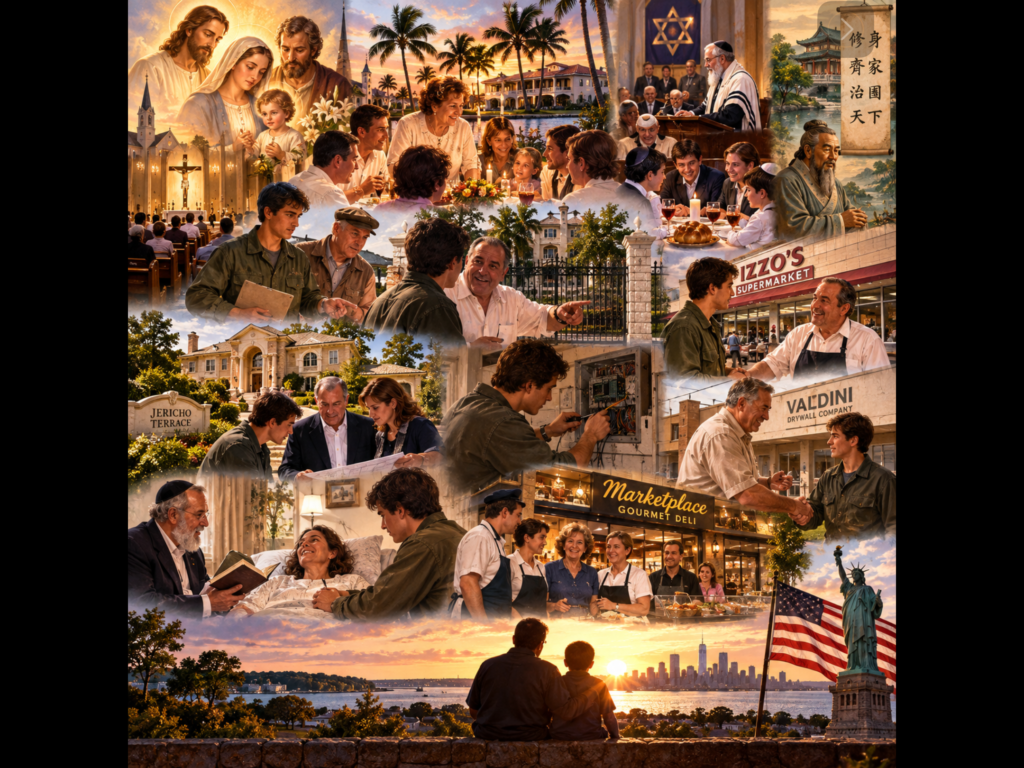
During one period of my religious searching, I remember going into a local synagogue. My own religious experiences had made me curious about the way other people understood God, family, responsibility, and the meaning of life, and I wanted to observe rather than merely assume. I listened to the service, but what remained with me most strongly happened afterward. Families gathered together around tables. There was bread and wine, conversation, children, parents, older people, and a sense that the religious experience had not ended when the formal service ended. It continued around the family table. That image stayed with me. Later, as I read Jewish scripture and reflected upon Jewish history and tradition, I became increasingly aware of the importance of family, education, remembrance, and the transmission of identity from one generation to the next. What impressed me was not only theology. It was continuity. A people remembered who they were because someone taught the children. A family carried stories, beliefs, responsibilities, and memory forward. I began to understand, in my own way, that a people does not preserve itself through institutions alone. It preserves itself because families remember.
Something similar happened when I began thinking again about Confucian philosophy. When I was younger, I remembered hearing the tradition described too simply as ancestor worship, but as I read and thought more deeply I began to see an order of responsibility that made sense to me. A person first had to learn to govern himself, then to care for the family, then to extend that responsibility into the community, and only afterward could he properly think about larger civic responsibility. That sequence spoke to me because I had lived something like it without knowing the language for it. Before I could ever become responsible for customers, employees, businesses, security systems, or ideas about the nation, I had first been learning responsibility through the people closest to me. Family was not separate from public life. It was preparation for it.
Then the same lesson began appearing in business, although business taught it in a far more practical language. One of the early men I remember was Rudy Izzo in Lloyd Neck. Rudy was a family man with a large, beautiful home, and I remember looking around and wondering how he had gotten there. I asked him how he had started his supermarket and how he had built the life I was seeing. His answer was simple. He told me he could not get a job, so he had to create a business. I never forgot that because there was no grand theory in it. There was necessity, responsibility, and the need to support a family. Rudy was teaching me something about entrepreneurship without calling it entrepreneurship. Sometimes a business begins because a person realizes that no one else is going to create the opportunity he needs, so he must create it himself.
After finishing that job, Pop was with me and noticed another large home nearby. He told me I ought to knock on the door because they might need a security system. I told him that anyone building a house like that had probably already prewired for security. I had already decided that knocking would accomplish nothing. Pop did not care about my reasoning. He simply thought I should knock on the door. So I did, and the man who answered was Tony Marullo. Tony told me that he already had a security system, but it had never worked properly, and he wanted me to fix it. I looked at the system and scratched my head. Tony asked me what I was thinking about. I told him I did not know what was wrong with it. He seemed almost amused by the answer because he already knew it did not work. That was why I was there. He wanted me to make it work. I scratched my head again, and Tony asked me what I was thinking about now. I told him that I did not know what to charge him because I still did not know exactly what I was getting into. Tony looked at me and told me, in his own very direct way, that he did not care what I charged him, but if I ripped him off he would break my head. That was Tony. There was humor in it, but there was also a business principle: do the work, charge fairly, and do not betray the trust.
So I went to work and figured the system out. I repaired it, and something changed after that. Tony did not treat me as though I had completed one small job and should disappear. Instead, he began giving me other things to solve. One day he called me over to a window and pointed across the property. He told me he wanted what he was looking at. I thought he meant the house. Tony quickly let me know that I was looking at the wrong thing. He wanted the security gate in front of the house. I had never installed that kind of gate, but Tony wanted one, so I learned. Then he wanted a stereo system, so I learned that. Then he wanted telephone systems, and I learned those too. At the time, I thought Tony simply kept finding new jobs for me. Looking back now, I understand that he was helping me develop a trade and become a businessman. He kept putting problems in front of me that were just beyond what I already knew and expected me to find a way to solve them.
Then one day Tony told me to come with him because he wanted me to meet a friend in Old Westbury. We drove there and he introduced me to Tom, telling him that I was the man he wanted to use for the security system in his new home. That introduction changed something important in my life. One man had trusted me enough to place his own reputation behind my work with another man. That was how business often moved in the world I was learning. It was not through advertising algorithms or corporate purchasing committees. It moved through trust, reputation, relationships, and one person telling another, in effect, “Use Ed. I trust him.” Somewhere behind that introduction was Pop, because I have often wondered whether Tony and other men like him saw the way Pop and I worked together and recognized something familiar in that father-and-son relationship. Perhaps they saw that we were trying to build something together.
The same pattern kept appearing. I remember Nick Leone, connected with Jericho Terrace, and the work I did on his beautiful home in Mill Neck. My sister helped me on that job, which now seems meaningful in itself because even my work was often becoming family work. Later I came across a book that included Nick’s story, and I learned more about the hardships he had overcome and the way he had built a life in America. I remember thinking that if someone really wants to understand entrepreneurship, he should spend time studying the people who came to this country with very little, sometimes without even knowing the language, and still found a way to create something. They were not sitting in classrooms discussing entrepreneurship. They were living it. They had families, responsibilities, bills, dreams, and very little room for failure. They learned, worked, adapted, and built.
I saw another side of the same pattern through Hillel Shohet. His father had been a renowned rabbi and had hoped that Hillel would follow in that tradition. I remember Hillel as a beautiful man. When his wife suffered an accident, I brought books into their home dealing with Jewish Science, a movement I had encountered during my spiritual searching. I was interested in ideas about divine mind, healing, and the possibility of relationship with an intelligence greater than ourselves. What remains important to me now is not an argument over one theory of healing. What remains is the family scene itself. Hillel’s wife was hurt, a family was facing suffering, and I entered their home carrying books, concern, faith, and hope. Once again, religion had moved out of the institution and entered a home where people actually needed one another.
Then there was Charles Valdini. I can still see myself walking down commercial streets looking for business, wearing Army fatigues or something close to them, knocking on doors because I needed customers. Charles told me he needed a security system. Looking backward, I have sometimes wondered whether he needed that system as much as he wanted to give a young man an opportunity. He saw me working. He saw Pop. He saw what we were trying to build. He gave me work, and eventually I did his home and became connected with his company. Years passed. Charles died. His wife died. His son continued the business, and I still monitor that account today. When I think about the length of that relationship, I realize that it became much more than a sale. The original customer is gone, yet the relationship moved into another generation. The business connection survived because the trust survived.
Grace Doria and the Marketplace became another example of what I kept seeing across Long Island. It was a family enterprise where relatives worked together, one business helped create another, and work became both livelihood and education. Family members learned from one another while building something together. The older I become, the more I understand that many of the people who taught me business never called themselves teachers. They were customers, fathers, husbands, immigrants, contractors, supermarket owners, restaurant owners, and family businesspeople. They taught me because they gave me problems and expected me to solve them. Rudy showed me that necessity could become enterprise. Tony taught me that trust brings responsibility and that a person sometimes learns by being asked to do something beyond what he already knows. Nick reminded me that people can arrive with little and build something substantial. Charles showed me how trust can move from one generation to another. Hillel reminded me that faith becomes most human when a family is suffering and needs hope. Grace showed me a family enterprise where work and family strengthened one another.
And Pop was there through so much of it. When I think about him telling me to knock on Tony Marullo’s door, I can almost see him standing there again. I had already convinced myself that there was no reason to knock because the house probably had a security system. Pop did not know whether there was business behind that door. He simply knew there was a door, and sometimes you had to knock. Because I listened to him, Tony entered my life. Tony led to new systems I had to learn. Tony led to Tom. Tom led to other work. One relationship led into another until a young man scratching his head in front of a broken security panel gradually became a security contractor and businessman.
Looking back, I can see how much of my education happened in exactly that way. Farmingdale gave me formal education. The military gave me discipline. Religion gave me questions about purpose and meaning. But family and business gave me an education in responsibility. A person could read a book about courage, but eventually he still had to knock on the door. He could study electronics, but eventually someone was standing behind him expecting the system to work. He could speak about honesty, but eventually a customer was trusting him with his home and his money. He could speak about family values, but eventually someone in the family needed him to show up.
That is why I now understand the family as something deeper than simply a private relationship between relatives. I do not mean that families are perfect. Mine was not. None of the families I encountered were. There were divorces, arguments, illness, death, disappointment, mistakes, estrangement, and people who took very different paths. But even through those imperfections, the family remained one of the first places where a person encountered responsibility. Someone depended upon you. Someone corrected you. Someone fed you before you could feed yourself. Someone taught you language, stories, habits, beliefs, work, and expectations. Someone showed you what it meant to belong somewhere.
The more I think about the religions and philosophies I encountered, the more I see that they kept bringing me back to that same reality. The Holy Family brought me there. Judaism brought me there. Confucian thought brought me there. Aunt Amy’s table brought me there. Pop brought me there. Margie brought me there. Business brought me there. Again and again, the lesson seemed to be that the individual matters, but the individual does not create himself alone. Before a person becomes a businessman, teacher, soldier, engineer, political leader, or anything else, he is first a child who depends upon someone. Someone feeds him, teaches him language, tells him stories, corrects him, encourages him, expects something from him, gives him responsibility, and gives him a chance.
Then those lessons leave the home. They walk out the door. They cross golf courses. They enter construction sites, supermarkets, restaurants, drywall companies, security businesses, offices, schools, and neighborhoods. They become businesses. Those businesses create jobs. Those jobs support homes. Those homes become communities, and those communities become part of a nation. When I say that family and business helped build the America I knew, I am not trying to reduce the history of the country to one simple explanation. I am describing what I saw with my own eyes on Long Island. I saw immigrants and family entrepreneurs create livelihoods because they had to. I saw fathers and sons work together. I saw people extend trust because they recognized character in a relationship. I saw businesses move from parents to children. I saw one man introduce another because reputation meant something. I saw how work could become an education and how business could become a vehicle for independence.
And now I understand something I could not have understood when I was younger. Aunt Amy’s table and Tony Marullo’s security system were not as far apart as they once seemed. One taught me belonging, and the other taught me responsibility. One taught me that people need a place where they know they are loved, and the other taught me that people need to become capable enough to serve others and stand on their own. One gave me spiritual meaning, and the other gave me practical competence. Together they helped make me who I became.
Perhaps that is the deep center I have been trying to find all along. The family table is not simply where people eat. It is one of the first places where a human being learns how to become a person capable of walking out the door and carrying responsibility into the world. That may also explain why I become concerned when I see individuals surrendering more and more of their personal responsibility to institutions. Institutions have purposes. Governments have purposes. Schools have purposes. Businesses have purposes. Technology has purposes. But none of them can completely replace the human formation that begins when one person becomes responsible for another. Someone still has to sit beside the child. Someone still has to teach the story. Someone still has to say that something is right or wrong. Someone still has to give the young person a chance. Someone still has to tell him to knock on the door.
That is how I learned. I sat at family tables, and then I walked out into the world. I crossed the golf course. I worked construction. I walked commercial streets looking for business. I repaired systems I did not fully understand when I first saw them. I learned gates, telephones, stereos, security systems, sales, service, customers, and people. Eventually, almost without realizing exactly when it happened, I became a businessman. But before I was a businessman, I was a son. I was a member of a family. I was shaped by people who loved me, challenged me, trusted me, taught me, and sometimes pushed me through doors I would not have opened by myself.
That came first.
And perhaps that is why the family remains the deep center. Before a nation can have responsible citizens, before a business can have trustworthy employees, before a community can have leaders, and before an individual can truly govern himself, someone has to teach that person how to belong, how to work, how to care, and how to carry responsibility. More and more, I believe education begins long before school, enterprise begins long before the first business, citizenship begins long before voting, and character begins long before public life. Much of it begins around a family table, where a child learns that he belongs to something, that other people matter, that his actions have consequences, and that one day he will have to get up from that table, walk out the door, and carry what he learned into the world.
That is the story I now see behind so much of my life.