AMERICANISM
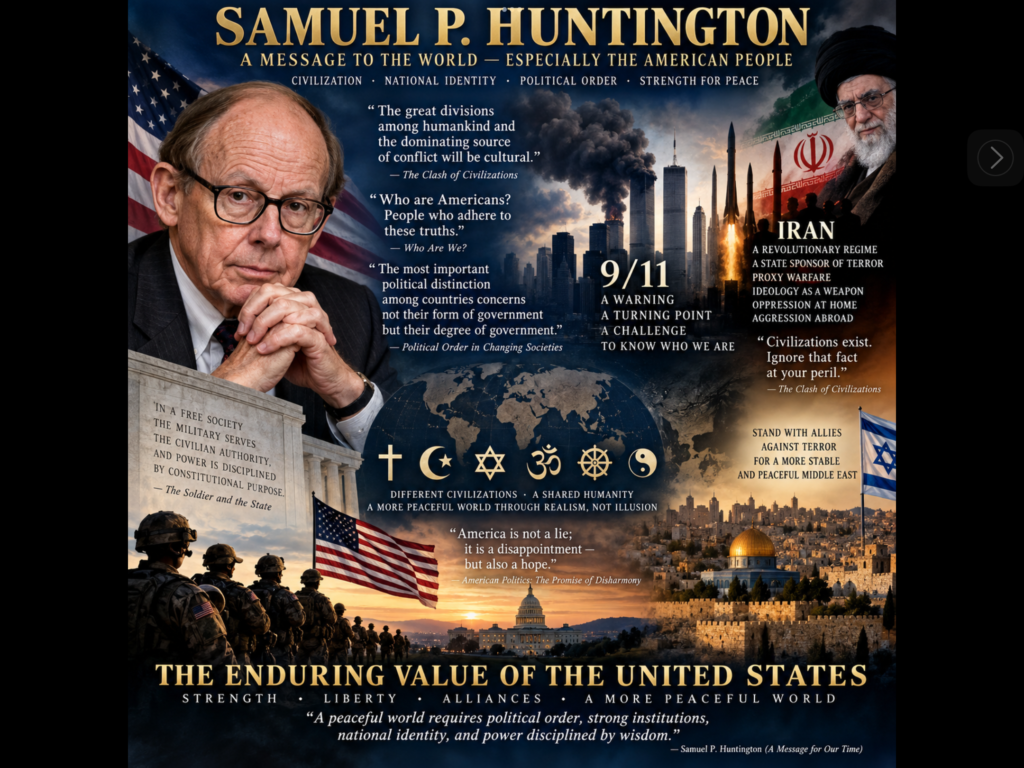
SAMUEL P. HUNTINGTON’S WARNING
TO AMERICA AND THE WORLD
Civilization, National Identity, Political Order, 9/11, Revolutionary Iran,
and the American Responsibility for World Peace
A Contemporary Huntingtonian Address to the American People
Master Americanism Chapter — September 2026
EDITORIAL NOTE: This chapter is a historically informed reconstruction and synthesis of Samuel P. Huntington’s published ideas, written as a contemporary address. It is not an authentic Huntington manuscript, speech, quotation, or posthumous statement. Direct quotations are limited and identified as quotations.
MASTER CHAPTER PURPOSE
This chapter brings together the central themes of Huntington’s major works—The Soldier and the State, Political Order in Changing Societies, American Politics: The Promise of Disharmony, The Clash of Civilizations and the Remaking of World Order, and Who Are We? The Challenges to America’s National Identity—and applies their recurring concerns to the strategic environment of the twenty-first century. The narrative is intentionally written in the first person to create the sense of a contemporary address, while remaining an interpretive reconstruction rather than an attribution of new words to Huntington.
A MESSAGE ACROSS TIME
If I were speaking to the American people today, I would begin with a warning against the most persistent temptation of powerful nations: the belief that power relieves them of the obligation to understand. It does not. Power enlarges the obligation to understand. The United States possesses extraordinary military, economic, technological, cultural, and institutional capacity, but none of those forms of power can substitute for knowledge of history, identity, religion, political order, and the limits of what one civilization can impose upon another. The central questions before America are therefore not merely how strong we are, how much wealth we possess, or how sophisticated our weapons have become. The questions are more fundamental: Who are we? What institutions make our freedom possible? What must we defend? What should we ask of other peoples? What should we never presume to decide for them? And how can American power contribute to a world in which different civilizations coexist without surrendering either their identities or their peace?
POLITICAL ORDER BEFORE POLITICAL ILLUSION
My earliest work was concerned less with the romance of political ideals than with the hard problem of political order. The most important political distinction among countries is not simply whether they call themselves democratic, socialist, revolutionary, religious, or republican. It is whether their institutions possess the authority, legitimacy, adaptability, and capacity necessary to govern. A society can proclaim magnificent principles and still disintegrate if its institutions cannot absorb social change. Modernization can produce education, urbanization, mobility, wealth, expectation, and political participation; yet when those forces expand faster than institutions develop, political decay may follow political awakening. This is one reason Americans must resist the assumption that destroying an objectionable regime automatically creates a free political order. Institutions are not improvised overnight. Legitimacy is not delivered by an invading army. Political communities are formed through history, custom, authority, law, religion, memory, conflict, and compromise. A prudent foreign policy begins by understanding that political order is a civilizational achievement, not a mechanical product.
THE SOLDIER, THE STATE, AND THE DISCIPLINE OF POWER
I also spent much of my career studying the relationship between military professionalism and constitutional government. Every serious civilization must answer a difficult question: how can it possess enough organized force to defend itself without allowing force to become the master of political life? In the American system, the answer has been civilian control joined to a professional military ethic. The officer possesses expertise in the management of violence, but that expertise does not confer sovereignty. Military power serves the constitutional state. This distinction matters more, not less, in an era of terrorism, cyber conflict, autonomous systems, drones, artificial intelligence, long-range precision weapons, and persistent competition below the threshold of formal war. The stronger the instruments of coercion become, the more important it is that they remain subordinated to political judgment, law, and national purpose. Loyalty, duty, restraint, and dedication are not sentimental virtues. They are safeguards against the corruption of power.
THE AMERICAN PROMISE AND ITS PERMANENT DISHARMONY
America has always lived with a gap between its ideals and its conduct. That gap is not evidence that the ideals are meaningless. It is evidence that they function as standards against which Americans repeatedly judge themselves. The United States has proclaimed liberty while tolerating slavery, proclaimed equality while practicing segregation, proclaimed constitutional rights while sometimes violating them in periods of fear, and proclaimed government by consent while struggling repeatedly over who fully belongs to the political community. Yet American history is also a history of citizens using American principles to condemn American failures. The Declaration, the Constitution, religious conviction, civic movements, courts, elections, journalism, and political organization have repeatedly furnished the language of correction. America can disappoint precisely because it also creates hope. That tension between creed and conduct is not a defect that can be eliminated. It is one of the engines of American political renewal.
THE END OF THE COLD WAR DID NOT END HISTORY
When the Cold War ended, many Americans understandably believed that the great ideological struggle of the twentieth century had been resolved. Communism had failed as a universal political-economic model, the Soviet Union had collapsed, and American power stood unmatched. But the disappearance of one ideological conflict did not erase older sources of human identity. Peoples do not cease to remember because economists declare markets global. They do not cease to worship because technology accelerates. They do not abandon language, ancestry, historical grievance, sacred geography, or collective memory because international institutions expand. The great divisions among humankind would increasingly be cultural because culture answers questions that ideology and economics cannot fully answer: Who are we? Where do we come from? To whom do we owe loyalty? What is sacred? What historical injuries must never be forgotten? What way of life deserves protection? These are questions of civilization.
THE CLASH OF CIVILIZATIONS WAS A WARNING, NOT A WISH
My argument concerning civilizations was never an invitation to wage civilizational war. It was a warning that statesmen who deny the power of civilizational identity will misread the world. Civilizations are not monolithic armies. They contain internal disputes, rival states, religious disagreements, ideological movements, and competing national interests. Islam is not a single political actor. The West is not a single political actor. China, India, the Orthodox world, Latin America, Japan, and other civilizational formations contain diversity within themselves. The purpose of recognizing civilizations is therefore not to reduce humanity to hostile blocs. It is to recognize that peace requires understanding difference. A stable world cannot be built upon the assumption that all peoples will eventually become culturally interchangeable versions of the most powerful society. Peace requires restraint, recognition, boundaries, negotiation, and the acceptance that other civilizations will often order their societies differently from our own.
SEPTEMBER 11 AND THE WEAPONIZATION OF IDENTITY
September 11, 2001 forced Americans to confront the consequences of identity used as a weapon. Al-Qaeda was not a civilization and did not speak for Islam, but it attempted to portray itself as the defender of a civilization under assault. Its violence depended upon a radical interpretation of religion joined to historical grievance, political resentment, and a strategy of provocation. The World Trade Center and the Pentagon were not randomly chosen structures. They represented systems of American economic and military power. The attack was designed to kill, but it was also designed to communicate, humiliate, polarize, provoke, and recruit. The deeper strategic purpose of asymmetric violence is often to induce the stronger power to react in ways that enlarge the weaker actor’s constituency. A terrorist organization that cannot defeat the United States conventionally may nevertheless hope to manipulate American power, trigger indiscriminate retaliation, deepen resentment, and transform a limited conflict into a broader war of identities.
WHY AMERICA RESPONDED AS AMERICA
The American response to September 11 cannot be understood solely through calculations of military necessity. The attacks awakened national identity. Americans saw the dead not merely as residents of New York, employees of private firms, military personnel, firefighters, police officers, travelers, Republicans, Democrats, Christians, Jews, Muslims, or people of no faith. They were Americans. The national flag regained symbolic force because citizens suddenly perceived an attack upon one part of the political community as an attack upon the whole. This is what national identity does at moments of danger: it converts millions of otherwise separate lives into a community of fate. A state without such a sense of common identity may possess wealth and weapons yet lack the cohesion necessary to endure sacrifice. The question ‘Who are we?’ is therefore not a cultural luxury. It is a national-security question.
THE STRATEGIC IMPORTANCE OF REFUSING A WAR AGAINST ISLAM
The United States was right to distinguish the perpetrators of September 11 from Islam itself. That distinction was morally correct and strategically necessary. If America had defined Islam as the enemy, it would have accepted the premise of the extremists who sought precisely such a confrontation. A civilization of more than a billion people cannot be reduced to the ideology of a terrorist movement. Nor can the American national interest be served by manufacturing enemies unnecessarily. The proper object of American power is conduct that threatens Americans, allies, and international order: terrorism, aggression, coercive networks, attacks upon civilians, and the deliberate destruction of peaceful political arrangements. The United States must be capable of identifying enemies without inventing a civilizational enemy larger than the actual threat.
AFGHANISTAN, IRAQ, AND THE LIMITS OF TRANSFORMATION
The post-September 11 wars should be distinguished analytically. Afghanistan was directly connected to the sanctuary from which al-Qaeda operated. The United States had a compelling interest in denying such sanctuary and demonstrating that mass-casualty attacks upon the American homeland would carry consequences. Iraq presented a different strategic problem. Whatever arguments were advanced regarding the Iraqi regime, the effort to transform Iraq also illustrated the limits of military power when political order, institutional legitimacy, sectarian identity, historical memory, and regional competition are insufficiently understood. The lesson is not that American power should never be used. It is that the destruction of an existing political order creates responsibilities and consequences that military victory by itself cannot resolve. A government can be overthrown in weeks. A political order may take generations to construct.
REVOLUTIONARY IRAN: STATE POWER AND IDEOLOGICAL POWER
Iran presents a different challenge from al-Qaeda. The Islamic Republic is a sovereign state with ministries, armed forces, intelligence services, diplomatic institutions, industrial resources, missiles, drones, cyber capabilities, energy assets, and a large population embedded in one of the world’s oldest civilizations. At the same time, the revolutionary regime developed an architecture for projecting power through organizations operating beyond Iran’s borders. The United States has long designated Iran a state sponsor of terrorism, and Iran has supported armed organizations and militant networks as instruments of influence and deterrence. This allows a state to combine the resources of sovereignty with forms of conflict that remain below, or move ambiguously around, the threshold of conventional interstate war. Such a strategy is not irrational. It is an adaptation to a world in which Iran understands that it cannot match American conventional military power symmetrically.
THE PROXY AS AN INSTRUMENT OF MODERN STATECRAFT
The proxy network transforms the traditional map of warfare. Conflict is no longer simply State A sending its army across a border to fight State B. A state can provide weapons, training, finance, intelligence, political support, technology, and ideological legitimacy to organizations that possess their own local motives yet also advance parts of the sponsor’s strategy. The degree of control varies from case to case, and serious analysis must avoid the lazy assumption that every aligned organization is merely a puppet. But the strategic utility is clear. The sponsor can threaten adversaries, impose costs, create uncertainty, complicate retaliation, and disperse risk. The stronger state then faces a dilemma: retaliate narrowly and perhaps fail to deter the sponsor, or retaliate directly and risk escalating a localized attack into a regional war. Ambiguity becomes a strategic resource.
RELIGION, INTERPRETATION, AND REVOLUTIONARY LEGITIMACY
To understand revolutionary Iran, Americans must make distinctions that are intellectually and strategically essential. The Qur’an is not Iranian state policy. Islam is not the Islamic Republic. Shi’a Islam is not identical to the doctrine of the ruling clerical establishment. Persian civilization is older and broader than the revolutionary state created in 1979. What matters politically is the joining of sacred text, authoritative interpretation, revolutionary doctrine, clerical institutions, historical martyrdom narratives, nationalism, and state power. When a political system claims authority to define the religious meaning of resistance, oppression, sacrifice, and loyalty, geopolitical conflict can acquire sacred legitimacy. The adversary is no longer merely a competing state. It can be depicted as an embodiment of arrogance or oppression. Resistance is no longer merely strategic behavior. It can be depicted as moral and religious duty.
THE DANGER OF SACRALIZING GEOPOLITICS
Once ordinary disputes become sacred struggles, compromise becomes much more difficult. A territorial adjustment can be portrayed as surrender to evil. A diplomatic accommodation can be condemned as betrayal. Military sacrifice can be transformed into martyrdom. Political opponents can be recast as enemies of faith. The emotional resources available to the state thereby expand beyond conventional nationalism. This does not mean every believer accepts the state’s interpretation; indeed, religious traditions often contain powerful internal arguments against coercion, extremism, and political manipulation. But it does mean that a regime capable of joining theology to state institutions possesses a mechanism for converting political objectives into moral imperatives. That mechanism can mobilize followers abroad and discipline subjects at home.
THE EXTERNAL ENEMY AND THE INTERNAL DISSENTER
The same ideological machinery used to identify enemies beyond the border can be used to identify enemies within it. A political system that claims privileged authority to define legitimate religion can treat disagreement not merely as opposition but as deviation, corruption, sedition, betrayal, or hostility to the sacred order. This is one of the oldest political uses of ideology. The individual is not simply required to obey law; the individual is pressured to inhabit an official interpretation of history, morality, identity, and loyalty. Mandatory social rules, restrictions on religious minorities, suppression of dissent, censorship, punishment of protest, and ideological tests can all become instruments through which the state attempts to preserve its conception of society. The problem is not religious faith. The problem is coercive monopoly over religious and political truth.
THE IRANIAN PEOPLE ARE NOT THE IRANIAN REGIME
The United States must therefore resist another dangerous simplification: the equation of the Iranian people with the ruling regime. Nations and regimes are not identical. Civilizations outlive governments. The Iranian people contain believers and skeptics, conservatives and reformers, nationalists and cosmopolitans, supporters and opponents of the existing order. Many seek greater freedom while remaining deeply attached to Persian culture, Islam, family, and national pride. A wise American strategy distinguishes between the political system that sponsors coercive activities and the population over which that system governs. To confuse the two would reinforce the regime’s claim that foreign pressure is directed against Iran as a civilization rather than against specific conduct of the state.
ISRAEL, AMERICAN ALLIES, AND THE POLITICS OF RESISTANCE
Iranian revolutionary rhetoric gives Israel and American regional influence a central place in its political imagination. Here again, precision is indispensable. Judaism is a religion. Jewish people hold diverse political views. Israel is a sovereign state. Zionism is a historical and political movement with multiple traditions. When political rhetoric collapses all of these distinctions into a single theological enemy, it enlarges conflict and makes coexistence harder. The United States has legitimate strategic interests in the security of Israel, the protection of treaty partners and friendly states, freedom of navigation, the security of energy and commercial routes, and the prevention of terrorism. But these interests are best defended when America refuses broad hatred and instead identifies concrete threats, responsibilities, and limits.
FROM TERRORISM TO SYSTEMS WARFARE
The evolution from September 11 to proxy warfare reveals a larger transformation. Modern adversaries increasingly target systems rather than armies alone. The World Trade Center embodied commercial and financial power. The Pentagon embodied military command. Today the systems that generate national power include electrical grids, telecommunications, data centers, satellites, ports, shipping, financial clearing, insurance, semiconductor supply chains, energy infrastructure, transportation, cyber networks, defense production, artificial intelligence, and industrial capacity. A relatively inexpensive missile, drone, malware package, sabotage operation, or proxy attack can impose costs far beyond the price of the weapon itself. It can interrupt shipping, raise insurance costs, force naval deployments, disrupt logistics, frighten investors, divide political coalitions, and create pressure for escalation. The battlefield has expanded into the architecture of modern life.
TECHNOLOGY DOES NOT ABOLISH HUMAN NATURE
The rapid development of drones, artificial intelligence, autonomous systems, electronic warfare, cyber capabilities, and precision weapons may tempt policymakers to believe that technology has transformed war into an engineering problem. It has not. Technology changes the means of conflict more rapidly than it changes the motives of human beings. Fear, honor, religion, ambition, humiliation, revenge, prestige, national identity, and political legitimacy remain decisive. The most advanced weapon is still employed by a political community for purposes shaped by human judgment. A state that understands technology but misunderstands the civilization, political culture, and identity of its adversary may achieve tactical success while producing strategic failure. The accelerating rate of technological change therefore increases, rather than decreases, the need for historical and cultural intelligence.
WHO ARE WE, AND WHAT MUST WE PROTECT?
The central American question is no longer merely ‘Who are we?’ It is also ‘What must we protect?’ If national identity becomes too weak, citizens cannot agree upon what sacrifices are justified. If the concept of national interest becomes limitless, the country exhausts itself attempting to manage every conflict on earth. The proper answer lies between withdrawal and crusade. America must protect its territory, people, constitutional order, military security, economic foundations, technological capabilities, critical infrastructure, and the international arrangements on which its safety and prosperity materially depend. It must honor serious commitments to allies because credibility is itself an element of power. It must preserve freedom of navigation and resist successful terrorism because systems that reward coercion invite more coercion. But it must also distinguish vital interests from peripheral ambitions and understand that prudence is not weakness.
AMERICA’S POWER RESTS UPON INSTITUTIONS AT HOME
No foreign policy can permanently compensate for political decay at home. A wealthy society whose institutions lose legitimacy becomes strategically fragile. A technologically dominant country whose citizens no longer believe that their constitutional order deserves preservation cannot indefinitely sustain leadership abroad. Military superiority cannot repair every civic fracture. National power begins in domestic political order: trusted institutions, lawful authority, productive enterprise, social cooperation, education, infrastructure, competent administration, and a citizenry capable of disagreement without treating every opponent as an existential enemy. The United States therefore protects its position in the world first by preserving the institutions that make it governable at home.
THE AMERICAN CREED AND RELIGIOUS LIBERTY
American identity has never been purely abstract, and its historical development cannot be separated from the cultural inheritance of the society that created its institutions. Yet the durable political achievement of the United States is that citizenship ultimately does not require adherence to a state-imposed theology. Americans may be Christian, Jewish, Muslim, Hindu, Buddhist, atheist, agnostic, or members of other traditions and still participate in the same constitutional community. This is not indifference to religion. It is a political arrangement that protects religion from governmental monopoly and protects government from theological absolutism. Religious liberty converts difference from a permanent cause of civil war into a condition of constitutional coexistence. In an age when regimes and movements can weaponize religious identity, this American achievement should not be treated casually.
AMERICA CANNOT DEFEND FREEDOM BY ABANDONING IT
The United States must never become what it opposes in the process of defending itself. The answer to religious coercion is not religious coercion. The answer to propaganda is not contempt for truth. The answer to authoritarianism is not the permanent militarization of political life. The answer to terrorism is not indiscriminate hostility toward populations that share a religion or ancestry with terrorists. The answer to ideological conformity abroad is not ideological conformity at home. A free society must defend itself as a free society. Its methods matter because methods shape institutions, and institutions eventually shape national character. To win a struggle by destroying the constitutional restraints that define the American political order would be a strategic contradiction.
THE VALUE OF AMERICAN POWER TO WORLD PEACE
The value of the United States to world peace does not arise from moral perfection or from an unlimited right to command other nations. It arises from the unusual combination of national power with constitutional restraint. Since the middle of the twentieth century, American military, economic, and diplomatic power has helped sustain an international environment in which many states have been able to trade, develop, and retain political independence without relying solely upon their own ability to defeat stronger neighbors. Sea lanes have remained broadly open. Alliances have deterred aggression. Financial and commercial systems have operated across borders. Smaller nations have often possessed strategic space precisely because a larger balancing power existed. This order has never been perfectly just or peaceful, but its destruction would not necessarily produce a more humane world. Power vacuums are rarely filled by abstractions. They are filled by other powers.
STRENGTH AND RESTRAINT
America therefore confronts a permanent paradox. It must be strong enough that aggression fails, yet wise enough that its own power does not unnecessarily enlarge conflicts. Strength without judgment becomes domination. Idealism without power becomes impotence. Isolation without deterrence allows others to shape the order upon which American security depends. Intervention without cultural understanding can destroy more order than it creates. Good statecraft therefore requires a difficult synthesis: military capability, economic strength, political legitimacy, cultural knowledge, historical memory, alliance management, and restraint. The statesman must know not only what America can do but what America should do, what America cannot sustainably do, and what consequences will follow after the immediate objective has been achieved.
THE RESPONSIBILITY OF AMERICANISM
Americanism, properly understood, should not mean a campaign to erase the identities of other civilizations. It should mean confidence in the American constitutional inheritance and the willingness to defend the conditions under which free peoples can determine their own futures. It should mean patriotism without compulsory political theology, national strength without civilizational arrogance, alliance without empire, enterprise without contempt for social responsibility, religious conviction without religious persecution, and military power without military government. It should also mean an acceptance that the United States will sometimes fail to meet its own standards and that patriotism includes the responsibility to correct those failures rather than abandon the standards themselves.
A WARNING TO AMERICANS ABOUT INTERNAL DIVISION
A civilization may be weakened from outside, but it can also be weakened by losing confidence in itself. Americans should therefore be careful about the language with which they conduct internal political conflict. A democratic republic requires vigorous disagreement, but it cannot function if every election is treated as the final battle between absolute good and absolute evil, if every opponent is declared illegitimate, or if citizens cease to believe they share any political identity beyond faction. External adversaries understand this vulnerability. Information operations and propaganda succeed not because foreign actors possess magical powers but because they exploit divisions already present inside the society. National cohesion does not require uniformity. It requires a deeper agreement that constitutional procedures, lawful opposition, and common citizenship survive partisan defeat.
THE WORLD OF 2026: ACCELERATION WITHOUT WISDOM
If I were observing the world in 2026, I would be struck by the speed with which technological capability has increased and the much slower pace at which political wisdom has developed. Artificial intelligence accelerates decision-making. Drones make precision violence cheaper. Cyber systems connect civilian life to national defense. Financial networks transmit shocks instantly. Social media magnifies outrage and collapses distance. States, corporations, insurgent movements, and individuals now possess capabilities that previous generations would have regarded as extraordinary. Yet the fundamental human problems remain familiar: how to govern power, how to preserve legitimacy, how to prevent fear from becoming fanaticism, how to manage cultural difference, how to deter aggression without producing unlimited escalation, and how to maintain identity without transforming identity into hatred. Technology has compressed time. It has not abolished politics.
THE MESSAGE TO THE WORLD
To the wider world, the American message should not be that history ends in imitation of the United States. The message should be that different civilizations can coexist within a political order that rejects conquest as the normal method of international change. The United States should respect the dignity of other peoples while insisting that terrorism, hostage-taking, indiscriminate attacks on civilians, coercive interference with navigation, and the violent destruction of neighboring societies cannot become accepted instruments of political negotiation. This is not a demand for cultural uniformity. It is a demand for rules sufficient to prevent cultural and political differences from producing perpetual war. The purpose of power should be to create the space within which politics can replace violence.
THE FINAL QUESTION: CAN POWER BE DISCIPLINED BY WISDOM?
The ultimate question confronting America is not whether it will remain powerful. No nation is permanently powerful. The question is whether, while it possesses great power, it can discipline that power through institutions, history, constitutional restraint, and an understanding of other civilizations. The United States can contribute to world peace only if it simultaneously remembers who it is and recognizes that others possess identities of their own. It must resist adversaries without becoming captive to their definitions of the conflict. It must oppose revolutionary coercion without declaring war upon civilizations. It must protect allies without assuming responsibility for remaking every society. It must defend systems that generate national power while preserving the constitutional system that gives American power its legitimacy.
CONCLUSION — AMERICA AND THE RESPONSIBILITY OF POWER
The message I would leave with the American people is therefore neither triumphalist nor pessimistic. Civilizations can decline. Institutions can decay. National identities can fragment. Political orders can collapse. Technology can empower both defenders and destroyers. Religion can inspire compassion or be manipulated to justify coercion. Military power can preserve peace or deepen catastrophe. None of these outcomes is predetermined. Human beings make choices, construct institutions, preserve traditions, revise policies, and decide what they are willing to defend. The United States remains valuable to world peace when it joins power to constitutional purpose, military strength to civilian authority, enterprise to law, faith to liberty, national identity to pluralism, and patriotism to restraint. The task is not to create an American world. It is to preserve an international order in which America can remain American, other civilizations can remain themselves, and differences need not become wars. Know who you are. Understand who others are. Protect the institutions that make freedom possible. Defend the systems that sustain national power. Use strength when necessary. Exercise restraint whenever possible. And remember that the highest purpose of power is not domination. It is the preservation of a political order in which human beings and nations may live without fear of conquest. That is the responsibility of Americanism, and it is one of the great responsibilities of the United States to the peace of the world.
SELECTED HUNTINGTON WORKS UNDERLYING THIS SYNTHESIS
Samuel P. Huntington, The Soldier and the State: The Theory and Politics of Civil-Military Relations (1957).
Samuel P. Huntington, Political Order in Changing Societies (1968).
Samuel P. Huntington, American Politics: The Promise of Disharmony (1981).
Samuel P. Huntington, “The Clash of Civilizations?” Foreign Affairs (1993).
Samuel P. Huntington, The Clash of Civilizations and the Remaking of World Order (1996).
Samuel P. Huntington, Who Are We? The Challenges to America’s National Identity (2004).
Quotation note: The chapter uses only brief phrases associated with Huntington’s published work and otherwise paraphrases and synthesizes his arguments. Contemporary discussion of Iran, terrorism, proxy warfare, religious coercion, and systems warfare is the editor’s application of the Huntingtonian framework, not language written by Huntington.